LF-18 · TEACHER LESSON PLAN
Baking soda and vinegar reaction lab
Why mixing baking soda and vinegar inflates a balloon on its own
Driving question
Learning objectives
- Students measure balloon circumference at exactly 60 seconds for three baking-soda amounts using three trials per amount and fixed vinegar volume.
- Students compare and analyze all nine readings, then calculate the mean and range for each amount.
- Students explain gas formation using evidence while recognizing that balloon circumference is an indirect measure.
Standards
| Dimension | Alignment |
|---|---|
| Performance expectation | MS-PS1-2Analyze and interpret data on the properties of substances before and after the substances interact to determine if a chemical reaction has occurred. (Partial alignment: students use balloon inflation as indirect evidence that gas formed; the assessment boundary for this performance expectation lists density, melting point, boiling point, solubility, flammability and odor, and gas production is not among them.) |
| Core idea | PS1.BIn a chemical process, the atoms that make up the original substances are regrouped into different molecules, and these new substances have different properties from those of the reactants. |
| Crosscutting | PatternsMacroscopic patterns are related to the nature of microscopic and atomic-level structure. |
Standards text paraphrased from nextgenscience.org. Alignment is partial; this hands-on activity does not cover every part of the performance expectation. The source lab lists no SEP statements for this activity.
State standards crosswalk
Use the row as a planning crosswalk, then confirm local district pacing and grade placement. “Partial” labels describe a skill connection, not full mastery of the complete standard.
| State | Verified standard | How this lesson aligns | Official source |
|---|---|---|---|
| California | CA NGSS MS-PS1-2 | Analyze evidence from interacting substances; partial because circumference is an indirect gas measure and does not assess the full property set. | Open standard ↗ |
| Texas | SCIENCE.8.1.F | Organize repeated measurements in tables or graphs and use means to identify patterns; directly supports the nine-trial data analysis. | Open standard ↗ |
| Florida | SC.8.N.1.1 | Plan an experiment, identify variables, collect and organize data, interpret graphics, and defend a conclusion; strong methods alignment. | Open standard ↗ |
| New York | MS-PS1-2 | Analyze before-and-after evidence for a chemical reaction; partial because the lesson emphasizes gas production and an indirect proxy. | Open standard ↗ |
| Pennsylvania | 3.2.6-8.D | Analyze substance properties before and after interaction; partial because balloon circumference alone is not a diagnostic property test. | Open standard ↗ |
Materials and prep timeline
PER GROUP
- Nine matching plastic bottles and a tray
- 270 mL same labeled 5% white vinegar (30 mL per run)
- Level ⅛, ¼ and ⅜ tsp baking-soda measures
- Nine matching fresh balloons and a dry funnel
- Flexible tape or string and cm ruler
- Goggles, labels, paper towels, timer
TEACHER ONLY
- Check balloons fit the plastic bottle neck without forcing; never add a rigid cap or use a bottle that looks strained.
- Provide 30 mL vinegar per fresh run; use one new balloon/bottle setup per trial and keep the balloon out of students' faces.
- One student sheet per student.
CLASS-SIZE KIT PLANNER
One per-group kit contains every item in the team materials list above. Groups are balanced around the listed 3–4 students target.
| Students | Groups | Per-group kits | Student sheets | Suggested group split |
|---|---|---|---|---|
| 20 | 5 | 5 complete kits | 20 copies | 4 students per group |
| 25 | 7 | 7 complete kits | 25 copies | 4 or 3 students per group |
| 30 | 8 | 8 complete kits | 30 copies | 4 or 3 students per group |
Choose a testable prediction; assign measuring, timing and circumference roles. Review goggles, tray and balloon safety.
Label ⅛, ¼ and ⅜ tsp conditions with three trials each. Measure 30 mL of the same labeled 5% vinegar into each fresh plastic bottle.
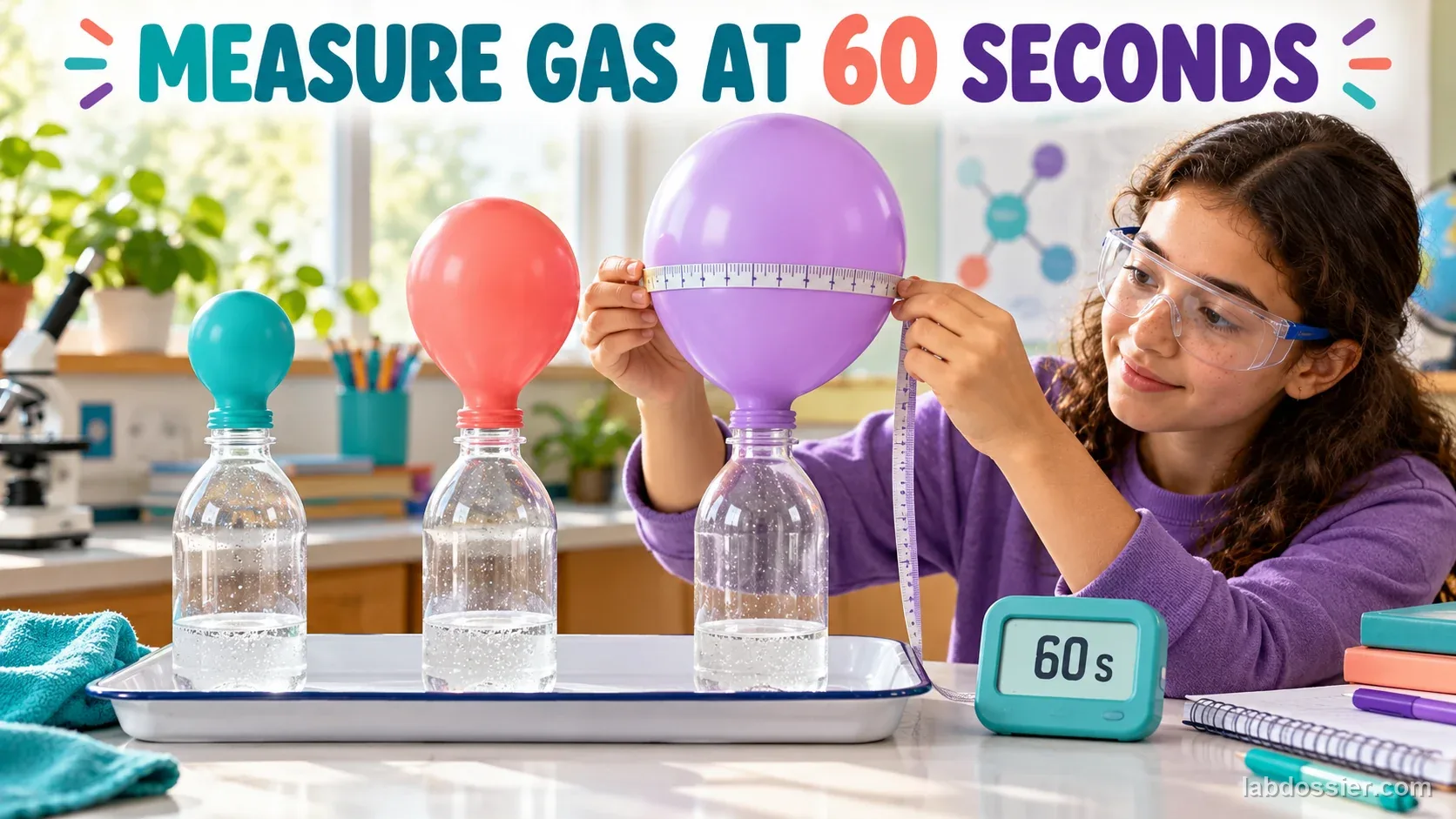
For each run, add the level amount to a fresh balloon, fit it without forcing, start timing at powder contact, then measure widest circumference at exactly 60 seconds. Reset with new materials.
Keep all nine readings; calculate the mean and range for each amount and look for a consistent change or overlapping variation.
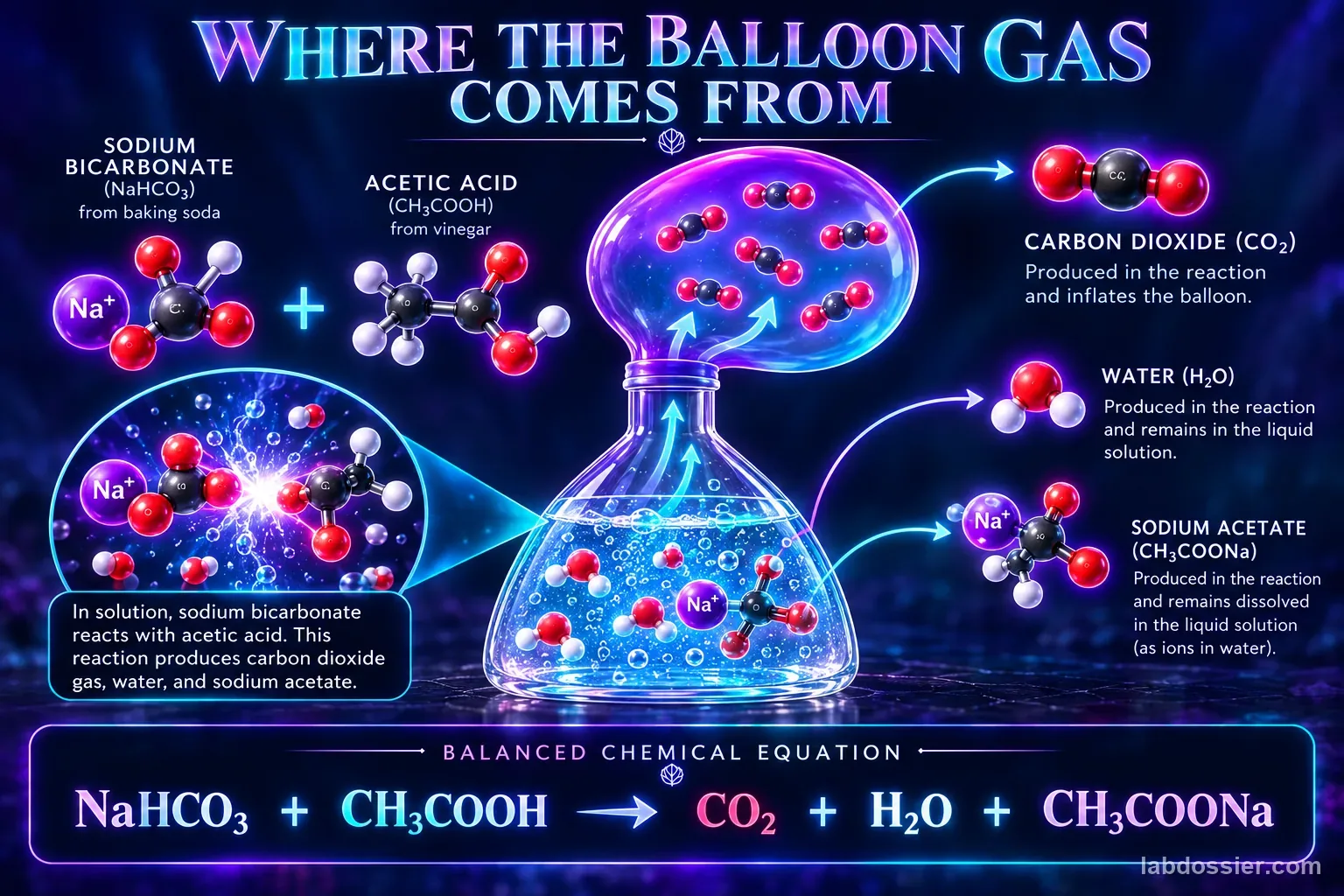
Use the reaction equation and evidence; state why circumference does not directly measure gas volume and why this test does not locate a vinegar-limited plateau.
Lab figures and data visuals
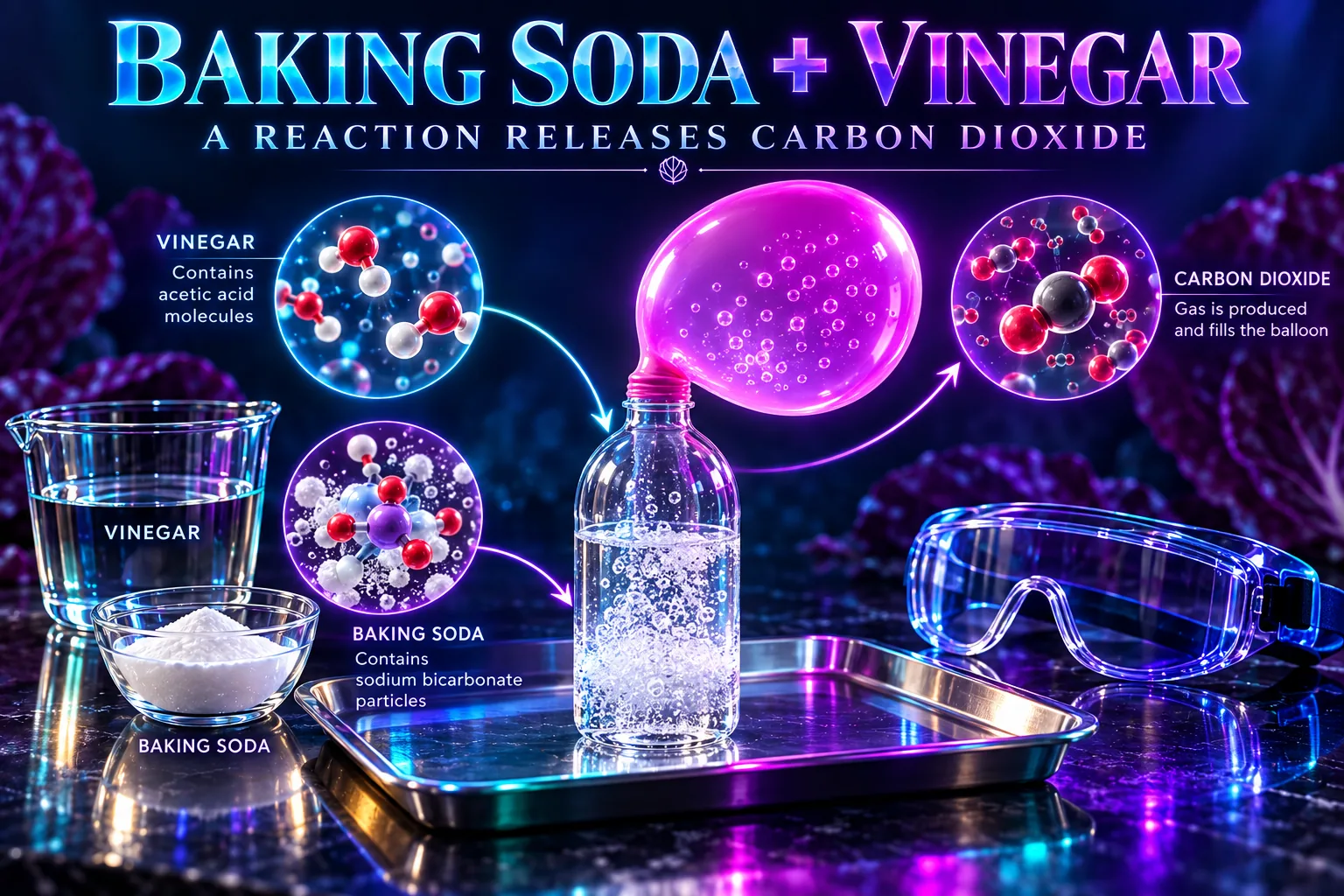
Reviewed article images support the lesson flow. Use the tables and student sheet to record actual observations; pictured patterns are not target results.
Printable shopping list
Shopping and staging checklist
Multiply the per-group kit contents by the class-size planner. The teacher section includes teacher-provided materials and setup or safety notes.
PER-GROUP KITS
- Nine matching plastic bottles and a tray
- 270 mL same labeled 5% white vinegar (30 mL per run)
- Level ⅛, ¼ and ⅜ tsp baking-soda measures
- Nine matching fresh balloons and a dry funnel
- Flexible tape or string and cm ruler
- Goggles, labels, paper towels, timer
TEACHER-PROVIDED MATERIALS + SETUP RULES
- Check balloons fit the plastic bottle neck without forcing; never add a rigid cap or use a bottle that looks strained.
- Provide 30 mL vinegar per fresh run; use one new balloon/bottle setup per trial and keep the balloon out of students' faces.
- One student sheet per student.
Prepare 5 kits for 20 · 7 kits for 25 · 8 kits for 30 students.
Lesson flow
| Minutes | What happens |
|---|---|
| 0–4 | Engage Ask what one-quarter teaspoon changes when 30 mL of vinegar stays the same. Have students predict without promising a result. |
| 4–8 | Explore Measure 30 mL of the same labeled 5% vinegar into nine matching plastic bottles. Keep them on trays; never cap or rigidly seal them. |
| 8–12 | Explore Load a level ⅛, ¼ or ⅜ teaspoon into a fresh balloon with a dry funnel and fit it gently over the bottle neck without spilling. |
| 12–23 | Lift the balloon so powder contacts vinegar and start the timer. At exactly 60 seconds, measure the widest circumference. Run three fresh trials at each amount. |
| 23–30 | Explain Compare all nine values, means and ranges; note leaks or fit differences. The selected amounts are intended to keep vinegar in excess. |
| 30–35 | Evaluate Connect observations to carbon dioxide formation and describe circumference as an indirect proxy, not a direct gas-volume measurement. |
Discussion questions
1. What did the balloon show, and what did it not measure?
2. Why keep the vinegar amount and bottle the same?
3. Why measure at exactly 60 seconds?
4. Does this test show when vinegar becomes limiting?
5. How do the repeats help interpret a small difference?
Common misconceptions
Differentiation
SUPPORT
- Give each team pre-labeled bottles and a nine-trial checklist for ⅛, ¼ and ⅜ tsp.
- Model starting the timer at contact and measuring the widest circumference at exactly 60 seconds.
- Offer the frame: “At ___ tsp, my trial readings were ___. The pattern may show ___ because ___.”
EXTEND
- Graph each trial as a point and compare the mean and range for each amount.
- Plan a separate, teacher-reviewed test with higher baking-soda amounts to investigate when fixed vinegar could become limiting.
- Discuss how a calibrated gas syringe or displacement apparatus could measure gas volume more directly than balloon circumference.
Assessment rubric
| Criterion | Beginning | Developing | Secure |
|---|---|---|---|
| Fair test | Changes several conditions or omits vinegar amount. | Names one control but misses another important condition. | Identifies baking soda as changed and vinegar volume, bottle setup and measurement as controlled. |
| Repeated data | Records fewer than three trials per amount. | Records repeated readings but does not compare their variation. | Records all nine values and uses them to compare the pattern and spread. |
| Evidence-based pattern | States a winner without using readings. | Uses some readings but overlooks spread or a setup issue. | Compares all trials and describes a supported rise or an uncertain pattern using the recorded evidence. |
| Scientific explanation | Calls circumference a direct gas measurement. | Mentions gas without describing measurement limits. | Explains carbon-dioxide formation and names circumference as indirect evidence. |
Vocabulary
- Reactant – A starting substance that participates in a chemical reaction.
- Product – A substance made by a chemical reaction.
- Carbon dioxide – A gas product formed when vinegar and baking soda react.
- Limiting reactant – The reactant that is used up first and limits how much product can form.
- Trial – One repeat of an investigation under the planned conditions.
- Indirect measure – An observation used as evidence about something not measured directly.
Safety, cleanup and troubleshooting
BEFORE STUDENTS TOUCH ANYTHING
- Wear splash goggles and work over a tray. Keep faces away from the bottle opening; vinegar can sting eyes and foam can overflow.
- Do not cap or rigidly seal the reacting bottle. If using a balloon, fit it without stretching or forcing the bottle neck, and stop if the balloon or container looks strained.
Troubleshooting: If a balloon barely inflates, check for a loose neck fit or a leak without squeezing the bottle. If foam approaches the neck, stop and let it settle over the tray. Never add a rigid cap or force a strained balloon.