LF-27 · TEACHER LESSON PLAN
Balloon rocket lab
Why a balloon shoots forward as air rushes out the back
Driving question
Learning objectives
- Students assemble a straight, taut string track with a straw and balloon attached using a consistent setup.
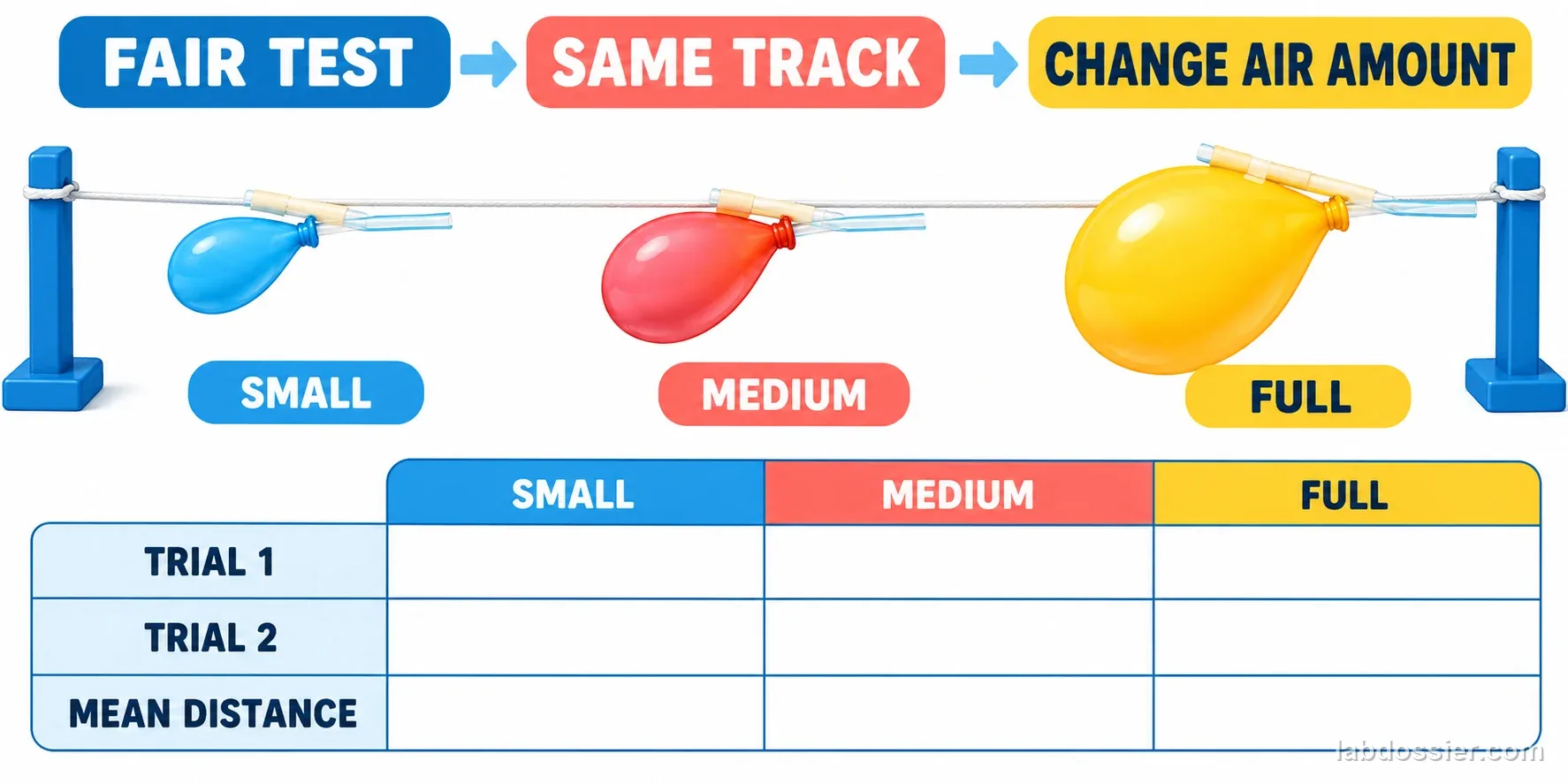
- Students measure starting circumference and three travel distances for small, medium and full breath-count conditions, then calculate mean and range.
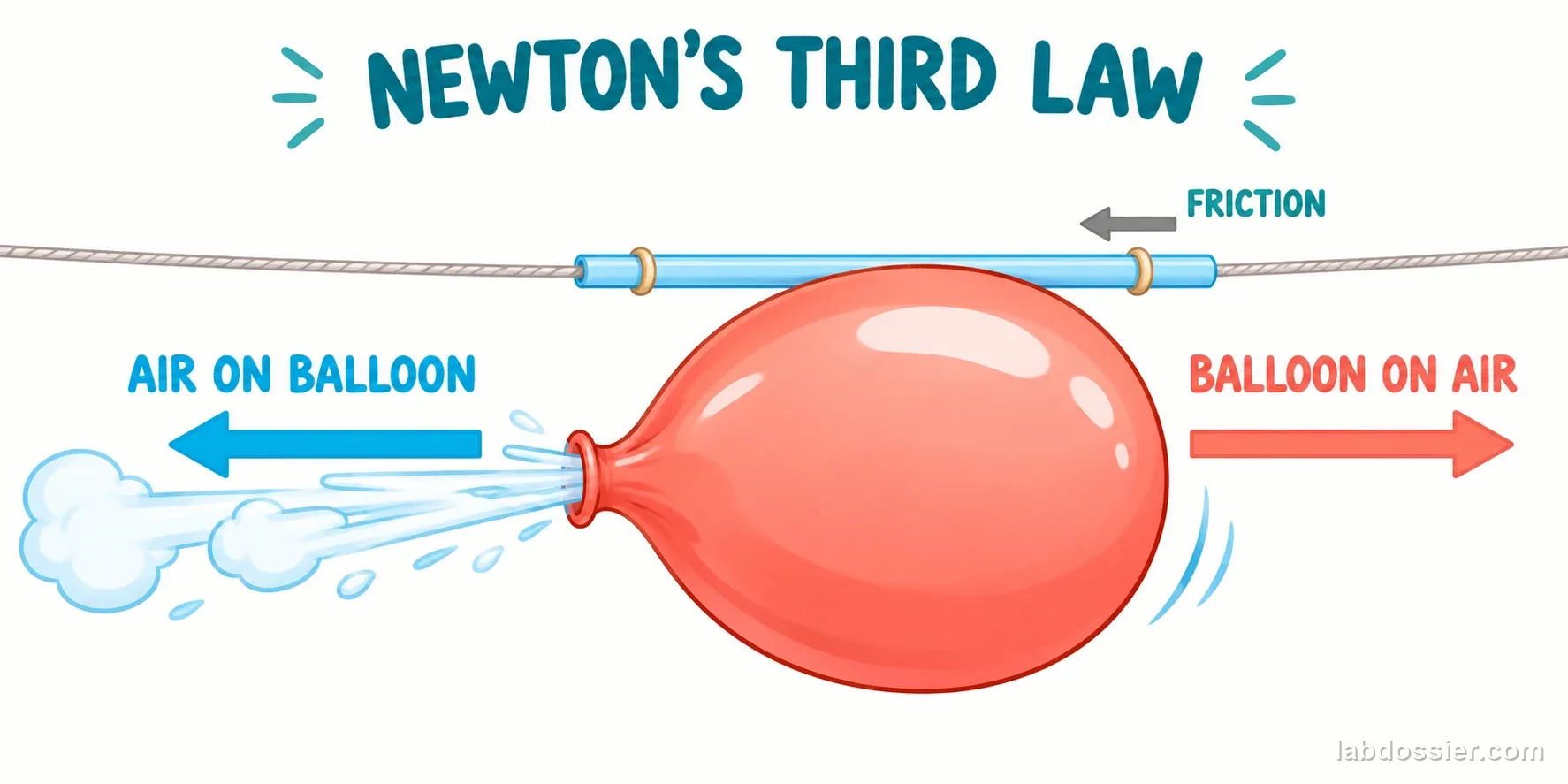
- Students explain how backward air flow and an opposite force move the balloon while identifying track friction as a limit.
Standards
| Dimension | Alignment |
|---|---|
| Performance expectation | MS-PS2-1Apply Newton's Third Law to design a solution to a problem involving the motion of two colliding objects. (Partial alignment: this is the performance expectation the lab lists, but the activity tests how the amount of air changes the distance a balloon travels along a string; it does not design a solution to a collision problem.) |
| Practices | SEP 3Plan and carry out investigations. |
| Core idea | PS2.AFor any pair of interacting objects, the force exerted by the first object on the second is equal in strength to the force that the second object exerts on the first, but in the opposite direction (Newton's third law). |
| Crosscutting | Systems and System ModelsModels can be used to represent systems and their interactions—such as inputs, processes and outputs—and energy and matter flows within systems. |
Standards text paraphrased from nextgenscience.org. Alignment is partial; this hands-on activity does not cover every part of the performance expectation.
State standards crosswalk
Use the row as a planning crosswalk, then confirm local district pacing and grade placement. “Partial” labels describe a skill connection, not full mastery of the complete standard.
| State | Verified standard | How this lesson aligns | Official source |
|---|---|---|---|
| California | CA NGSS MS-PS2-1 | Partial. Students explain the equal and opposite air and balloon forces, but the standard asks students to design a solution for a collision problem; this string-track test does not. | Open standard ↗ |
| Texas | Science.6.7(C) | Partial. Students connect expelled air with an opposite balloon force, while this test does not identify or diagram a full set of simultaneous force pairs as the expectation requires. | Open standard ↗ |
| Florida | SC.6.P.13.3 | Limited. The balloon changes motion under an unbalanced force, but this benchmark focuses on how an unbalanced force changes speed or direction rather than on Newton's Third Law force pairs. | Open standard ↗ |
| New York | MS-PS2-1 | Partial. The investigation uses Newton's Third Law to explain air moving backward as the balloon moves forward, but it does not design a solution to a collision problem. | Open standard ↗ |
| Pennsylvania | 3.2.6-8.G | Partial. The force-pair explanation fits Newton's Third Law, but students do not design a solution to a problem involving two colliding objects. | Open standard ↗ |
Materials and prep timeline
PER GROUP
- Nine matching balloons: three fresh trials at each of three air levels
- Long string, drinking straw, tape and two adult-approved anchor points
- Flexible measuring tape for starting circumference; meter stick for travel distance
- Recording sheet, labels and breath-count card
- Clear low track away from doors and walkways
TEACHER ONLY
- Check for latex allergies; use an approved non-latex balloon when needed. Do not overinflate. Prepare a level, taut string at low height with stable adult-approved anchors.
- Keep the track clear of faces, doors, walkways and necks. Demonstrate pinching the nozzle until release and using the same start mark each time.
- Have one person inflate and one counter record about 5, 8 or 12 breaths; measure circumference at the widest point. Breath count and circumference are proxies, not direct air volume. Pick up snapped pieces promptly.
CLASS-SIZE KIT PLANNER
One per-group kit contains every item in the team materials list above. Groups are balanced around the listed 3–4 students target.
| Students | Groups | Per-group kits | Student sheets | Suggested group split |
|---|---|---|---|---|
| 20 | 6 | 6 complete kits | 20 copies | 2 groups of 4 and 4 groups of 3 |
| 25 | 7 | 7 complete kits | 25 copies | 4 groups of 4 and 3 groups of 3 |
| 30 | 8 | 8 complete kits | 30 copies | 6 groups of 4 and 2 groups of 3 |
Predict how measured starting size may relate to travel. Check latex allergy needs and clear the track away from faces, doors and walkways.
Thread a straw onto a taut, low string between stable approved anchors. Mark the start, measure the track, and keep the nozzle pointed away from people.
For each small, medium and full condition, use three fresh matching balloons. Record breath count and starting circumference, pinch until release, then measure travel distance.
Calculate the mean and range of the three distances in each condition. Keep all raw readings and flag any leak or snag.
Compare measured starting circumference and distance; explain the opposite force pair and track friction. Collect popped balloon pieces and clear the track.
Lab figures and data visuals
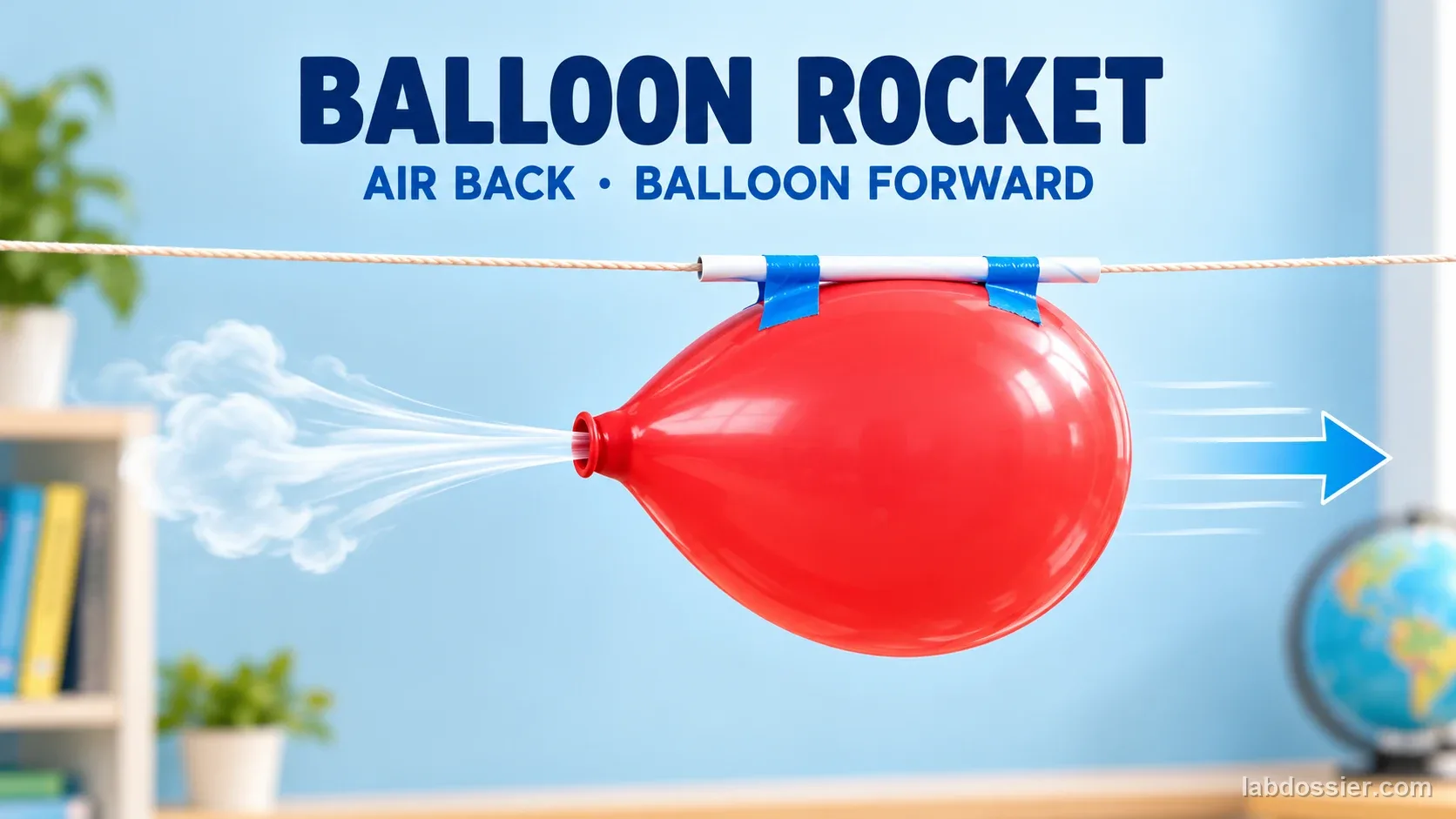
Reviewed article images support the lesson flow. Use the tables and student sheet to record actual observations; pictured patterns are not target results.
Printable shopping list
Shopping and staging checklist
Multiply the per-group kit contents by the class-size planner. The teacher section includes teacher-provided materials and setup or safety notes.
PER-GROUP KITS
- Nine matching balloons: three fresh trials at each of three air levels
- Long string, drinking straw, tape and two adult-approved anchor points
- Flexible measuring tape for starting circumference; meter stick for travel distance
- Recording sheet, labels and breath-count card
- Clear low track away from doors and walkways
TEACHER-PROVIDED MATERIALS + SETUP RULES
- Check for latex allergies; use an approved non-latex balloon when needed. Do not overinflate. Prepare a level, taut string at low height with stable adult-approved anchors.
- Keep the track clear of faces, doors, walkways and necks. Demonstrate pinching the nozzle until release and using the same start mark each time.
- Have one person inflate and one counter record about 5, 8 or 12 breaths; measure circumference at the widest point. Breath count and circumference are proxies, not direct air volume. Pick up snapped pieces promptly.
QUANTITIES BY CLASS SIZE
| Material | Per group kit | 20 students | 25 students | 30 students |
|---|---|---|---|---|
| Matching balloons for three air levels and three trials | 9 balloons | 54 balloons | 63 balloons | 72 balloons |
| String tracks and straws | 1 of each | 6 of each | 7 of each | 8 of each |
| Tape and two adult-approved anchors | 1 roll and 2 anchors | 6 rolls and 12 anchors | 7 rolls and 14 anchors | 8 rolls and 16 anchors |
| Tape measures or meter sticks | 1 | 6 | 7 | 8 |
| Breath-count cards and start markers | 1 set of each | 6 sets of each | 7 sets of each | 8 sets of each |
| Student data sheets | 1 per student | 20 copies | 25 copies | 30 copies |
Prepare 6 kits for 20 · 7 kits for 25 · 8 kits for 30 students.
Lesson flow
| Minutes | What happens |
|---|---|
| 0–5 min | Engage Predict how measured starting size may relate to travel. Check latex allergy needs and clear the track. |
| 5–11 min | Explore Build a low, taut track with one start mark and safe anchors; point the balloon nozzle away from people. |
| 11–27 min | Explore Launch three fresh balloons at each air condition. Record breath count, circumference and distance; note leaks or snags. |
| 27–34 min | Explain Calculate mean and range for each condition while preserving all three raw distances. |
| 34–40 min | Evaluate Compare results, explain the opposite force pair and friction, and clear popped pieces from the track. |
Discussion questions
1. Which way does expelled air travel compared with the balloon?
2. Why might a larger balloon travel farther in some trials?
3. Why record circumference as well as breath count?
4. Do three balloon launches replicate the string track?
5. What does this model leave out?
Common misconceptions
Differentiation
SUPPORT
- Pre-thread the straw and mark the start line and track distance before students launch.
- Assign one student to count breaths, one to release and one to read distance from the same marked scale.
- Offer: ‘At about __ breaths, the balloon traveled __ m and __ m; its average was __ m.’
EXTEND
- Measure balloon circumference before release as a more direct size measure while preserving the breath-count table for this investigation.
- Repeat with a second string tension and explain how friction changed as a new test.
- Record start-to-stop video and compare the stopping point with a tape-measure reading.
Assessment rubric
| Criterion | Beginning | Developing | Secure |
|---|---|---|---|
| Track and controls | Uses a loose track or changes start point between trials. | Builds a track but has inconsistent tension or balloon setup. | Uses the same taut string, straw, start mark, angle and balloon setup throughout. |
| Distance data | Leaves air condition or distance unrecorded. | Records distances but omits units, circumference or one repeat. | Records circumference and three distances in meters for each condition and notes setup issues. |
| Average and explanation | Does not compare data or misstates air direction. | Compares means but omits the paired force directions or limits. | Calculates each three-trial mean and range, then connects backward air flow with forward balloon motion and notes that trials share one track. |
| Safety | Overinflates or leaves track/popped pieces unsafe. | Uses a clear track but needs reminders about allergy or anchor check. | Checks latex allergy, avoids overinflation, uses approved anchors and clears snapped pieces promptly. |
Vocabulary
- Thrust – A push that changes an object's motion; here, the balloon's forward push.
- Newton's Third Law – Interacting objects exert equal-strength forces in opposite directions.
- Air amount – The approximate inflation level represented here by a consistent breath count.
- Friction – A force that resists motion between contacting surfaces, such as straw and string.
- Track – The taut string path that guides the straw and balloon.
- Trial – One run of a condition used to collect a measurement.
Safety, cleanup and troubleshooting
BEFORE STUDENTS TOUCH ANYTHING
- Keep the string level and taut; a sag can add friction and change every run.
- Pinch each balloon opening shut until release so a leak does not change its starting circumference.
- Use the same inflator and counter for every fresh balloon because breath sizes vary.
- Check for latex allergies and do not overinflate. Keep launch direction away from faces; place the string low and away from walkways, doors and necks.
- Use an adult-approved anchor and clear the path. Pick up snapped balloon pieces immediately because they are a choking hazard.
Troubleshooting: If the straw snags, a balloon leaks or the string sags, note the affected run and repair the setup before repeating. Keep the path away from faces, doors, necks and walkways; collect snapped pieces immediately.