LF-24 · TEACHER LESSON PLAN
Bouncing ball energy lab
Why some balls bounce back higher than others from the same drop
Driving question
Learning objectives
- Students release four ball types from one marked height over the same hard, flat surface without throwing.
- Students measure three first-bounce heights per ball, calculate their mean and range, and express mean height as a percent of the fixed drop height.
- Students argue which tested ball returned the greatest fraction of drop height using measurements and an energy-transfer explanation.
Standards
| Dimension | Alignment |
|---|---|
| Performance expectation | MS-PS3-5Construct, use, and present arguments to support the claim that when the kinetic energy of an object changes, energy is transferred to or from the object. (Partial alignment: this is the performance expectation the lab lists, but students measure bounce height as a percent of drop height rather than calculating kinetic energy.) |
| Practices | SEP 4Analyze and interpret data. |
| Core idea | PS3.BWhen the motion energy of an object changes, there is inevitably some other change in energy at the same time. |
| Crosscutting | Energy and MatterEnergy may take different forms (e.g. energy in fields, thermal energy, energy of motion). |
Standards text paraphrased from nextgenscience.org. Alignment is partial; this hands-on activity does not cover every part of the performance expectation.
State standards crosswalk
Use the row as a planning crosswalk, then confirm local district pacing and grade placement. “Partial” labels describe a skill connection, not full mastery of the complete standard.
| State | Verified standard | How this lesson aligns | Official source |
|---|---|---|---|
| California | CA NGSS MS-PS3-5 | Partial. Students use rebound-height evidence to argue that energy transfers during impact, but they do not calculate kinetic energy or quantify energy transferred to or from the ball. | Open standard ↗ |
| Texas | Science.6.8(A) | Partial. Students compare gravitational potential energy before release with kinetic energy during motion, but this activity does not compare the full set of energy types named in the grade-six expectation. | Open standard ↗ |
| Florida | SC.6.P.11.1 | Partial. The drop and rebound show kinetic and potential energy changing form, but the height ratio is not a calculation of energy and does not establish conservation quantitatively. | Open standard ↗ |
| New York | MS-PS3-5 | Partial. Students make an evidence-based argument from rebound height and discuss sound, heat, and deformation, but do not calculate kinetic energy changes. | Open standard ↗ |
| Pennsylvania | 3.2.6-8.O | Partial. Students argue that motion-energy changes involve transfers, but the activity does not measure kinetic energy or quantify what transfers to or from the ball. | Open standard ↗ |
Materials and prep timeline
PER GROUP
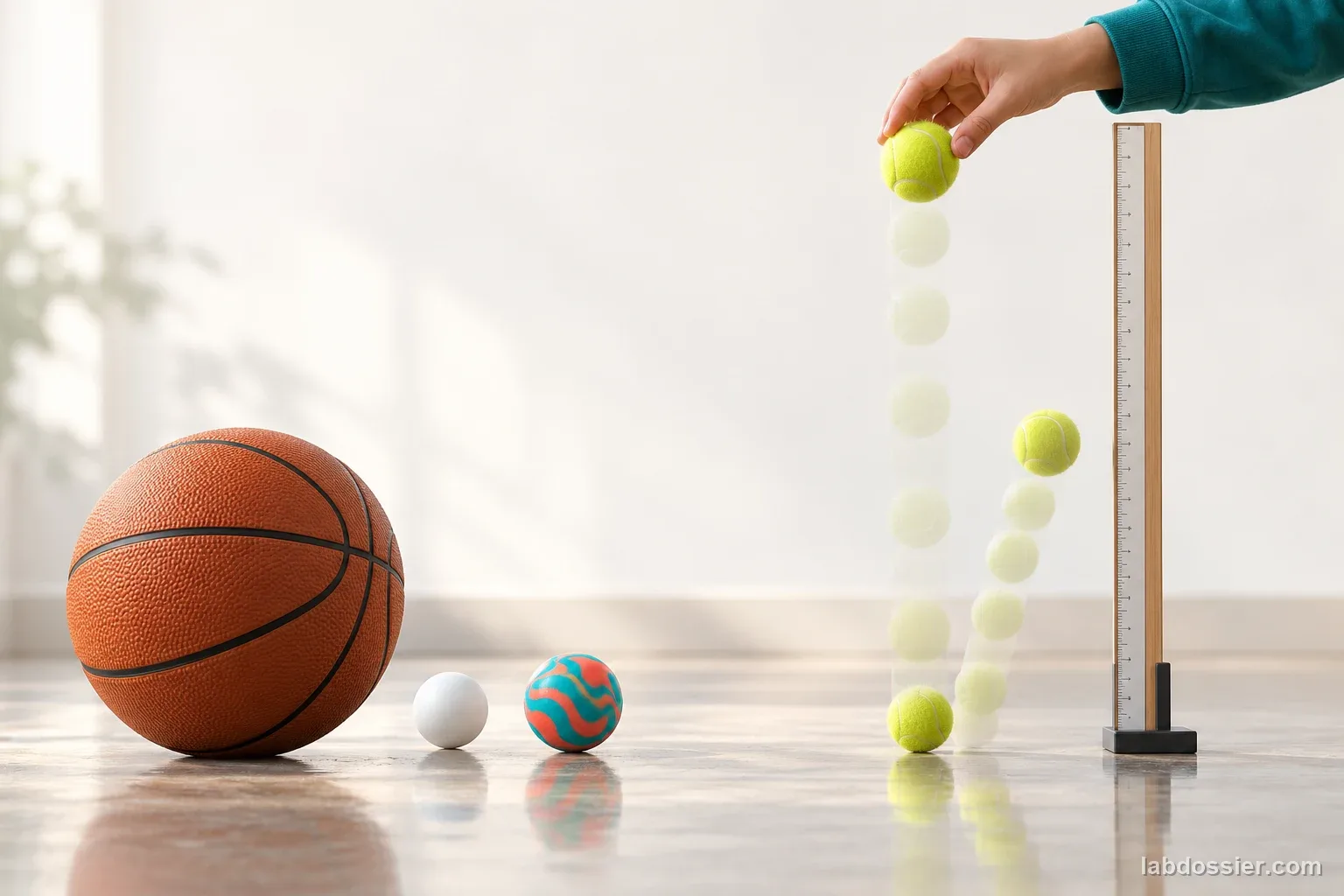
- Tennis ball, basketball, ping-pong ball and rubber bouncy ball
- Same hard, flat floor area and a fixed 100 cm release mark
- Vertical meter stick or wall scale
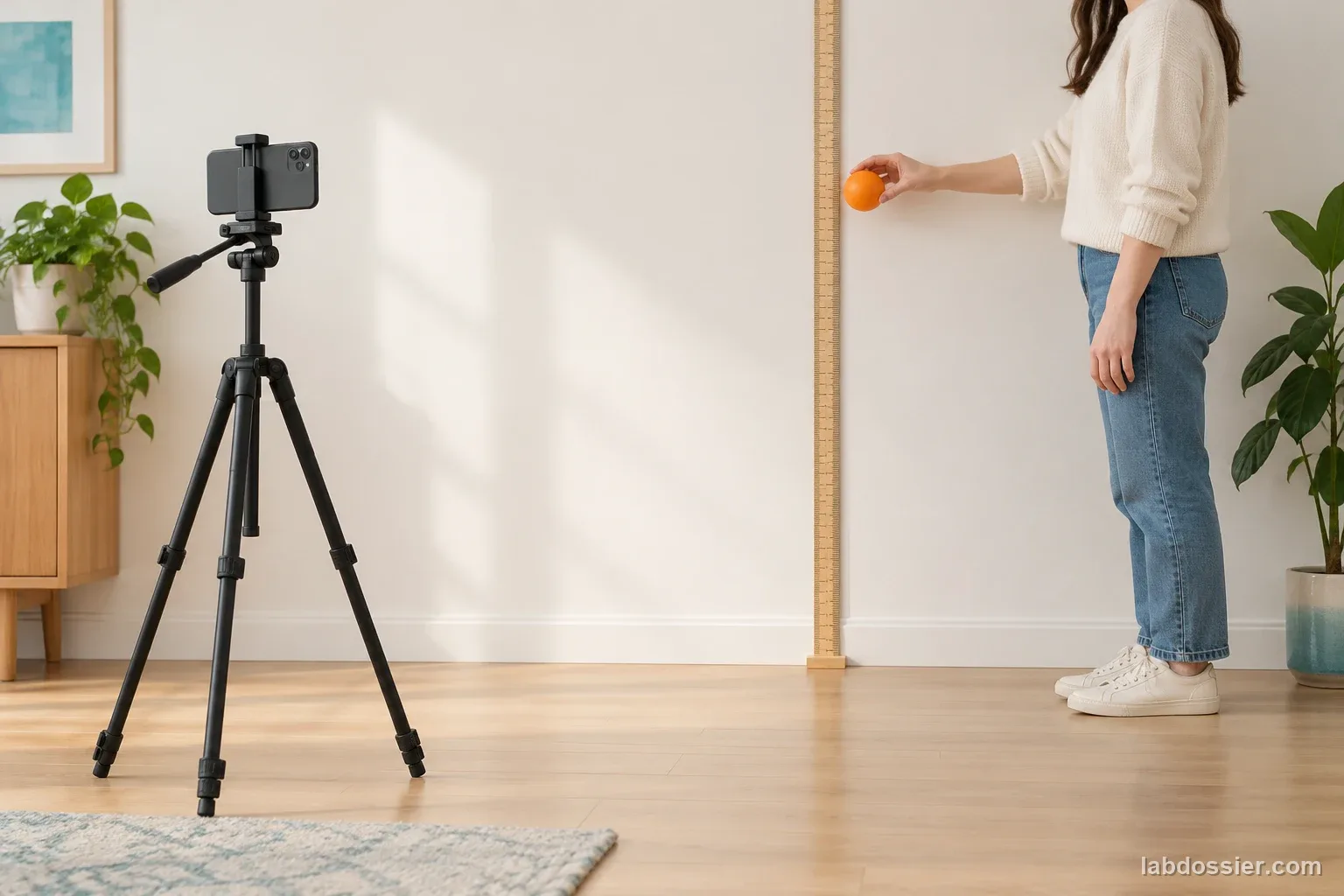
- Side-view phone camera with slow-motion video, if available
- Tape, calculator, recording sheet and clear retrieval zone
TEACHER ONLY
- Choose an open, level hard floor; mark 100 cm consistently for all releases and position the scale beside, not behind, the ball path.
- Check balls are intact and that the floor is dry. Keep people, pets and breakable items away from the bounce zone.
- Demonstrate releasing from rest without a push. If filming, place the camera outside the zone, perpendicular to the scale.
CLASS-SIZE KIT PLANNER
One per-group kit contains every item in the team materials list above. Groups are balanced around the listed 3–4 students target.
| Students | Groups | Per-group kits | Student sheets | Suggested group split |
|---|---|---|---|---|
| 20 | 6 | 6 complete kits | 20 copies | 2 groups of 4 and 4 groups of 3 |
| 25 | 7 | 7 complete kits | 25 copies | 4 groups of 4 and 3 groups of 3 |
| 30 | 8 | 8 complete kits | 30 copies | 6 groups of 4 and 2 groups of 3 |
Predict which tested sample may rebound highest. Clear the level bounce zone and review drop, not throw.
Set a reachable 100 cm release height and a vertical scale beside the path on the same hard, flat floor. Put a side-view camera outside the drop zone if available.
Drop each ball from rest three times. Record the ball's lower edge at the first-rebound peak, using that same edge as the release-height reference and the same scale and viewing angle.
Find each ball's mean height and range (highest minus lowest); then calculate mean height ÷ 100 cm × 100%. This is a height ratio, not energy returned.
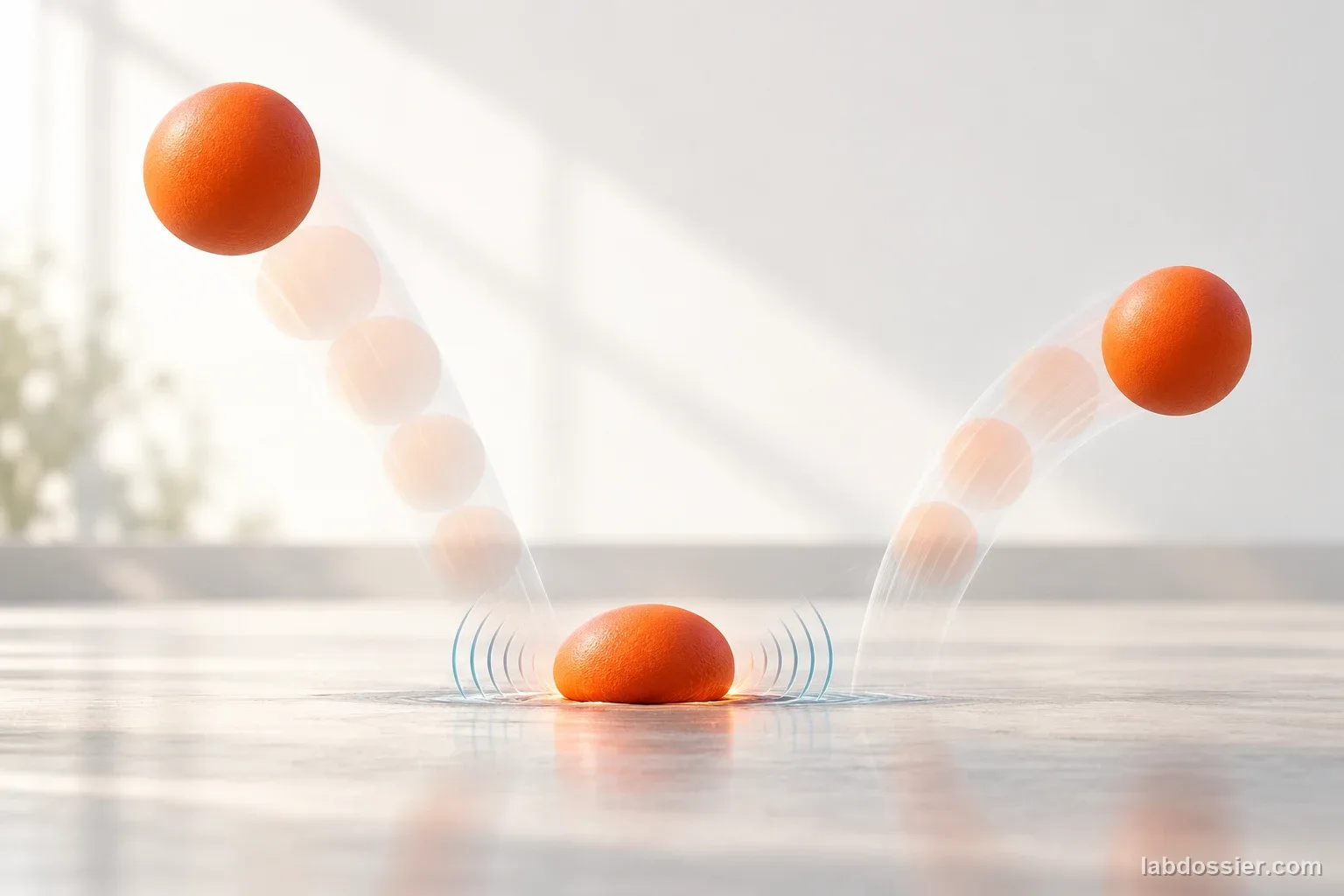
Compare measured sample means and ranges; discuss transfers to sound, warming, deformation and motion of the floor. Retrieve balls only after each bounce ends; dry the area if needed.
Lab figures and data visuals
Reviewed article images support the lesson flow. Use the tables and student sheet to record actual observations; pictured patterns are not target results.
Printable shopping list
Shopping and staging checklist
Multiply the per-group kit contents by the class-size planner. The teacher section includes teacher-provided materials and setup or safety notes.
PER-GROUP KITS
- Tennis ball, basketball, ping-pong ball and rubber bouncy ball
- Same hard, flat floor area and a fixed 100 cm release mark
- Vertical meter stick or wall scale
- Side-view phone camera with slow-motion video, if available
- Tape, calculator, recording sheet and clear retrieval zone
TEACHER-PROVIDED MATERIALS + SETUP RULES
- Choose an open, level hard floor; mark 100 cm consistently for all releases and position the scale beside, not behind, the ball path.
- Check balls are intact and that the floor is dry. Keep people, pets and breakable items away from the bounce zone.
- Demonstrate releasing from rest without a push. If filming, place the camera outside the zone, perpendicular to the scale.
QUANTITIES BY CLASS SIZE
| Material | Per group kit | 20 students | 25 students | 30 students |
|---|---|---|---|---|
| Tennis, basketball, ping-pong, and rubber bouncy balls | 1 of each | 6 of each | 7 of each | 8 of each |
| Vertical meter sticks or wall scales | 1 | 6 | 7 | 8 |
| Tape and 100 centimeter release-height markers | 1 set | 6 sets | 7 sets | 8 sets |
| Calculators and timers | 1 of each | 6 of each | 7 of each | 8 of each |
| Student data sheets | 1 per student | 20 copies | 25 copies | 30 copies |
| Optional side-view phone camera | 1 shared device | 6 devices or rotate | 7 devices or rotate | 8 devices or rotate |
Prepare 6 kits for 20 · 7 kits for 25 · 8 kits for 30 students.
Lesson flow
| Minutes | What happens |
|---|---|
| 0–4 min | Engage Predict which tested sample may rebound highest. Clear the level bounce zone and review drop, not throw. |
| 4–8 min | Explore Set a reachable 100 cm release height and a vertical scale beside the path on the same hard, flat floor. Put a side-view camera outside the drop zone if available. |
| 8–20 min | Explore Drop each ball from rest three times. Record the ball's lower edge at the first-rebound peak, using that same edge as the release-height reference and the same scale and viewing angle. |
| 20–26 min | Explain Find each ball's mean height and range (highest minus lowest); then calculate mean height ÷ 100 cm × 100%. This is a height ratio, not energy returned. |
| 26–30 min | Evaluate Compare average percentages and discuss transfer to sound, heat and deformation. Retrieve balls only after each bounce ends; dry the area if needed. |
Discussion questions
1. Why compare bounce height as a percent of the same 100 cm drop?
2. Where can energy go when a ball hits the floor?
3. Why use the first rebound and repeat three times?
4. What limits a conclusion from this test?
Common misconceptions
Differentiation
SUPPORT
- Mark the same 100 cm start line and use a partner to call the first-rebound peak.
- Provide a calculator and write the sequence: mean of three heights, then mean ÷ 100 cm × 100%.
- Offer: ‘The __ ball averaged __ cm, which is __% of 100 cm; the readings varied by __ cm.’
EXTEND
- Graph all three trial heights to compare consistency as well as each mean.
- Repeat one ball from a second release height while keeping the floor and release method fixed.
- Use slow-motion frames and a scale in the same plane to compare manual and video peak estimates.
Assessment rubric
| Criterion | Beginning | Developing | Secure |
|---|---|---|---|
| Controlled releases | Uses different heights or throws balls. | Keeps height mostly fixed but varies release or surface. | Releases all ball types from rest at one height over the same dry, level hard floor. |
| Measurements | Records fewer than three trials or leaves units off. | Records three trials but misses first-bounce peak or uses inconsistent viewing. | Records three first-bounce heights in cm for each ball using the same scale and viewing angle. |
| Calculation and argument | Does not compute an average percent or cite evidence. | Computes a percent with an arithmetic or average error. | Averages the three heights, computes percent of 100 cm correctly and supports a claim with data. |
| Energy and safety | Says energy disappears or leaves the bounce path uncleared. | Names an energy transfer but needs reminders about retrieval or clear space. | Explains sound/heat/deformation transfers and keeps the zone clear and dry. |
Vocabulary
- Rebound – The upward motion of a ball after it contacts the floor.
- Drop height – The vertical starting height from which a ball is released.
- First-bounce height – The highest point reached on the first rebound.
- Average – The sum of repeated measurements divided by their number.
- Energy transfer – Movement of energy from one object or form to another.
- Deformation – A change in an object's shape, such as a ball compressing at impact.
Safety, cleanup and troubleshooting
BEFORE STUDENTS TOUCH ANYTHING
- Drop each ball from the exact same height and release it the same way — a small toss instead of a drop adds extra energy that isn't part of the test.
- Test on the same hard, flat floor for every ball — carpet or an uneven surface absorbs more energy and skews the comparison.
- Watching the exact top of a fast bounce takes practice — recording in slow motion on a phone makes the height easier to read accurately.
- Use small, intact balls on a clear, level floor. Keep faces, feet, pets and breakable objects away; drop, do not throw. Retrieve balls only after they stop.
- Wipe up any water or debris before testing so nobody slips while retrieving a ball.
Troubleshooting: If a ball travels sideways or the peak is unclear, mark that trial as uncertain and repeat from rest with the camera or reader in the same position. Keep carpet and uneven surfaces out of the comparison; dry the floor before retrieving balls.