LF-15 · TEACHER LESSON PLAN
Catalase enzyme lab
Test how reaction temperature changes the evidence from potato catalase
Driving question
Learning objectives
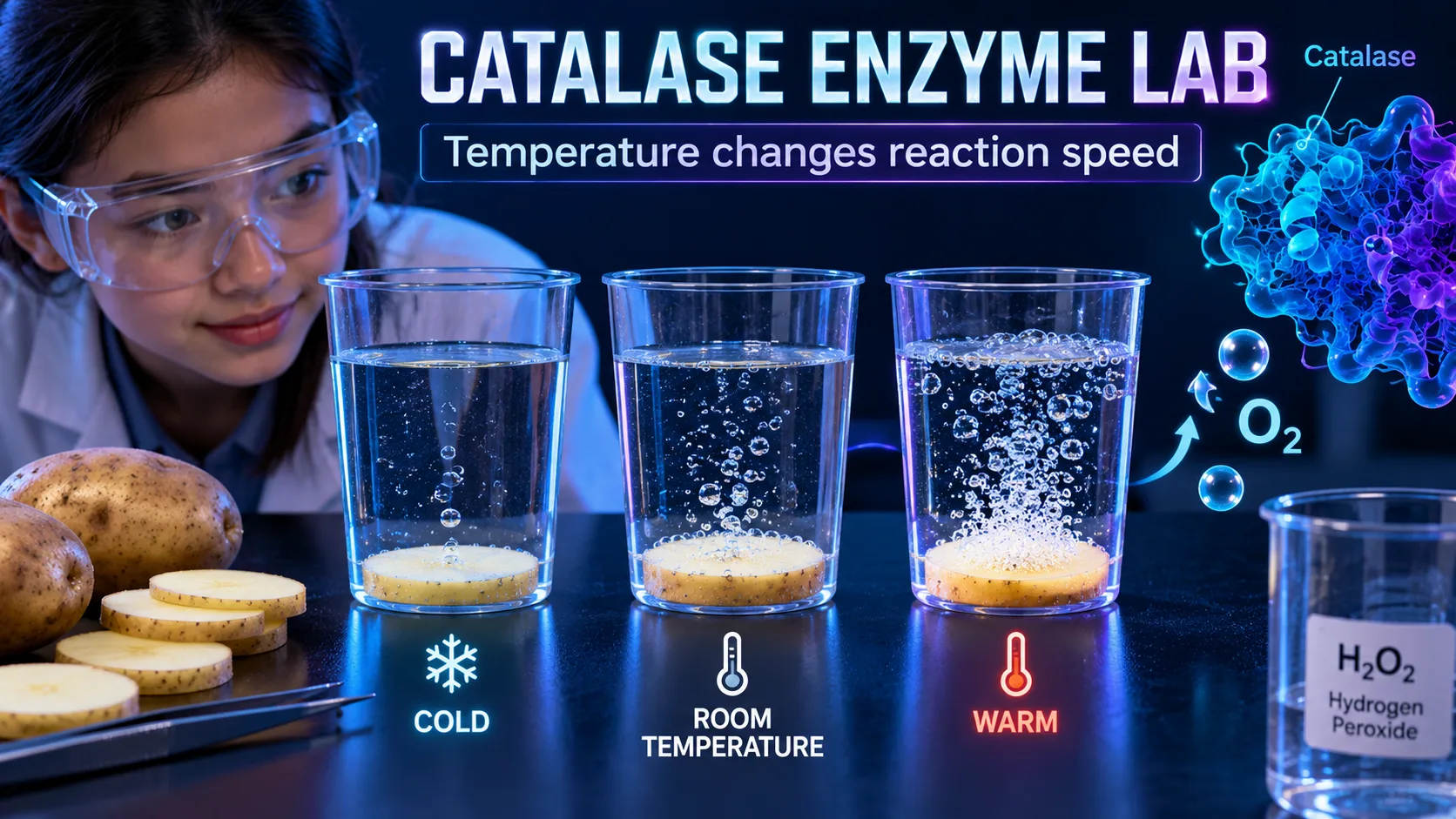
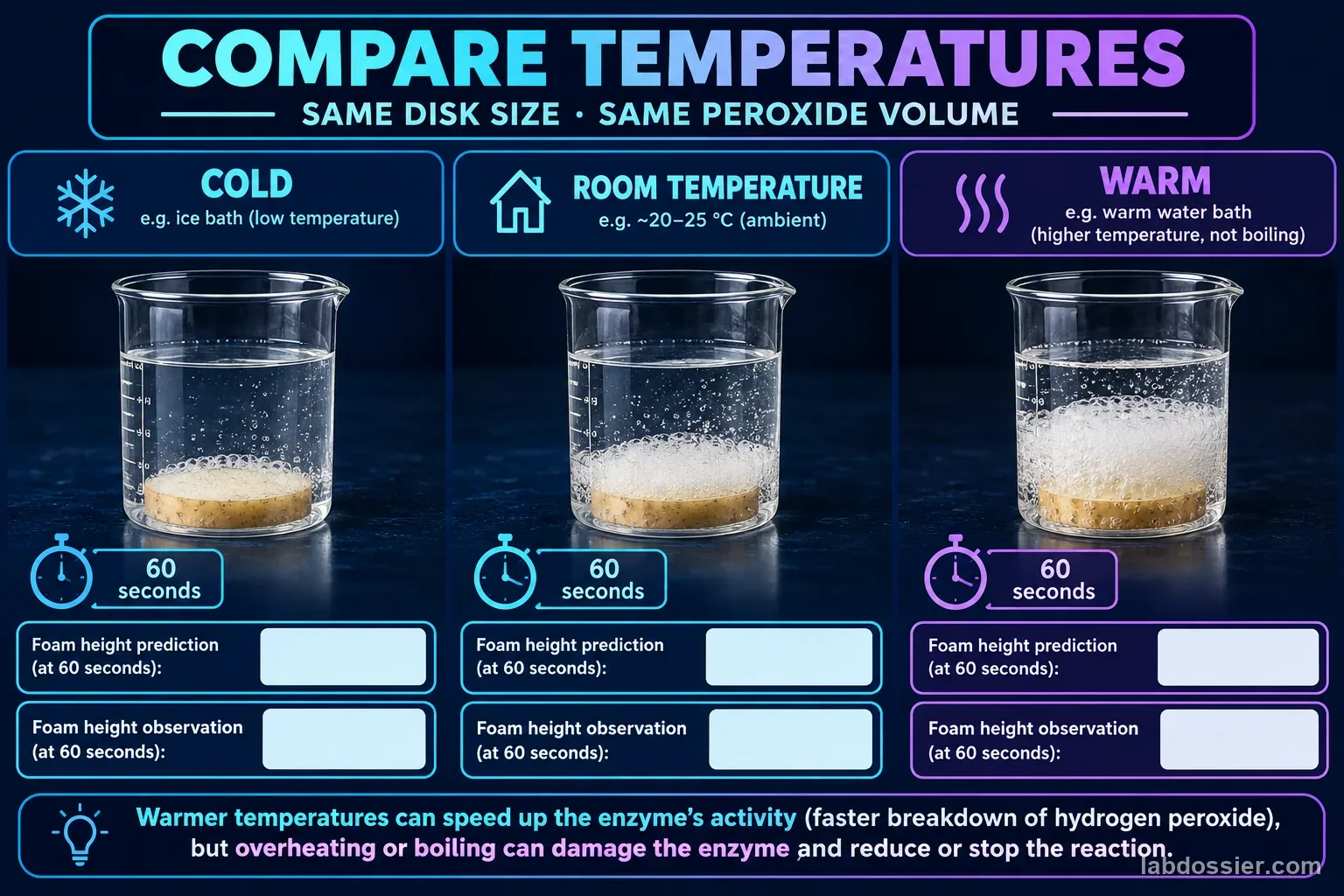
- Students compare cold, room-temperature and comfortably warm reactions with three independent fresh trials per temperature.
- Students measure starting temperature, seconds to first clear bubbles and foam height after exactly 60 seconds; then compare means and ranges.
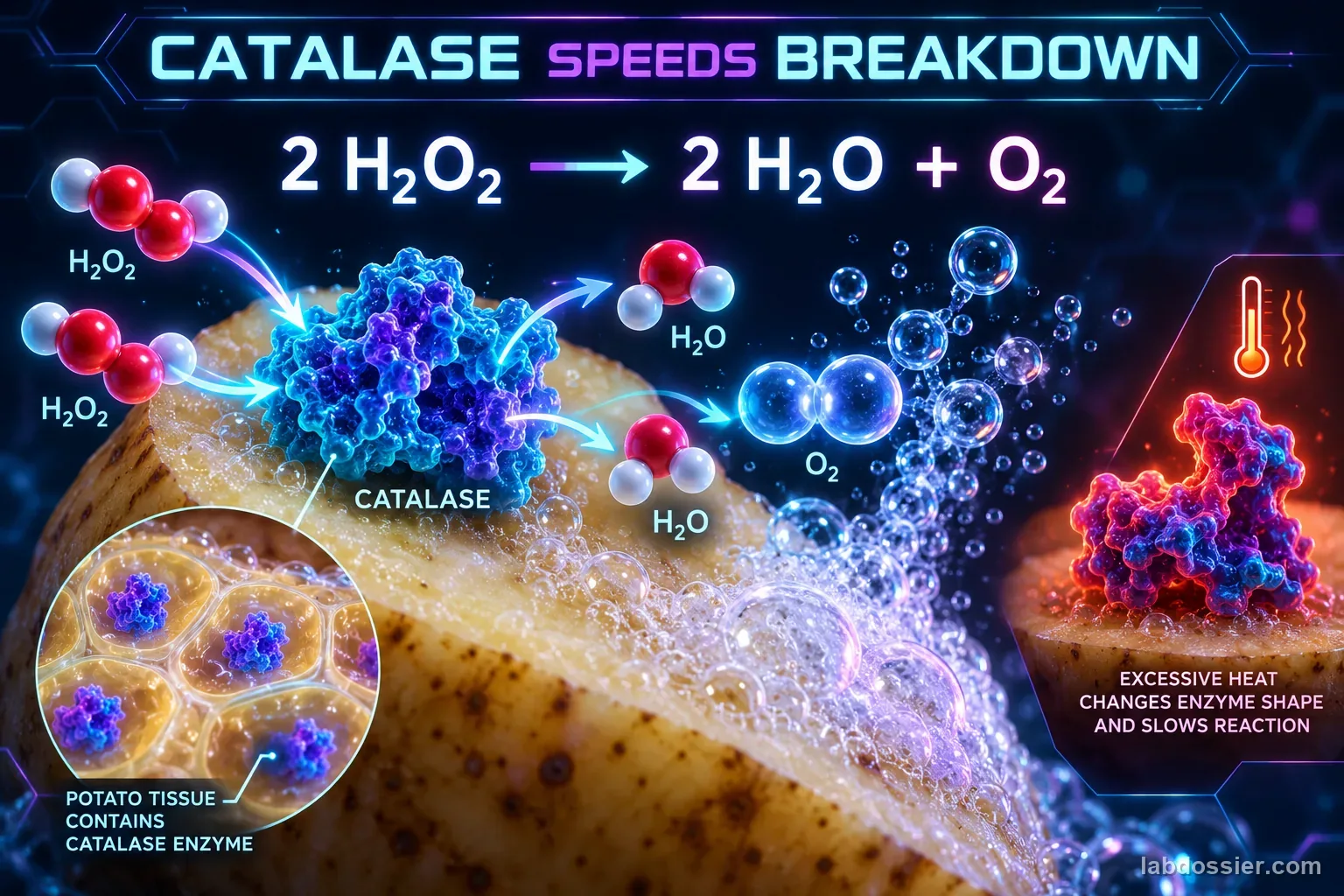
- Students explain how catalase activity can change with temperature and why foam height is an indirect indicator.
Standards
| Dimension | Alignment |
|---|---|
| Performance expectation | MS-PS1-2Analyze and interpret data on the properties of substances before and after the substances interact to determine if a chemical reaction has occurred. (Partial alignment: students observe oxygen bubbles and foam while hydrogen peroxide reacts with potato catalase, but they do not systematically compare a full set of reactant and product properties.) |
| Practices | SEP 3Plan and carry out investigations. SEP 4Analyze and interpret data. |
| Core idea | PS1.BIn a chemical reaction, atoms are rearranged to form new substances; the number and kinds of atoms are conserved. |
| Crosscutting | Stability and changeExplanations of stability and change in natural or designed systems can be constructed by examining the changes over time. |
Standard text paraphrased from the Next Generation Science Standards. Alignment is partial: this activity measures reaction proxies rather than identifying all before-and-after substance properties.
State standards crosswalk
Use the row as a planning crosswalk, then confirm local district pacing and grade placement. “Partial” labels describe a skill connection, not full mastery of the complete standard.
| State | Verified standard | How this lesson aligns | Official source |
|---|---|---|---|
| California | CA NGSS MS-PS1-2 | Partial connection: gas bubbles and foam are observations of a reaction, but students do not compare all relevant substance properties before and after interaction. | Open standard ↗ |
| Texas | Science.7.6(C) | Partial connection: students use gas production as evidence while distinguishing a chemical reaction from a physical change; they do not survey other kinds of matter changes. | Open standard ↗ |
| Florida | SC.8.P.9.2 | Partial connection: students observe a chemical change indicator in one enzyme reaction, but do not compare a broad range of physical and chemical changes. | Open standard ↗ |
| New York | NYSSLS MS-PS1-2 | Partial connection: students interpret bubbling and foam as evidence, but do not analyze a systematic set of substance properties before and after the reaction. | Open standard ↗ |
| Pennsylvania | STEELS 3.2.6-8.D | Partial connection: students record visible gas and foam evidence, but do not test multiple properties of both substances before and after interaction. | Open standard ↗ |
Materials and prep timeline
PER GROUP
- Nine equal-thickness potato disks from one potato; one fresh disk per independent trial
- 3% household hydrogen peroxide: nine 15 mL portions (135 mL total)
- Nine identical clear, open reaction containers and a tray
- Three water-bath cups for cold (about 5–10 °C), measured room temperature, and comfortably warm (about 35–40 °C); thermometer
- Graduated cylinder, ruler, stopwatch, labels, goggles and recording sheet
TEACHER ONLY
- Adult cuts nine equal-diameter, equal-thickness disks and prepares the three baths. Keep the warm bath at or below 40 °C; do not use boiling water or flames.
- Provide splash goggles and only 3% household hydrogen peroxide. Measure nine fresh 15 mL portions, one per reaction.
- Let each dry disk and its peroxide portion equilibrate in the same bath for about five minutes before combining. Record actual starting temperature.
- Set the open reactions on a tray; keep containers open so oxygen can escape. Provide the product-label/school rinse procedure and handwashing.
CLASS-SIZE KIT PLANNER
One per-group kit contains every item in the team materials list above. Groups are balanced around the listed 3–4 students target.
| Students | Groups | Per-group kits | Student sheets | Suggested group split |
|---|---|---|---|---|
| 20 | 6 | 6 complete kits | 20 copies | 2 groups of 4 and 4 groups of 3 |
| 25 | 7 | 7 complete kits | 25 copies | 4 groups of 4 and 3 groups of 3 |
| 30 | 8 | 8 complete kits | 30 copies | 6 groups of 4 and 2 groups of 3 |
Predict how starting reaction temperature may affect bubble-start time. Review goggles, no flame, no tasting and open reaction vessels.
Label three reaction cups per temperature. Measure 15 mL peroxide per cup and use nine fresh matched disks. Equilibrate peroxide and dry disks in the same bath for about five minutes.
For each condition, combine one disk and one peroxide portion, time to first clear bubbles for up to 60 seconds, and record all three independent trials. If none appear by 60 seconds, record that limit rather than assigning a time. Measure actual starting temperature.
At exactly 60 seconds, measure foam height in mm. For each temperature, retain the three readings and compare the mean and range for both measures.
Compare results without assuming a universal order or optimum. Foam depends on bubble stability as well as gas production; follow teacher cleanup directions.
Lab figures and data visuals
Reviewed article images support the lesson flow. Use the tables and student sheet to record actual observations; pictured patterns are not target results.
Printable shopping list
Shopping and staging checklist
Multiply the per-group kit contents by the class-size planner. The teacher section includes teacher-provided materials and setup or safety notes.
PER-GROUP KITS
- Nine equal-thickness potato disks from one potato; one fresh disk per independent trial
- 3% household hydrogen peroxide: nine 15 mL portions (135 mL total)
- Nine identical clear, open reaction containers and a tray
- Three water-bath cups for cold (about 5–10 °C), measured room temperature, and comfortably warm (about 35–40 °C); thermometer
- Graduated cylinder, ruler, stopwatch, labels, goggles and recording sheet
TEACHER-PROVIDED MATERIALS + SETUP RULES
- Adult cuts nine equal-diameter, equal-thickness disks and prepares the three baths. Keep the warm bath at or below 40 °C; do not use boiling water or flames.
- Provide splash goggles and only 3% household hydrogen peroxide. Measure nine fresh 15 mL portions, one per reaction.
- Let each dry disk and its peroxide portion equilibrate in the same bath for about five minutes before combining. Record actual starting temperature.
- Set the open reactions on a tray; keep containers open so oxygen can escape. Provide the product-label/school rinse procedure and handwashing.
QUANTITIES BY CLASS SIZE
| Material | Per group kit | 20 students | 25 students | 30 students |
|---|---|---|---|---|
| Medium potatoes for fresh disks | 1 | 6 | 7 | 8 |
| 3% household hydrogen peroxide | 135 mL | 810 mL | 945 mL | 1,080 mL |
| Clear open reaction containers | 9 | 54 | 63 | 72 |
| Water-bath cups | 3 | 18 | 21 | 24 |
| Water-bath cups | 3 | 18 | 21 | 24 |
| Tray, graduated cylinder, ruler, timer and thermometer | 1 of each | 6 of each | 7 of each | 8 of each |
| Safety goggles | 1 per student | 20 | 25 | 30 |
| Student recording sheets | 1 per student | 20 | 25 | 30 |
Prepare 6 kits for 20 · 7 kits for 25 · 8 kits for 30 students.
Lesson flow
| Minutes | What happens |
|---|---|
| 0–5 min | Engage Predict how starting reaction temperature may affect bubble-start time. Review goggles, no flame, no tasting and open reaction vessels. |
| 5–12 min | Explore Set up three independent cups per temperature with fresh matched disks and 15 mL of peroxide each. Equilibrate both reactants in the same bath. |
| 12–27 min | Explore Run all nine reactions; time from contact to first clear bubbles for up to 60 seconds and record actual starting temperature. If none appear, record not observed by 60 seconds. |
| 27–35 min | Explain At exactly 60 seconds, measure foam height in mm. Compare all three readings, then calculate each condition's mean and range. |
| 35–40 min | Evaluate Interpret the measured pattern without claiming a universal optimum. Foam depends on bubble stability as well as gas production. |
Discussion questions
1. What do the first bubbles show in this potato test?
2. Why could a warm disk bubble sooner than a cold disk?
3. Why might the tallest foam not identify the fastest reaction by itself?
4. Why repeat each temperature three times?
5. What limits the conclusion from three temperature conditions?
Common misconceptions
Differentiation
SUPPORT
- Use labeled cold, room and warm cups and a visual start/stop timing card.
- Provide a millimeter ruler and demonstrate measuring from liquid surface to top of foam without touching it.
- Offer: ‘The __ disk began bubbling in __ s and had __ mm of foam at 60 s.’
EXTEND
- Repeat each condition with fresh disks and fresh 15 mL peroxide portions; compare ranges, not only single readings.
- Measure bath temperatures and plot bubble-start time against measured temperature.
- Design a follow-up with another moderate temperature while holding disk dimensions and peroxide constant; do not use boiling samples.
Assessment rubric
| Criterion | Beginning | Developing | Secure |
|---|---|---|---|
| Fair comparison | Changes several conditions or reuses a reacted disk. | Matches some conditions but omits one control such as disk size or peroxide volume. | Uses fresh matched disks, equal peroxide volumes and open identical containers across temperatures. |
| Observations | Leaves bubble time or foam height blank. | Records observations but omits units or the 60-second endpoint. | Records time to first bubbles in seconds and foam height in millimeters at 60 seconds. |
| Evidence and reasoning | Makes a claim without citing measurements. | Uses one measure but treats foam as direct oxygen volume. | Uses both measured indicators and explains catalase and temperature with the limits of foam height. |
| Safe practice | Touches peroxide or seals a bubbling vessel. | Uses goggles but needs reminders about open vessels or cleanup. | Wears goggles, uses only 3% peroxide with adult supervision, keeps vessels open and follows rinse/cleanup directions. |
Vocabulary
- Catalase – An enzyme in potato tissue that speeds hydrogen peroxide breakdown.
- Enzyme – A molecule that speeds a chemical reaction without being used up in one reaction.
- Substrate – The substance an enzyme acts on; here, hydrogen peroxide.
- Denature – To change a protein's shape so it no longer works in the same way.
- Reaction rate – How quickly a reaction proceeds, measured here by bubble-start time and foam at a fixed time.
- Oxygen – A gas released as catalase breaks hydrogen peroxide into water and oxygen.
Safety, cleanup and troubleshooting
BEFORE STUDENTS TOUCH ANYTHING
- Hydrogen peroxide can irritate skin and eyes at higher concentrations — wear goggles and avoid contact with skin.
- Wear splash goggles and use adult supervision with 3% household hydrogen peroxide only. Never use concentrated peroxide; keep it off skin and out of eyes and mouths.
- Keep the reaction vessel open and on a tray. If solution splashes, stop and follow the product label and the classroom rinse procedure.
- Use fresh potato disks for each trial — a disk that has already reacted has used up some of its catalase.
- Do not seal the container while it's bubbling — the reaction releases oxygen gas that needs to escape.
Troubleshooting: If bubbling is hard to see, use the same clear container and lighting and record the observation as unclear rather than guessing. Use a fresh disk for every repeat. If a splash occurs, stop and follow the product label and classroom rinse procedure; never cap a reacting container.