LF-22 · TEACHER LESSON PLAN
Celery and food coloring lab
Why colored water climbs a celery stalk into its leaves
Driving question
Learning objectives
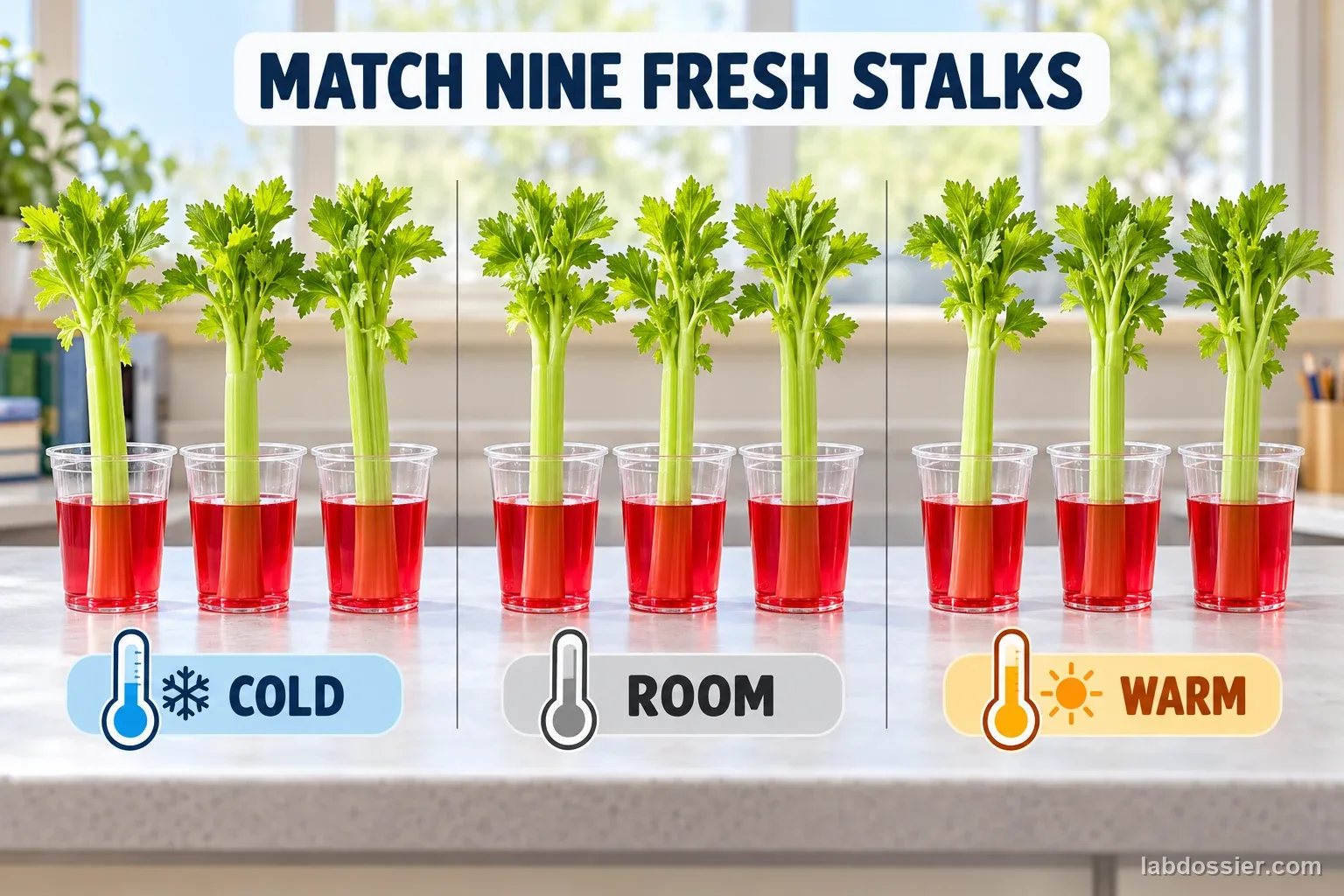
- Students prepare three repeated cups for each cold, room-temperature and comfortably warm starting-water condition.
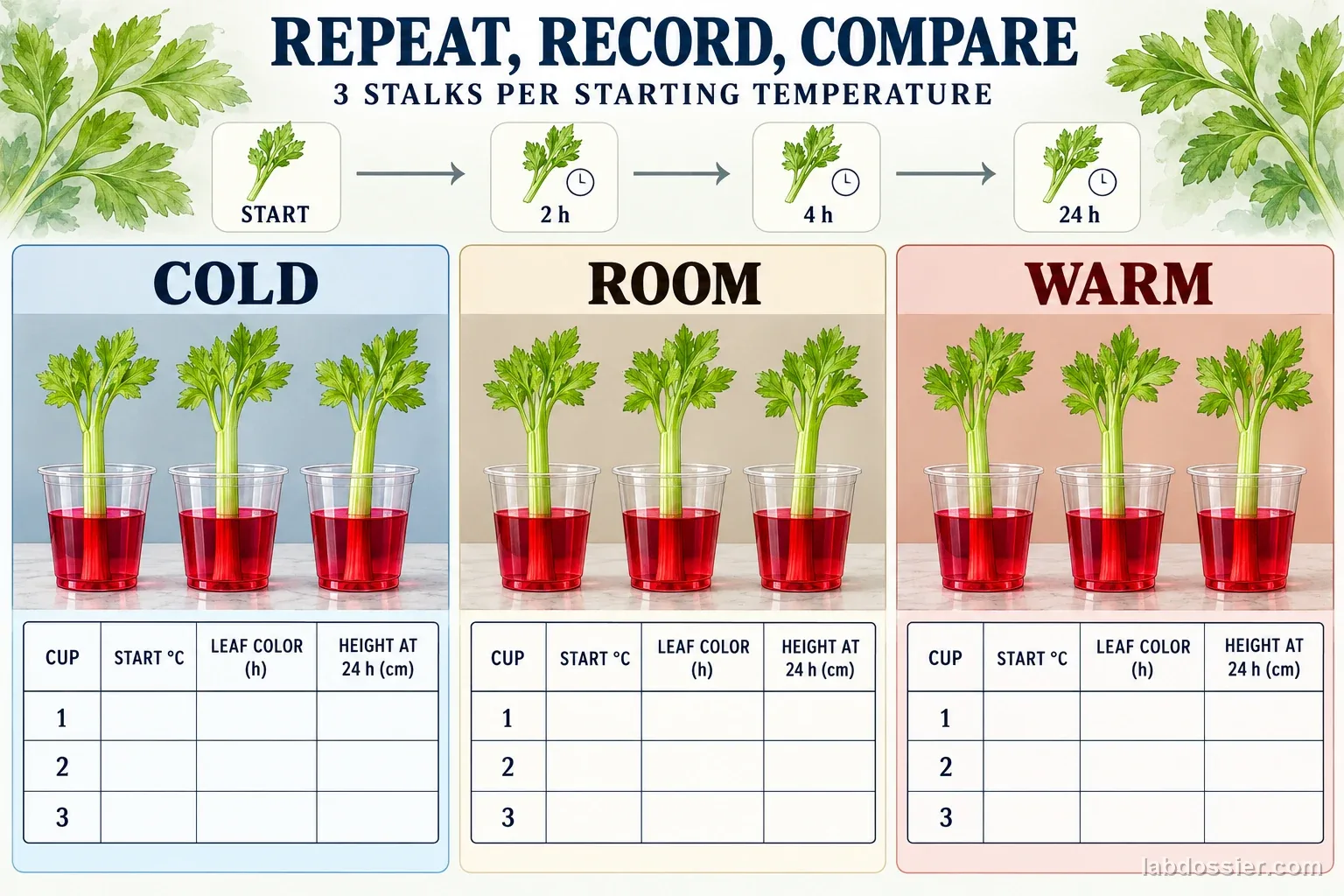
- Students record starting water temperature and its drift at 2, 4 and 24 hours, leaf-arrival times, and visible color height after 24 hours.
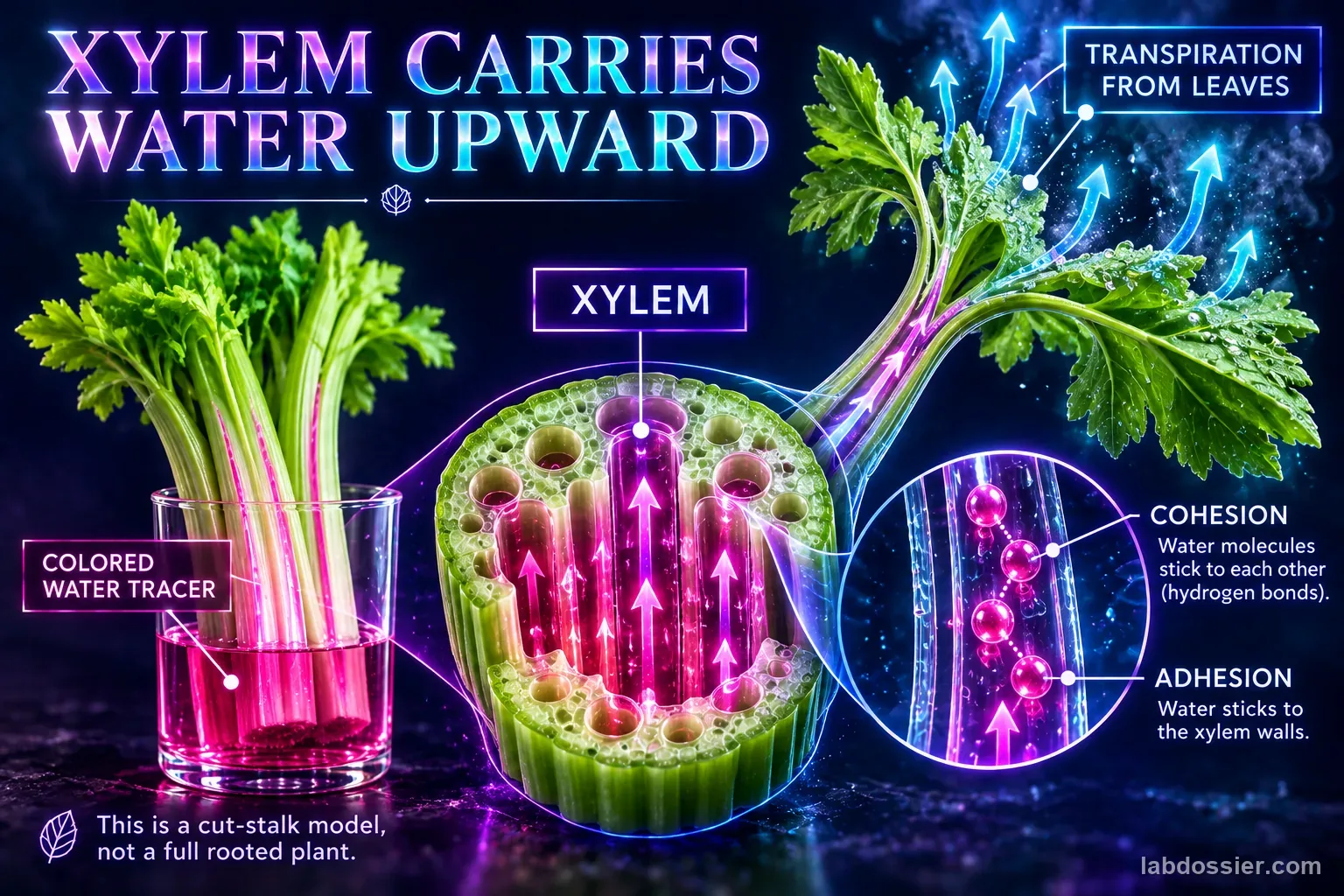
- Students explain how colored water traces vascular tissue and why a cut stalk is a limited model of water transport in a whole plant.
Standards
| Dimension | Alignment |
|---|---|
| Performance expectation | 4-LS1-1Construct an argument that plants and animals have internal and external structures that function to support survival, growth, behavior, and reproduction. (Limited connection: students observe colored water in celery vascular tissue, but this cut-stalk model does not test how plant structures support the whole plant's survival or growth.) |
| Practices | SEP 4Analyze and interpret data. SEP 6Construct explanations and design solutions. |
| Core idea | LS1.APlants and animals have both internal and external structures that serve various functions in growth, survival, behavior, and reproduction. |
| Crosscutting | Structure and functionThe way an organism's structures work together can support its functions. |
Standard text paraphrased from the Next Generation Science Standards. This is a limited connection because a colored-water celery stalk is a model of vascular transport, not evidence for every part of whole-plant survival and growth.
State standards crosswalk
Use the row as a planning crosswalk, then confirm local district pacing and grade placement. “Partial” labels describe a skill connection, not full mastery of the complete standard.
| State | Verified standard | How this lesson aligns | Official source |
|---|---|---|---|
| California | CA NGSS 4-LS1-1 | Limited connection: the colored pathway makes an internal plant structure visible, but the activity does not argue how structures support all listed life functions. | Open standard ↗ |
| Texas | Science.4.13(A) | Partial connection: students observe a plant structure and relate it to water transport, but do not investigate the full range of plant structures and functions. | Open standard ↗ |
| Florida | SC.3.L.14.1 | Partial connection: the celery stalk supports discussion of plant structure and function, but this activity focuses on one transport pathway rather than comparing plant and animal structures. | Open standard ↗ |
| New York | NYSSLS 4-LS1-1 | Limited connection: students use an internal plant structure as evidence, but the cut-stalk model does not address the complete survival, growth, behavior, and reproduction expectation. | Open standard ↗ |
| Pennsylvania | STEELS 3.1.4.A | Partial connection: students connect a plant structure with water movement, while the lesson does not examine the wider set of structures and functions in the standard. | Open standard ↗ |
Materials and prep timeline
PER GROUP
- Nine similar fresh celery stalks with leafy tops
- Nine same-size cups with 100 mL water in each
- 10 drops of food coloring per cup, 90 drops total
- Cold, room-temperature and comfortably warm starting water; thermometer
- Rulers, labels, timers, covered work surface and recording sheet
TEACHER ONLY
- Immediately before setup, an adult makes a fresh angled cut (about 45°) across each base with a sharp knife on a stable cutting board; do not use scissors, which can crush the stem.
- Prepare nine cups with 100 mL water and 10 drops of identical food coloring each. Use comfortably warm starting water, not hot, and similar leafy stalks.
- Cover the bench and place labeled cups on a stable surface. Record temperatures at setup and at 2, 4 and 24 hours; cups on the bench are not temperature-controlled. Provide cleanup supplies; dyed celery is not food.
CLASS-SIZE KIT PLANNER
One per-group kit contains every item in the team materials list above. Groups are balanced around the listed 3–4 students target.
| Students | Groups | Per-group kits | Student sheets | Suggested group split |
|---|---|---|---|---|
| 20 | 6 | 6 complete kits | 20 copies | 2 groups of 4 and 4 groups of 3 |
| 25 | 7 | 7 complete kits | 25 copies | 4 groups of 4 and 3 groups of 3 |
| 30 | 8 | 8 complete kits | 30 copies | 6 groups of 4 and 2 groups of 3 |
Predict which cup may show color in its leaves first. Label the temperatures and review dye-stain and no-eating reminders.
Prepare three 100 mL cups with 10 food-coloring drops for each starting temperature. An adult cuts about 1 cm from each base at about 45° with a sharp knife on a stable board; do not use scissors. Place one fresh-cut stalk per cup, record actual starting temperatures and start together.
Record each starting group's measured water temperature and check for first leaf color at consistent times. Log each cup separately; do not call the starting temperature a maintained 24-hour treatment.
Record the 24-hour temperature and measure the highest visible color path in every stalk in centimeters. Record thin vascular streaks as observed; do not infer unseen flow.
If leaf color has not appeared, continue observations to 48 hours and record no arrival by then. Calculate arrival-time mean/range only for groups where all three cups show color; otherwise report the non-arrival count and observed times. Calculate height mean/range from all three 24-hour readings, then clean the covered area and wash hands.
Lab figures and data visuals
Reviewed article images support the lesson flow. Use the tables and student sheet to record actual observations; pictured patterns are not target results.
Printable shopping list
Shopping and staging checklist
Multiply the per-group kit contents by the class-size planner. The teacher section includes teacher-provided materials and setup or safety notes.
PER-GROUP KITS
- Nine similar fresh celery stalks with leafy tops
- Nine same-size cups with 100 mL water in each
- 10 drops of food coloring per cup, 90 drops total
- Cold, room-temperature and comfortably warm starting water; thermometer
- Rulers, labels, timers, covered work surface and recording sheet
TEACHER-PROVIDED MATERIALS + SETUP RULES
- Immediately before setup, an adult makes a fresh angled cut (about 45°) across each base with a sharp knife on a stable cutting board; do not use scissors, which can crush the stem.
- Prepare nine cups with 100 mL water and 10 drops of identical food coloring each. Use comfortably warm starting water, not hot, and similar leafy stalks.
- Cover the bench and place labeled cups on a stable surface. Record temperatures at setup and at 2, 4 and 24 hours; cups on the bench are not temperature-controlled. Provide cleanup supplies; dyed celery is not food.
QUANTITIES BY CLASS SIZE
| Material | Per group kit | 20 students | 25 students | 30 students |
|---|---|---|---|---|
| Fresh leafy celery stalks | 9 | 54 | 63 | 72 |
| Clear cups | 9 | 54 | 63 | 72 |
| Water at 100 mL per cup | 900 mL | 5.4 L | 6.3 L | 7.2 L |
| Food coloring at 10 drops per cup | 90 drops | 540 drops | 630 drops | 720 drops |
| Rulers, thermometers, timers and labels | 1 of each | 6 of each | 7 of each | 8 of each |
| Student recording sheets | 1 per student | 20 | 25 | 30 |
| Covered work surface and cleanup supplies | 1 shared station | 1 | 1 | 1 |
Prepare 6 kits for 20 · 7 kits for 25 · 8 kits for 30 students.
Lesson flow
| Minutes | What happens |
|---|---|
| Day 1 setup — 0–5 min | Engage Predict which cup may show color in its leaves first. Label the temperatures and review dye-stain and no-eating reminders. |
| Day 1 setup — 5–15 min | Explore Prepare three 100 mL cups with 10 food-coloring drops for each starting temperature. An adult cuts about 1 cm from each base at about 45° with a sharp knife on a stable board; do not use scissors. Place one fresh-cut stalk per cup, record actual starting temperatures and start together. |
| Day 1 — at 2 h and 4 h | Explore Record starting-group temperature and check for first leaf color at consistent times. Log each cup separately and identify the treatment as starting temperature only. |
| Day 2 — at 24 h | Explain Record the 24-hour temperature and measure the highest visible color path in every stalk in centimeters. Record thin vascular streaks as observed; do not infer unseen flow. |
| By 48 h | Evaluate If leaf color has not appeared, continue observations to 48 hours and record no arrival by then. Calculate arrival-time mean/range only if all three cups show color; otherwise report the non-arrival count and observed times. Summarize all three 24-hour heights, compare the temperature log, then clean the covered area and wash hands. |
Discussion questions
1. Why does the color often appear as narrow lines in the celery?
2. Why start the three stalks at the same time with equal water and dye?
3. Does a higher visible color line measure all water moving through the stalk?
4. What limits the conclusion from a cut celery stalk?
Common misconceptions
Differentiation
SUPPORT
- Pre-label cups and provide a check-time card with space for actual elapsed hours.
- Place a centimeter ruler beside each stalk and mark the 24-hour reading point on the data sheet.
- Offer: ‘At __ h, color reached __ cm in the __ water; color first appeared in leaves after __ h.’
EXTEND
- Photograph each stalk at fixed times against the same ruler, background and lighting.
- Repeat with similar stalks and compare the range of arrival times, noting leaf area and cut freshness.
- Inspect a cross-section with adult help and sketch where colored vascular bundles are visible.
Assessment rubric
| Criterion | Beginning | Developing | Secure |
|---|---|---|---|
| Matched setup | Uses unmatched water or stalks without labeling temperatures. | Labels temperatures but leaves one important condition unmatched. | Uses similar fresh-cut leafy stalks, equal water and dye amounts, and labeled temperature conditions. |
| Time and height records | Leaves arrival or height blank. | Records observations but omits hours, centimeters or 24-hour endpoint. | Records elapsed hours to leaf color and visible height in cm at 24 h, including no arrival when applicable. |
| Interpretation | Claims the stalk was colored throughout without evidence. | Uses a visible path but treats it as total water flow. | Uses the observed path and height to describe vascular transport and states what the dye does not measure. |
| Safe handling | Handles knife or eats dyed celery. | Keeps food away but needs reminders about fresh adult cuts or stains. | Leaves cutting to an adult, works over a cover, does not eat samples and washes hands after cleanup. |
Vocabulary
- Vascular tissue – Plant tissue that transports water and other materials through a plant.
- Xylem – Vascular tissue that carries water through a plant.
- Stalk – The celery stem that supports leaves and contains vascular bundles.
- Transport – Movement of material from one place to another.
- Elapsed time – Time passed since the stalk was placed in colored water.
- Evidence – An observation or measurement used to support an explanation.
Safety, cleanup and troubleshooting
BEFORE STUDENTS TOUCH ANYTHING
- Immediately before setup, an adult cuts about 1 cm from each stalk base at about 45° with a sharp knife; scissors can crush the stem.
- Use a stable cutting board and point the knife away from hands. Students place the prepared celery into cups.
- Food coloring stains and the dyed celery is not food. Keep samples away from mouths, cover the bench, and wash hands after cleanup.
Troubleshooting: If color does not reach leaves, record the elapsed observation time and continue only through the planned 48-hour window. Check whether the stalk remains in the colored water and note a loose or wilted stalk; do not claim an unobserved arrival. An adult should inspect any cross-section.