LF-03 · TEACHER LESSON PLAN
Elephant toothpaste
How a catalyst speeds up hydrogen peroxide breaking down
Driving question
Learning objectives
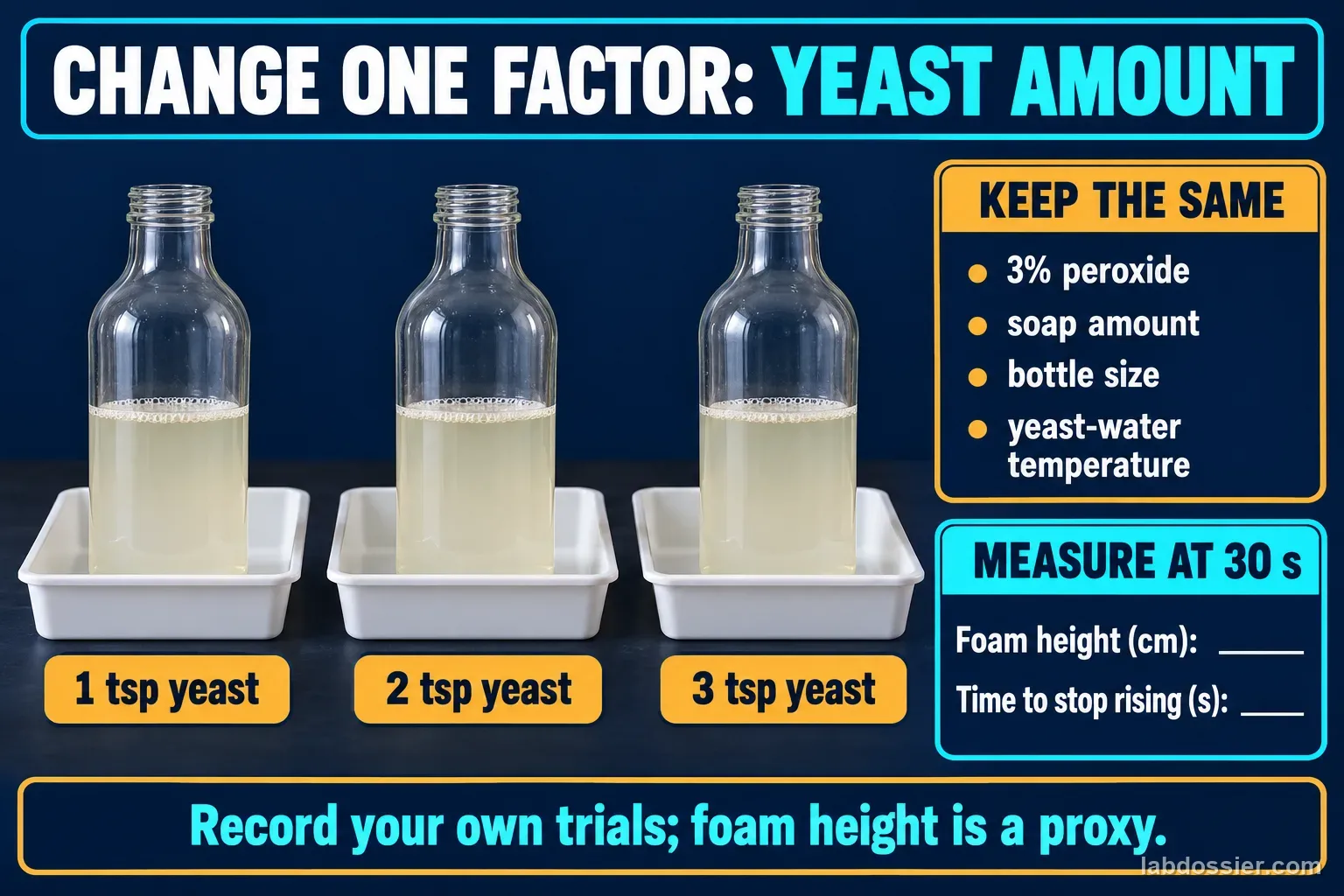
- Students plan a fair comparison using 1, 2 and 3 teaspoons of yeast while keeping the 3% hydrogen peroxide, soap, bottle and yeast-water temperature consistent.
- Students measure three fresh trials at each of 1, 2 and 3 teaspoons of yeast, then compare mean peak height, range and mean plateau time.
- Students interpret whether the foam and bottle warming are evidence of a chemical reaction, while distinguishing evidence from a complete analysis of substance properties.
Standards
| Dimension | Alignment |
|---|---|
| Performance expectation | MS-PS1-2Analyze and interpret data on the properties of substances before and after the substances interact to determine if a chemical reaction has occurred. (Partial alignment: students observe foam and heat as evidence of a reaction; the assessment boundary lists density, melting point, boiling point, solubility, flammability and odor as the properties analyzed.) |
| Practices | SEP 3Plan and carry out investigations. |
| Core idea | PS1.BIn a chemical process, the atoms that make up the original substances are regrouped into different molecules, and these new substances have different properties from those of the reactants. |
| Crosscutting | PatternsMacroscopic patterns are related to the nature of microscopic and atomic-level structure. |
Standards text paraphrased from nextgenscience.org. Alignment is partial; this hands-on activity does not cover every part of the performance expectation.
State standards crosswalk
Use the row as a planning crosswalk, then confirm local district pacing and grade placement. “Partial” labels describe a skill connection, not full mastery of the complete standard.
| State | Verified standard | How this lesson aligns | Official source |
|---|---|---|---|
| California | CA NGSS MS-PS1-2 | Analyze evidence that substances interacted; partial because foam and warmth support a reaction explanation but do not test the full listed property set. | Open standard ↗ |
| Texas | SCIENCE.8.1.F | Organize repeated observations and use means to find patterns; supports comparing maximum foam height and plateau time. | Open standard ↗ |
| Florida | SC.8.N.1.1 | Plan investigations, identify variables, collect and interpret data, and defend conclusions; strong investigation alignment. | Open standard ↗ |
| New York | MS-PS1-2 | Analyze before-and-after substance properties for reaction evidence; partial because foam and warmth alone do not assess every property in the boundary. | Open standard ↗ |
| Pennsylvania | 3.2.6-8.D | Analyze properties before and after substances interact; partial because the foam-height investigation is evidence-focused, not a full diagnostic property comparison. | Open standard ↗ |
Materials and prep timeline
PER GROUP
- 1.08 L of teacher-portioned 3% household hydrogen peroxide for nine runs
- Active dry yeast: three 1-tsp, three 2-tsp and three 3-tsp portions
- 540 mL dish soap and 540 mL warm water, portioned to match each run
- One 600 mL bottle, rinsed and fully dried between runs; separate yeast cups
- Ruler, timer, labels, tray, goggles and cleanup towels
TEACHER ONLY
- Use only 3% household hydrogen peroxide; do not substitute stronger lab or salon peroxide. Keep the peroxide amount and bottle setup the same across trials.
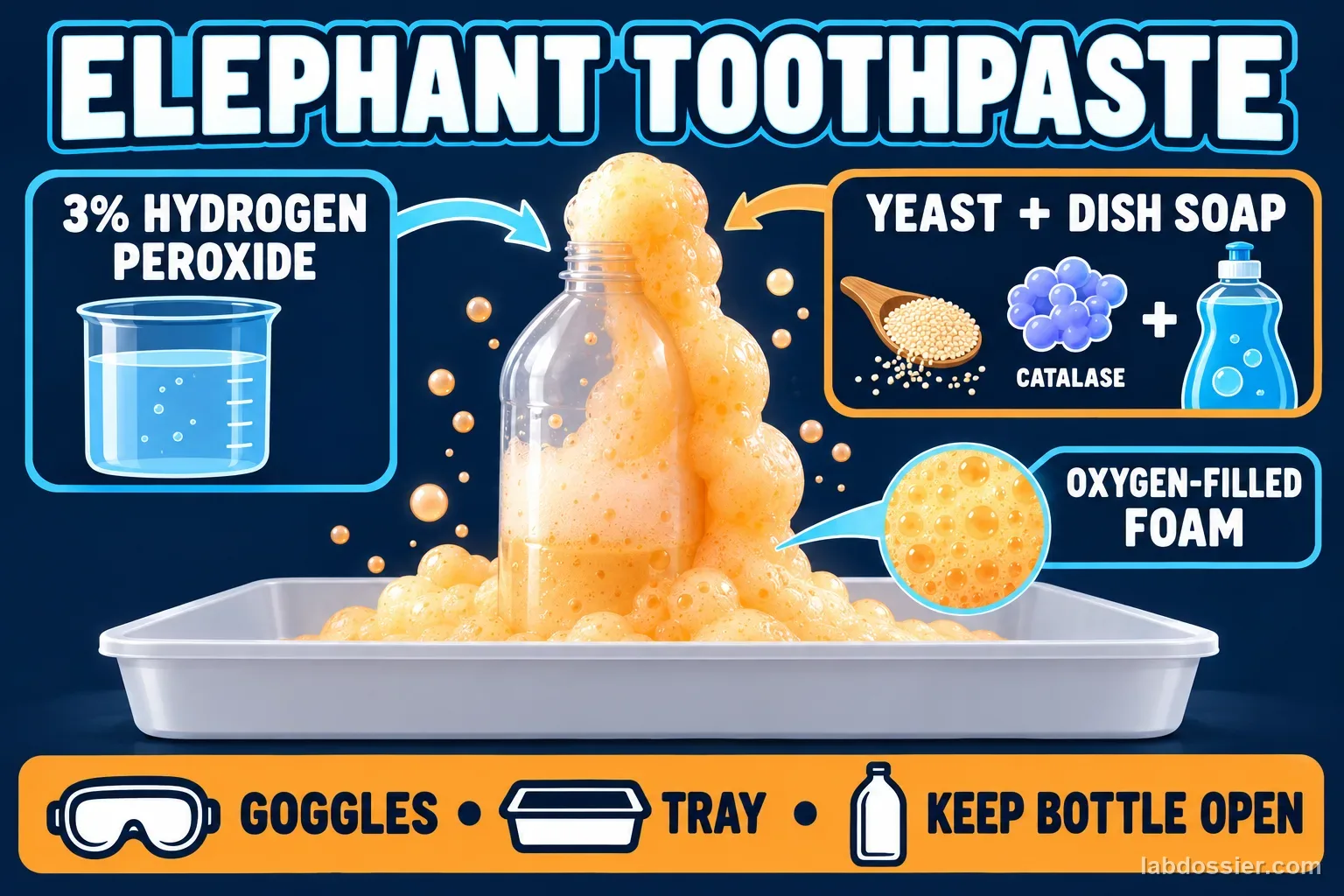
- Set the bottle on a tray. Check goggles, supervise the warm foam and keep the bottle open; never seal it.
- Provide fresh measured ingredients for each run. Rinse and fully dry the bottle between trials; direct students not to taste or touch the foam and arrange handwashing.
CLASS-SIZE KIT PLANNER
One per-group kit contains every item in the team materials list above. Groups are balanced around the listed 3–4 students target.
| Students | Groups | Per-group kits | Student sheets | Suggested group split |
|---|---|---|---|---|
| 20 | 5 | 5 complete kits | 20 copies | 4 students per group |
| 25 | 7 | 7 complete kits | 25 copies | 4 or 3 students per group |
| 30 | 8 | 8 complete kits | 30 copies | 4 or 3 students per group |
Read the driving question, predict how yeast amount may affect height and speed, and review goggles, tray, open-bottle setup and the 3% peroxide-only rule.
Label three trials each for 1, 2 and 3 teaspoons of yeast. Measure equal peroxide, soap and 60 mL warm water for every run; keep water temperature and the bottle matched.
Run all nine fresh trials one at a time. Record height every 10 seconds until it is unchanged or lower at two consecutive checks. Rinse and fully dry the open bottle between runs.
Calculate each yeast condition's mean peak height, range and mean plateau time. Graph the mean height and discuss variation instead of treating one unusually foamy run as the result.
Use the repeated measurements, foam and warmth as evidence of a chemical reaction, then name one limit of that evidence. Let the adult direct cleanup and wash hands.
Lab figures and data visuals
Reviewed article images support the lesson flow. Use the tables and student sheet to record actual observations; pictured patterns are not target results.
Printable shopping list
Shopping and staging checklist
Multiply the per-group kit contents by the class-size planner. The teacher section includes teacher-provided materials and setup or safety notes.
PER-GROUP KITS
- 1.08 L of teacher-portioned 3% household hydrogen peroxide for nine runs
- Active dry yeast: three 1-tsp, three 2-tsp and three 3-tsp portions
- 540 mL dish soap and 540 mL warm water, portioned to match each run
- One 600 mL bottle, rinsed and fully dried between runs; separate yeast cups
- Ruler, timer, labels, tray, goggles and cleanup towels
TEACHER-PROVIDED MATERIALS + SETUP RULES
- Use only 3% household hydrogen peroxide; do not substitute stronger lab or salon peroxide. Keep the peroxide amount and bottle setup the same across trials.
- Set the bottle on a tray. Check goggles, supervise the warm foam and keep the bottle open; never seal it.
- Provide fresh measured ingredients for each run. Rinse and fully dry the bottle between trials; direct students not to taste or touch the foam and arrange handwashing.
Prepare 5 kits for 20 · 7 kits for 25 · 8 kits for 30 students.
Lesson flow
| Minutes | What happens |
|---|---|
| 0–6 | Engage Ask how yeast amount may affect foam height and speed. Record a prediction and review goggles, tray, open bottle and use of 3% household peroxide only. |
| 6–12 | Explore Label three trials each for 1, 2 and 3 teaspoons. Match peroxide, soap, bottle size and 60 mL warm water at the same temperature for every run. |
| 12–30 | Explore Run all nine trials. Record height at 10-second intervals until it is unchanged or lower at two checks in a row; rinse and fully dry the open bottle between runs. |
| 30–38 | Explain Compare mean peak heights, ranges and mean plateau times. Explain that extra yeast can speed the reaction while fixed peroxide limits total product. |
| 38–45 | Evaluate Use repeated data, foam and warmth as reaction evidence and identify what these observations alone cannot establish. Have the adult direct cleanup; wash hands. |
Discussion questions
1. Why measure both foam height and time to plateau?
2. Why might 3 teaspoons not make a taller column than 2 teaspoons?
3. What do foam and warmth suggest?
4. Why keep the peroxide concentration and bottle size the same?
Common misconceptions
Differentiation
SUPPORT
- Prepare labeled yeast portions and a height scale before students begin.
- Assign one student to time, one to read height and one to record the 10-second observations.
- Offer the frame: “With __ tsp yeast, the foam reached __ cm in __ seconds; compared with __ tsp, it was __.”
EXTEND
- Graph maximum height against yeast amount and mark the point where added yeast no longer increases height.
- Repeat one condition and compare trial variation while holding peroxide and bottle setup constant.
- Design a follow-up that changes peroxide amount only, with teacher approval, and predict how a reactant limit might shift.
Assessment rubric
| Criterion | Beginning | Developing | Secure |
|---|---|---|---|
| Fair test | Changes several conditions or omits the yeast amounts. | Tests the yeast amounts but does not clearly match a key condition. | Compares 1, 2 and 3 teaspoons while keeping peroxide at 3% and matching the other listed controls. |
| Measurements | Leaves height or time data mostly blank. | Records some heights or times but omits units or the plateau rule. | Records maximum height in centimeters and plateau time in seconds from 10-second checks. |
| Pattern | States a result without comparing conditions. | Compares conditions but treats a prediction as guaranteed. | Uses measured height and time to describe the observed yeast-amount pattern, including a possible plateau. |
| Reaction reasoning and safety | Calls the foam edible or gives no evidence for a reaction. | Uses foam as evidence but omits heat, limits or a safety rule. | Uses foam and warmth as evidence, notes limits of the alignment and follows 3% peroxide, goggles, tray and open-bottle precautions. |
Vocabulary
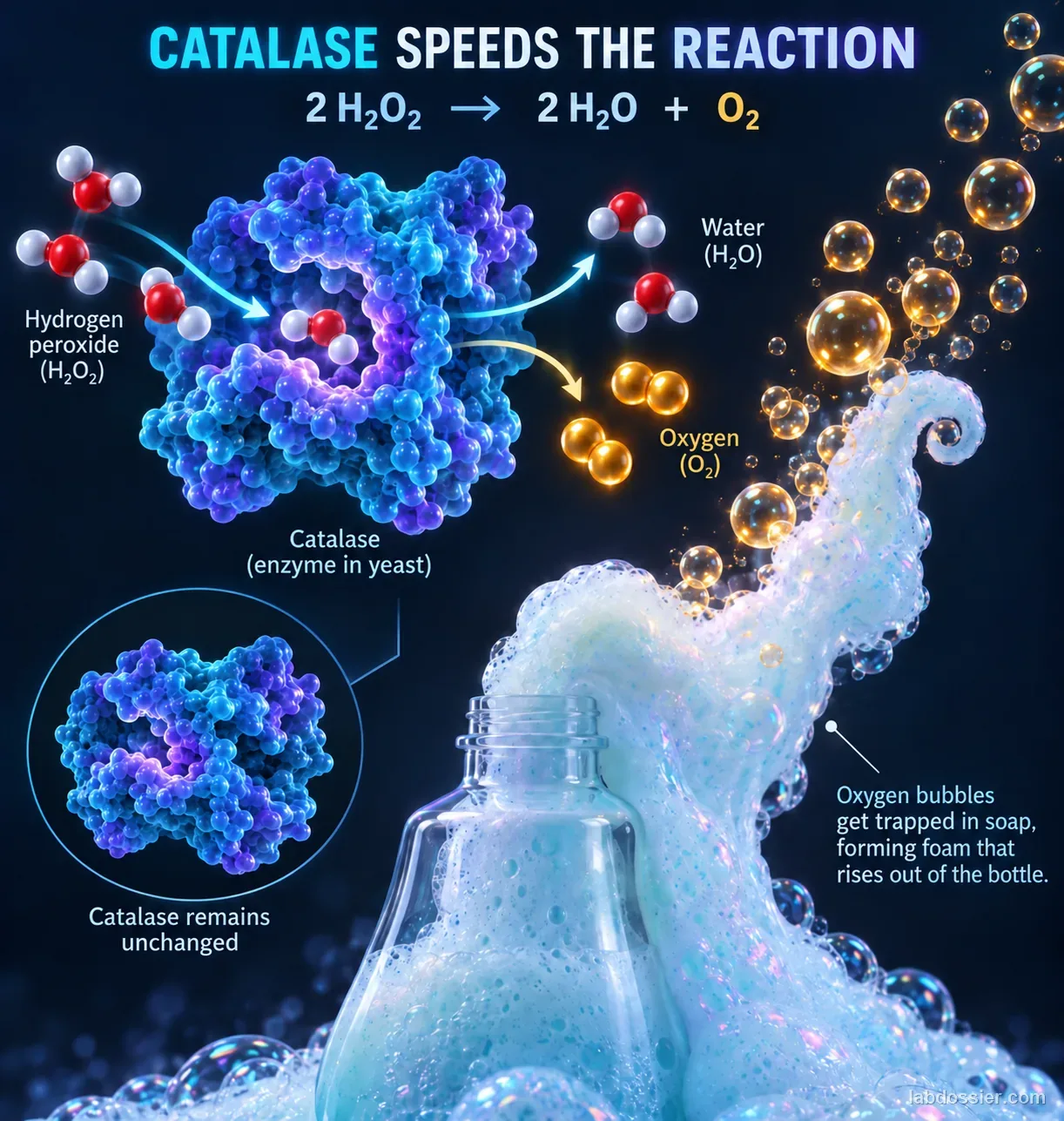
- Catalyst – A substance that speeds a reaction without being used up in the overall process.
- Catalase – An enzyme in yeast that speeds the breakdown of hydrogen peroxide.
- Reactant – A starting substance that takes part in a chemical reaction.
- Oxygen – A gas produced as hydrogen peroxide breaks down in this activity.
- Plateau – A point when a measured value stops increasing noticeably.
- Exothermic – Describes a process that releases heat to its surroundings.
Safety, cleanup and troubleshooting
BEFORE STUDENTS TOUCH ANYTHING
- Use only 3% household hydrogen peroxide, never stronger lab or salon peroxide. Wear goggles and work over a tray under adult supervision.
- The foam can be warm and overflow quickly. Keep the bottle open and hands, faces and eyes clear; do not touch, taste or call the foam real toothpaste.
- Wash hands after handling and follow adult cleanup directions.
Troubleshooting: If the foam overflows, keep hands and faces clear and let the adult manage the tray cleanup. If little foam forms, check that the yeast was mixed into warm water and that the 3% peroxide and soap were measured as planned; record the actual result rather than switching to stronger peroxide. Never cap the reacting bottle.