LF-02 · TEACHER LESSON PLAN
Gummy bear osmosis
How a gummy bear changes in water and salt solution
Driving question
Learning objectives
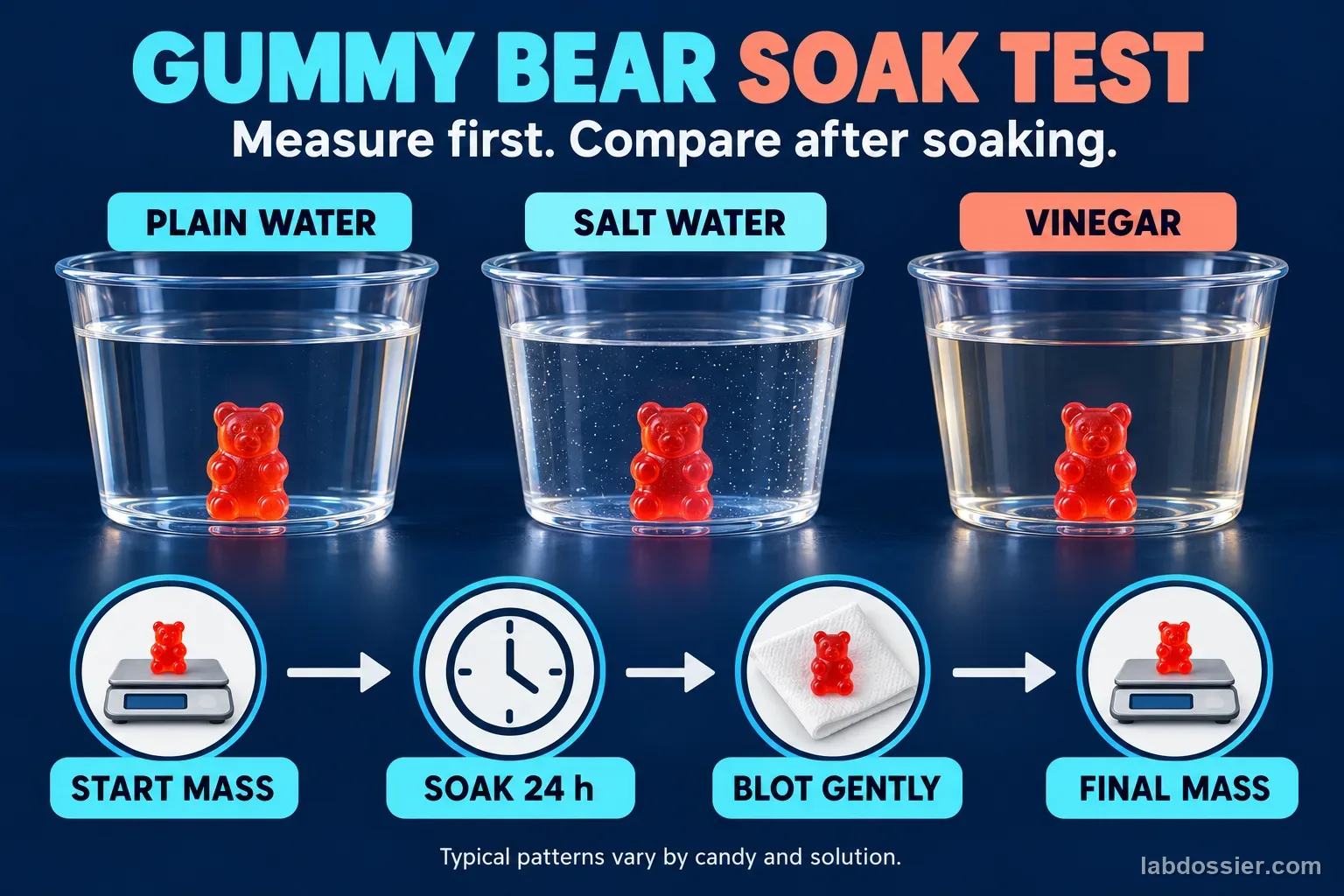
- Students prepare same-brand gummy bears in 100 mL each of distilled water, about 10% salt water and vinegar for a 24-hour soak.
- Students measure starting and final mass to 0.01 g, calculate mass and percent change, and compare each bear's size before and after soaking.
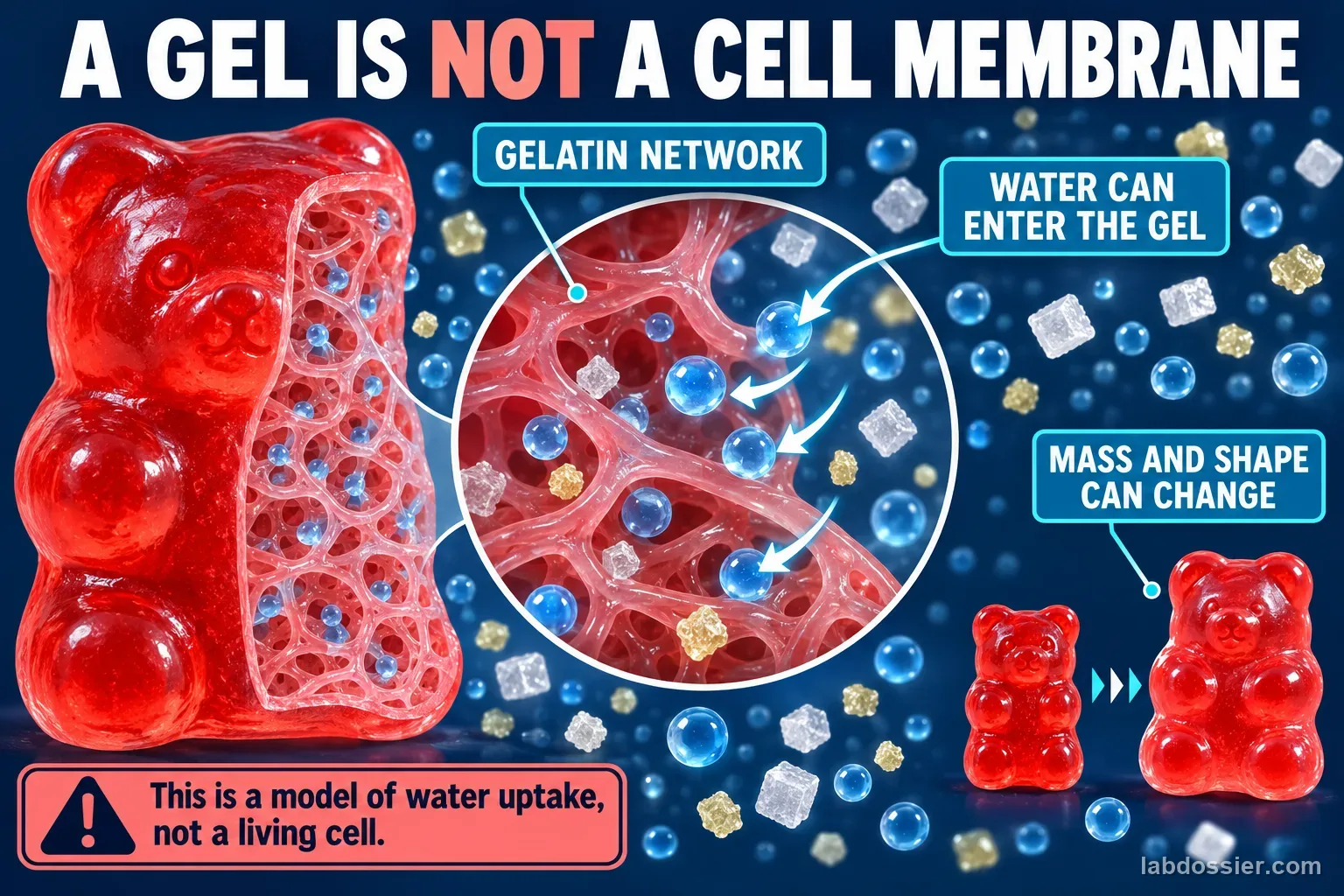
- Students model how water movement can change a gummy bear's mass while explaining why gelatin candy is only a limited model of a cell membrane.
Standards
| Dimension | Alignment |
|---|---|
| Performance expectation | MS-LS1-2Develop and use a model to describe the function of a cell as a whole and ways the parts of cells contribute to the function. (Partial alignment: this lab does not list a performance expectation; MS-LS1-2 is the closest match because a gelatin gummy bear is a limited model of how a membrane-bounded cell gains or loses water. Gummy bears have no living cell membrane, so the activity does not model cell parts.) |
| Practices | SEP 3Plan and carry out investigations. SEP 4Analyze and interpret data. |
| Core idea | LS1.AWithin cells, special structures are responsible for particular functions, and the cell membrane forms the boundary that controls what enters and leaves the cell. |
| Crosscutting | Structure and functionComplex and microscopic structures and systems can be visualized, modeled, and used to describe how their function depends on the relationships among its parts, therefore complex natural structures/systems can be analyzed to determine how they function. |
Standards text paraphrased from nextgenscience.org. Alignment is partial; this hands-on activity does not cover every part of the performance expectation.
State standards crosswalk
Use the row as a planning crosswalk, then confirm local district pacing and grade placement. “Partial” labels describe a skill connection, not full mastery of the complete standard.
| State | Verified standard | How this lesson aligns | Official source |
|---|---|---|---|
| California | CA NGSS MS-LS1-2 | Partial model connection. The bear's mass change can prompt a water-movement model, but gelatin candy has no cell membrane or cell parts and cannot demonstrate the whole-cell expectation. | Open standard ↗ |
| Texas | Science.8.13(A) | Limited model connection. The standard identifies cell-part functions, while a gummy bear has no membrane or organelles; use the candy only to discuss limits of a visible water-movement model. | Open standard ↗ |
| Florida | SC.6.L.14.4 | Partial model connection. This activity compares mass changes in candy rather than describing the structures and functions of the cell parts named by the benchmark. | Open standard ↗ |
| New York | NYSSLS MS-LS1-2 | Partial model connection. Students discuss water movement and model limits, but the candy has no living cell membrane and does not represent a whole cell or its parts. | Open standard ↗ |
| Pennsylvania | STEELS 3.1.6-8.B | Partial model connection. The measured candy response can support discussion of model limits, but it cannot show cell parts or the function of a living cell as a whole. | Open standard ↗ |
Materials and prep timeline
PER GROUP
- Three same-brand, same-color gummy bears
- Three labeled cups and a tray
- 100 mL each of distilled water, 10% salt solution and vinegar
- 10 g table salt and up to 100 mL extra distilled water to prepare the salt solution
- Balance readable to 0.01 g, ruler, spoon and paper towels
- Labels, timer and recording sheet
TEACHER ONLY
- Check ingredient labels for allergies and keep small candies away from young children. Students must not eat bears after soaking or handling them.
- For a 10% mass-per-volume salt solution, dissolve 10 g salt and add distilled water until the final solution volume is 100 mL. Use equal 100 mL liquid portions and room-temperature conditions.
- Place cups on a tray where they can remain undisturbed for 24 hours. Set teacher-directed disposal for salt water and vinegar, and provide handwashing supplies.
CLASS-SIZE KIT PLANNER
One per-group kit contains every item in the team materials list above. Groups are balanced around the listed 3–4 students target.
| Students | Groups | Per-group kits | Student sheets | Suggested group split |
|---|---|---|---|---|
| 20 | 6 | 6 complete kits | 20 copies | 2 groups of 4 and 4 groups of 3 |
| 25 | 7 | 7 complete kits | 25 copies | 4 groups of 4 and 3 groups of 3 |
| 30 | 8 | 8 complete kits | 30 copies | 6 groups of 4 and 2 groups of 3 |
Predict which liquid may cause the largest mass increase or loss. Label water, salt water and vinegar cups; review allergies, no tasting and handwashing.
Use same-brand bears, record each starting mass and longest length, add 100 mL of the assigned liquid per cup, then soak undisturbed for exactly 24 hours.
Use a spoon to lift each bear, blot all bears the same way and record final mass to 0.01 g and final length without squeezing the softened candy.
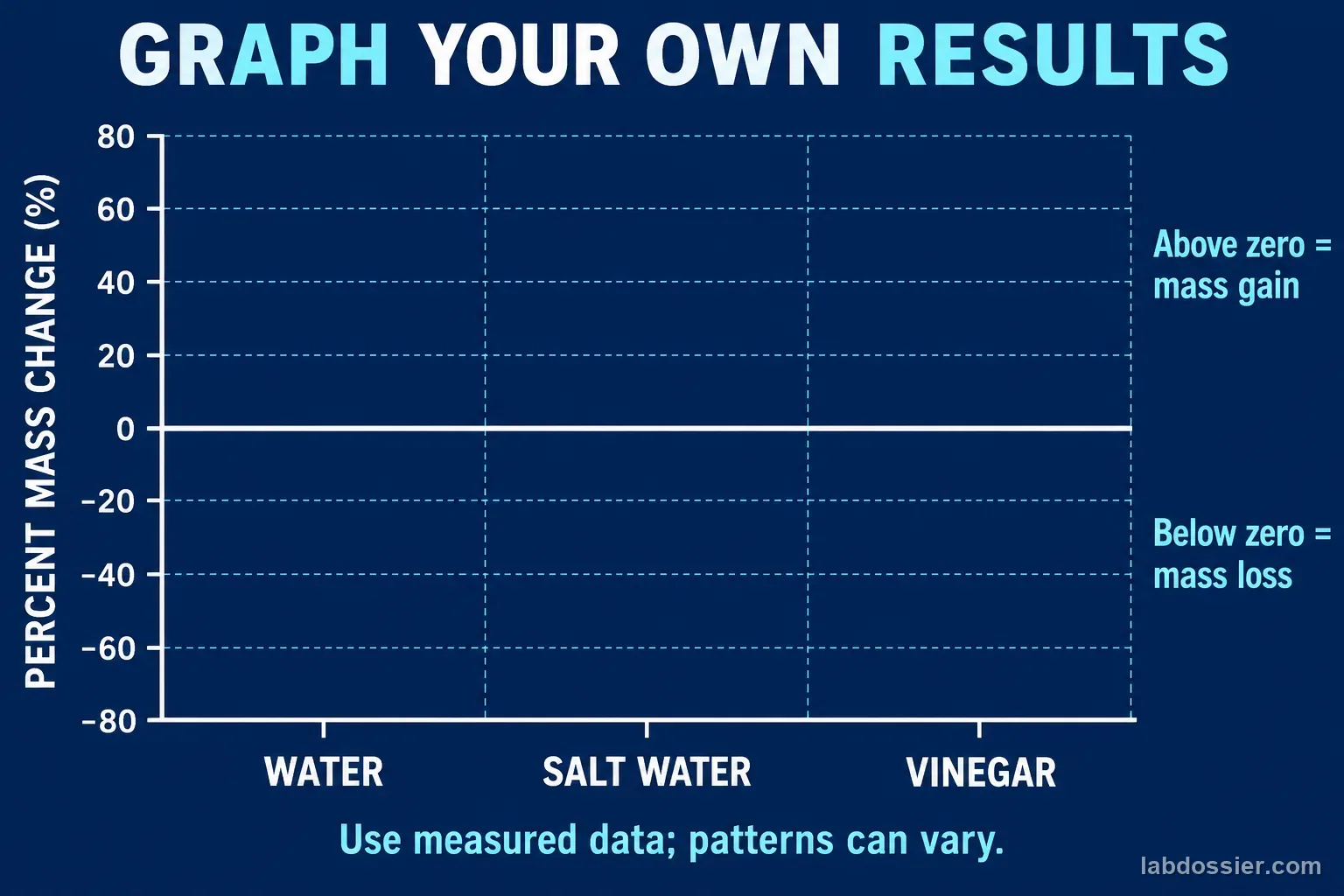
For each bear, calculate final minus starting mass and divide mass change by starting mass for percent change. Record size observations.
Compare all three liquids and discuss the model's limits, especially vinegar's effect on gelatin. Do not eat test bears; wash hands and dispose of liquids as directed.
Lab figures and data visuals
Reviewed article images support the lesson flow. Use the tables and student sheet to record actual observations; pictured patterns are not target results.
Printable shopping list
Shopping and staging checklist
Multiply the per-group kit contents by the class-size planner. The teacher section includes teacher-provided materials and setup or safety notes.
PER-GROUP KITS
- Three same-brand, same-color gummy bears
- Three labeled cups and a tray
- 100 mL each of distilled water, 10% salt solution and vinegar
- 10 g table salt and up to 100 mL extra distilled water to prepare the salt solution
- Balance readable to 0.01 g, ruler, spoon and paper towels
- Labels, timer and recording sheet
TEACHER-PROVIDED MATERIALS + SETUP RULES
- Check ingredient labels for allergies and keep small candies away from young children. Students must not eat bears after soaking or handling them.
- For a 10% mass-per-volume salt solution, dissolve 10 g salt and add distilled water until the final solution volume is 100 mL. Use equal 100 mL liquid portions and room-temperature conditions.
- Place cups on a tray where they can remain undisturbed for 24 hours. Set teacher-directed disposal for salt water and vinegar, and provide handwashing supplies.
QUANTITIES BY CLASS SIZE
| Material | Per group kit | 20 students | 25 students | 30 students |
|---|---|---|---|---|
| Same-brand gummy bears | 3 bears | 18 bears | 21 bears | 24 bears |
| Labeled cups and tray | 3 cups and 1 tray | 18 cups and 6 trays | 21 cups and 7 trays | 24 cups and 8 trays |
| Distilled water for control and brine prep | Up to 200 mL | 1.2 L | 1.4 L | 1.6 L |
| Prepared 10% salt solution, mass per volume | 100 mL | 600 mL | 700 mL | 800 mL |
| Table salt for 10% solution | 10 g | 60 g | 70 g | 80 g |
| Vinegar | 100 mL | 600 mL | 700 mL | 800 mL |
| Balance, ruler and spoon | 1 set | 6 sets | 7 sets | 8 sets |
| Labels, paper towels and timer | 1 set | 6 sets | 7 sets | 8 sets |
| Student data sheets | 1 per student | 20 copies | 25 copies | 30 copies |
Prepare 6 kits for 20 · 7 kits for 25 · 8 kits for 30 students.
Lesson flow
| Minutes | What happens |
|---|---|
| Day 1 setup — about 0–5 min | Engage Predict the liquid expected to change gummy-bear mass most. Label the three liquids and review allergies, no tasting and handwashing. |
| Day 1 setup — about 5–15 min | Explore Record starting mass and longest length for same-brand bears. Place one in each 100 mL liquid sample and leave the cups undisturbed for 24 hours. |
| Day 2 results — about 0–6 min | Explore Lift each bear with a spoon, blot in the same way and record final mass to 0.01 g and longest length without compressing it. |
| Day 2 results — about 6–12 min | Explain Calculate mass change and percent change from each bear's starting mass. Compare the size observations with the mass data. |
| Day 2 results — about 12–15 min | Evaluate Explain water movement and the limits of candy as a cell model. Do not eat test bears; wash hands and follow teacher directions for liquid disposal. |
Discussion questions
1. Why does a gummy bear usually gain mass in distilled water?
2. Why might salt water reduce the mass gain or make a bear lose mass?
3. Why can vinegar make a bear soft or partly dissolve it?
4. How is a gummy bear different from a cell?
Common misconceptions
Differentiation
SUPPORT
- Provide pre-labeled cups and a balance checklist for tare, starting mass, blotting and final mass.
- Use a calculator and a worked example for change = final − start and percent change = change ÷ start × 100.
- Offer the frame: “The bear in __ changed from __ g to __ g, a __% change; its length changed from __ to __ cm.”
EXTEND
- Repeat with additional bears from the same bag and compare the range of percent changes for each liquid.
- Measure width as well as longest length and explain why an irregular soft bear is difficult to size consistently.
- Test a second salt concentration while keeping liquid volume, bear type, room temperature and soak time at 24 hours.
Assessment rubric
| Criterion | Beginning | Developing | Secure |
|---|---|---|---|
| Matched soak | Does not label liquids or uses unmatched soak times. | Labels all liquids but misses equal volume or same-brand bears. | Uses same-brand bears in 100 mL samples and records a 24-hour soak in all three liquids. |
| Mass and size | Leaves starting or final measurements blank. | Records mass but omits units, consistent blotting or size observations. | Records start and final mass to 0.01 g, longest length in centimeters and consistent blotting. |
| Calculations | Does not calculate changes or uses the wrong starting value. | Calculates mass change or percent change but not both correctly. | Calculates final-minus-start mass and percent change using starting mass for each bear. |
| Explanation and safety | Treats the candy as a living cell or eats a test bear. | Explains water movement but ignores vinegar effects or allergy precautions. | Uses mass evidence, notes vinegar and model limits, avoids tasting and washes hands after handling. |
Vocabulary
- Osmosis – Net movement of water across a selectively permeable boundary.
- Solute – A substance dissolved in a liquid, such as sugar or salt.
- Concentration – The amount of dissolved substance in a stated amount of liquid or solution.
- Percent change – The change divided by the starting value, multiplied by 100.
- Model – A representation that helps explain a system but has limits.
- Gelatin – A protein material that forms the flexible network in gummy candy.
Safety, cleanup and troubleshooting
BEFORE STUDENTS TOUCH ANYTHING
- Do not eat gummy bears after they have been soaked or handled. Check ingredient labels for allergies and keep small candies away from young children who could choke.
- Use cups on a tray, clean spills promptly and wash hands after handling samples. Avoid splashes when pouring vinegar, and keep liquids away from eyes and mouths.
- Keep cups labeled and undisturbed for 24 hours. Dispose of salt solution and vinegar according to teacher directions; do not taste any liquid or sample.
Troubleshooting: If a bear tears or partly dissolves, especially in vinegar, record the observation and do not force it onto the balance. Blot each bear using the same gentle method; if it is too soft to handle, note the measurement as unavailable. Do not extend the soak past 24 hours, and discard all test bears as directed.