LF-28 · TEACHER LESSON PLAN
Invisible ink lab
How dried ink and paper respond to careful, moving warm air
Driving question
Learning objectives
- Students write the same short mark with lemon juice, milk and plain water on matched sheets for three trials, using a fresh swab for each liquid and one untreated reference per trial.
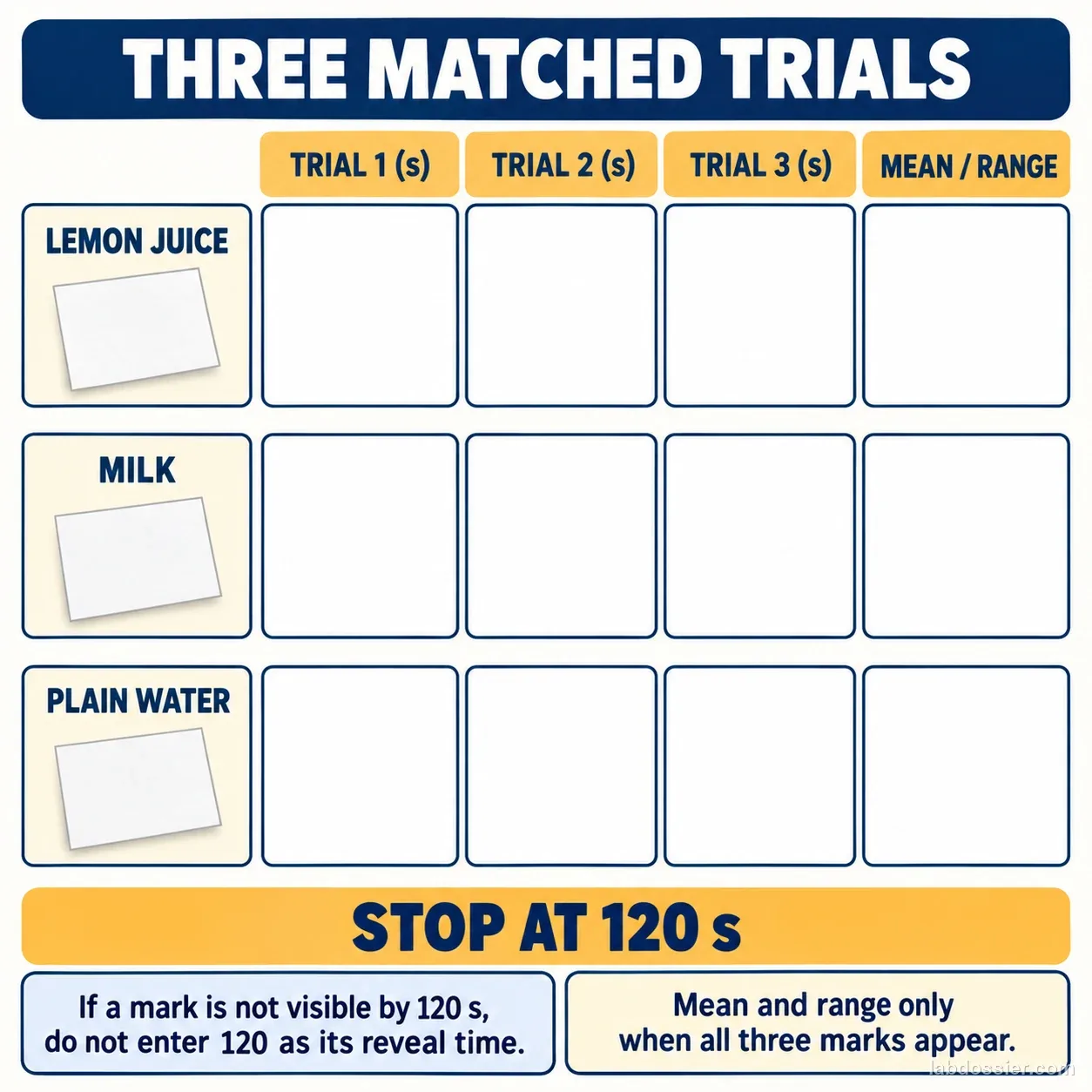
- Students measure three seconds-to-first-visible-contrast readings per liquid under the same adult-held warm air, stopping at 120 s, and rate darkness as light, medium or dark.
- Students explain why the dried marks can darken with heat, using the plain-water and untreated-paper checks to separate message-specific change from general browning.
Standards
| Dimension | Alignment |
|---|---|
| Performance expectation | MS-PS1-2Analyze and interpret data on the properties of substances before and after the substances interact to determine if a chemical reaction has occurred. (Partial alignment: this is the performance expectation the lab lists, but students compare how quickly different liquids darken when heated rather than comparing properties before and after a known reaction.) |
| Practices | SEP 6Construct explanations. |
| Core idea | PS1.BSubstances react chemically in characteristic ways. In a chemical process, the atoms that make up the original substances are regrouped into different molecules, and these new substances have different properties from those of the reactants. |
| Crosscutting | PatternsMacroscopic patterns are related to the nature of microscopic and atomic-level structure. |
Standards text paraphrased from nextgenscience.org. Alignment is partial; this hands-on activity does not cover every part of the performance expectation.
State standards crosswalk
Use the row as a planning crosswalk, then confirm local district pacing and grade placement. “Partial” labels describe a skill connection, not full mastery of the complete standard.
| State | Verified standard | How this lesson aligns | Official source |
|---|---|---|---|
| California | CA NGSS MS-PS1-2 | Partial. Students compare visible properties after heating, but do not analyze the standard's full set of properties before and after a known interaction. | Open standard ↗ |
| Texas | Science.7.6(C) | Partial. Students discuss a possible chemical change during heating, but do not systematically distinguish reversible and irreversible changes across examples. | Open standard ↗ |
| Florida | SC.8.P.9.2 | Partial. The comparison can support distinguishing physical from chemical change, but heat-darkening observations alone do not identify the mechanism for every ink. | Open standard ↗ |
| New York | MS-PS1-2 | Partial. Students compare heated marks and controls, but do not analyze all listed properties before and after a defined reaction. | Open standard ↗ |
| Pennsylvania | 3.2.6-8.D | Limited. The lesson observes possible change but does not analyze substance properties before and after interaction to determine whether a reaction occurred. | Open standard ↗ |
Materials and prep timeline
PER GROUP
- Nine same-size sheets for three repeats of lemon juice, milk and plain water, plus three untreated reference sheets
- Small labeled cups with lemon juice, milk and plain water
- Three fresh cotton swabs, one per liquid
- Pencil labels, stopwatch or timer, goggles
- Heatproof tile or tray to hold one matched set during each reveal
TEACHER ONLY
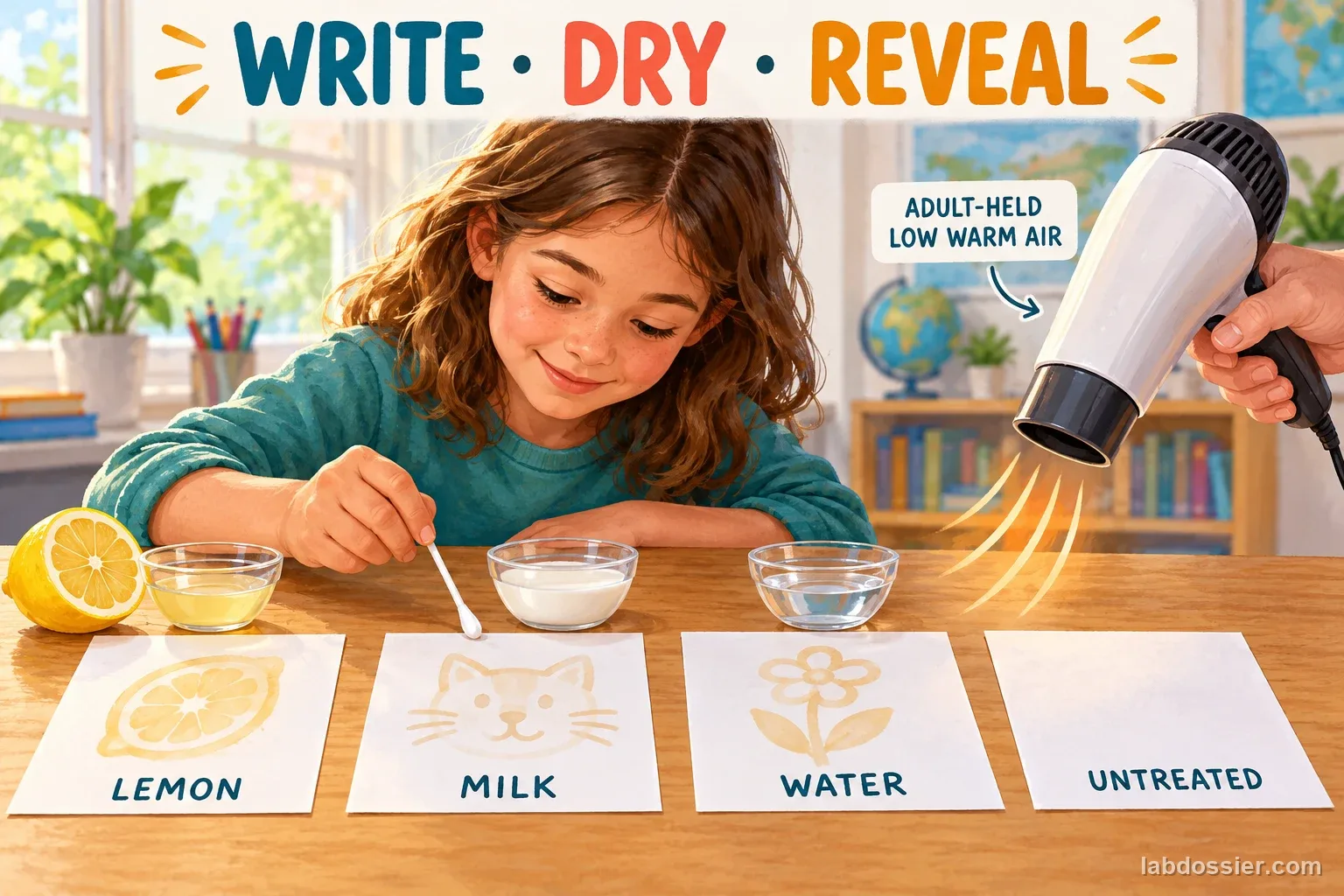
- Run the heat yourself: move a low-setting hair dryer at the same safe distance over each sheet. Never use an iron, candle, match, stovetop or open flame.
- Dry sheets away from direct sunlight so the message does not partly reveal before the test; keep water away from the dryer and let it cool before storage.
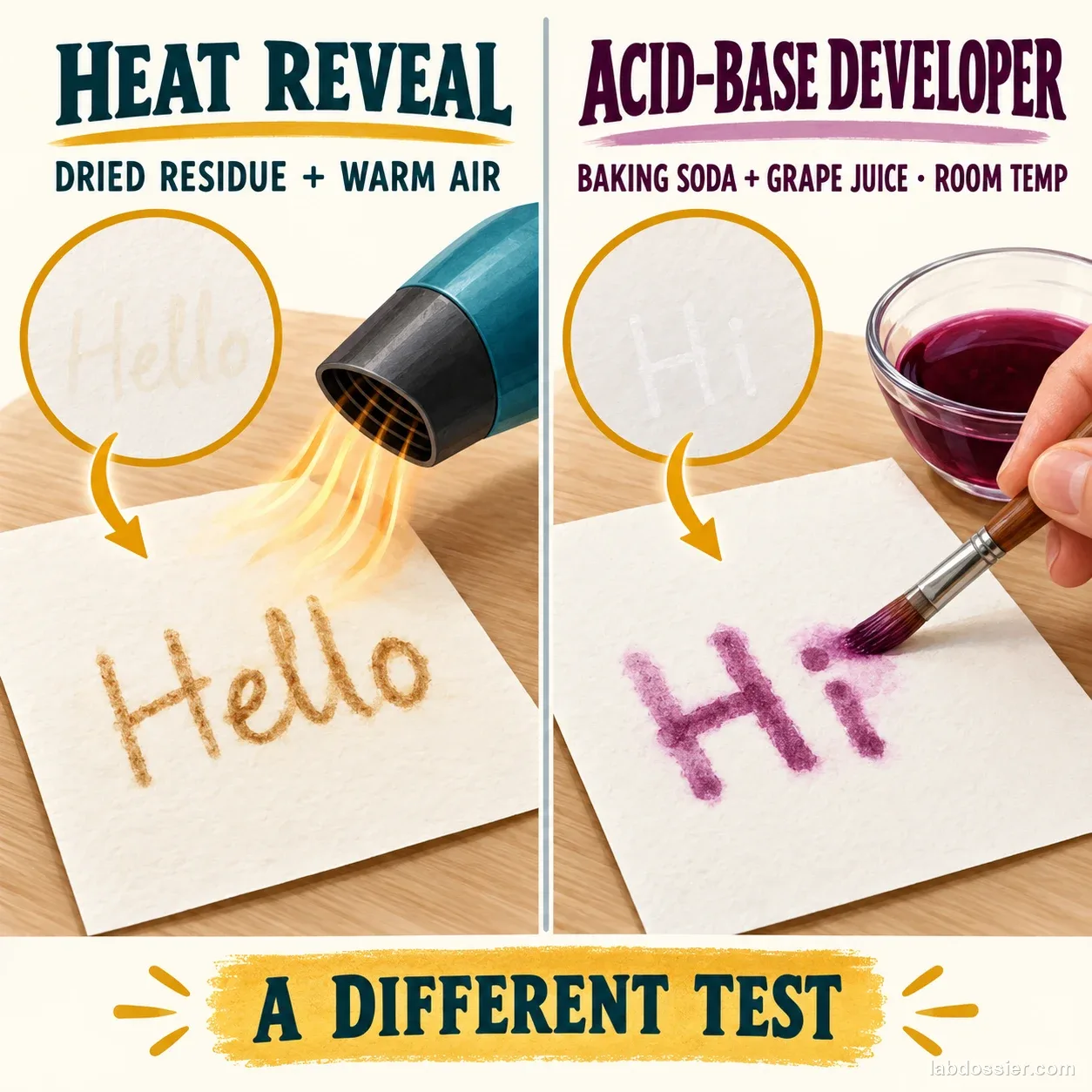
- Use only these three labeled liquids in the timed heat comparison. Stop if a sheet browns unevenly, smokes or scorches. Keep any baking-soda/grape-juice extension at room temperature and separate.
CLASS-SIZE KIT PLANNER
One per-group kit contains every item in the team materials list above. Groups are balanced around the listed 3–4 students; an adult runs the heat target.
| Students | Groups | Per-group kits | Student sheets | Suggested group split |
|---|---|---|---|---|
| 20 | 5 | 5 complete kits | 20 copies | 5 groups of 4 |
| 25 | 7 | 7 complete kits | 25 copies | 4 groups of 4 and 3 groups of 3 |
| 30 | 8 | 8 complete kits | 30 copies | 6 groups of 4 and 2 groups of 3 |
Predict how the three liquids may differ. Confirm only the adult handles the low-setting dryer and nobody tastes the materials.
Write the same short mark on three equal sheets per liquid, using the same measured amount and a fresh swab for each liquid. Label three untreated reference sheets.
Let each marked sheet dry away from sunlight until the writing is invisible. Set up the heatproof station and timer while waiting.
The adult heats one matched set at a time with low moving air at one distance. Record the time and darkness for each mark; stop at 120 seconds or earlier if paper browns or smokes.
Compare the three marks with water and untreated paper; describe background browning and the limits of this test. Let the dryer cool and clean up.
Lab figures and data visuals
Reviewed article images support the lesson flow. Use the tables and student sheet to record actual observations; pictured patterns are not target results.
Printable shopping list
Shopping and staging checklist
Multiply the per-group kit contents by the class-size planner. The teacher section includes teacher-provided materials and setup or safety notes.
PER-GROUP KITS
- Nine same-size sheets for three repeats of lemon juice, milk and plain water, plus three untreated reference sheets
- Small labeled cups with lemon juice, milk and plain water
- Three fresh cotton swabs, one per liquid
- Pencil labels, stopwatch or timer, goggles
- Heatproof tile or tray to hold one matched set during each reveal
TEACHER-PROVIDED MATERIALS + SETUP RULES
- Run the heat yourself: move a low-setting hair dryer at the same safe distance over each sheet. Never use an iron, candle, match, stovetop or open flame.
- Dry sheets away from direct sunlight so the message does not partly reveal before the test; keep water away from the dryer and let it cool before storage.
- Use only these three labeled liquids in the timed heat comparison. Stop if a sheet browns unevenly, smokes or scorches. Keep any baking-soda/grape-juice extension at room temperature and separate.
QUANTITIES BY CLASS SIZE
| Material | Per group kit | 20 students | 25 students | 30 students |
|---|---|---|---|---|
| Matched writing sheets: nine marked plus three untreated references | 12 sheets | 60 sheets | 84 sheets | 96 sheets |
| Lemon juice | 15 mL | 75 mL | 105 mL | 120 mL |
| Milk | 15 mL | 75 mL | 105 mL | 120 mL |
| Plain water | 15 mL | 75 mL | 105 mL | 120 mL |
| Cotton swabs and labeled cups | 3 of each | 15 of each | 21 of each | 24 of each |
| Student recording sheets | 1 per student | 20 sheets | 25 sheets | 30 sheets |
| Shared teacher heat station | 1 low-setting hair dryer and heatproof tile per class | 1 station | 1 station | 1 station |
Prepare 5 kits for 20 · 7 kits for 25 · 8 kits for 30 students.
Lesson flow
| Minutes | What happens |
|---|---|
| 0–5 min | Engage Predict how the three liquids may differ and review adult-only low-heat rules. |
| 5–12 min | Explore Write three matched sets of lemon, milk and water marks with fresh swabs; add one untreated reference to each set. |
| 12–22 min | Explore Dry all marked sheets away from sunlight while preparing the heatproof station. |
| 22–35 min | Explain The adult moves low warm air over one matched set at a time. Record all three trials per liquid, stopping each set at 120 seconds or earlier if paper scorches. |
| 35–45 min | Evaluate Compare with plain water and untreated paper; explain why baking soda and grape juice would be a separate room-temperature reveal. |
Discussion questions
1. Why can a dried mark be invisible and then appear?
2. What do the plain-water sheet and the untreated sheet tell you?
3. How should students use a mark that did not appear by 120 seconds?
4. Why is baking soda not part of the timed heat test?
5. Why is this not a secure way to hide a message?
Common misconceptions
Differentiation
SUPPORT
- Pre-label three matched sets and one untreated reference per set with pencil on the back.
- Give a three-picture darkness card (light, medium, dark) so groups rate marks consistently.
- Offer the frame: “Across three trials, ___ appeared in ___ of them; the untreated check ___.”
EXTEND
- Add a second paper type and compare reveal times while keeping liquid and heat matched.
- Demonstrate a separate baking-soda mark with grape-juice developer at room temperature; compare it qualitatively, not in the heat-time chart.
- Photograph each sheet with the same camera settings before and after heating and compare contrast instead of only using a three-level rating.
Assessment rubric
| Criterion | Beginning | Developing | Secure |
|---|---|---|---|
| Fair setup | Uses different paper or reuses a swab between liquids. | Matches most conditions but omits the untreated sheet or drying time. | Uses the same paper, a fresh swab per liquid, equal amount, complete drying and an untreated sheet. |
| Measurements | Leaves trial readings blank. | Records some times but omits units or the 120 s limit. | Records all three seconds-to-first-visible readings and darkness ratings, marks no-appearance by 120 s, and summarizes only complete sets. |
| Evidence and explanation | Claims a winner without citing the data. | Uses the times but ignores the water and untreated checks. | Uses times, darkness and both checks to explain the reveal as residue and paper darkening with heat, noting limits. |
| Heat safety | Handles the heat source or holds paper still against it. | Keeps distance but needs reminders to keep the paper or dryer moving. | Leaves heat to the adult, keeps the dryer moving at a fixed distance and stops before scorching, smoke or tasting. |
Vocabulary
- Residue – A thin layer of material left on paper after the liquid dries.
- Organic compound – A carbon-containing substance, such as those in lemon juice and milk, that can darken when heated.
- Oxidation – A chemical change in which a substance reacts with oxygen; one way a dried residue can darken.
- Control sample – A comparison sheet, here plain water or untreated paper, treated the same way but without the test liquid.
- Acid – A substance such as lemon juice that tastes sour and can change how paper browns.
- Chemical change – A change that forms new substances, such as the brown color that cannot be reversed.
Safety, cleanup and troubleshooting
BEFORE STUDENTS TOUCH ANYTHING
- Heat sources can burn skin or scorch paper into flame if held too close: an adult handles the heat source and keeps the paper moving, never held still against it.
- Use only a moving hair dryer on a low setting, kept away from the paper, and stop before the page browns or smokes. Never use candles, matches, irons, stovetops or open flames.
- Let the writing dry completely and out of direct sunlight, or it may partly reveal itself before the heating step.
- Do not taste the lemon-juice writing; keep the warm-air tool away from water and let it cool before storage. Wear goggles during the reveal.
Troubleshooting: If the mark never appears, check that the sheet dried completely and that the warm air was at the same distance; record “none visible by 120 s” instead of heating longer. If a sheet starts to brown unevenly or smoke, stop at once and let the adult move the heat away.