LF-16 · TEACHER LESSON PLAN
Homemade lava lamp lab
Why oil and water separate, and what makes the bubbles rise and fall
Driving question
Learning objectives
- Students build a stable oil-and-colored-water column in a clear plastic bottle and wait for the liquids to separate before adding a tablet piece.
- Students measure visible bubbling duration three times each for 1/4, 1/2 and one tablet, then compare the mean and range.
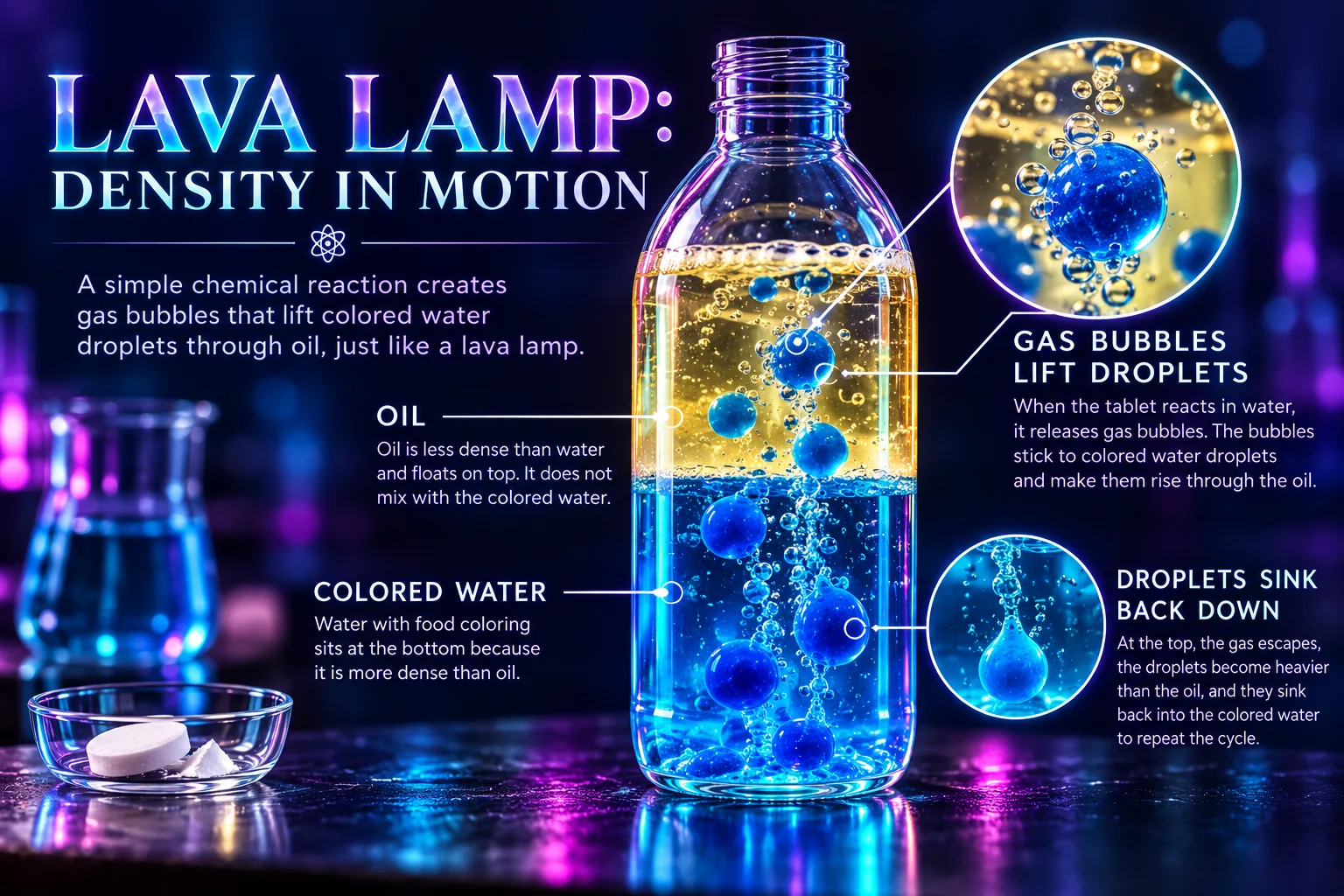
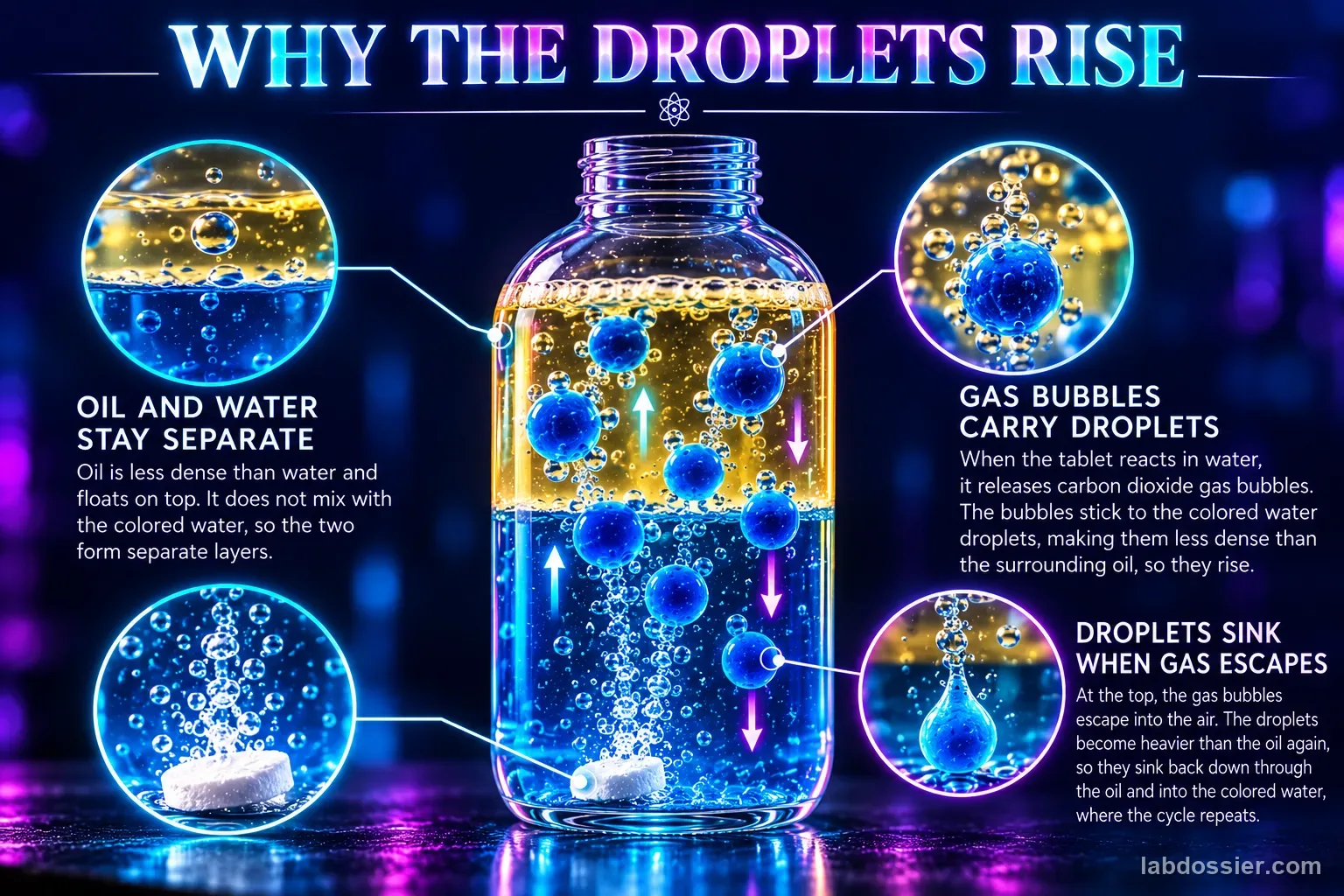
- Students explain how carbon dioxide bubbles can carry colored water through oil and why the layers separate when the gas escapes.
Standards
| Dimension | Alignment |
|---|---|
| Performance expectation | MS-PS1-1Develop models to describe the atomic composition of simple molecules and extended structures. (Partial alignment: this is the performance expectation the lab lists, but the activity investigates liquids that do not mix and gas bubbles carrying colored liquid rather than building atomic models.) |
| Practices | SEP 4Analyze and interpret data. |
| Core idea | PS1.AEach pure substance has characteristic physical and chemical properties (for any bulk quantity under given conditions) that can be used to identify it. |
| Crosscutting | Cause and effectCause and effect relationships are routinely identified, tested, and used to explain change. |
Standards text paraphrased from nextgenscience.org. Alignment is partial; this hands-on activity does not cover every part of the performance expectation. CCC wording not independently verified.
State standards crosswalk
Use the row as a planning crosswalk, then confirm local district pacing and grade placement. “Partial” labels describe a skill connection, not full mastery of the complete standard.
| State | Verified standard | How this lesson aligns | Official source |
|---|---|---|---|
| California | CA NGSS 5-PS1-4 | Partial. Students observe gas released during the tablet trial, but do not use before-and-after evidence to determine whether combinations of substances form new substances as the expectation requires. | Open standard ↗ |
| Texas | Science.4.6(B) | Partial. Students compare oil and water as a liquid mixture, but do not investigate the broader variety of mixtures named by the expectation. | Open standard ↗ |
| Florida | SC.5.P.8.2 | Limited. Students observe oil and water remaining in separate layers, but do not compare a range of materials that dissolve or the conditions that change dissolving rate. | Open standard ↗ |
| New York | MS-PS1-8 | Partial. The lesson observes a physical oil-water mixture, but does not investigate separating a mixture by evaporation, filtration, or magnetism. | Open standard ↗ |
| Pennsylvania | 3.2.5.B | Limited. Students observe layers and bubble motion, but do not use the full set of material properties to identify unknown samples. | Open standard ↗ |
Materials and prep timeline
PER GROUP
- Nine matching clear plastic bottles (250 mL or larger)
- 450 mL water and 900 mL vegetable oil
- Food coloring, same measured amount per bottle
- Effervescent tablets: three 1/4, three 1/2 and three whole-tablet portions
- Timer, labels, measuring tools, data sheet, tray and eye protection
TEACHER ONLY
- Measure the same oil, water and food-coloring amounts in each trial; use one bottle size and one tablet brand.
- Use clear plastic bottles upright on a tray. Point them away from faces while adding a tablet. Never cap a reacting bottle, even loosely; gas pressure can build.
- Provide eye protection and a container for oily liquid disposal. Students must not drink the mixture or pour oil-containing liquid down a drain.
CLASS-SIZE KIT PLANNER
One per-group kit contains every item in the team materials list above. Groups are balanced around the listed 3–4 students target.
| Students | Groups | Per-group kits | Student sheets | Suggested group split |
|---|---|---|---|---|
| 20 | 5 | 5 complete kits | 20 copies | 5 groups of 4 |
| 25 | 7 | 7 complete kits | 25 copies | 4 groups of 4 and 3 groups of 3 |
| 30 | 8 | 8 complete kits | 30 copies | 6 groups of 4 and 2 groups of 3 |
Identify tablet amount as the change and duration as the measurement. Review goggles, no drinking, keeping bottles upright and open, and keeping faces clear.
Label three bottles for each amount. Add 50 mL colored water and 100 mL oil to every bottle. Wait until the layers settle.
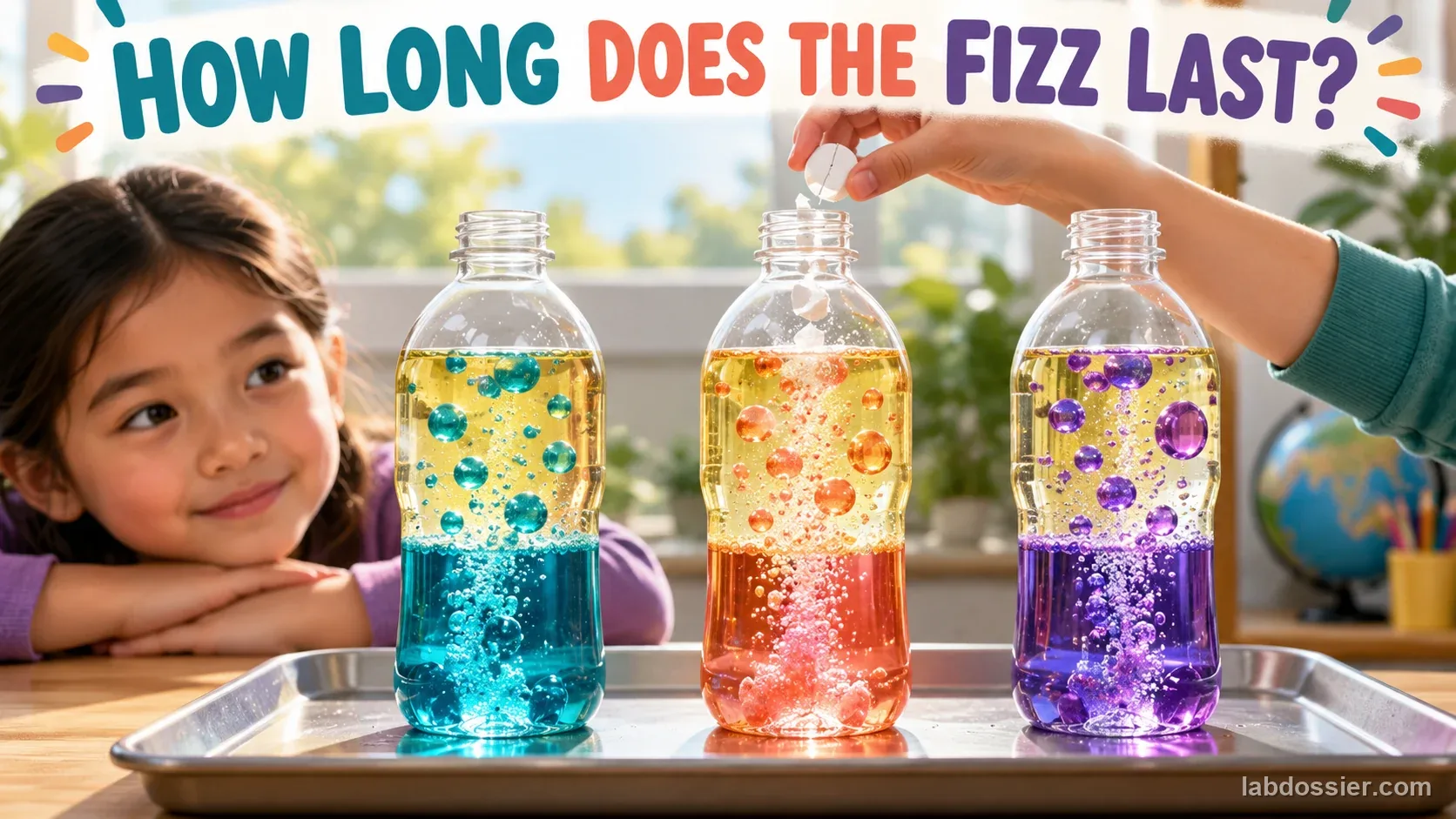
Test 1/4 tablet, 1/2 tablet and one tablet in three fresh bottles per amount. Start when each tablet contacts water; stop after no new bubbles appear for 10 seconds. Record all nine durations.
Calculate each amount's mean and range. Describe the measured result without assuming more tablet must mean longer bubbling.
Explain how bubbles carry colored water through oil. Keep mixtures for teacher-directed disposal; do not pour oil-containing liquid down a drain.
Lab figures and data visuals
Reviewed article images support the lesson flow. Use the tables and student sheet to record actual observations; pictured patterns are not target results.
Printable shopping list
Shopping and staging checklist
Multiply the per-group kit contents by the class-size planner. The teacher section includes teacher-provided materials and setup or safety notes.
PER-GROUP KITS
- Nine matching clear plastic bottles (250 mL or larger)
- 450 mL water and 900 mL vegetable oil
- Food coloring, same measured amount per bottle
- Effervescent tablets: three 1/4, three 1/2 and three whole-tablet portions
- Timer, labels, measuring tools, data sheet, tray and eye protection
TEACHER-PROVIDED MATERIALS + SETUP RULES
- Measure the same oil, water and food-coloring amounts in each trial; use one bottle size and one tablet brand.
- Use clear plastic bottles upright on a tray. Point them away from faces while adding a tablet. Never cap a reacting bottle, even loosely; gas pressure can build.
- Provide eye protection and a container for oily liquid disposal. Students must not drink the mixture or pour oil-containing liquid down a drain.
QUANTITIES BY CLASS SIZE
| Material | Per group kit | 20 students | 25 students | 30 students |
|---|---|---|---|---|
| Clear plastic bottles, three fresh trials per tablet amount | 9 bottles | 45 bottles | 63 bottles | 72 bottles |
| Vegetable oil, 100 milliliters per bottle | 900 milliliters | 4.5 liters | 6.3 liters | 7.2 liters |
| Water, 50 milliliters per bottle | 450 milliliters | 2.25 liters | 3.15 liters | 3.6 liters |
| Food coloring, same measured amount per bottle | 9 portions | 45 portions | 63 portions | 72 portions |
| Effervescent tablets (three each of 1/4, 1/2 and 1 whole) | 5.25 tablets | 27 tablets | 37 tablets | 42 tablets |
| Trays, timers, labels, eye protection, and data sheets | 1 set per group; sheet per student | 5 sets; 20 sheets | 7 sets; 25 sheets | 8 sets; 30 sheets |
Prepare 5 kits for 20 · 7 kits for 25 · 8 kits for 30 students.
Lesson flow
| Minutes | What happens |
|---|---|
| 0–4 min | Engage Predict how tablet amount may affect duration. Review goggles, no drinking, upright bottles, face direction and open tops. |
| 4–10 min | Explore Prepare nine matched open bottles with 50 mL colored water and 100 mL oil each; wait for settled layers. |
| 10–25 min | Explore Run three fresh trials at each amount. Start at tablet-water contact and stop after 10 seconds without new bubbles; keep all nine results. |
| 25–30 min | Explain Compare the mean and range for each amount; explain that tablet amount and dissolving rate may both affect duration. |
| 30–35 min | Evaluate Explain how bubbles lift colored water through oil. Do not drink; give oil-containing liquid to the teacher for disposal. |
Discussion questions
1. Why does colored water rise through oil during bubbling?
2. Why do oil and water form separate layers?
3. Does a whole tablet always bubble for longer than a quarter tablet?
4. Why must the bottle stay open?
Common misconceptions
Differentiation
SUPPORT
- Color-code nine open bottles in three groups of three before adding liquids.
- Assign one student to time, one to watch the endpoint, and one to record the nine durations.
- Offer the frame: “The mean for __ tablet was __ seconds; the range was __ to __ seconds.”
EXTEND
- Repeat one tablet amount in a second matched bottle and compare its duration with the first trial.
- Count how many colored droplets complete an upward-and-downward cycle during a fixed observation period.
- Compare water temperature in a follow-up while keeping tablet amount, oil and water volumes, bottle and tablet brand constant.
Assessment rubric
| Criterion | Beginning | Developing | Secure |
|---|---|---|---|
| Matched liquid setup | Uses different bottles or liquid amounts without recording them. | Builds oil and water layers but leaves a key condition unmatched. | Uses the same clear plastic bottle size, oil, colored-water and dye amounts, and tablet brand for all portions. |
| Observations | Leaves most measurements blank. | Records some durations but omits units or repeats. | Records all three durations per amount in seconds using the same 10-second endpoint rule. |
| Data interpretation | Claims a pattern without comparing amounts. | Compares single trials or assumes the biggest piece must last longest. | Compares mean and range for all three repeats and explains how amount and dissolution rate may both affect bubbling. |
| Explanation and safety | Says oil and water mix or drinks the sample. | Explains some bubble movement but omits the open bottle or disposal rule. | Explains bubble transport and layer separation, keeps bottle open and directs oily mixture to teacher disposal rather than the drain. |
Vocabulary
- Effervescent – Releasing bubbles of gas when a tablet reacts in water.
- Carbon dioxide – A gas produced by the antacid tablet's reaction in water.
- Density – Mass divided by volume; water is denser than vegetable oil in this setup.
- Immiscible – Unable to mix into a single uniform liquid layer.
- Dissolve – When particles spread through a liquid to form a solution.
- Buoyancy – The upward support a fluid gives an immersed object or droplet.
Safety, cleanup and troubleshooting
BEFORE STUDENTS TOUCH ANYTHING
- Do not drink the oil, water, dye or tablet mixture. Wear eye protection and keep the bottle upright and pointed away from faces while adding tablet pieces.
- Use clear plastic bottles on a tray. Keep every bottle uncapped during the reaction; never cap one, even loosely, because gas pressure can build up.
- Keep the setup stable and give oil-containing liquid to the teacher for disposal rather than pouring it down a drain.
Troubleshooting: If layers have not separated, wait before adding a tablet. If bubbling splashes, keep faces clear and let the bottle stand open and upright on its tray. Do not cap it to preserve the effect. Wipe spills and collect the oil-containing liquid for the teacher; never send it down a sink drain.