LF-19 · TEACHER LESSON PLAN
Oobleck non-Newtonian fluid lab
How this cornstarch suspension responds to gentle sinking and quick force
Driving question
Learning objectives
- Students prepare fresh mixtures at 1:1, 1.5:1 and 2:1 cornstarch-to-water ratios using the same measuring method and stirring time.
- Students measure three five-second marble depths in separate spots of each batch, then calculate a mean and range; log one separate qualitative tap observation.
- Students explain how a cornstarch suspension can resist rapid force yet flow under gentle force, without treating it as a pure substance.
Standards
| Dimension | Alignment |
|---|---|
| Performance expectation | MS-PS1-1Develop models to describe the atomic composition of simple molecules and extended structures. (Partial alignment: this is the performance expectation the lab lists, but the activity investigates a suspension that behaves differently under slow and fast force rather than building atomic models.) |
| Practices | SEP 4Analyze and interpret data. |
| Core idea | PS1.AEach pure substance has characteristic physical and chemical properties (for any bulk quantity under given conditions) that can be used to identify it. |
| Crosscutting | Cause and effectCause and effect relationships are routinely identified, tested, and used to explain change. |
Standards text paraphrased from nextgenscience.org. Alignment is partial; this hands-on activity does not cover every part of the performance expectation. CCC wording not independently verified.
State standards crosswalk
Use the row as a planning crosswalk, then confirm local district pacing and grade placement. “Partial” labels describe a skill connection, not full mastery of the complete standard.
| State | Verified standard | How this lesson aligns | Official source |
|---|---|---|---|
| California | CA NGSS 5-PS1-3 | Partial. Students measure a material response, but this standard concerns identifying materials by their properties; it does not assess how a cornstarch suspension responds to force speed. | Open standard ↗ |
| Texas | Science.5.6(B) | Limited. Oobleck is a mixture, but this investigation measures its response to gentle and quick force rather than demonstrating that a mixture's ingredients maintain their separate physical properties. | Open standard ↗ |
| Florida | SC.8.P.8.4 | Partial. Students observe a physical response of a suspension, but they do not classify samples using the standard's full set of characteristic properties. | Open standard ↗ |
| New York | NYSSLS MS-PS1-8 | Partial. The activity investigates a cornstarch-water mixture, but it does not demonstrate the full range of mixture separation or analysis described by the standard. | Open standard ↗ |
| Pennsylvania | STEELS 3.2.2.A | Partial. Students investigate observable properties of a mixture, while the grade-two expectation is a simpler material-classification task and does not address non-Newtonian behavior. | Open standard ↗ |
Materials and prep timeline
PER GROUP
- Cornstarch and water measured by volume: 75 + 75 mL, 90 + 60 mL, and 100 + 50 mL for 1:1, 1.5:1 and 2:1 ratios
- Three identical wide shallow trays for 150 mL batches
- Same clean marble, millimeter ruler and timer
- Stirring spoons, ratio labels and recording sheet
- Covered table, scraper and waste container for drying mixture
TEACHER ONLY
- Measure each ratio with the same volume method and stir each batch for the same time until no dry pockets remain.
- Mark three separated untouched spots in each tray. Use the same clean marble, gently place it, and measure from the original surface to its lowest point at exactly five seconds. Retrieve it and repeat at the next spot; record every reading and any bottom limit. These repeated spots share one batch and are not independent recipe preparations.
- After depth readings, use a separate spot for one quick tap with the same tool. Keep this qualitative observation separate from the slow marble measure. Keep all mixture out of sinks and drains; scrape it into waste to dry, then discard the solid. Do not eat the mixture.
CLASS-SIZE KIT PLANNER
One per-group kit contains every item in the team materials list above. Groups are balanced around the listed 3–4 students target.
| Students | Groups | Per-group kits | Student sheets | Suggested group split |
|---|---|---|---|---|
| 20 | 6 | 6 complete kits | 20 copies | 2 groups of 4 and 4 groups of 3 |
| 25 | 7 | 7 complete kits | 25 copies | 4 groups of 4 and 3 groups of 3 |
| 30 | 8 | 8 complete kits | 30 copies | 6 groups of 4 and 2 groups of 3 |
Predict how increasing the cornstarch-to-water ratio may affect a gently placed marble. Review the covered tray and strict no-drain disposal rule.
Measure 1:1, 1.5:1 and 2:1 cornstarch-to-water batches into matching containers. Stir each for the same time until no dry pockets remain.
Use the same clean marble in three separate spots per ratio. Measure the depth below the original surface at exactly five seconds and keep all nine readings. Mark any result limited by the tray bottom.
Use one untouched spot per ratio and the same tool for one quick tap. Record the observation without treating this as a measured force.
Calculate each batch's mean and range, compare with its tap note, and explain the limitations of repeated spots from one batch. Scrape mixture into waste rather than the drain.
Lab figures and data visuals
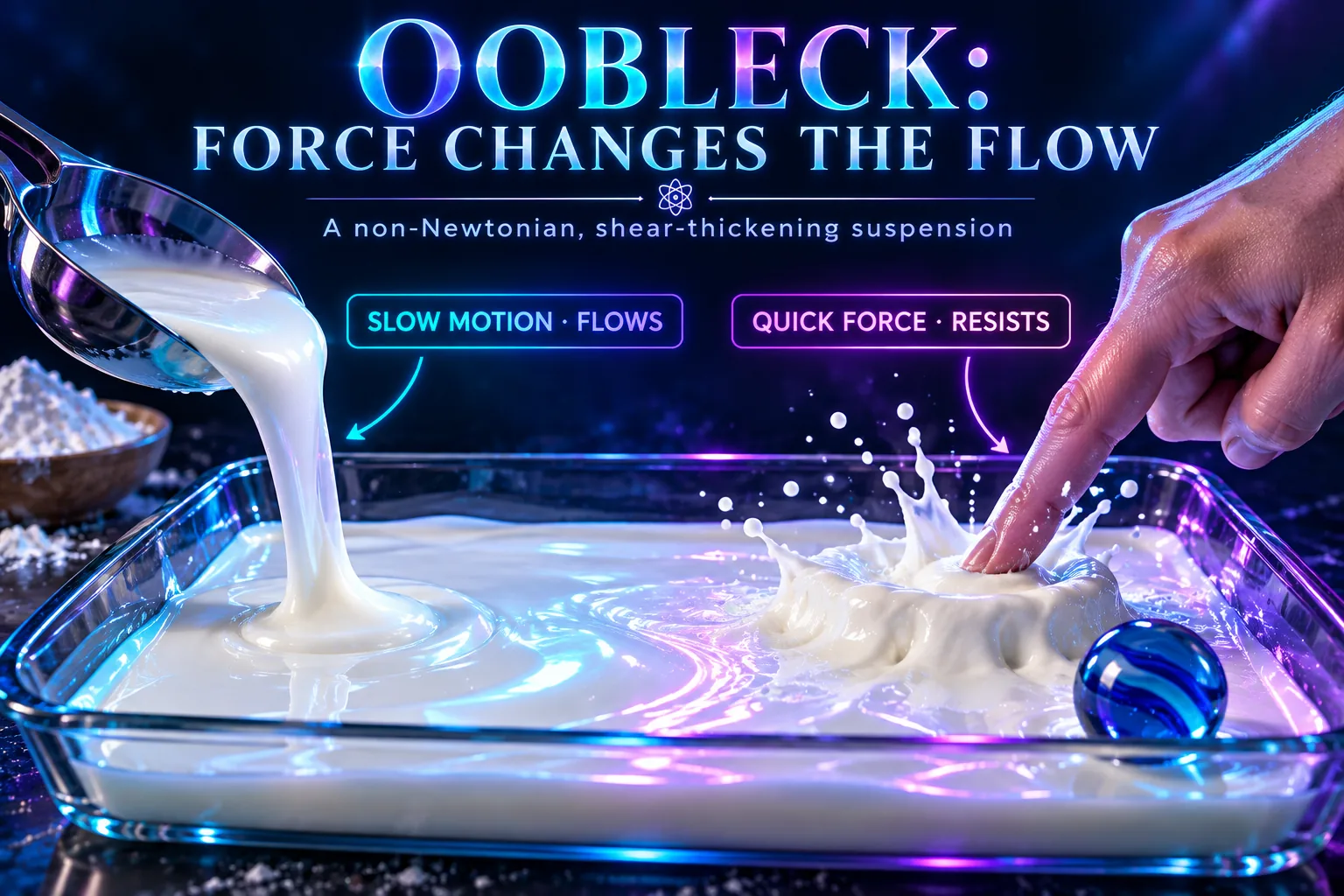
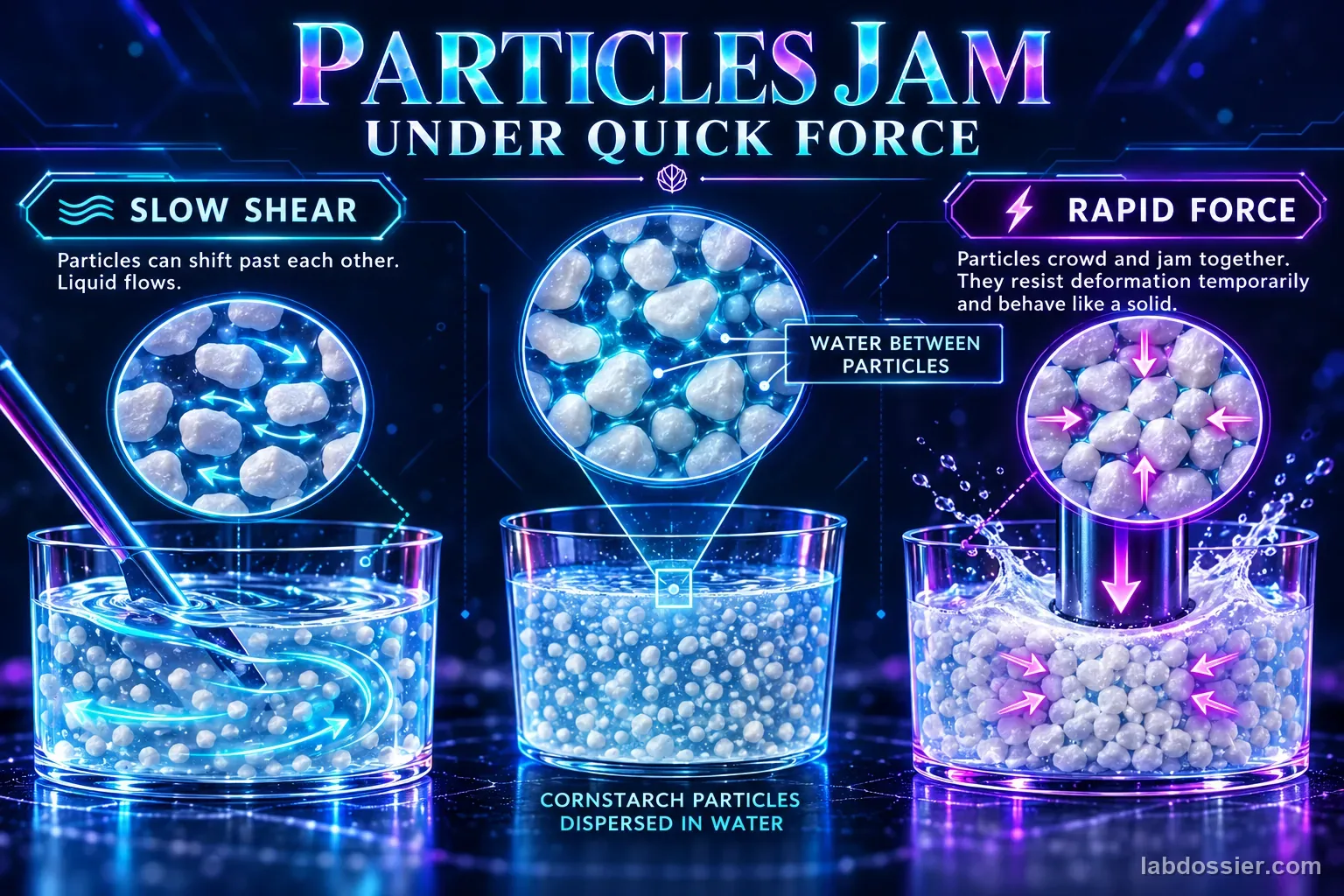
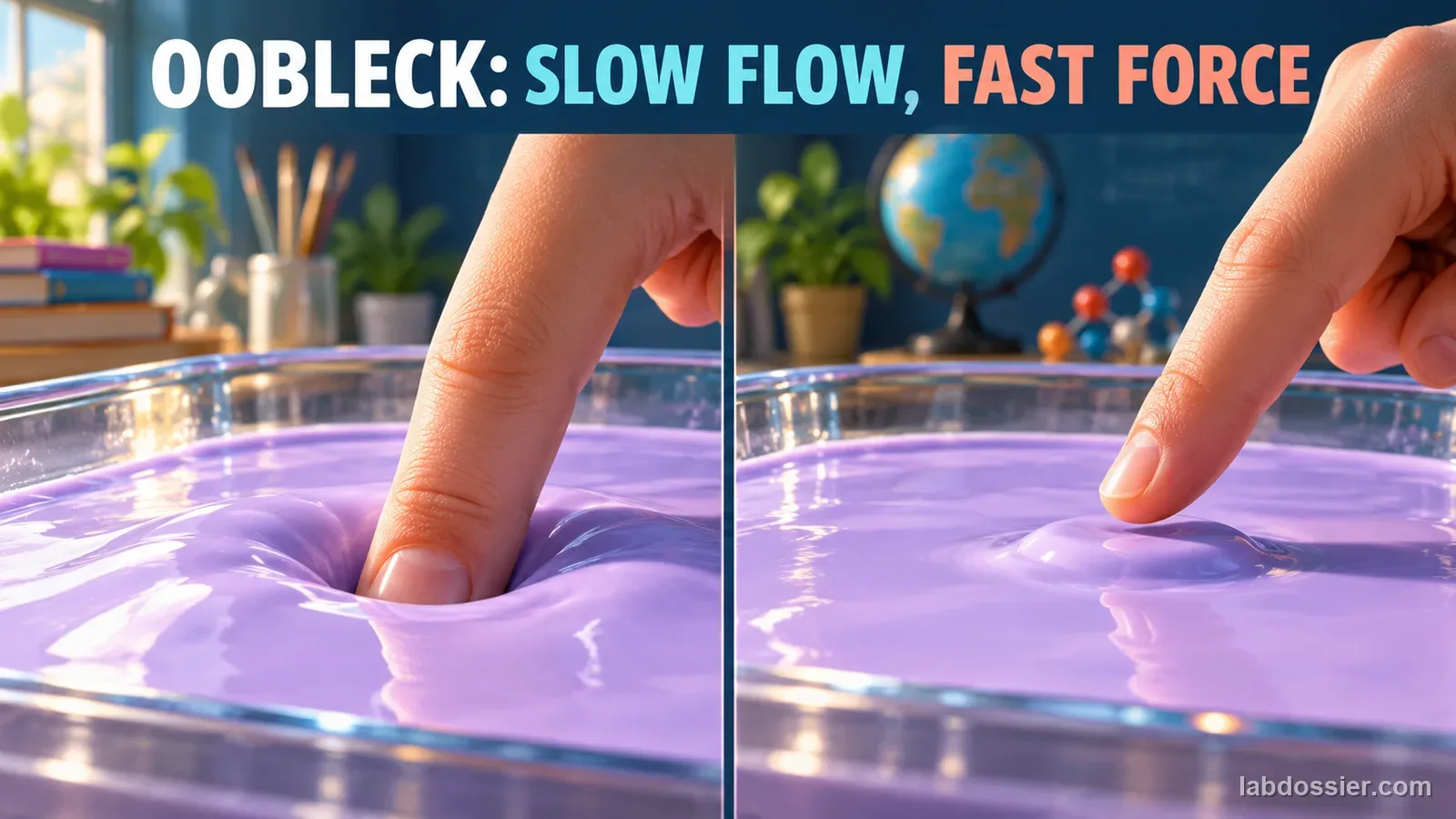
Reviewed article images support the lesson flow. Use the tables and student sheet to record actual observations; pictured patterns are not target results.
Printable shopping list
Shopping and staging checklist
Multiply the per-group kit contents by the class-size planner. The teacher section includes teacher-provided materials and setup or safety notes.
PER-GROUP KITS
- Cornstarch and water measured by volume: 75 + 75 mL, 90 + 60 mL, and 100 + 50 mL for 1:1, 1.5:1 and 2:1 ratios
- Three identical wide shallow trays for 150 mL batches
- Same clean marble, millimeter ruler and timer
- Stirring spoons, ratio labels and recording sheet
- Covered table, scraper and waste container for drying mixture
TEACHER-PROVIDED MATERIALS + SETUP RULES
- Measure each ratio with the same volume method and stir each batch for the same time until no dry pockets remain.
- Mark three separated untouched spots in each tray. Use the same clean marble, gently place it, and measure from the original surface to its lowest point at exactly five seconds. Retrieve it and repeat at the next spot; record every reading and any bottom limit. These repeated spots share one batch and are not independent recipe preparations.
- After depth readings, use a separate spot for one quick tap with the same tool. Keep this qualitative observation separate from the slow marble measure. Keep all mixture out of sinks and drains; scrape it into waste to dry, then discard the solid. Do not eat the mixture.
QUANTITIES BY CLASS SIZE
| Material | Per group kit | 20 students | 25 students | 30 students |
|---|---|---|---|---|
| Cornstarch | 265 mL measured by volume | 1,590 mL | 1,855 mL | 2,120 mL |
| Water | 185 mL | 1,110 mL | 1,295 mL | 1,480 mL |
| Matching wide shallow trays | 3 trays | 18 trays | 21 trays | 24 trays |
| Clean marble | 1 marble | 6 marbles | 7 marbles | 8 marbles |
| Ruler and timer | 1 set | 6 sets | 7 sets | 8 sets |
| Tray, scraper and waste container | 1 cleanup set | 6 sets | 7 sets | 8 sets |
| Student recording sheets | 1 per student | 20 copies | 25 copies | 30 copies |
Prepare 6 kits for 20 · 7 kits for 25 · 8 kits for 30 students.
Lesson flow
| Minutes | What happens |
|---|---|
| 0–3 min | Engage Ask how cornstarch-to-water ratio may change marble sinking. Predict first and review that oobleck must never go into a sink drain. |
| 3–8 min | Explore Measure 1:1, 1.5:1 and 2:1 batches in matching containers. Stir each mixture for the same time until no dry cornstarch pockets remain. |
| 8–14 min | Explore Use the same marble in three separate untouched spots per ratio. Record each depth after 5 seconds and note whenever it reaches the bottom. |
| 14–16 min | Explain Use the same tool for one quick tap on a separate spot and record only the qualitative response; do not call it a calibrated force. |
| 16–20 min | Evaluate Calculate the three-reading mean and range for each batch, then explain what these repeated spots can and cannot show. Scrape mixture into waste to dry; never pour it down a drain. |
Discussion questions
1. Why can oobleck feel firm when tapped but flow when left alone?
2. What do three readings in separate spots tell you?
3. Why might a 1:1 mixture behave more like a liquid than a 2:1 mixture?
4. Why can no oobleck be poured down a drain?
Common misconceptions
Differentiation
SUPPORT
- Pre-label three containers with 1:1, 1.5:1 and 2:1 ratios and prepare ratio measuring cards.
- Use a visible 5-second timer and a ruler held against the transparent side of the container to read depth.
- Offer the frame: “At __ ratio, the marble sank __ mm in 5 s; when tapped, the mixture __.”
EXTEND
- Repeat the marble test at each ratio and compare repeated depths before making a claim.
- Change only the tap speed in a follow-up and describe how the response differs from gentle placement.
- Test whether a larger marble changes depth while keeping ratio, container and placement method constant; record when it reaches the bottom.
Assessment rubric
| Criterion | Beginning | Developing | Secure |
|---|---|---|---|
| Ratio preparation | Does not label ratios or changes measuring methods. | Prepares labeled mixtures but leaves stirring or container conditions unmatched. | Prepares 1:1, 1.5:1 and 2:1 batches with the same volume method, stirring time and container setup. |
| Marble measurements | Leaves the sink-depth table mostly blank. | Records some depths but omits the five-second endpoint or millimeters. | Records all three five-second depths per ratio in millimeters, calculates the mean/range, and notes any bottom limit and shared-batch limitation. |
| Tap comparison | Does not compare the tap test with slow sinking. | Records a tap response but leaves the method or observation unclear. | Uses one quick tap on a separate spot and records whether it feels solid or splashes like a liquid. |
| Explanation and disposal | Calls the mixture a new pure substance or rinses it into a drain. | Explains one behavior but misses the force-rate difference or cleanup rule. | Explains resistance under quick force versus slow flow and scrapes the mixture for drying and trash disposal. |
Vocabulary
- Suspension – A mixture with particles distributed through a liquid that can settle over time.
- Non-Newtonian fluid – A fluid whose resistance to flow changes when the applied force or speed changes.
- Shear thickening – An increase in resistance to flow when a suspension is forced to move more quickly.
- Ratio – A comparison of amounts, here measured cornstarch volume to water volume.
- Depth – The distance the marble moves below the mixture surface.
- Control variable – A condition kept the same while testing the mixture ratio.
Safety, cleanup and troubleshooting
BEFORE STUDENTS TOUCH ANYTHING
- Do not eat or breathe dry starch. Mix gently over a covered tray and wash hands.
- Never drain oobleck; let it dry and put it in trash. Wipe spills to prevent slips.
Troubleshooting: If a batch is too dry to flow, add a small measured amount of water and record the adjustment; if too runny, add a small measured amount of cornstarch and record it. Do not compare an adjusted batch as if its original ratio were unchanged. Scrape all mixture into a waste container to dry; never rinse it down a drain.