LF-01 · TEACHER LESSON PLAN
Osmosis egg lab
Why a shell-less egg swells in water and shrinks in syrup
Driving question
Learning objectives
- Students predict the direction of net water movement across a selectively permeable membrane from a difference in dissolved sugar.
- Students calculate mass change and percent change from their own measurements, keeping the sign (+ or −).
- Students write a claim supported by their own numbers and a reason that uses the word “net”.
Standards
| Dimension | Alignment |
|---|---|
| Performance expectation | MS-LS1-2Develop and use a model to describe the function of a cell as a whole and ways parts of cells contribute to the function. (Partial alignment: students use the egg membrane as a model of the cell membrane boundary.) |
| Practices | SEP 3Plan and carry out investigations SEP 4Analyze and interpret data |
| Core idea | LS1.AThe cell membrane forms the boundary that controls what enters and leaves the cell. |
| Crosscutting | Cause and effectA concentration difference causes a net movement of water. |
Standards text paraphrased from nextgenscience.org. Alignment is partial; a model egg does not cover every part of the performance expectation.
State standards crosswalk
Use the row as a planning crosswalk, then confirm local district pacing and grade placement. “Partial” labels describe a skill connection, not full mastery of the complete standard.
| State | Verified standard | How this lesson aligns | Official source |
|---|---|---|---|
| California | CA NGSS MS-LS1-2 | Partial model connection: students use the egg membrane to reason about a boundary, but the egg is not a whole-cell model and does not represent the other cell parts in the expectation. | Open standard ↗ |
| Texas | Science.8.11(A) | Partial connection: students discuss membrane transport as a cell-part function, but the egg investigation does not identify the functions of the other listed organelles. | Open standard ↗ |
| Florida | SC.6.L.14.4 | Partial connection: the benchmark includes cell membrane structure and function; this lesson models transport across a membrane but does not compare the full set of organelles named in the benchmark. | Open standard ↗ |
| New York | NYSSLS MS-LS1-2 | Partial model connection: the membrane model supports discussion of what crosses a cell boundary, but does not address the whole-cell system or all parts required by the expectation. | Open standard ↗ |
| Pennsylvania | STEELS 3.1.6-8.B | Partial model connection: students use egg data to reason about a membrane's role, but do not model the whole cell or the other parts that contribute to its function. | Open standard ↗ |
Materials and prep timeline
PER GROUP
- 2 raw eggs of similar size, plus 1 spare
- White vinegar, about 600 mL for the shell step
- 250 mL distilled water and 250 mL corn syrup
- 3 clear cups, labels and a marker
- Balance reading to 0.1 g, a spoon, paper towels
- Splash goggles and disposable gloves
TEACHER ONLY
- For 20, 25 or 30 students, stage 5, 7 or 8 complete group kits; print one student sheet per student.
- A tray for carrying cups
- Bleach-free wipes for benches
CLASS-SIZE KIT PLANNER
One per-group kit contains every item in the team materials list above. Groups are balanced around the listed 3–4 students target.
| Students | Groups | Per-group kits | Student sheets | Suggested group split |
|---|---|---|---|---|
| 20 | 5 | 5 complete kits | 20 copies | 5 groups of 4 |
| 25 | 7 | 7 complete kits | 25 copies | 4 groups of 4 and 3 groups of 3 |
| 30 | 8 | 8 complete kits | 30 copies | 6 groups of 4 and 2 groups of 3 |
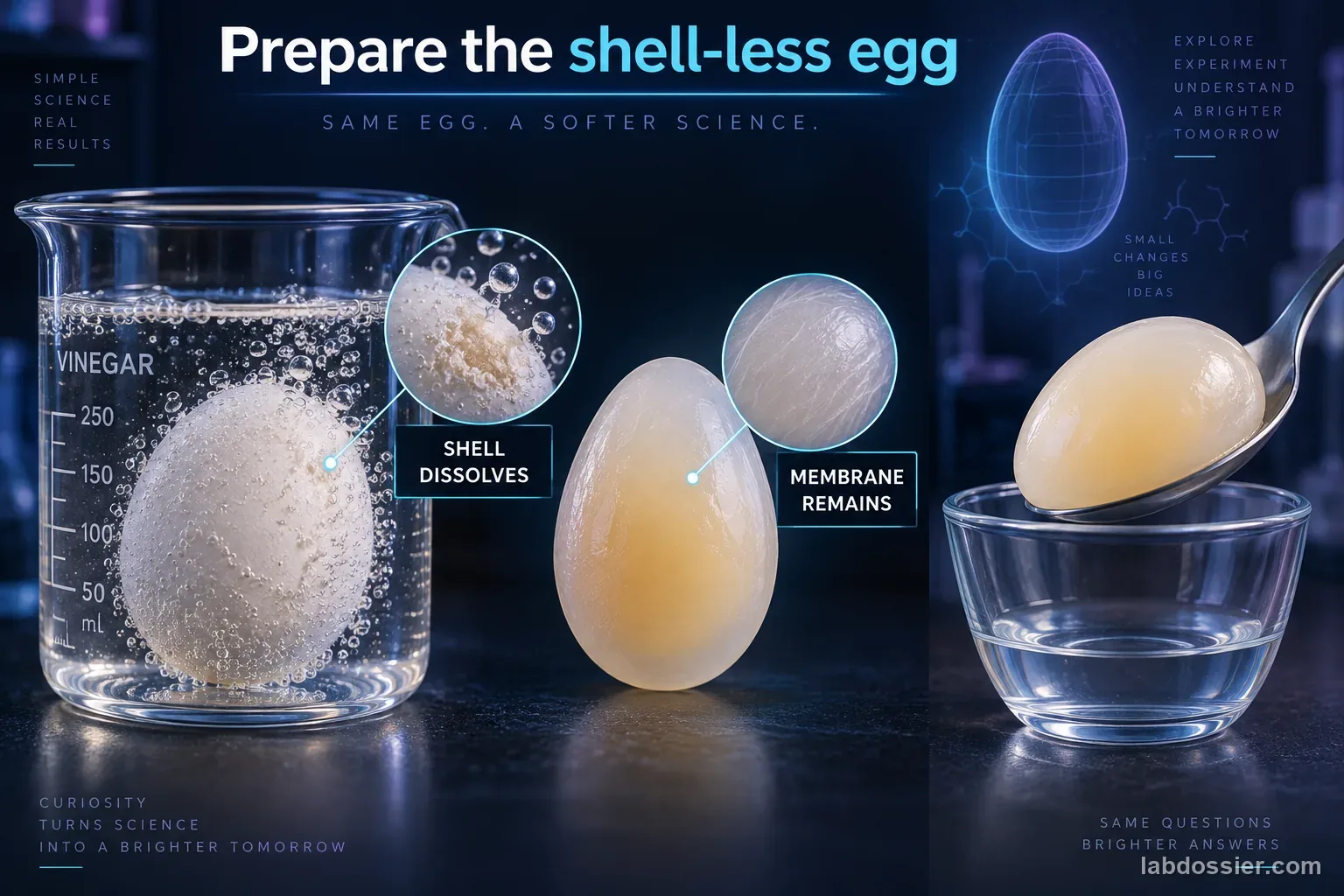
Cover each egg with vinegar and cover the cup. Leave 24 h, then replace the vinegar. 48 h in total.
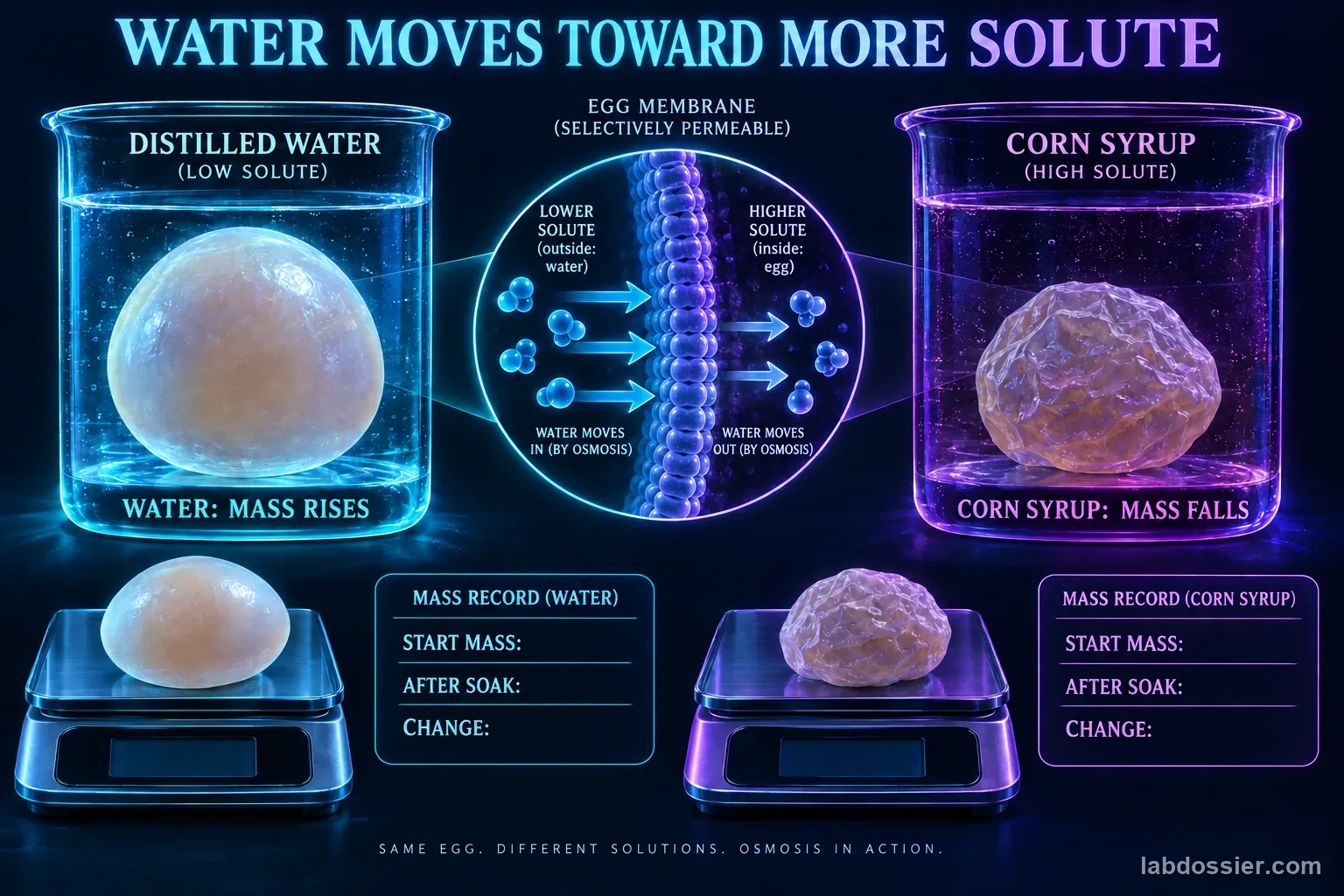
Rinse and blot gently. Record the start mass. Place the eggs in water and syrup. Soak 24 h at room temperature.
Blot and reweigh. Calculate. Graph. Write the claim, evidence and reasoning.
Lab figures and data visuals
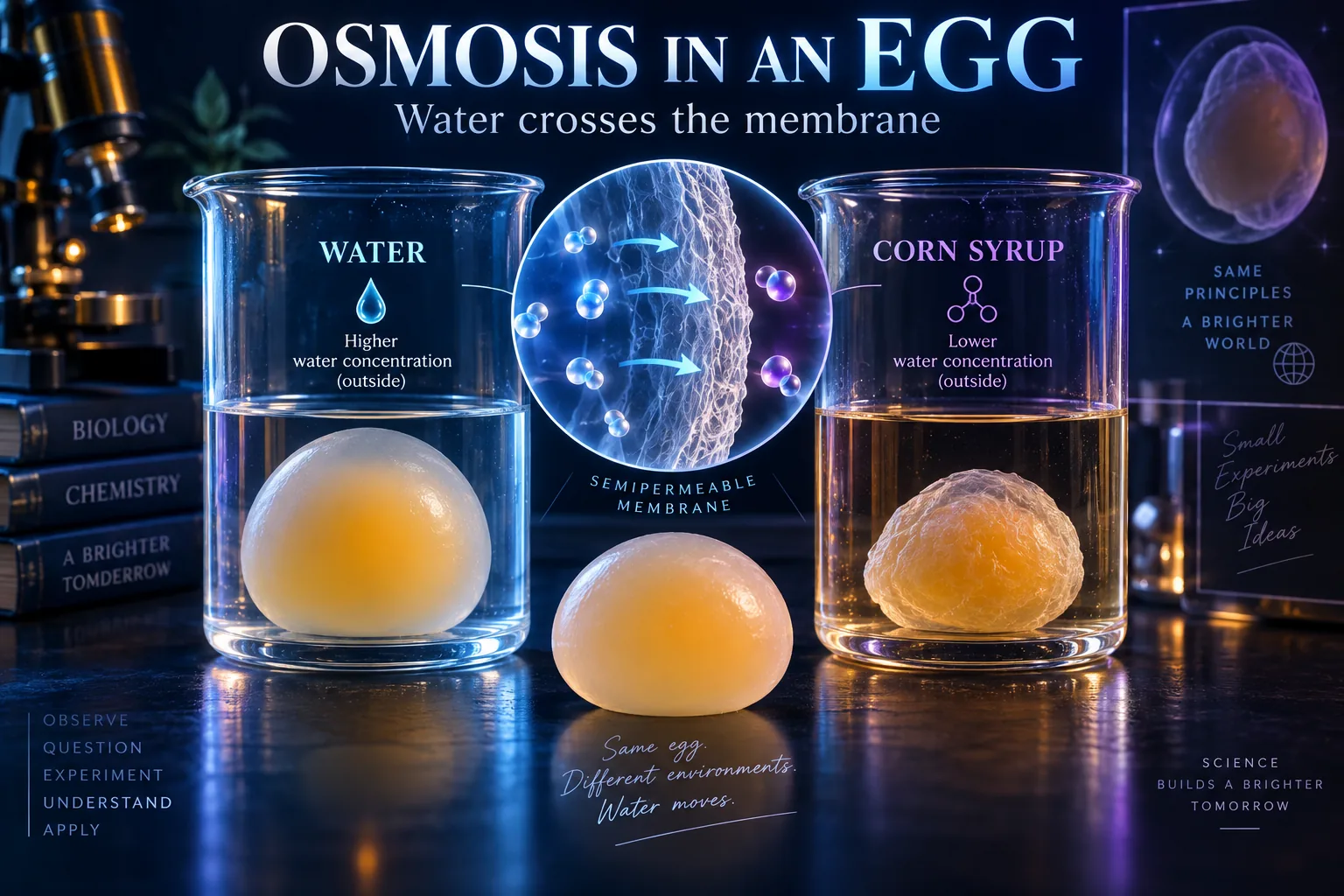
Reviewed article images support the lesson flow. Use the tables and student sheet to record actual observations; pictured patterns are not target results.
Printable shopping list
Shopping and staging checklist
Multiply the per-group kit contents by the class-size planner. The teacher section includes teacher-provided materials and setup or safety notes.
PER-GROUP KITS
- 2 raw eggs of similar size, plus 1 spare
- White vinegar, about 600 mL for the shell step
- 250 mL distilled water and 250 mL corn syrup
- 3 clear cups, labels and a marker
- Balance reading to 0.1 g, a spoon, paper towels
- Splash goggles and disposable gloves
TEACHER-PROVIDED MATERIALS + SETUP RULES
- For 20, 25 or 30 students, stage 5, 7 or 8 complete group kits; print one student sheet per student.
- A tray for carrying cups
- Bleach-free wipes for benches
QUANTITIES BY CLASS SIZE
| Material | Per group kit | 20 students | 25 students | 30 students |
|---|---|---|---|---|
| Raw eggs, including one spare per group | 3 | 15 | 21 | 24 |
| White vinegar for shell step | about 600 mL | 3 L | 4.2 L | 4.8 L |
| Distilled water | 250 mL | 1.25 L | 1.75 L | 2 L |
| Corn syrup | 250 mL | 1.25 L | 1.75 L | 2 L |
| Clear cups, labels and marker | 3 cups, 1 set | 15 cups, 5 sets | 21 cups, 7 sets | 24 cups, 8 sets |
| Balance reading to 0.1 g | 1 | 5 | 7 | 8 |
| Spoon, towels, goggles and gloves | 1 kit | 5 kits | 7 kits | 8 kits |
| Student sheets | 1 per student | 20 | 25 | 30 |
Prepare 5 kits for 20 · 7 kits for 25 · 8 kits for 30 students.
Lesson flow
| Minutes | What happens |
|---|---|
| S2 · 0–5 | Engage Show the driving question. Students vote “bigger / smaller / same” for each cup on the student sheet and write one reason. |
| S2 · 5–30 | Explore Groups rinse and blot the eggs, record the start mass to 0.1 g, label cups, pour the liquids and lower the eggs with a spoon. Circulate and check that both eggs get the same blot routine. |
| S2 · 30–40 | Clean up and wash hands. Cups go on the tray. Pause point: ask “what would make this unfair?” and collect two ideas. |
| S3 · 0–10 | Explore Lift, blot with the same routine, reweigh on the same balance. Record. Note texture (firm, floppy, wrinkled). |
| S3 · 10–25 | Explain Calculate change in grams and percent change, keeping the sign. Draw the bar graph. Use the discussion questions below. |
| S3 · 25–35 | Elaborate “Move the syrup egg into water. Predict what happens and why.” Open the interactive lab for the 24-hour recovery model. |
| S3 · 35–45 | Evaluate Students write the claim, evidence and reasoning. Use the rubric below. |
Discussion questions
1. In which cup did the measured mass suggest net water moved out of the egg? How do you know?
2. Water molecules move both ways. Why did the egg still change mass?
3. Why is the vinegar shell step not one of the two treatments?
4. How is the egg a good model of a cell, and where does it fall short?
Common misconceptions
Differentiation
SUPPORT
- Pre-labelled data table with the formula printed above it
- Sentence starters for the claim: “The egg in ___ gained/lost ___ g because water moved ___.”
- Calculator allowed; teacher models the first row
EXTEND
- Add salt water or two sugar concentrations and predict the order of percent change
- Repeat with 3 eggs per liquid and compare the spread
- Explain how a pickle, a slug and a salted road each show a related idea
Assessment rubric
| Criterion | Beginning | Developing | Secure |
|---|---|---|---|
| Claim | No claim, or only “it changed”. | States which egg gained or lost mass. | States the direction of net water movement for both liquids. |
| Evidence | No numbers from the table. | Uses one number or leaves out the sign. | Uses start, final and % change with correct signs and units. |
| Reasoning | Says “osmosis” without a reason. | Mentions sugar or water but not the difference. | Links the concentration difference to net water movement across the membrane. |
| Data care | Different routines for each egg. | Same routine, units missing. | Same blot, same balance, units in every cell. |
Vocabulary
- Osmosis – Net movement of water across a selectively permeable membrane.
- Selectively permeable – Lets some substances cross more easily than others.
- Concentration – How much dissolved substance is in a volume of liquid.
- Net movement – The difference between movement in and movement out.
- Percent change – Change ÷ start × 100.
- Control – A condition kept the same so the comparison is fair.
Safety, cleanup and troubleshooting
BEFORE STUDENTS TOUCH ANYTHING
- Raw eggs can carry Salmonella: gloves on, never taste, wash hands and wipe the bench.
- Vinegar irritates eyes: splash goggles while pouring.
- Used eggs and liquids go in the trash, not down a shared sink, and are never food.
Troubleshooting: Little change: check for shell patches and whether the liquid covered the egg. Torn membrane: record it as a damaged sample and swap in the spare.