LF-09 · TEACHER LESSON PLAN
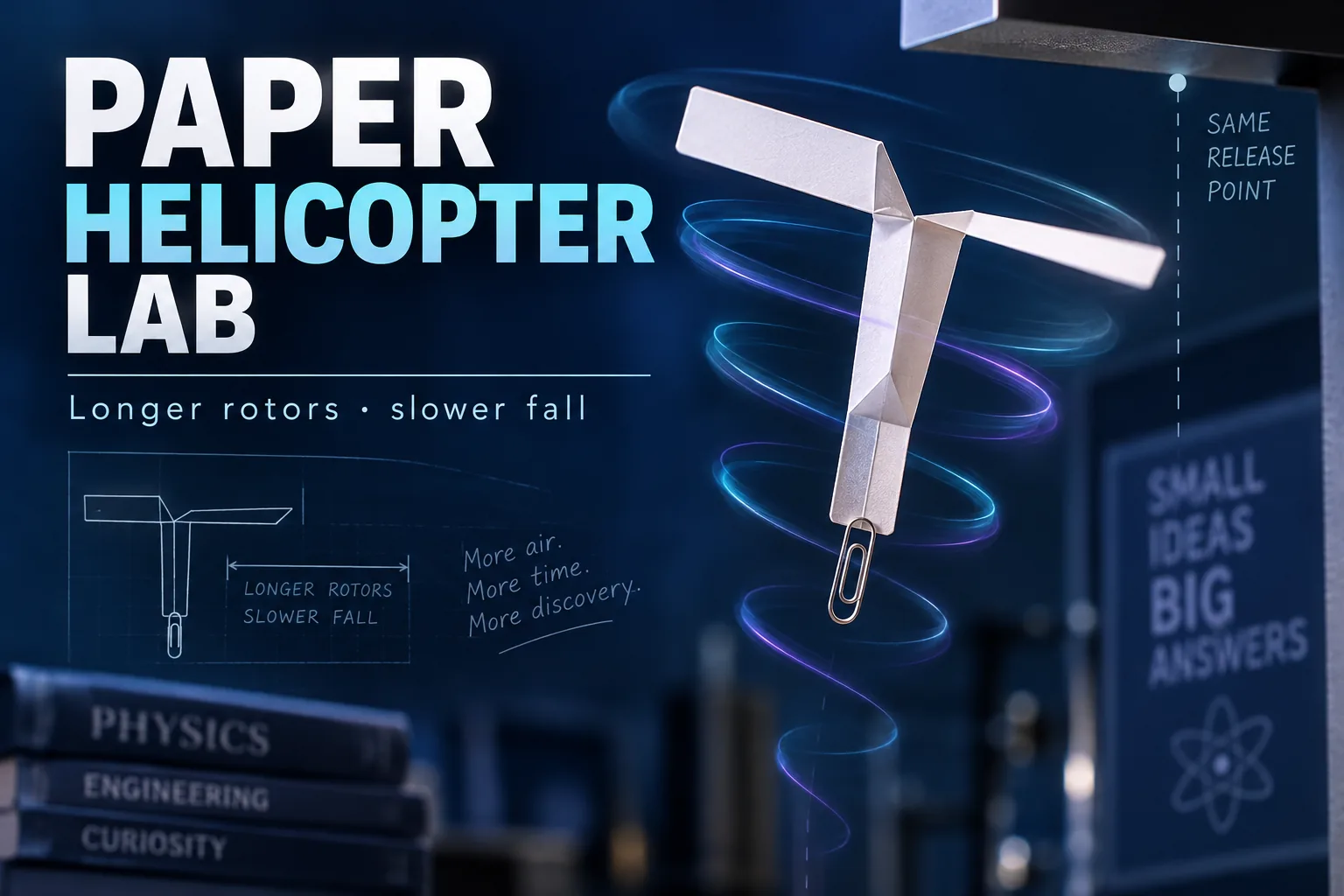
Paper helicopter lab
How rotor length can change a paper helicopter's fall time
Driving question
Learning objectives
- Students build three paper helicopters with 3, 6 and 9 cm rotor blades while matching body, paper, clip mass and folds.
- Students measure each model's fall time over three releases from a marked height using the same start/stop rule.
- Students analyze trial variation and mean fall time to describe a pattern without treating one flight as conclusive.
Standards
| Dimension | Alignment |
|---|---|
| Performance expectation | MS-PS2-2Plan an investigation to provide evidence that the change in an object's motion depends on the sum of the forces on the object and the mass of the object. (Partial alignment: students change one design feature and time the fall; they do not measure forces, so the link to force and mass is an interpretation, not a measured result.) |
| Practices | SEP 4Analyze and interpret data. |
| Core idea | PS2.AThe motion of an object is determined by the sum of the forces acting on it; if the total force on the object is not zero, its motion will change. |
| Crosscutting | Cause and effectCause and effect relationships are routinely identified, tested, and used to explain change. |
Standards text paraphrased from nextgenscience.org. Alignment is partial; this hands-on activity does not cover every part of the performance expectation. The CCC connection is conceptual: changing blade length may relate to a change in fall time, but this setup does not isolate force.
State standards crosswalk
Use the row as a planning crosswalk, then confirm local district pacing and grade placement. “Partial” labels describe a skill connection, not full mastery of the complete standard.
| State | Verified standard | How this lesson aligns | Official source |
|---|---|---|---|
| California | CA NGSS MS-PS2-2 | Partial. Students compare motion through fall time, but do not measure the net force or vary object mass as the full expectation requires. | Open standard ↗ |
| Texas | Science.7.1(B) | Practice connection. Students plan and conduct a controlled comparison; the lesson does not meet the separate engineering-design expectation by itself. | Open standard ↗ |
| Florida | SC.6.P.13.3 | Partial. Students observe a motion change in falling models, but do not directly measure an unbalanced force. | Open standard ↗ |
| New York | MS-PS2-2 | Partial. Fall time is evidence about motion, but net force and mass are not measured or varied in this investigation. | Open standard ↗ |
| Pennsylvania | 3.2.6-8.H | Limited. Students plan a motion investigation, but this standard requires evidence connecting motion change with net force and mass, neither of which is measured here. | Open standard ↗ |
Materials and prep timeline
PER GROUP
- Three matching paper helicopter templates
- Scissors and ruler marked in centimeters
- One identical paper clip per helicopter
- Stopwatch that displays tenths of a second
- Masking tape to mark release height
- Clear, level floor drop area
TEACHER ONLY
- Choose one low release mark an adult can reach while standing on the floor; lower it if needed. The teacher or another adult makes every release. Never use a ladder, stairs, chair, desk, balcony or raised platform.
- Mark a clear landing zone, keep observers outside it, and check that paper clips are secure.
- Agree on one timing rule before the first drop and provide one student flight-record sheet per student.
CLASS-SIZE KIT PLANNER
One per-group kit contains every item in the team materials list above. Groups are balanced around the listed 3–4 students target.
| Students | Groups | Per-group kits | Student sheets | Suggested group split |
|---|---|---|---|---|
| 20 | 6 | 6 complete kits | 20 copies | 2 groups of 4 and 4 groups of 3 |
| 25 | 7 | 7 complete kits | 25 copies | 4 groups of 4 and 3 groups of 3 |
| 30 | 8 | 8 complete kits | 30 copies | 6 groups of 4 and 2 groups of 3 |
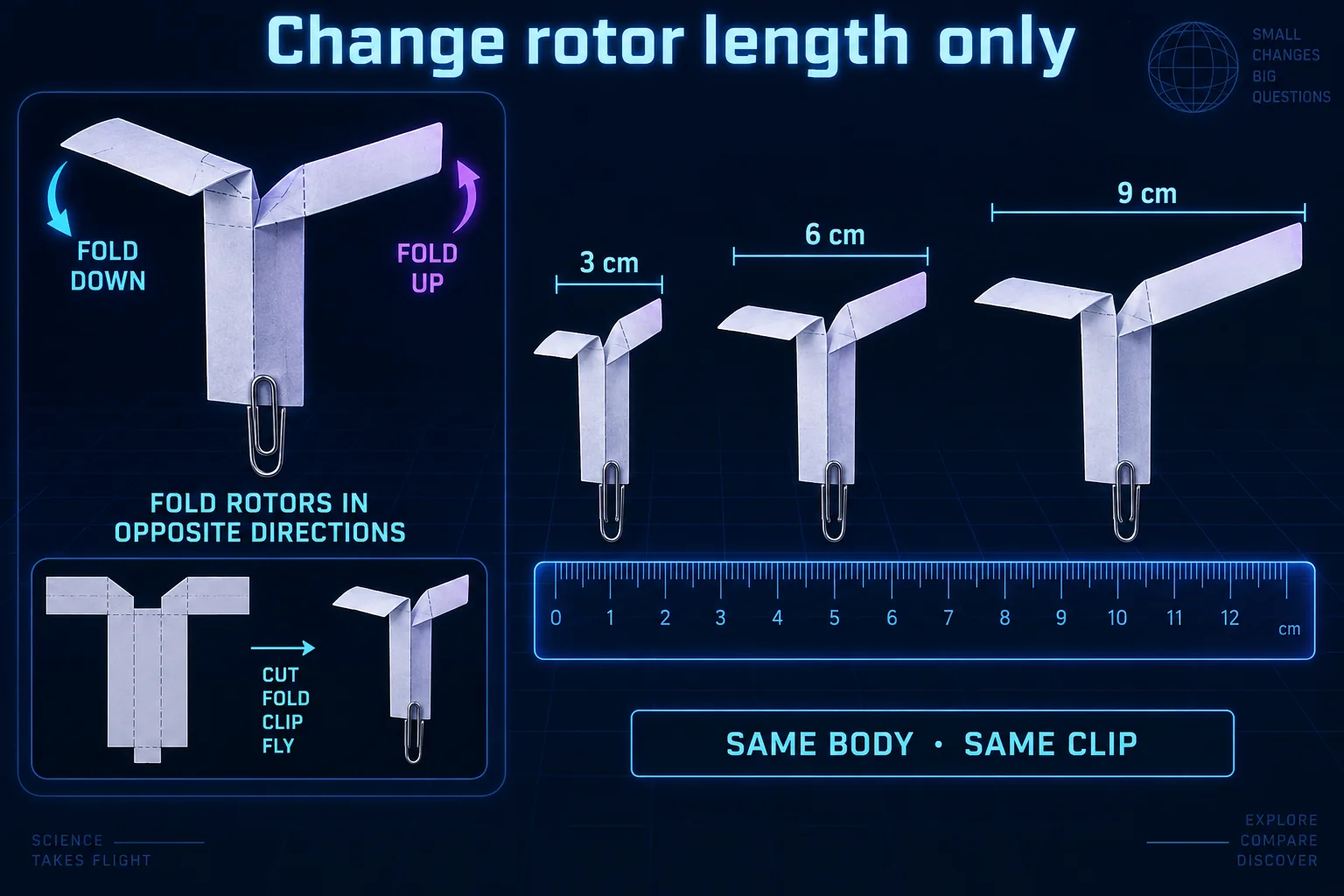
Measure short, medium and long blades (3, 6 and 9 cm) on identical paper while keeping the body the same.
Cut and fold matching bodies, turn rotor blades in opposite directions and add the same clip mass to each model.
Check matched folds and secure clips; mark one low release point an adult can reach from the floor, lower it if needed, clear the landing zone, and agree on the timing endpoint.
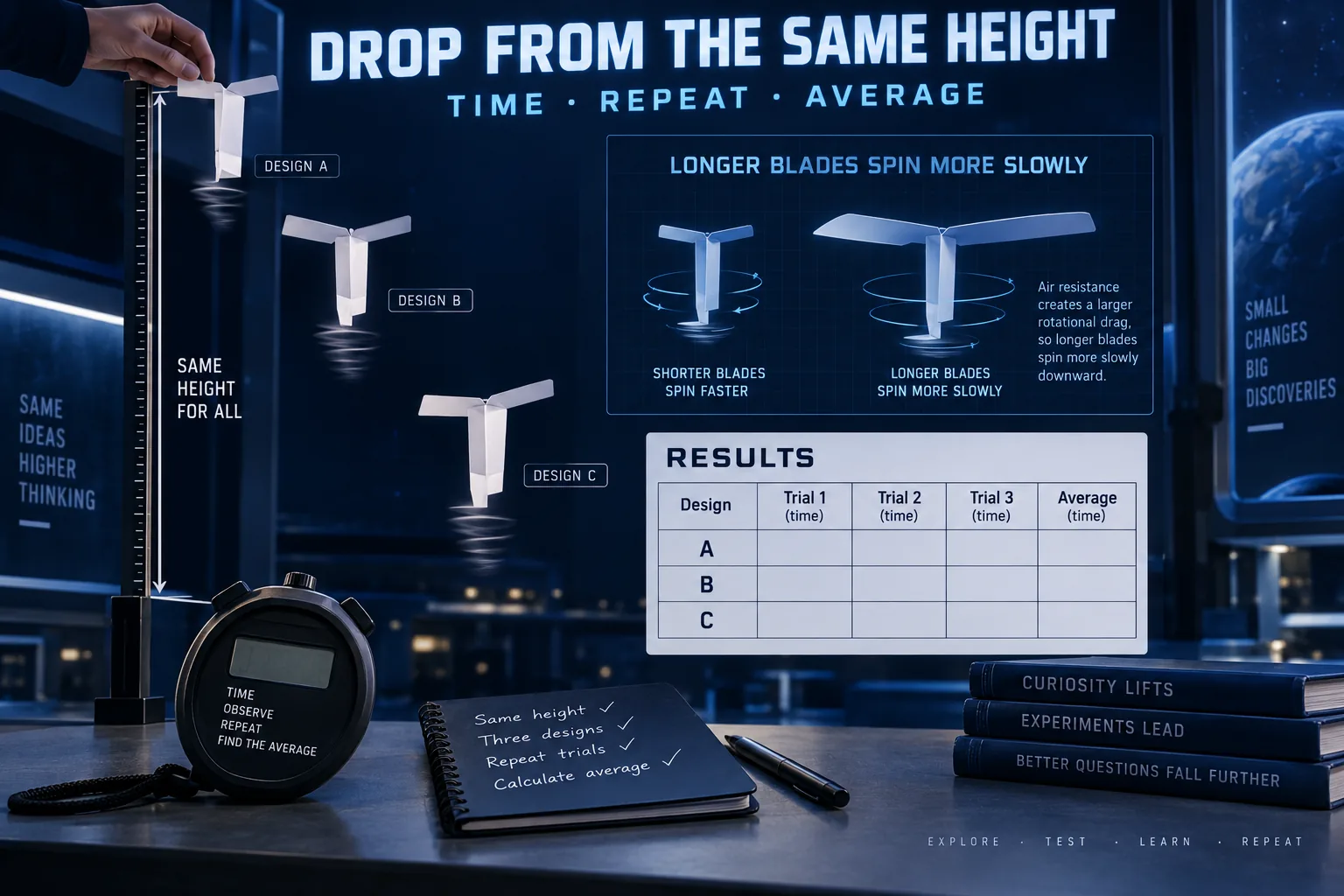
Release rotor-side up without a push or twist. Time each fall to the same landing point and record three trials per blade length.
Calculate each mean, plot blade length against mean fall time and discuss variation or drafts.
Lab figures and data visuals
Reviewed article images support the lesson flow. Use the tables and student sheet to record actual observations; pictured patterns are not target results.
Printable shopping list
Shopping and staging checklist
Multiply the per-group kit contents by the class-size planner. The teacher section includes teacher-provided materials and setup or safety notes.
PER-GROUP KITS
- Three matching paper helicopter templates
- Scissors and ruler marked in centimeters
- One identical paper clip per helicopter
- Stopwatch that displays tenths of a second
- Masking tape to mark release height
- Clear, level floor drop area
TEACHER-PROVIDED MATERIALS + SETUP RULES
- Choose one low release mark an adult can reach while standing on the floor; lower it if needed. The teacher or another adult makes every release. Never use a ladder, stairs, chair, desk, balcony or raised platform.
- Mark a clear landing zone, keep observers outside it, and check that paper clips are secure.
- Agree on one timing rule before the first drop and provide one student flight-record sheet per student.
QUANTITIES BY CLASS SIZE
| Material | Per group kit | 20 students | 25 students | 30 students |
|---|---|---|---|---|
| Paper helicopter templates | 3 models | 18 models | 21 models | 24 models |
| Identical paper clips | 3 clips | 18 clips | 21 clips | 24 clips |
| Scissors, centimeter rulers, tenths stopwatches | 1 of each | 6 of each | 7 of each | 8 of each |
| Masking tape for release-height marks | 1 roll shared | 1 roll | 1 roll | 1 roll |
| Student flight-record sheets | 1 per student | 20 copies | 25 copies | 30 copies |
Prepare 6 kits for 20 · 7 kits for 25 · 8 kits for 30 students.
Lesson flow
| Minutes | What happens |
|---|---|
| Build · 0–5 | Engage Predict how rotor length might change fall time. Identify the response and the conditions to hold steady. |
| Build · 5–15 | Explore Cut 3, 6 and 9 cm rotors from matching templates. Keep body length, paper, fold and paper-clip weight the same. |
| Build · 15–30 | Fold blades in opposite directions and attach identical clips. Mark one low height an adult can reach while standing on the floor; an adult releases and keeps the landing zone clear. |
| Test · 0–12 | Explore Drop each model three times from the same height without pushing or spinning it. Start timing at release and stop at landing. |
| Test · 12–17 | Explain Calculate mean times; compare the three trials and check uneven folds, drafts or inconsistent release if one value differs. |
| Test · 17–20 | Evaluate Graph rotor length and mean fall time, then explain that time combines the falling motion and air interaction rather than measuring force directly. |
Discussion questions
1. What makes the blade-length comparison fair?
2. Why take three times for each rotor length?
3. What might cause one time to differ from the other two?
4. What does a longer fall time suggest, and what does it not measure?
Common misconceptions
Differentiation
SUPPORT
- Provide templates with blade lengths marked at 3, 6 and 9 cm and pre-folded body lines.
- Use a shared timer operator and a clear start-at-release, stop-at-floor protocol.
- Offer the frame: “The mean for ___ cm was ___ s; its trials ranged from ___ to ___ s.”
EXTEND
- Calculate each design's range and compare repeatability as well as mean fall time.
- Repeat the comparison with a new paper-clip mass while holding blade length fixed.
- Use slow-motion video to compare rotation and descent, then explain why full fall time combines both motions.
Assessment rubric
| Criterion | Beginning | Developing | Secure |
|---|---|---|---|
| Matched designs | Changes multiple features or omits design labels. | Changes rotor length but leaves another condition unclear. | Labels 3, 6 and 9 cm designs and matches paper, body, folds, clip and release conditions. |
| Repeated measurements | Records fewer than three trials for one or more designs. | Records trials but omits units or mean for one design. | Records all nine times in seconds and calculates all three means correctly. |
| Graph and pattern | Graph axes or data are missing. | Plots means but omits units or trial variation. | Plots blade length against mean time with units and uses the trial spread to discuss the pattern. |
| Interpretation | Says time is a direct force measurement. | Describes a trend without naming limits. | Connects the trend to air interaction and recognizes release, fold, mass and draft limits. |
Vocabulary
- Rotor – A set of blades that rotates as air pushes against them.
- Drag – A force from air or another fluid that resists motion through it.
- Trial – One repeat of the same test conditions.
- Mean – The sum of measured values divided by the number of values.
- Variable – A factor that can change or be measured in an investigation.
- Repeatability – How closely repeated results agree under the same conditions.
Safety, cleanup and troubleshooting
BEFORE STUDENTS TOUCH ANYTHING
- Use one low mark an adult can reach while standing on the floor; lower it if needed. An adult releases from that mark. Never use a ladder, stairs, chair, desk, balcony, railing or raised platform. Keep people and fragile objects outside the clear landing zone.
- Use scissors while seated at a clear table, with blades pointed away from the body. Paper clips are small parts; keep them away from young children and collect them after testing.
- Secure each clip so it cannot fall off. Retrieve a model only after it has landed and the area is clear.
Troubleshooting: If a helicopter tilts or flutters, inspect the matched folds and blade bends before interpreting its time. If room air is moving, wait for it to settle and repeat. Keep the same low release mark and landing point for every flight; do not move the release point onto stairs or furniture.