LF-04 · TEACHER LESSON PLAN
Pendulum period
How length sets a pendulum’s rhythm in the small-angle model
Driving question
Learning objectives
- Students predict how changing the pivot-to-bob length will affect the period while the bob and release angle stay the same.
- Students calculate the mean time for ten cycles, period T, and T² for four tested string lengths.
- Students graph and explain T² against length and use the near-linear pattern to describe how length affects a pendulum's timing.
Standards
| Dimension | Alignment |
|---|---|
| Performance expectation | 3-PS2-2Make observations and/or measurements of an object's motion to provide evidence that a pattern can be used to predict future motion. (Partial alignment: this is a grade 3 performance expectation, and its assessment boundary excludes the terms period and frequency, which this lesson uses. It supports the pattern idea (a swing repeats, so future motion can be predicted from it).) |
| Practices | SEP 3Plan and carry out investigations (control variables, provide evidence). SEP 4Analyze and interpret data. |
| Core idea | 3-PS2 core ideaThe patterns of an object's motion in various situations can be observed and measured; when that past motion exhibits a regular pattern, future motion can be predicted from it. |
| Crosscutting | PatternsPatterns of change can be used to make predictions. |
Standards text paraphrased from nextgenscience.org. Alignment is partial; this hands-on activity does not cover every part of the performance expectation.
State standards crosswalk
Use the row as a planning crosswalk, then confirm local district pacing and grade placement. “Partial” labels describe a skill connection, not full mastery of the complete standard.
| State | Verified standard | How this lesson aligns | Official source |
|---|---|---|---|
| California | CA NGSS MS-PS2-2 | Partial connection: students plan a controlled motion investigation, but the changed variable is pendulum length, not the net force named in this expectation. | Open standard ↗ |
| Texas | Science.8.7(B) | Limited connection: students investigate a moving system, but do not analyze all three Newton laws as the expectation requires. | Open standard ↗ |
| Florida | SC.6.P.12.1 | Partial connection: students measure motion over time, but the pendulum does not move at constant speed as this benchmark specifies. | Open standard ↗ |
| New York | NYSSLS MS-PS2-2 | Partial connection: students plan a controlled investigation, but vary pendulum length rather than the force acting on an object. | Open standard ↗ |
| Pennsylvania | STEELS 3.2.3.A | Topic match for observing and measuring a repeatable motion pattern to support prediction; this lesson extends the pattern work to period and T-squared. | Open standard ↗ |
Materials and prep timeline
PER GROUP
- 1 secure clamp stand, 1 light bob and 1 string adjustable to 20, 40, 60 and 80 cm
- 1 ruler marked in centimeters, measured from pivot to bob center
- 1 stopwatch, recording sheet and calculator
- Safety glasses if required by local classroom rules
TEACHER ONLY
- Check each clamp and knot before class; mark a clear swing zone
- One printed student sheet per student
CLASS-SIZE KIT PLANNER
One per-group kit contains every item in the team materials list above. Groups are balanced around the listed 3 students target.
| Students | Groups | Per-group kits | Student sheets | Suggested group split |
|---|---|---|---|---|
| 20 | 6 | 6 complete kits | 20 copies | 2 groups of 4 and 4 groups of 3 |
| 25 | 8 | 8 complete kits | 25 copies | 1 group of 4 and 7 groups of 3 |
| 30 | 10 | 10 complete kits | 30 copies | 10 groups of 3 |
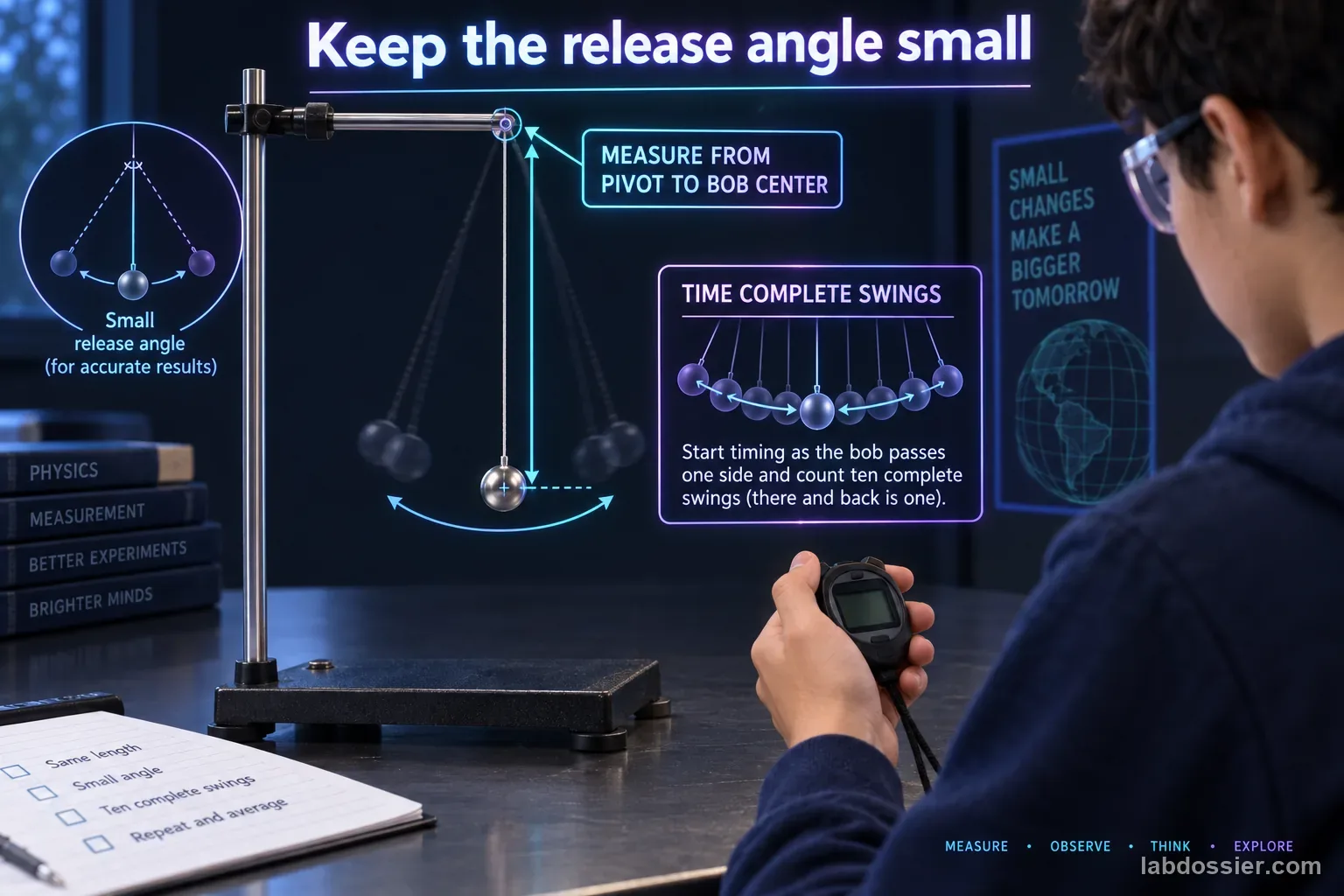
Secure the support, predict the pattern, then take three ten-cycle timing trials at each listed length with the same bob and small release angle.
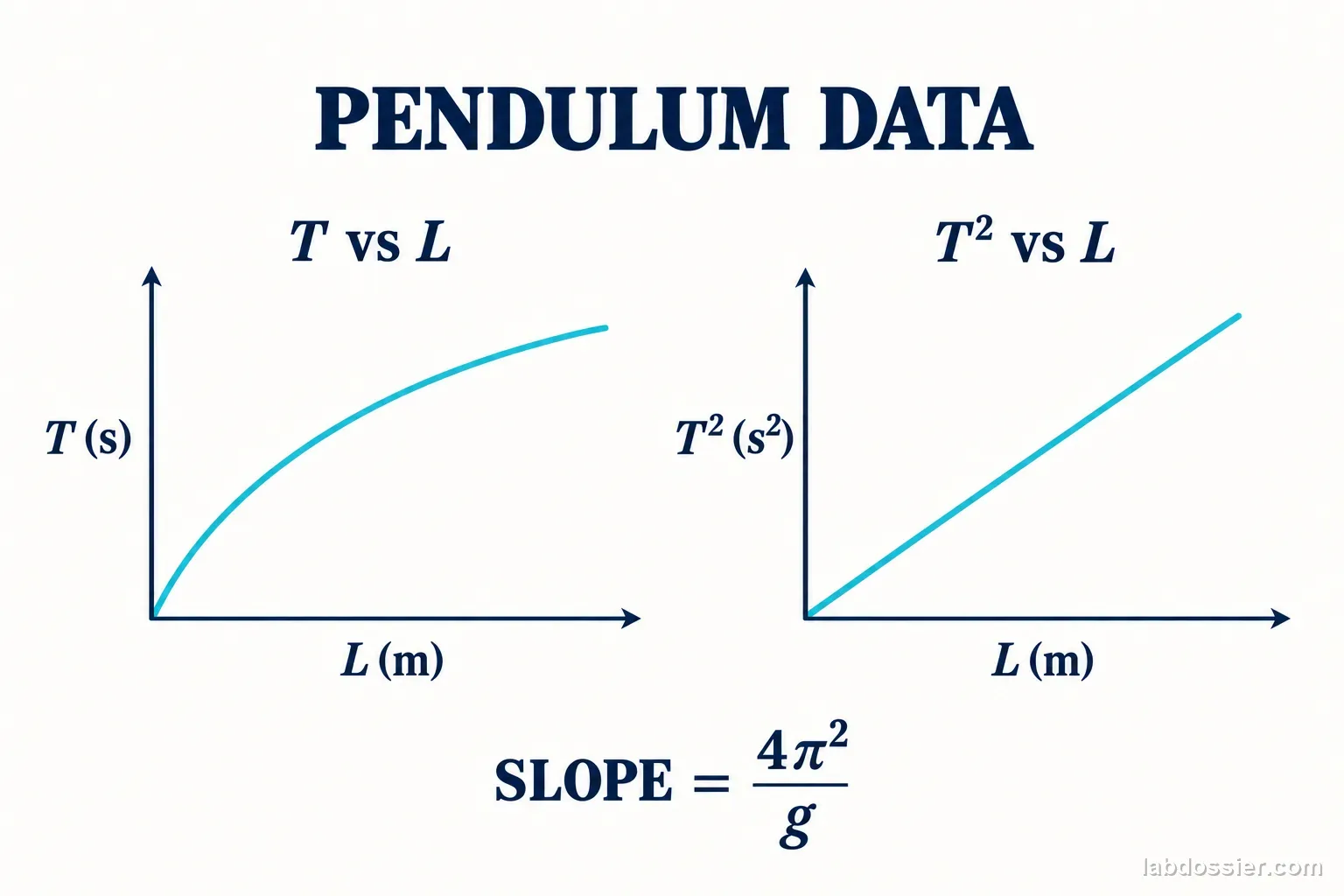
Average each length's trials, find T and T², graph T² against length, and explain the pattern and limits of the ideal model.
Lab figures and data visuals
Reviewed article images support the lesson flow. Use the tables and student sheet to record actual observations; pictured patterns are not target results.

Printable shopping list
Shopping and staging checklist
Multiply the per-group kit contents by the class-size planner. The teacher section includes teacher-provided materials and setup or safety notes.
PER-GROUP KITS
- 1 secure clamp stand, 1 light bob and 1 string adjustable to 20, 40, 60 and 80 cm
- 1 ruler marked in centimeters, measured from pivot to bob center
- 1 stopwatch, recording sheet and calculator
- Safety glasses if required by local classroom rules
TEACHER-PROVIDED MATERIALS + SETUP RULES
- Check each clamp and knot before class; mark a clear swing zone
- One printed student sheet per student
QUANTITIES BY CLASS SIZE
| Material | Per group kit | 20 students | 25 students | 30 students |
|---|---|---|---|---|
| Secure clamp stand | 1 | 6 | 8 | 10 |
| Light bob, string, ruler, stopwatch and calculator | 1 of each | 6 of each | 8 of each | 10 of each |
| Student recording sheets | 1 per student | 20 | 25 | 30 |
| Safety glasses, only if local rules require them | 1 pair per student | 20 pairs | 25 pairs | 30 pairs |
Prepare 6 kits for 20 · 8 kits for 25 · 10 kits for 30 students.
Lesson flow
| Minutes | What happens |
|---|---|
| S1 · 0–4 | Engage Show the short-versus-long pendulum and ask why a heavier bob on the same length barely changes its rhythm. Students predict a pattern before measuring. |
| S1 · 4–8 | Explore Secure the stand. Demonstrate measuring from pivot to the bob's center and choosing a release angle under 15°; clear the swing path. |
| S1 · 8–20 | Explore Use one bob, release without a push, time ten full cycles three times at each of 20, 40, 60 and 80 cm, and record all trials. |
| S2 · 0–9 | Explain Average the three total times at each length. Divide each mean by ten for T, then square T; keep seconds and seconds squared distinct. |
| S2 · 9–17 | Plot T² (s²) against length (cm), label both axes and draw a best-fit trend rather than joining points in order. |
| S2 · 17–22 | Elaborate Compare the curved T-versus-length idea with the straighter T²-versus-length pattern; discuss how pivot friction or a large angle can alter results. |
| S2 · 22–25 | Evaluate Write a claim with a measured mean and explain what the classroom setup can and cannot establish about mass and length. |
Discussion questions
1. Which length should have the longest period, and what result would support that claim?
2. Why time ten cycles three times instead of timing one cycle once?
3. Why graph T² against length rather than expecting T to double when length doubles?
4. What does this apparatus leave out of the ideal pendulum model?
Common misconceptions
Differentiation
SUPPORT
- Provide a four-row table for 20, 40, 60 and 80 cm and model one mean from three times.
- Give a calculator-ready sequence: mean ten-cycle time ÷ 10 = T; T × T = T².
- Use a partner counter and a marked center crossing so cycle starts and finishes at the same point and direction.
EXTEND
- Test a second light bob mass at one fixed length and compare the mean T values.
- Compare two small release angles at the same length; keep the bob and support unchanged.
- Convert centimeters to meters and compare the slope of T² against L with 4π²/g, explaining timing uncertainty.
Assessment rubric
| Criterion | Beginning | Developing | Secure |
|---|---|---|---|
| Claim | Does not identify how length relates to period. | Names a direction but does not distinguish period from ten-cycle time. | States how period changes with length and limits the claim to the tested setup. |
| Evidence | Gives no timing result. | Uses one trial or omits its unit. | Uses a mean supported by repeated ten-cycle times with seconds and length units. |
| Reasoning | Says only that a long string is slower. | Mentions T² or length without connecting them. | Explains why T² plotted against L supports the small-angle model's pattern. |
| Data care | Changes bob, angle, or timing method across lengths. | Controls most conditions but leaves a measurement or repeat unclear. | Uses the same bob, small angle, pivot, cycle definition and three recorded trials at each length. |
Vocabulary
- Period – Time for one complete back-and-forth cycle.
- Pivot – The fixed point from which the pendulum hangs.
- Bob – The mass attached to the lower end of the string.
- Cycle – One repeat of the motion, returning to the same side in the same direction.
- Mean – The sum of repeated measurements divided by the number of trials.
- Amplitude – The greatest displacement from the resting position.
Safety, cleanup and troubleshooting
BEFORE STUDENTS TOUCH ANYTHING
- Clamp or hold the support securely and use a light bob. Keep faces, fingers, and other people outside the swing path; do not wrap the string around a hand or neck.
- Have an adult help with any elevated support, and stop if the stand shifts or the bob becomes loose.
Troubleshooting: If repeated times scatter, agree on the same center crossing and direction for starting and stopping, then repeat the three trials. If the string slips at the clamp or the support shifts, stop and reset the length before collecting more data.