LF-05 · TEACHER LESSON PLAN
Drops on a penny
How surface tension holds a dome of water on a coin
Driving question
Learning objectives
- Students plan a repeated comparison of plain and soapy water using the same clean coin, dropper, drop height and level surface.
- Students measure the whole-number count of drops held on the coin immediately before the next drop causes the first spill, for three trials per liquid.
- Students explain how cohesion and surface tension help plain water form a dome, while soap can reduce the number of drops held.
Standards
| Dimension | Alignment |
|---|---|
| Performance expectation | MS-PS1-1Develop models to describe the atomic composition of simple molecules and extended structures. (Partial alignment: this is the performance expectation the lab lists, but the activity investigates how many water drops stay on a coin surface (surface tension and cohesion) rather than building atomic models.) |
| Practices | SEP 3Plan and carry out investigations. |
| Core idea | PS1.AEach pure substance has characteristic physical and chemical properties (for any bulk quantity under given conditions) that can be used to identify it. |
| Crosscutting | Cause and effectCause and effect relationships are routinely identified, tested, and used to explain change. |
Standards text paraphrased from nextgenscience.org. Alignment is partial; this hands-on activity does not cover every part of the performance expectation. CCC wording not independently verified.
State standards crosswalk
Use the row as a planning crosswalk, then confirm local district pacing and grade placement. “Partial” labels describe a skill connection, not full mastery of the complete standard.
| State | Verified standard | How this lesson aligns | Official source |
|---|---|---|---|
| California | CA NGSS 5-PS1-3 | Limited. Students measure a liquid-related outcome, but do not identify materials by the full set of properties in the expectation. | Open standard ↗ |
| Texas | Science.8.6(C) | Partial. The standard names cohesion, adhesion and surface tension; this lab compares drop counts with and without soap but does not model the full water-property set. | Open standard ↗ |
| Florida | SC.5.P.8.1 | Limited. Students observe water behavior, but the benchmark's broader properties-of-matter expectations are not all assessed. | Open standard ↗ |
| New York | 5-PS1-3 | Limited. The activity collects measurements, but surface tension is not one of the example identification properties in the grade-five standard. | Open standard ↗ |
| Pennsylvania | 3.2.5.B | Limited. Students measure a water response, but do not use a range of observations to identify unknown materials. | Open standard ↗ |
Materials and prep timeline
PER GROUP
- One clean penny placed flat on a tray
- One dropper, 30 mL plain water and 30 mL water with 1 drop of dish soap
- Two small labeled cups for the liquids
- Six paper-towel squares to dry the coin completely between all trials
- Recording sheet and calculator
TEACHER ONLY
- Check that coins are age-appropriate; keep them away from mouths and younger children because they are small parts.
- Demonstrate a consistent dropper height and angle and a level penny. Use a tray to catch spills and wipe soapy water promptly.
- Do not drink test water after soap is added. Provide clean water for handwashing and keep the penny clean and dry between every trial.
CLASS-SIZE KIT PLANNER
One per-group kit contains every item in the team materials list above. Groups are balanced around the listed 2–3 students target.
| Students | Groups | Per-group kits | Student sheets | Suggested group split |
|---|---|---|---|---|
| 20 | 7 | 7 complete kits | 20 copies | 6 groups of 3 and 1 group of 2 |
| 25 | 9 | 9 complete kits | 25 copies | 7 groups of 3 and 2 groups of 2 |
| 30 | 10 | 10 complete kits | 30 copies | 10 groups of 3 |
Predict which liquid may allow more drops. Agree to count drops that stay on the coin, excluding the drop that causes the first spill; standardize dropper height and review safety.
Use one clean penny, a level tray and separate cups of plain and soapy water. Practice steady, one-at-a-time drops from the same height.
Add drops one at a time; when the next drop causes the first spill, record only the drops that stayed on the coin. Dry the penny fully and repeat until three plain-water trials are recorded.
Repeat three trials with water containing 1 drop of dish soap, drying the coin completely between each trial. Keep dropper height and angle unchanged.
Calculate each three-trial mean and compare the liquids. Explain how soap changes surface tension; wipe spills and wash hands.
Lab figures and data visuals
Reviewed article images support the lesson flow. Use the tables and student sheet to record actual observations; pictured patterns are not target results.
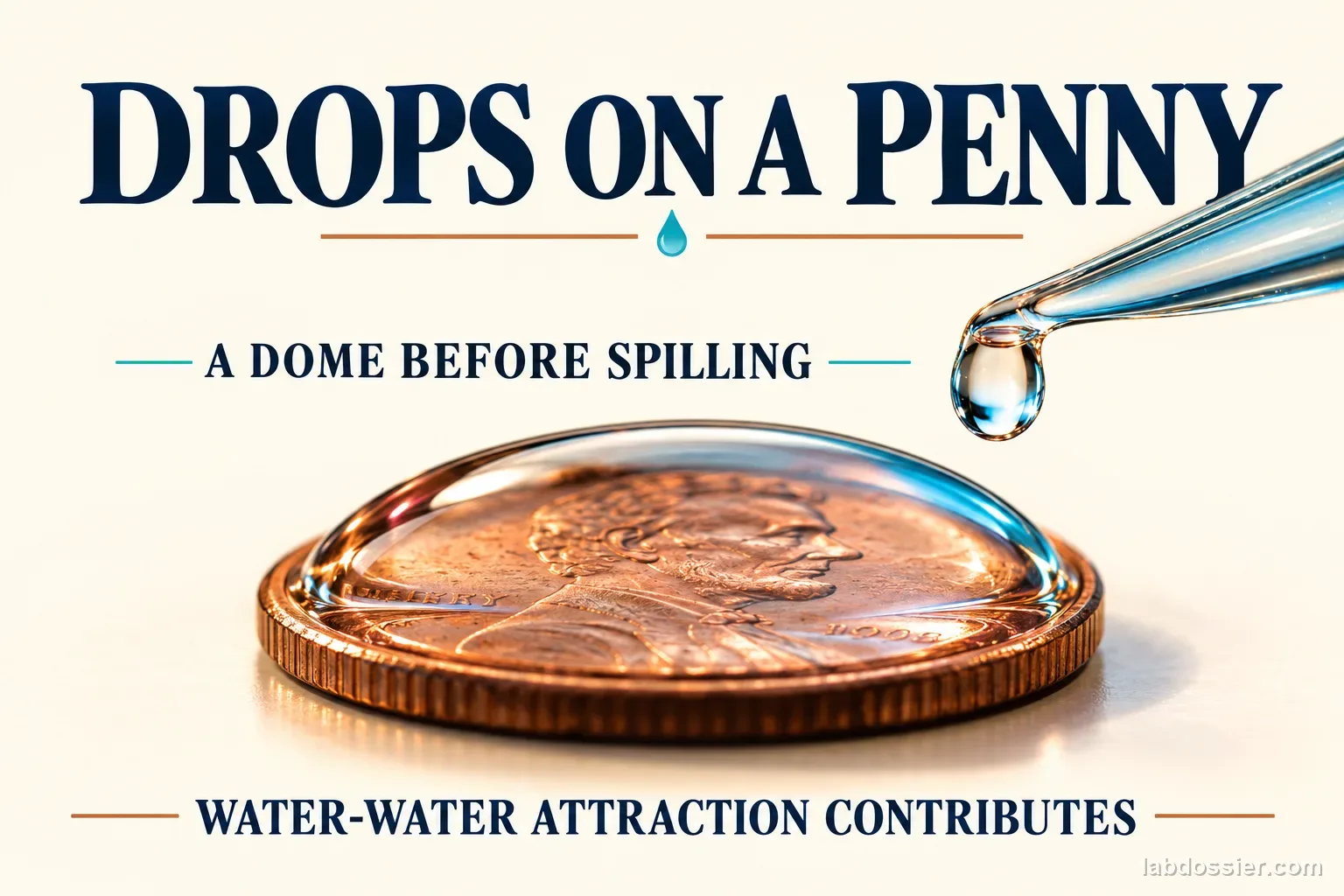
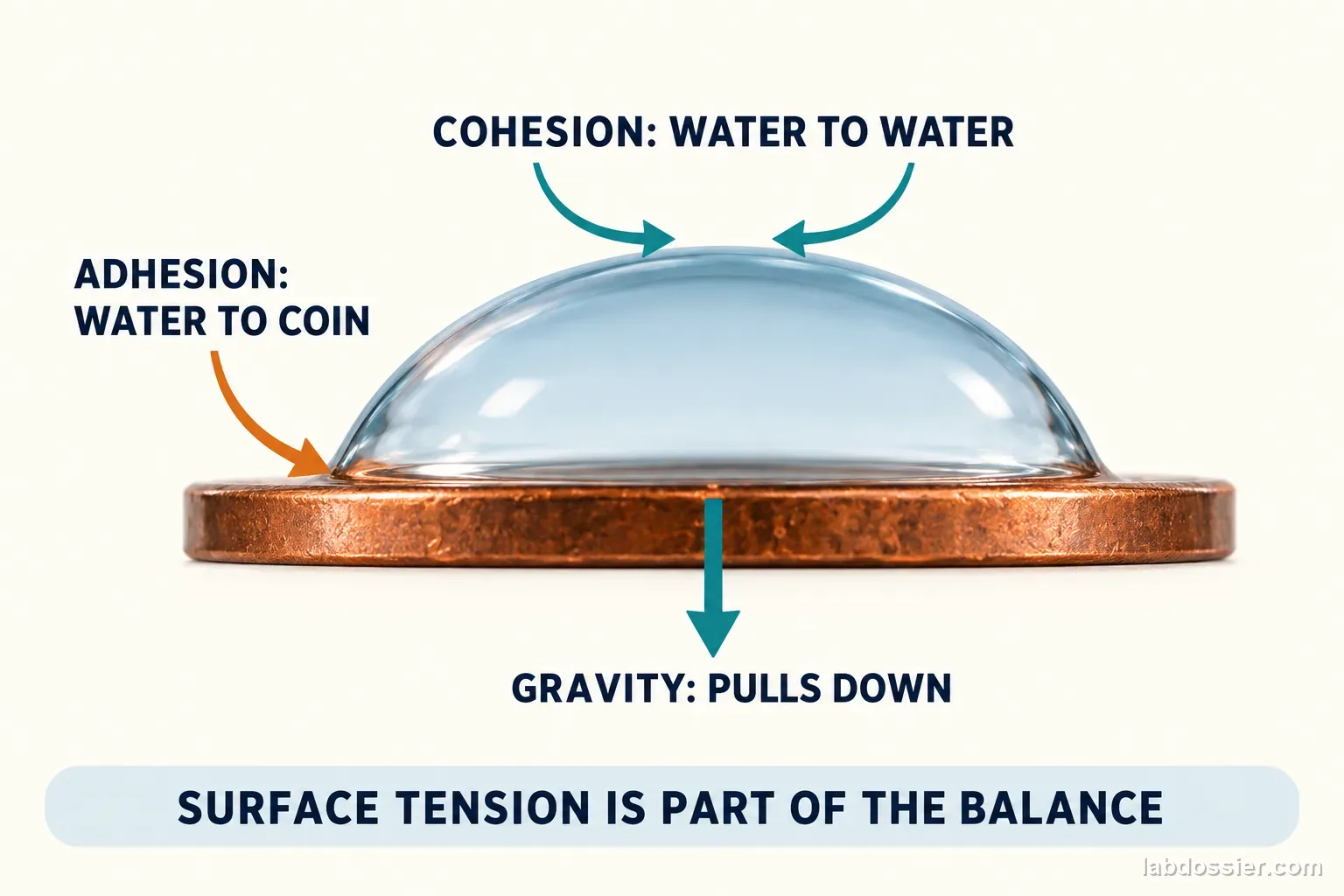
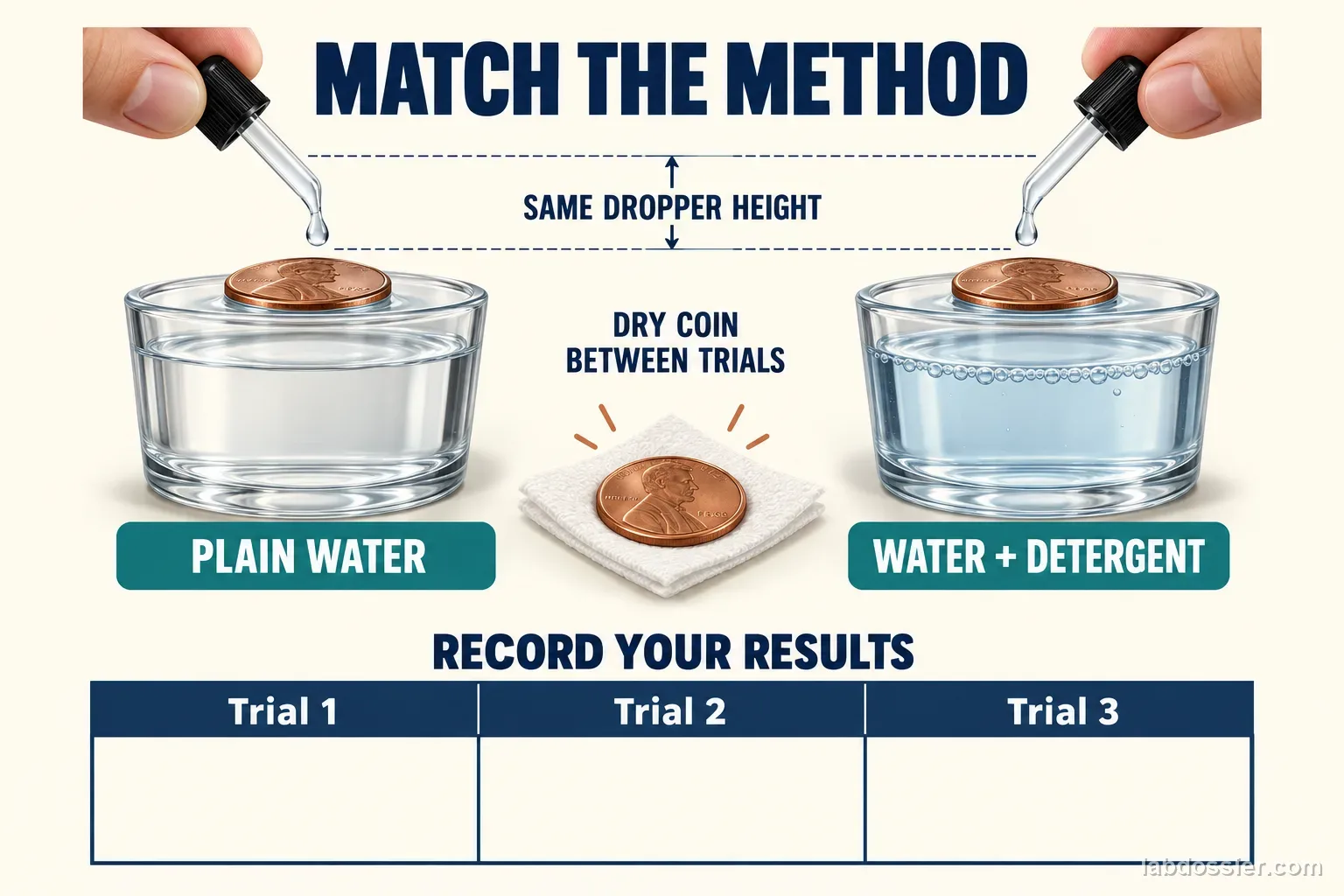
Printable shopping list
Shopping and staging checklist
Multiply the per-group kit contents by the class-size planner. The teacher section includes teacher-provided materials and setup or safety notes.
PER-GROUP KITS
- One clean penny placed flat on a tray
- One dropper, 30 mL plain water and 30 mL water with 1 drop of dish soap
- Two small labeled cups for the liquids
- Six paper-towel squares to dry the coin completely between all trials
- Recording sheet and calculator
TEACHER-PROVIDED MATERIALS + SETUP RULES
- Check that coins are age-appropriate; keep them away from mouths and younger children because they are small parts.
- Demonstrate a consistent dropper height and angle and a level penny. Use a tray to catch spills and wipe soapy water promptly.
- Do not drink test water after soap is added. Provide clean water for handwashing and keep the penny clean and dry between every trial.
QUANTITIES BY CLASS SIZE
| Material | Per group kit | 20 students | 25 students | 30 students |
|---|---|---|---|---|
| Clean coin | 1 | 7 | 9 | 10 |
| Dropper and labeled cups | 1 dropper and 2 cups | 7 droppers and 14 cups | 9 droppers and 18 cups | 10 droppers and 20 cups |
| Plain water | 30 mL | 210 mL | 270 mL | 300 mL |
| Soapy water | 30 mL with 1 drop dish soap | 210 mL with 7 drops soap | 270 mL with 9 drops soap | 300 mL with 10 drops soap |
| Coin-drying towels | 6 small squares | 42 squares | 54 squares | 60 squares |
| Student recording sheets | 1 per student | 20 sheets | 25 sheets | 30 sheets |
Prepare 7 kits for 20 · 9 kits for 25 · 10 kits for 30 students.
Lesson flow
| Minutes | What happens |
|---|---|
| 0–5 min | Engage Ask whether a penny will hold more drops of plain or soapy water. Set a common drop height and agree to exclude the drop that causes the first spill; review coin and soap precautions. |
| 5–10 min | Explore Place one clean penny flat on a level tray. Prepare separate cups of plain water and water with 1 drop of dish soap and practice a steady dropper position. |
| 10–20 min | Explore Add drops one at a time; when the next drop causes the first spill, record only the drops that stayed on the coin. Dry it fully and repeat for three plain-water trials. |
| 20–25 min | Explore Repeat for three soapy-water trials using the same coin and dropper position. Dry the penny completely between trials. |
| 25–30 min | Explain Calculate three-trial means and compare liquids. Explain how soap can reduce surface tension; wipe drips and wash hands. |
Discussion questions
1. Why can plain water form a dome above the penny?
2. Why does soapy water often spill sooner?
3. Why dry the same penny between all trials?
4. Why compare three trials instead of one?
Common misconceptions
Differentiation
SUPPORT
- Use a marked stand or card to keep the dropper at the same height for every trial.
- Assign one partner to release drops and another to count aloud and record.
- Offer the frame: “Plain water held an average of __ drops and soapy water __, a difference of __ drops.”
EXTEND
- Calculate the range of three counts for each liquid and compare it with the difference between the means.
- Test another measured soap amount while keeping coin, dropper and height constant.
- Compare two clean coins and explain how surface condition might affect results.
Assessment rubric
| Criterion | Beginning | Developing | Secure |
|---|---|---|---|
| Controlled method | Changes coin or dropper method between trials. | Keeps some conditions consistent but does not dry the coin or level the surface. | Uses the same clean, dry penny, dropper, height, angle and level surface throughout. |
| Trial record | Records few counts or omits the endpoint. | Records trials but omits units or does not separate the two liquids. | Records three whole-number counts of drops held before the spilling drop for each liquid. |
| Mean and comparison | Does not calculate means or compare liquids. | Calculates one mean or compares without using all trials. | Calculates both three-trial means correctly and compares the measured counts. |
| Explanation and care | Says the coin absorbs water or drinks soapy water. | Names surface tension but omits repeatability or coin safety. | Explains cohesion/surface tension, does not taste samples and wipes spills to prevent slipping. |
Vocabulary
- Cohesion – Attraction among molecules of the same substance, such as water molecules attracting one another.
- Surface tension – The effect of cohesive forces at a liquid surface that resists breaking or spreading.
- Drop count – The number of separate drops added before the stated spill endpoint.
- Trial – One run of a test under a specified method.
- Mean – The sum of values divided by the number of values.
- Surfactant – A substance such as soap that can change surface tension.
Safety, cleanup and troubleshooting
BEFORE STUDENTS TOUCH ANYTHING
- Use a clean penny and keep coins away from mouths and younger children because they are small parts. Do not drink water after dish soap is added.
- Keep soapy water away from eyes. Work over a tray and wipe drips promptly so the surface does not become slippery.
- Wash hands after handling the coin and liquids. Dry the penny completely between every trial and keep it on the tray.
Troubleshooting: If the water spreads immediately, check that the penny is level, clean and fully dry and that the dropper is held at the same height. If drops spill before counting is clear, dry the coin and repeat. Wipe all soapy drips before moving the tray or walking nearby.