LF-13 · TEACHER LESSON PLAN
Red cabbage pH indicator lab
Use cabbage pigment to compare acidic, near-neutral and basic samples
Driving question
Learning objectives
- Students observe and record each sample's indicator color under the same lighting and compare it with the purple reference.
- Students classify each tested liquid approximately as acidic, near neutral or basic from its observed color.
- Students explain how cabbage pigment responds to different liquids while noting that color is an approximate indicator, not an exact pH measurement.
Standards
| Dimension | Alignment |
|---|---|
| Performance expectation | MS-PS1-2Analyze and interpret data on the properties of substances before and after the substances interact to determine if a chemical reaction has occurred. (Partial alignment: students compare the indicator's color before and after adding household liquids; color change is not among the properties the assessment boundary lists (density, melting point, boiling point, solubility, flammability, odor).) |
| Practices | SEP 4Analyze and interpret data. |
| Core idea | PS1.BIn a chemical process, the atoms that make up the original substances are regrouped into different molecules, and these new substances have different properties from those of the reactants. |
| Crosscutting | PatternsMacroscopic patterns are related to the nature of microscopic and atomic-level structure. |
Standards text paraphrased from nextgenscience.org. Alignment is partial; this hands-on activity does not cover every part of the performance expectation.
State standards crosswalk
Use the row as a planning crosswalk, then confirm local district pacing and grade placement. “Partial” labels describe a skill connection, not full mastery of the complete standard.
| State | Verified standard | How this lesson aligns | Official source |
|---|---|---|---|
| California | CA NGSS MS-PS1-2 | Partial connection: students analyze color observations after samples interact, but color is not one of the properties named in the assessment boundary. | Open standard ↗ |
| Texas | Science.8.6(D) | Direct topic match: students compare acid and base behavior relative to the purple reference; the color test gives an approximate category, not a pH value. | Open standard ↗ |
| Florida | SC.8.P.9.2 | Partial connection: the investigation demonstrates an indicator color response, but does not distinguish physical from chemical changes using multiple lines of evidence. | Open standard ↗ |
| New York | NYSSLS MS-PS1-2 | Partial connection: students interpret a color change after interaction, but this short indicator test alone does not establish whether a new substance formed. | Open standard ↗ |
| Pennsylvania | STEELS 3.2.6-8.D | Partial connection: students analyze color properties after liquids interact, but color change alone is insufficient evidence to determine that a chemical reaction occurred. | Open standard ↗ |
Materials and prep timeline
PER GROUP
- Teacher-prepared cooled red-cabbage indicator: 10 mL in each of five cups
- Five clear or white cups: four food-grade tests plus one purple reference
- 2 mL each of lemon juice, vinegar, plain water and baking-soda solution
- One indicator dropper and one clean labeled dropper per test sample, labels, white paper and goggles
TEACHER ONLY
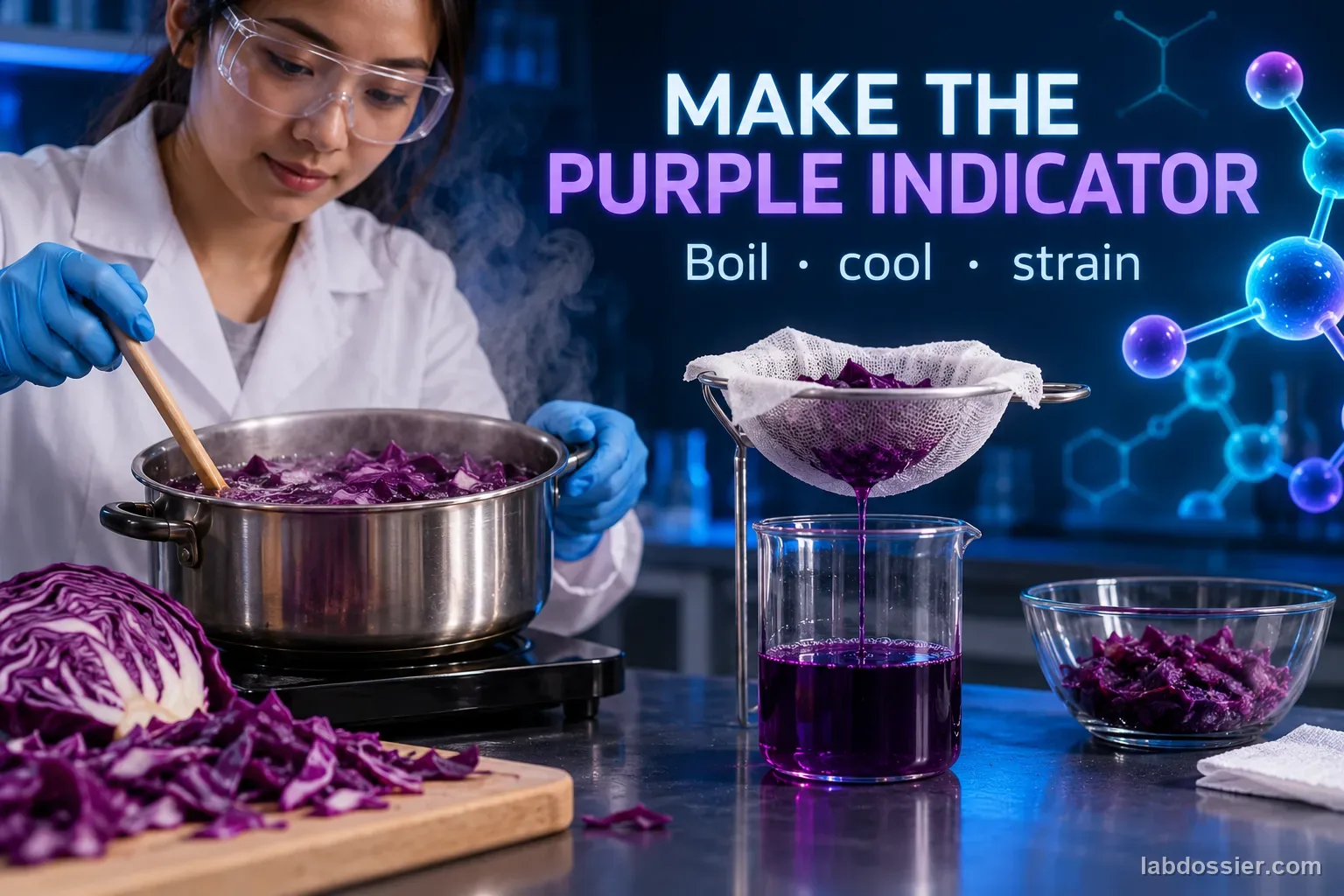
- An adult uses red cabbage and hot water to prepare the indicator, strains it through a separate strainer and lets it cool before students handle it.
- Use an adult-only pot for the hot-water preparation. Use only the listed food-grade samples and keep them in separate cups; do not bring household cleaners into this student activity.
- Provide one student sheet per student and keep a purple reference cup for comparison.
CLASS-SIZE KIT PLANNER
One per-group kit contains every item in the team materials list above. Groups are balanced around the listed 3–4 students target.
| Students | Groups | Per-group kits | Student sheets | Suggested group split |
|---|---|---|---|---|
| 20 | 5 | 5 complete kits | 20 copies | 5 groups of 4 |
| 25 | 7 | 7 complete kits | 25 copies | 4 groups of 4 and 3 groups of 3 |
| 30 | 8 | 8 complete kits | 30 copies | 6 groups of 4 and 2 groups of 3 |
Adult heats chopped cabbage in water, cools and strains the extract. Set out labeled, separate sample cups and fresh droppers.
Students predict possible color groups and review sample handling: observe only, do not taste, and never mix samples.
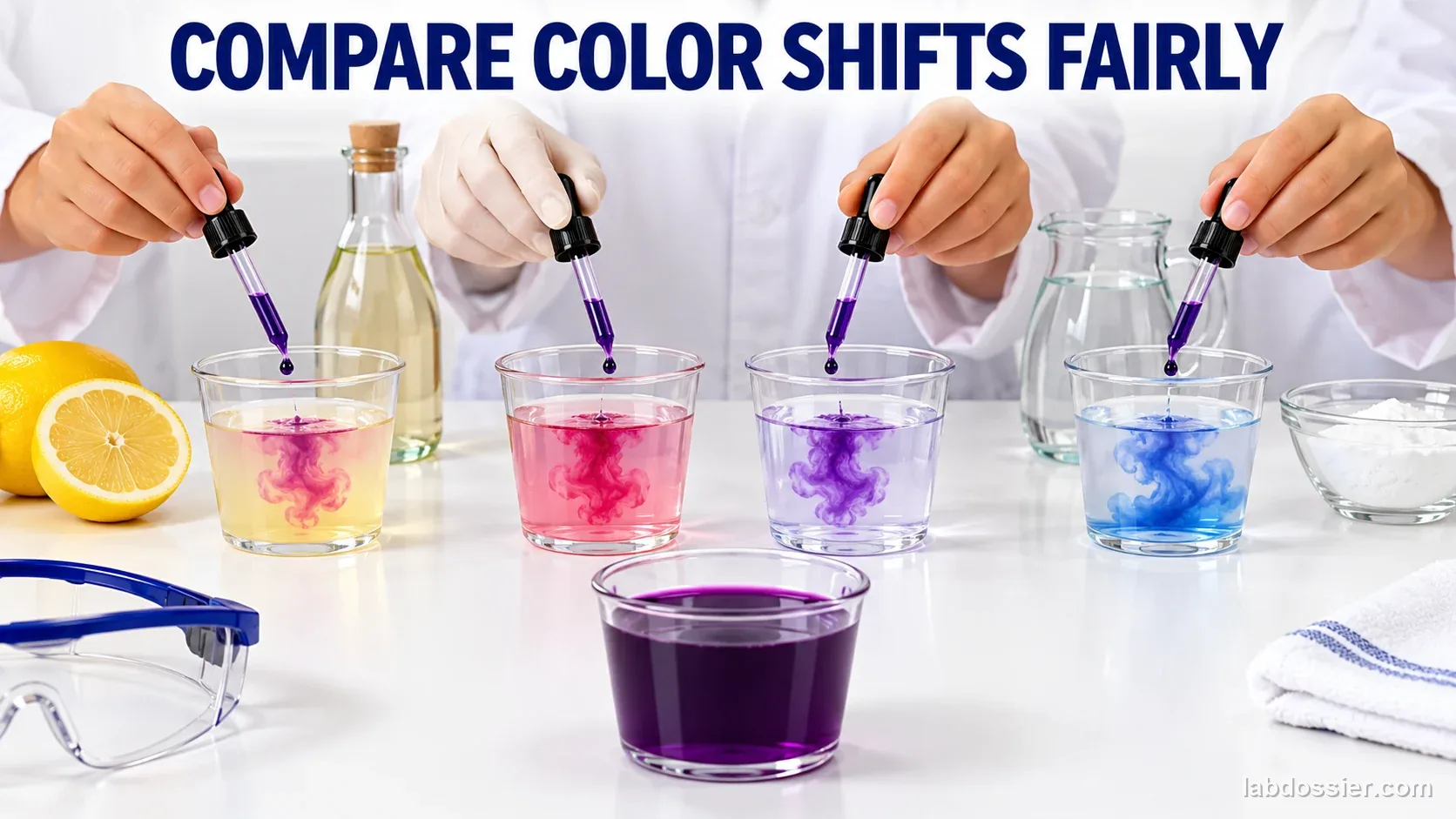
Add the same indicator volume to each cup and a small, equal amount of one teacher-approved liquid. Use a clean labeled dropper for each sample.
Record colors promptly under the same light and compare each with the purple reference; classify the result approximately.
Connect the color pattern to cabbage pigment and explain why it does not provide an exact pH value.
Lab figures and data visuals
Reviewed article images support the lesson flow. Use the tables and student sheet to record actual observations; pictured patterns are not target results.
Printable shopping list
Shopping and staging checklist
Multiply the per-group kit contents by the class-size planner. The teacher section includes teacher-provided materials and setup or safety notes.
PER-GROUP KITS
- Teacher-prepared cooled red-cabbage indicator: 10 mL in each of five cups
- Five clear or white cups: four food-grade tests plus one purple reference
- 2 mL each of lemon juice, vinegar, plain water and baking-soda solution
- One indicator dropper and one clean labeled dropper per test sample, labels, white paper and goggles
TEACHER-PROVIDED MATERIALS + SETUP RULES
- An adult uses red cabbage and hot water to prepare the indicator, strains it through a separate strainer and lets it cool before students handle it.
- Use an adult-only pot for the hot-water preparation. Use only the listed food-grade samples and keep them in separate cups; do not bring household cleaners into this student activity.
- Provide one student sheet per student and keep a purple reference cup for comparison.
QUANTITIES BY CLASS SIZE
| Material | Per group kit | 20 students | 25 students | 30 students |
|---|---|---|---|---|
| Cups, four food-grade test samples plus purple reference | 5 | 25 | 35 | 40 |
| Cooled red-cabbage indicator | 50 mL | 250 mL | 350 mL | 400 mL |
| Teacher prep: red cabbage, hot water, adult-only pot and strainer | Prepare a batch | Yield at least 250 mL | Yield at least 350 mL | Yield at least 400 mL |
| Lemon juice, vinegar and baking-soda solution | 2 mL each | 10 mL each | 14 mL each | 16 mL each |
| Separate clean droppers for the three test samples | 3, plus 1 indicator dropper | 15, plus 5 indicator droppers | 21, plus 7 indicator droppers | 24, plus 8 indicator droppers |
| White paper and label set | 1 sheet and set | 5 sheets and sets | 7 sheets and sets | 8 sheets and sets |
| Student sheets and goggles | 1 per student | 20 | 25 | 30 |
Prepare 5 kits for 20 · 7 kits for 25 · 8 kits for 30 students.
Lesson flow
| Minutes | What happens |
|---|---|
| 0–4 | Engage Show the cooled purple indicator. Ask how color might change across household liquids; separate prediction from measured result. |
| 4–7 | Explore Label clear cups and place a purple reference under the same light. Review goggles, no tasting, clean droppers and no mixing. |
| 7–14 | Explore Add equal indicator amounts. Test lemon juice, vinegar, plain water and baking-soda solution in separate labeled cups, using a clean dropper for each. Household cleaners are not part of this activity. |
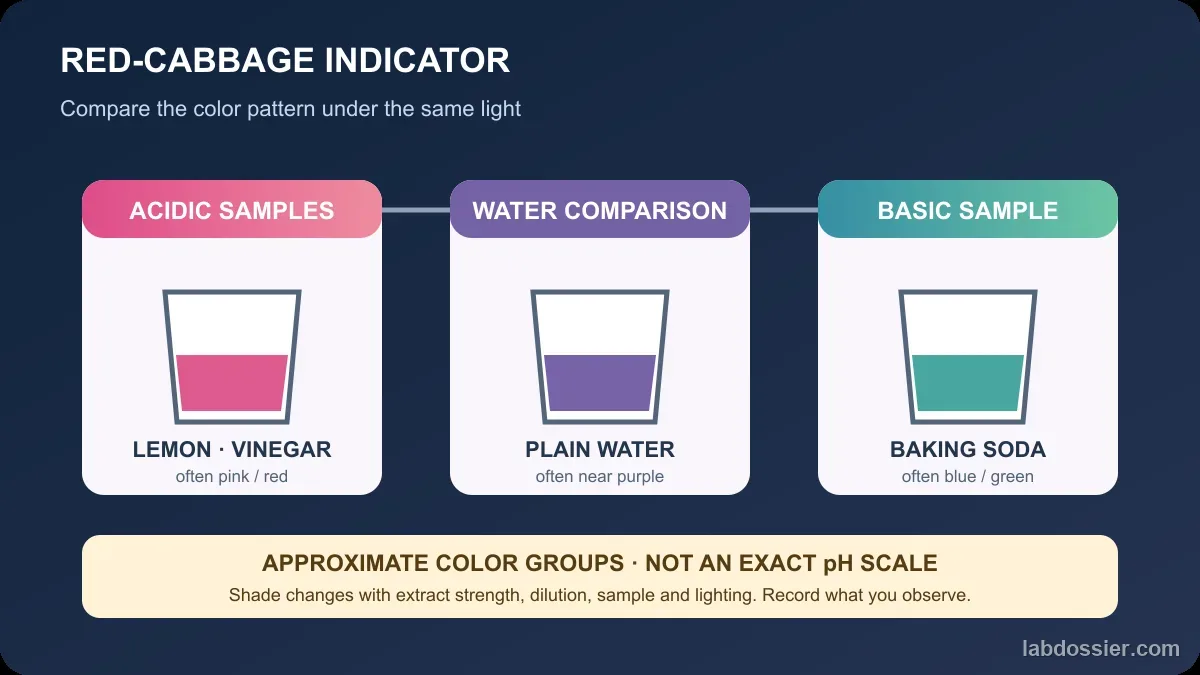
| 14–18 | Explain Record the resulting color and compare it with the reference. Red/pink commonly indicates an acidic sample, purple near neutral and blue/green a basic sample; shades depend on concentration and conditions. |
| 18–20 | Evaluate Use the color pattern to classify approximately. State that a calibrated pH strip or meter is needed for a more precise pH measurement. |
Discussion questions
1. What did the purple reference help you compare?
2. Which tested liquids appeared acidic or basic?
3. Why use the same amount of indicator and a clean dropper?
4. Why is cabbage color not an exact pH measurement?
Common misconceptions
Differentiation
SUPPORT
- Place a purple reference and a simple red/pink–purple–blue/green color strip beside the cups.
- Pre-label sample cups and match each to its own clean dropper; have an adult dispense the approved liquids.
- Offer the frame: “Compared with purple, sample ___ became ___. This suggests ___, but the color is approximate.”
EXTEND
- Compare a dilution series of one teacher-approved sample using equal indicator and total liquid volumes; record how the shade changes.
- Repeat the color comparison under two lighting conditions and explain why a controlled light source improves comparison.
- Compare the indicator's category with pH paper measurements collected by the teacher; explain mismatches and limits.
Assessment rubric
| Criterion | Beginning | Developing | Secure |
|---|---|---|---|
| Observation | Leaves colors blank or guesses from the sample name. | Records colors but uses inconsistent lighting or omits the reference. | Records each observed color and compares it with the purple reference under common light. |
| Approximate classification | Labels exact pH values without evidence. | Classifies some samples but does not connect labels to observed colors. | Uses observed colors to classify approximately and avoids claiming exact pH. |
| Fair comparison | Combines samples or uses no consistent method. | Uses separate cups but omits a control such as indicator amount or dropper cleanliness. | Uses equal indicator amounts, separately labeled cups and clean droppers for each approved sample. |
| Explanation and safety | Misstates color as exact or ignores safe handling. | Names pigment or safety rules without connecting them to the method. | Explains pigment-based color change, measurement limits and the rule never to mix samples or cleaners. |
Vocabulary
- Indicator – A material that changes appearance in response to a condition such as acidity or basicity.
- Anthocyanin – A plant pigment in red cabbage that can show different colors in different solutions.
- Acidic – A solution category associated with pH below neutral.
- Basic – A solution category associated with pH above neutral.
- Neutral – A solution category near pH 7 in water-based comparisons.
- Reference – A comparison standard, here the starting purple indicator color.
Safety, cleanup and troubleshooting
BEFORE STUDENTS TOUCH ANYTHING
- An adult should prepare the cabbage extract with hot water and let it cool before students handle it. Wear goggles and do not taste any test sample.
- Use only the listed small food-grade samples: lemon juice, vinegar, plain water and baking-soda solution. Keep samples in separate labeled cups and leave household cleaners out of the activity.
Troubleshooting: If no color shift is visible, confirm the extract is cooled and the liquid is added to its own clear cup under good light. Use fresh indicator and a clean dropper. If an unknown or unapproved product appears, do not test it; tell the supervising adult.