LF-20 · TEACHER LESSON PLAN
Salt water egg float lab
Why an egg sinks in plain water but floats in salt water
Driving question
Learning objectives
- Students prepare equal 300 mL water samples with 0, 3 and 6 tablespoons of salt, dissolving each salt amount fully before testing.
- Students classify the egg as sinking or floating in each prepared amount and measure its height above the surface when it floats.
- Students bracket the tested salt-amount interval where the egg begins to float without claiming an exact threshold between untested amounts.
Standards
| Dimension | Alignment |
|---|---|
| Performance expectation | MS-PS1-1Develop models to describe the atomic composition of simple molecules and extended structures. (Partial alignment: this is the performance expectation the lab lists, but the activity investigates a physical property of matter (salt-water density and concentration) rather than building atomic models.) |
| Practices | SEP 3Plan and carry out investigations. |
| Core idea | PS1.AEach pure substance has characteristic physical and chemical properties (for any bulk quantity under given conditions) that can be used to identify it. |
| Crosscutting | Cause and effectCause and effect relationships are routinely identified, tested, and used to explain change. |
Standards text paraphrased from nextgenscience.org. Alignment is partial; this hands-on activity does not cover every part of the performance expectation. CCC wording not independently verified.
State standards crosswalk
Use the row as a planning crosswalk, then confirm local district pacing and grade placement. “Partial” labels describe a skill connection, not full mastery of the complete standard.
| State | Verified standard | How this lesson aligns | Official source |
|---|---|---|---|
| California | CA NGSS 5-PS1-3 | Limited. Students measure a material property, but the California assessment boundary explicitly excludes density; this egg buoyancy test does not identify materials using the listed properties. | Open standard ↗ |
| Texas | Science.5.6(A) | Partial. The standard explicitly includes relative density through sinking and floating, but this investigation uses spoon-measured salt and does not calculate the egg or solution density. | Open standard ↗ |
| Florida | SC.8.P.8.4 | Partial. Density is a relevant physical property, but students observe an egg in prepared solutions rather than measure mass and volume to compare densities. | Open standard ↗ |
| New York | NYSSLS MS-PS1-7 | Limited. The standard uses density evidence to identify matter; this activity neither measures density nor identifies an unknown sample, and its threshold is only bracketed. | Open standard ↗ |
| Pennsylvania | STEELS 3.2.2.A | Limited. Students test an observable sinking or floating behavior, while this grade-two standard focuses on classifying materials by observable properties and does not address solution density. | Open standard ↗ |
Materials and prep timeline
PER GROUP
- One similar raw egg for the three sequential tests
- Three clear cups, each with 300 mL room-temperature water
- Table salt: 0, 3 and 6 tablespoons
- Measuring spoons and stirring spoon
- Labels, balance if available, tray and towel
TEACHER ONLY
- Check that the egg is intact before testing; keep it away from food and provide hand/surface-cleaning supplies.
- Use stable cups deep enough to submerge the egg; set the station on a tray.
- Provide one student sheet per student; no samples are tasted.
CLASS-SIZE KIT PLANNER
One per-group kit contains every item in the team materials list above. Groups are balanced around the listed 3–4 students target.
| Students | Groups | Per-group kits | Student sheets | Suggested group split |
|---|---|---|---|---|
| 20 | 6 | 6 complete kits | 20 copies | 2 groups of 4 and 4 groups of 3 |
| 25 | 7 | 7 complete kits | 25 copies | 4 groups of 4 and 3 groups of 3 |
| 30 | 8 | 8 complete kits | 30 copies | 6 groups of 4 and 2 groups of 3 |
Predict which tested salt amounts may make the egg float. Explain that the result will bracket a range, not necessarily an exact threshold.
Measure 300 mL water into each cup; add 0, 3 and 6 tablespoons of salt and stir the salted samples until fully dissolved.
Lower the intact egg gently with a spoon into each cup, rinse between tests and record sink/float. Measure height above the surface only when it floats.
Identify the greatest tested salt amount where the egg sinks and the smallest where it floats; that pair brackets the threshold.
Connect dissolved salt to solution density, discuss measurement limits and wash hands and surfaces.
Lab figures and data visuals
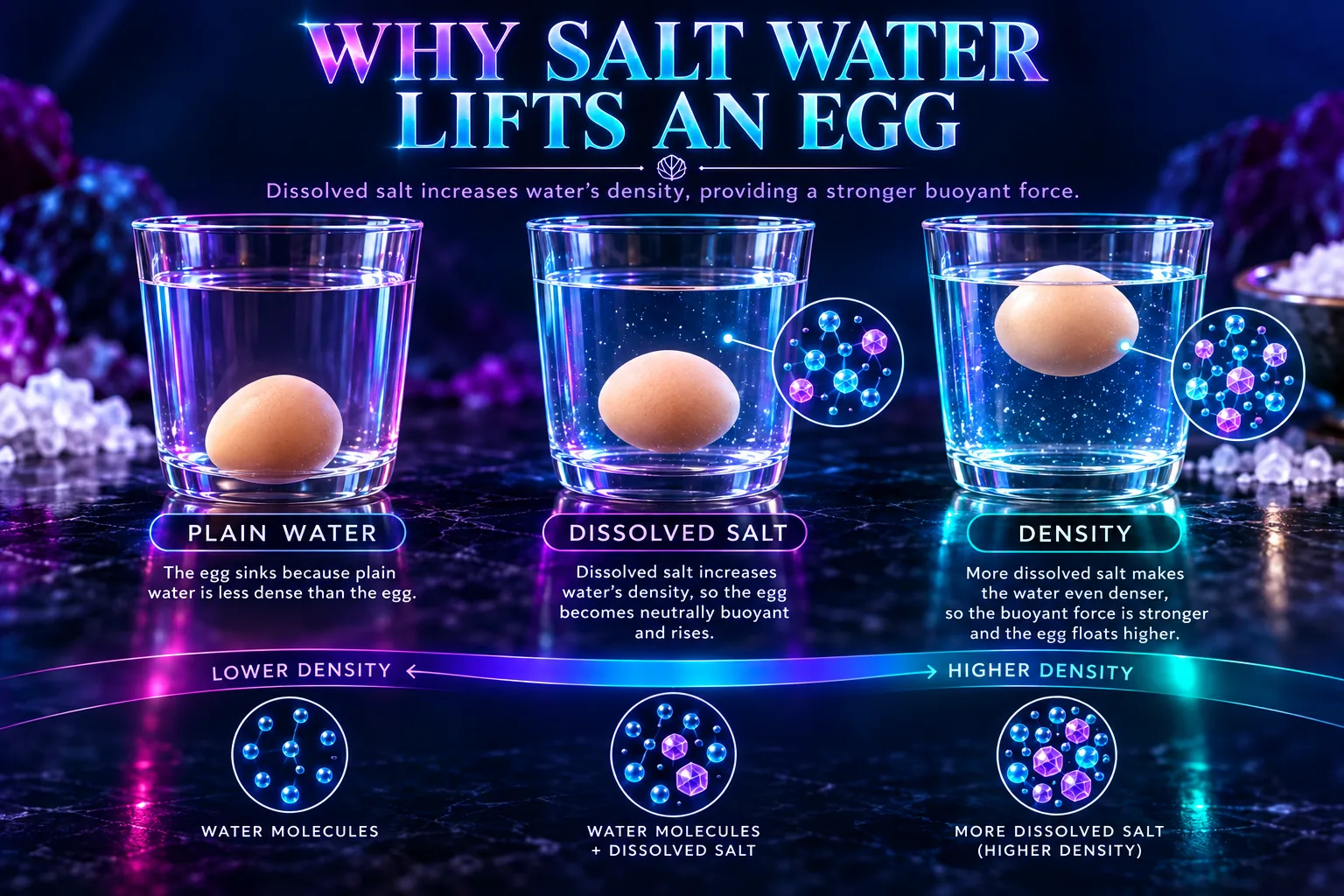
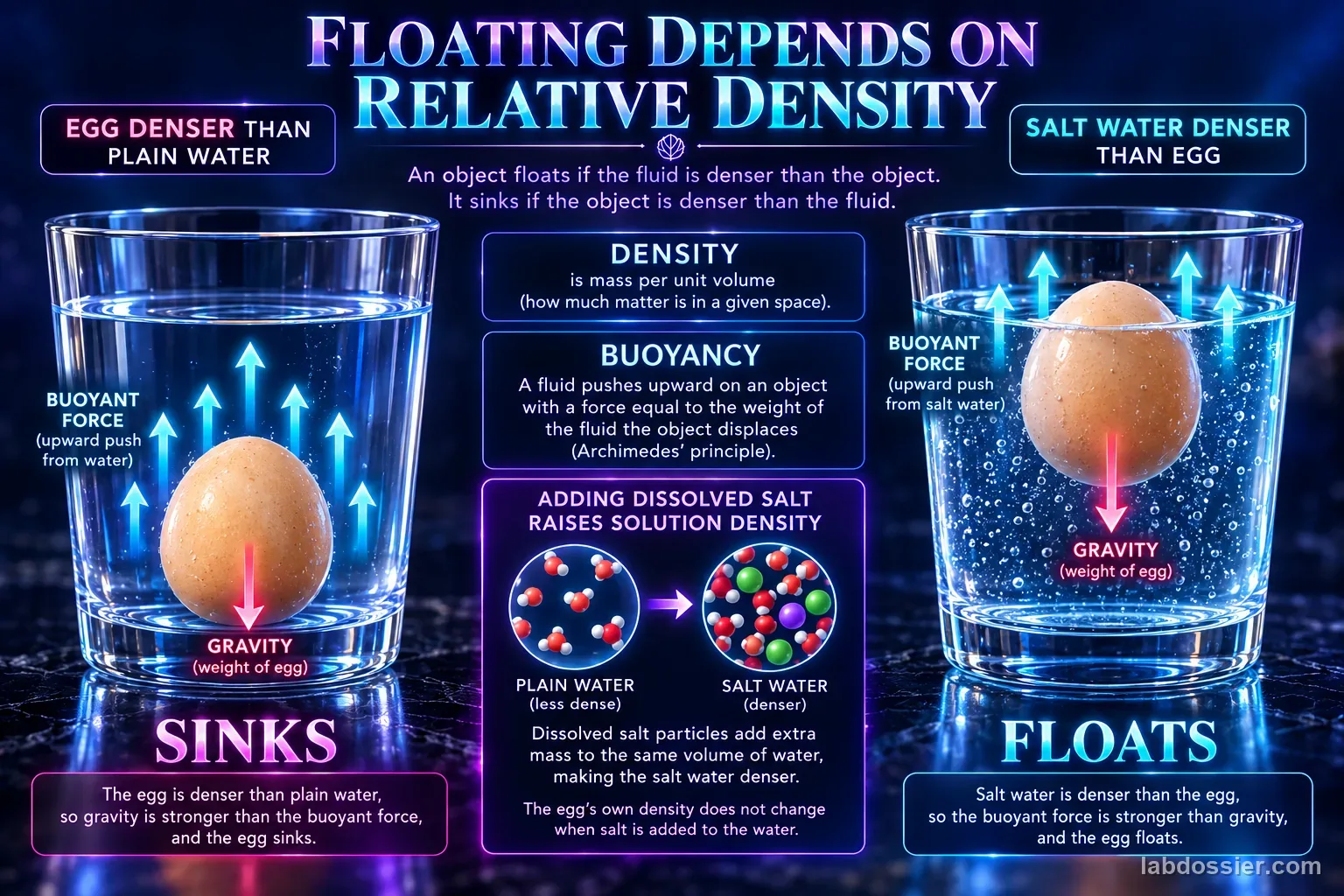
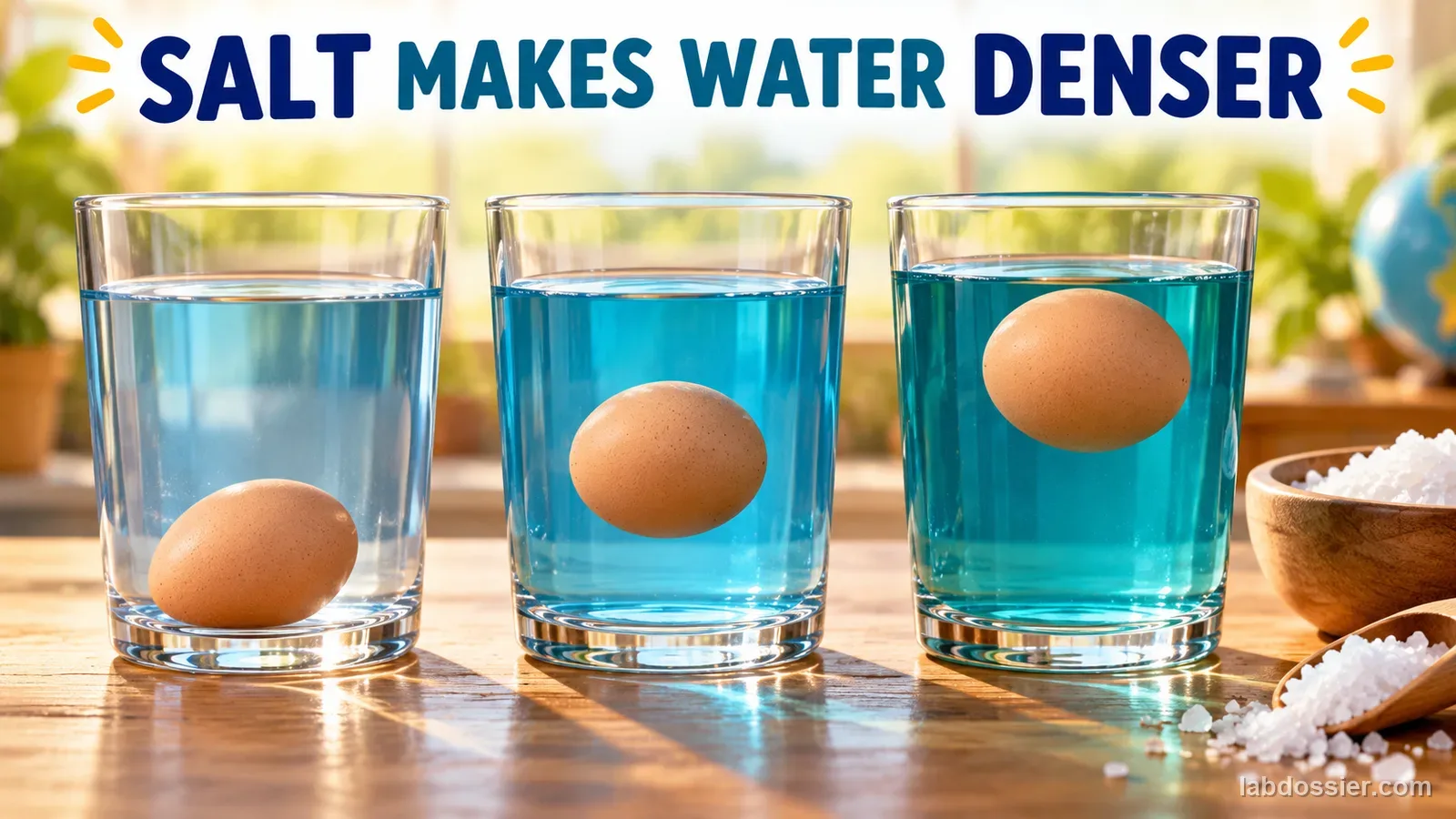
Reviewed article images support the lesson flow. Use the tables and student sheet to record actual observations; pictured patterns are not target results.
Printable shopping list
Shopping and staging checklist
Multiply the per-group kit contents by the class-size planner. The teacher section includes teacher-provided materials and setup or safety notes.
PER-GROUP KITS
- One similar raw egg for the three sequential tests
- Three clear cups, each with 300 mL room-temperature water
- Table salt: 0, 3 and 6 tablespoons
- Measuring spoons and stirring spoon
- Labels, balance if available, tray and towel
TEACHER-PROVIDED MATERIALS + SETUP RULES
- Check that the egg is intact before testing; keep it away from food and provide hand/surface-cleaning supplies.
- Use stable cups deep enough to submerge the egg; set the station on a tray.
- Provide one student sheet per student; no samples are tasted.
QUANTITIES BY CLASS SIZE
| Material | Per group kit | 20 students | 25 students | 30 students |
|---|---|---|---|---|
| Intact raw eggs | 1 egg | 6 eggs | 7 eggs | 8 eggs |
| Clear cups | 3 cups | 18 cups | 21 cups | 24 cups |
| Room-temperature water | 900 mL | 5.4 L | 6.3 L | 7.2 L |
| Table salt | 9 tablespoons total | 54 tablespoons | 63 tablespoons | 72 tablespoons |
| Measuring and stirring spoons | 1 set | 6 sets | 7 sets | 8 sets |
| Tray, labels and towels | 1 station set | 6 station sets | 7 station sets | 8 station sets |
| Student data sheets | 1 per student | 20 copies | 25 copies | 30 copies |
Prepare 6 kits for 20 · 7 kits for 25 · 8 kits for 30 students.
Lesson flow
| Minutes | What happens |
|---|---|
| 0–4 | Engage Ask how increasing dissolved salt may change an egg's position. Record a prediction before preparing or testing samples. |
| 4–10 | Explore Measure equal 300 mL water volumes into three labeled cups. Add 0, 3 and 6 tablespoons of salt; stir until every measured salt sample is dissolved. |
| 10–17 | Gently lower the same intact egg into each solution with a spoon, rinsing it between cups. Record sinks/floats and measure height above the water only when it floats. |
| 17–21 | Explain Find the highest tested salt amount where the egg sank and the lowest where it floated. Report these as the interval bracketing the threshold. |
| 21–25 | Evaluate Explain that dissolved salt raises water density; the exact transition depends on the egg and measured preparation. Wash hands, cups and the work surface. |
Discussion questions
1. What does a sink result in plain water and a float result at 3 tablespoons tell you?
2. Why must the salt dissolve fully?
3. Why keep each water volume and cup size the same?
4. Why might another class find a different threshold?
Common misconceptions
Differentiation
SUPPORT
- Use labeled cups and pre-measured 0, 3 and 6 tablespoon salt portions.
- Show a three-state card: sinks, floats at surface, or suspended; record the actual state before measuring height.
- Offer the frame: “The egg sank at __ tbsp and floated at __ tbsp, so the tested transition lies between those amounts.”
EXTEND
- Weigh the salt and calculate mass per 300 mL to describe the solution more precisely than spoon count.
- Test one or more intermediate amounts between the highest sink and lowest float, using fresh equal-volume samples.
- Repeat the threshold series with similar eggs and compare the intervals rather than claiming one exact universal threshold.
Assessment rubric
| Criterion | Beginning | Developing | Secure |
|---|---|---|---|
| Prepared samples | Does not label salt amounts or water volumes. | Labels the amounts but omits equal volume or complete dissolving. | Uses equal 300 mL samples labeled 0, 3 and 6 tbsp and dissolves the salt before testing. |
| Egg classification | Leaves sink/float results blank or guesses. | Records results but does not distinguish floating height from sinking. | Records actual sink/float result and measures above-surface height only when the egg floats. |
| Threshold interval | Claims an exact untested salt amount. | Identifies a broad transition but omits the bracketing results. | Uses the greatest tested sink amount and lowest tested float amount to state an interval. |
| Density explanation and safety | Explains only by egg weight or tastes a sample. | Names salt or density but omits a relevant control or safety step. | Connects dissolved salt with density, notes egg/preparation variation and handles raw egg safely. |
Vocabulary
- Solution – A mixture in which a substance such as salt is dissolved in water.
- Concentration – How much dissolved substance is present in a given amount of solution.
- Dissolve – To spread a substance's particles through a liquid to form a solution.
- Density – Mass divided by volume; how much mass occupies a given amount of space.
- Threshold – A boundary or range where an observed result changes from one state to another.
- Buoyancy – The upward support a liquid provides to an immersed object.
Safety, cleanup and troubleshooting
BEFORE STUDENTS TOUCH ANYTHING
- Raw eggs can carry Salmonella. Do not eat or taste any sample; wash hands, cups, and the work surface after handling, and keep the egg away from food-preparation areas.
- Use stable cups on a tray and wipe spilled water or salt solution promptly.
- Inspect the egg for cracks before use and lower it gently with a spoon so it does not strike the cup bottom. Stop if the shell breaks and clean up with adult help.
Troubleshooting: Six tablespoons is close to the most salt that 300 mL of room-temperature water can dissolve, so some may stay on the bottom; keep stirring, record any salt that does not dissolve, and do not treat that cup as a fully prepared sample. If salt remains visible in the other cups, keep stirring until dissolved before testing. If the egg cracks, do not continue with it; ask an adult to clean the cup and area, wash hands and use an intact egg if the activity can safely continue.