LF-26 · TEACHER LESSON PLAN
Sink or float lab
Test how density, shape and trapped air affect floating
Driving question
Learning objectives
- Students predict whether each safe everyday object will sink or float before testing it in the same water.
- Students classify the actual settled position separately from the prediction and distinguish floating, sinking, suspension and change over time.
- Students explain how buoyant force, average density, shape and trapped air help explain the observation, while noting that the test alone does not measure density.
Standards
| Dimension | Alignment |
|---|---|
| Performance expectation | MS-PS1-1Develop models to describe the atomic composition of simple molecules and extended structures. (Partial alignment: this is the performance expectation the lab lists, but the activity investigates a physical property of matter (object density compared with water) rather than building atomic models.) |
| Practices | SEP 3Plan and carry out investigations. |
| Core idea | PS1.AEach pure substance has characteristic physical and chemical properties (for any bulk quantity under given conditions) that can be used to identify it. |
| Crosscutting | Cause and effectCause and effect relationships are routinely identified, tested, and used to explain change. |
Standards text paraphrased from nextgenscience.org. Alignment is partial; this hands-on activity does not cover every part of the performance expectation. CCC wording not independently verified.
State standards crosswalk
Use the row as a planning crosswalk, then confirm local district pacing and grade placement. “Partial” labels describe a skill connection, not full mastery of the complete standard.
| State | Verified standard | How this lesson aligns | Official source |
|---|---|---|---|
| California | CA NGSS 2-PS1-1 | Partial. Students investigate and classify objects by an observed sink-or-float property, while the lesson's optional density calculations extend beyond the standard's listed observable-property examples. | Open standard ↗ |
| Texas | Science.5.6(A) | Partial. Testing and comparing sink-or-float behavior connects directly to relative density, but the lesson does not test the full list of physical properties named by this grade-five expectation. | Open standard ↗ |
| Florida | SC.1.P.8.1 | Direct activity connection. The benchmark explicitly includes whether objects sink or float among observable properties; the optional mass-volume density calculation extends beyond the benchmark wording. | Open standard ↗ |
| New York | 2-PS1-1 | Partial. Students plan a simple water test and classify materials by an observable result; sink-or-float is not among the standard's example properties, and density is not developed there. | Open standard ↗ |
| Pennsylvania | 3.2.2.A | Partial. The class conducts an investigation and classifies materials by an observed result, but the standard's examples focus on color, texture, hardness, and flexibility rather than density. | Open standard ↗ |
Materials and prep timeline
PER GROUP
- Stable clear basin with room-temperature water
- Large nonporous wooden block, metal spoon, plastic cap, rubber eraser and whole orange
- Balance and ruler; graduated cylinder only for suitable nonporous samples
- Towel, labels and recording sheet
- Tray to contain drips
TEACHER ONLY
- Choose large, clean, non-breakable objects without sharp edges; avoid small parts with young children.
- Keep the water basin stable and away from electrical equipment; prepare a dry spill area.
- Provide one student sheet per student; remind students not to put objects or water in their mouths.
CLASS-SIZE KIT PLANNER
One per-group kit contains every item in the team materials list above. Groups are balanced around the listed 3–4 students target.
| Students | Groups | Per-group kits | Student sheets | Suggested group split |
|---|---|---|---|---|
| 20 | 6 | 6 complete kits | 20 copies | 2 groups of 4 and 4 groups of 3 |
| 25 | 7 | 7 complete kits | 25 copies | 4 groups of 4 and 3 groups of 3 |
| 30 | 8 | 8 complete kits | 30 copies | 6 groups of 4 and 2 groups of 3 |
List the five objects, note their shape and visible air spaces, then predict a result and state one reason before testing.
Lower each object gently into the same basin. Wait for the water to settle and record the result.
Only for suitable nonporous samples, measure mass and valid volume, calculate density, and compare with the water; mark the rest not measured.
Compare predictions with actual positions; discuss buoyant force, shape, trapped air and possible surface-tension effects.
Use density rather than heaviness alone, then dry the surface and return objects.
Lab figures and data visuals
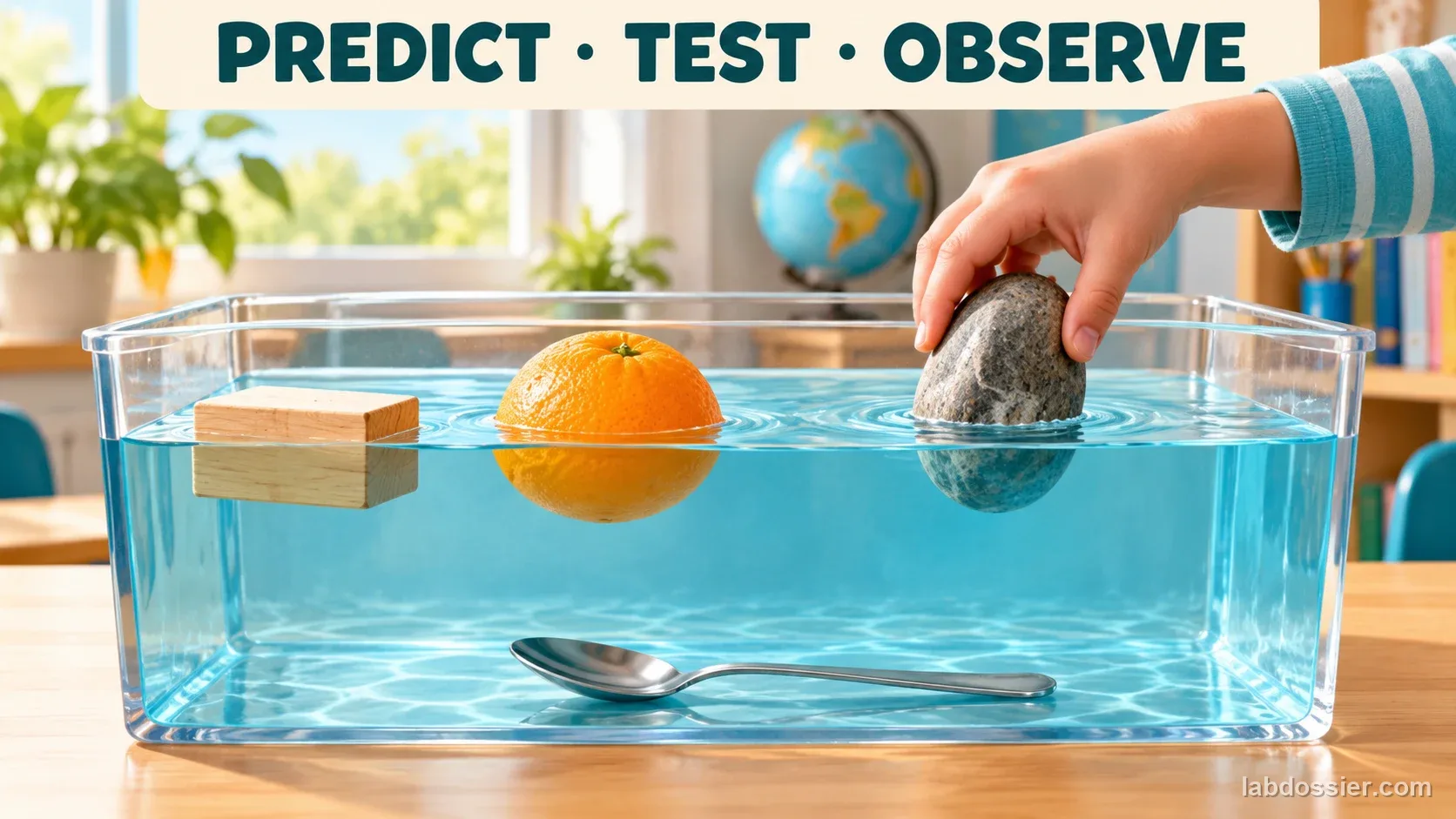
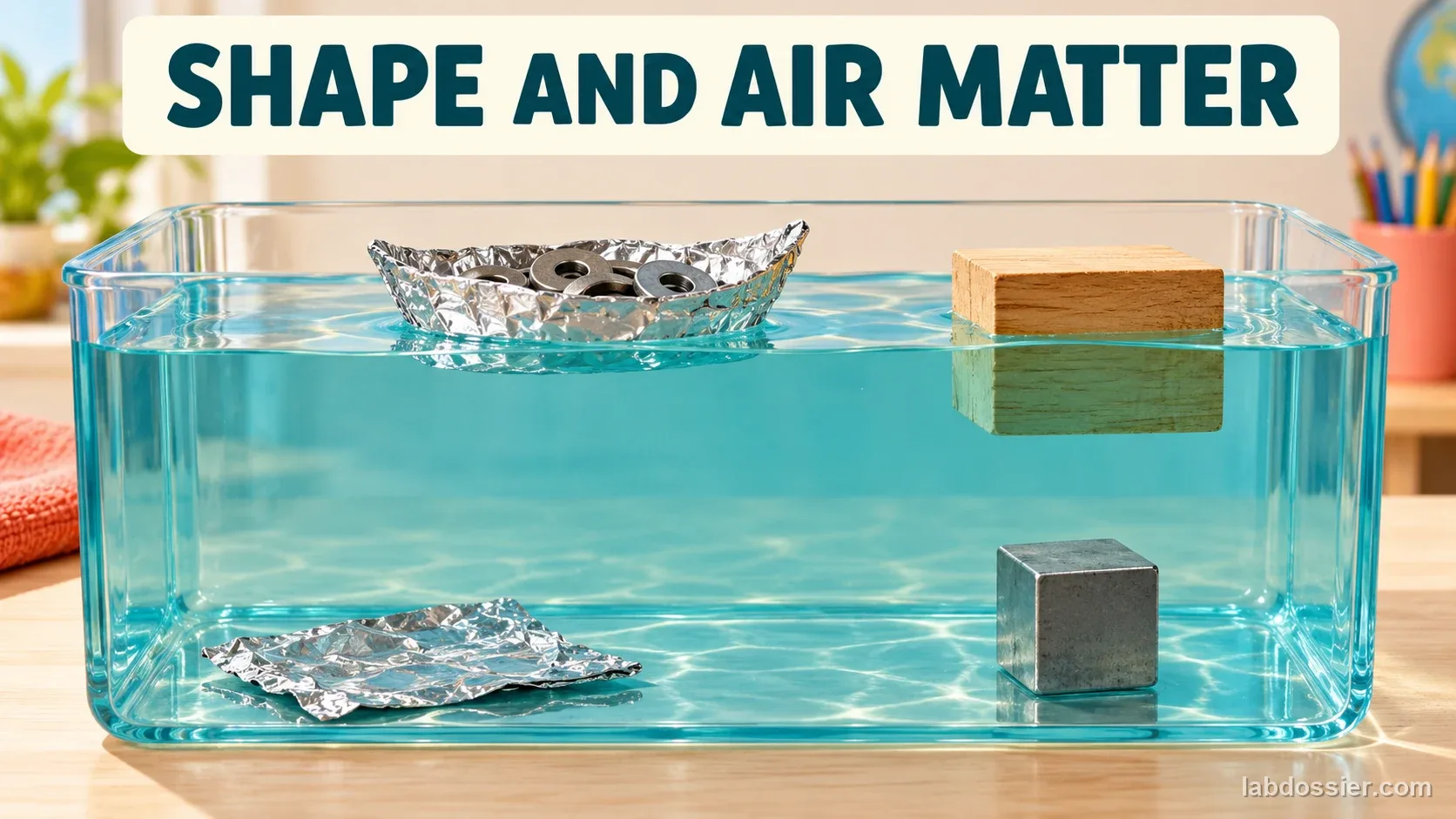
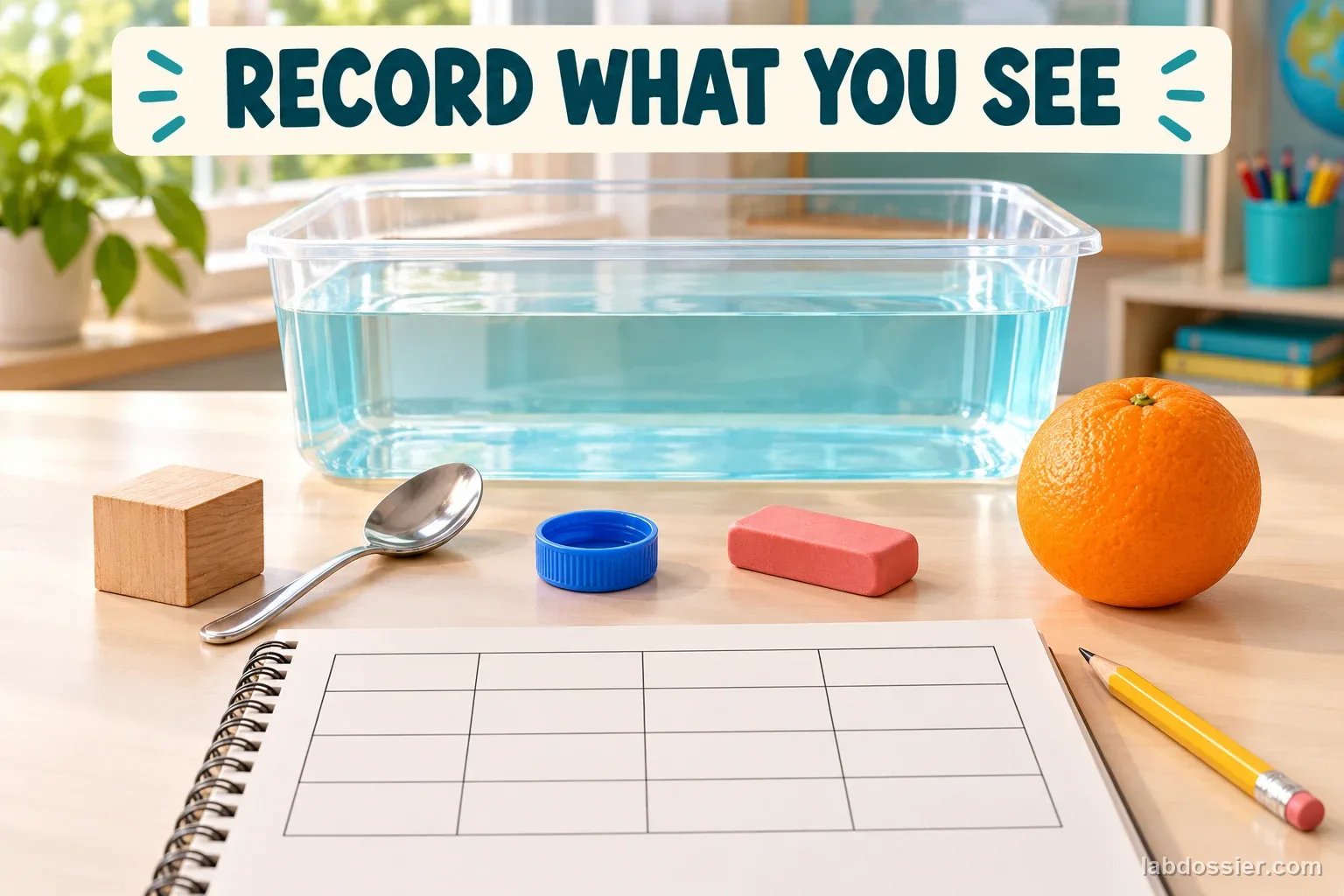
Reviewed article images support the lesson flow. Use the tables and student sheet to record actual observations; pictured patterns are not target results.
Printable shopping list
Shopping and staging checklist
Multiply the per-group kit contents by the class-size planner. The teacher section includes teacher-provided materials and setup or safety notes.
PER-GROUP KITS
- Stable clear basin with room-temperature water
- Large nonporous wooden block, metal spoon, plastic cap, rubber eraser and whole orange
- Balance and ruler; graduated cylinder only for suitable nonporous samples
- Towel, labels and recording sheet
- Tray to contain drips
TEACHER-PROVIDED MATERIALS + SETUP RULES
- Choose large, clean, non-breakable objects without sharp edges; avoid small parts with young children.
- Keep the water basin stable and away from electrical equipment; prepare a dry spill area.
- Provide one student sheet per student; remind students not to put objects or water in their mouths.
QUANTITIES BY CLASS SIZE
| Material | Per group kit | 20 students | 25 students | 30 students |
|---|---|---|---|---|
| Wooden blocks, metal spoons, plastic caps, rubber erasers, and oranges | 1 of each | 6 of each | 7 of each | 8 of each |
| Stable clear basins filled with water | 1 | 6 | 7 | 8 |
| Balances, rulers, and graduated cylinders | 1 of each | 6 of each | 7 of each | 8 of each |
| Trays and towels | 1 of each | 6 of each | 7 of each | 8 of each |
| Object labels | 5 | 30 | 35 | 40 |
| Student prediction and observation sheets | 1 per student | 20 copies | 25 copies | 30 copies |
Prepare 6 kits for 20 · 7 kits for 25 · 8 kits for 30 students.
Lesson flow
| Minutes | What happens |
|---|---|
| 0–4 | Engage Predict sink or float for a wooden block, metal spoon, plastic bottle cap, rubber eraser and orange with peel. Record reasons before testing. |
| 4–12 | Explore Use one stable basin of room-temperature water. Lower each large, safe object gently and record the actual classification after ripples stop. |
| 12–18 | Only for suitable samples, measure mass and valid volume, then calculate mass ÷ volume. Mark unsuitable samples not measured. |
| 18–22 | Explain Compare predictions with observations. Discuss buoyant force, shape, trapped air and how the same foil can sink flat or float as a boat. |
| 22–25 | Evaluate Explain one surprise without using total weight alone; dry drips and keep water away from electrical items. |
Discussion questions
1. Why can a large wooden block float even if it feels heavy?
2. What did the prediction column let you compare?
3. Why might the orange float with its peel?
4. Does the float-or-sink observation measure density?
Common misconceptions
Differentiation
SUPPORT
- Use two large picture cards labeled FLOAT and SINK and let students place each prediction before testing.
- Demonstrate lowering one object gently and waiting for ripples to stop before recording.
- Offer the frame: “I predicted ___. It actually ___. Its density is ___ than water / not measured.”
EXTEND
- Measure mass and volume for a regular block and calculate density in g/mL.
- Compare an orange with peel and the same orange peeled as a separate follow-up test.
- Test a sealed hollow container and explain why its average density differs from the material its shell is made from.
Assessment rubric
| Criterion | Beginning | Developing | Secure |
|---|---|---|---|
| Prediction | Leaves predictions blank or copies results after testing. | Predicts most objects but omits reasons or labels. | Records a sink/float prediction and a reason for each object before testing. |
| Classification | Does not record actual results. | Records most actual results but mixes predictions and observations. | Classifies each object from the settled observation and compares it with the prediction. |
| Density evidence | Explains only by total weight. | Names density but does not relate it to water or measured values. | Uses mass/volume only when both were validly measured and compares with water; marks other samples not measured. |
| Explanation | Claims object size or material name alone determines the result. | Explains one case but omits shape or trapped air. | Explains a result using average density and recognizes shape or trapped air as a factor. |
Vocabulary
- Density – Mass divided by volume; how much mass occupies a given amount of space.
- Mass – A measure of the amount of matter in an object.
- Volume – The amount of space an object or sample occupies.
- Displacement – The amount of water moved aside when an object is submerged.
- Classification – Grouping an observation by a stated rule, such as sink or float.
- Average density – Total mass divided by the whole object's volume, including sealed air spaces.
- Buoyant force – The upward force from water, equal to the weight of the water displaced by a submerged object.
- Surface tension – A surface effect that can support some very small objects without showing the usual bulk-density pattern.
Safety, cleanup and troubleshooting
BEFORE STUDENTS TOUCH ANYTHING
- Use large, clean, non-breakable objects with no sharp edges. Avoid small parts around young children, and never put test objects or water in your mouth.
- Lower objects gently into a stable basin, keep water away from electrical equipment, and dry spills promptly.
Troubleshooting: If an object is difficult to classify, wait for ripples to stop and check that it is not resting against the basin wall. If water spills, pause testing and dry the floor before walking through the area.