LF-10 · TEACHER LESSON PLAN
Skittles diffusion experiment
Test how water temperature affects candy-color spreading
Driving question
Learning objectives
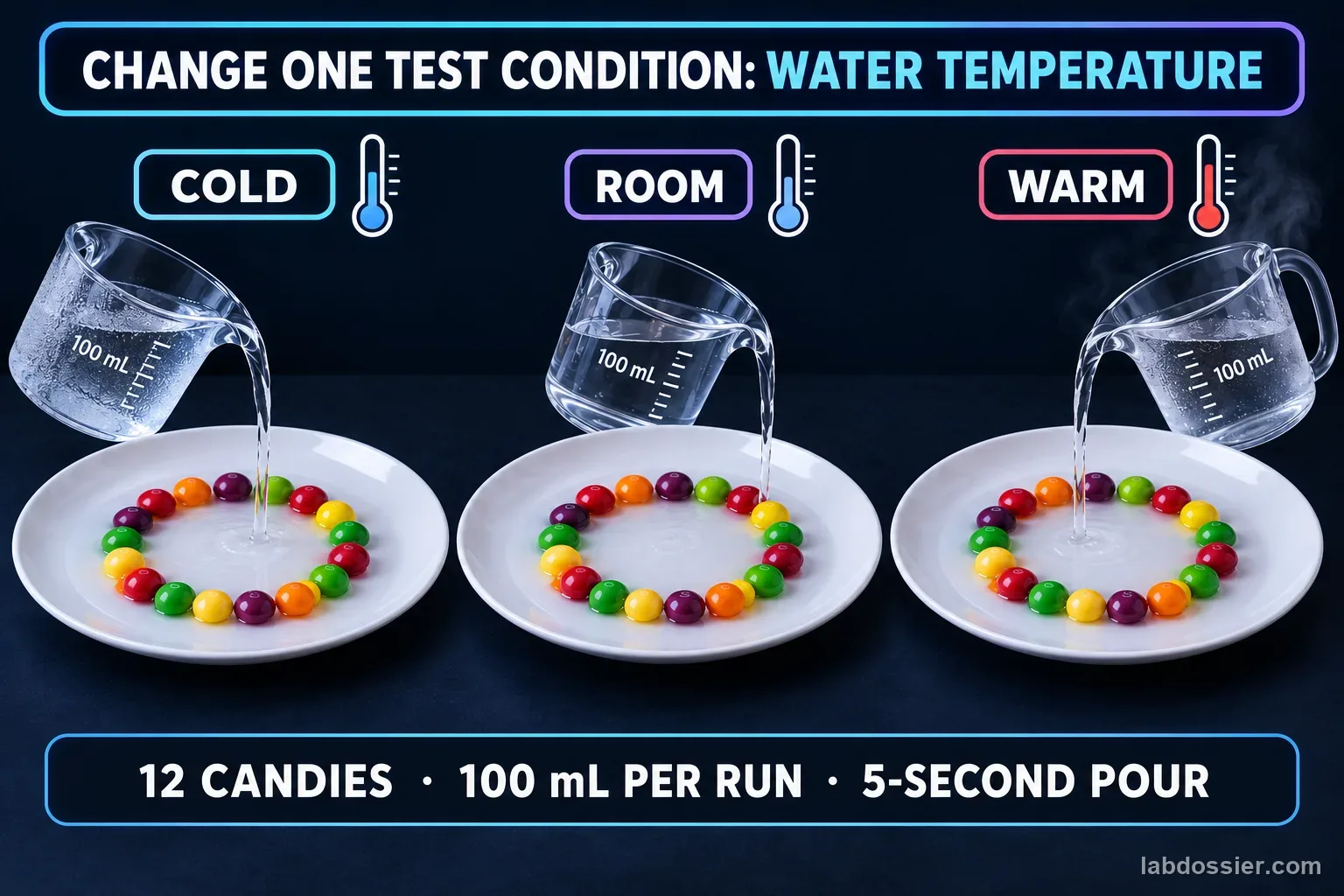
- Students plan a fair comparison using twelve candies, the same ring, level plate, 100 mL water per trial, and measured cold, room-temperature and comfortably warm water.
- Students measure and record each water temperature and the seconds from the end of the pour until the first color front reaches the plate center, using two trials per temperature.
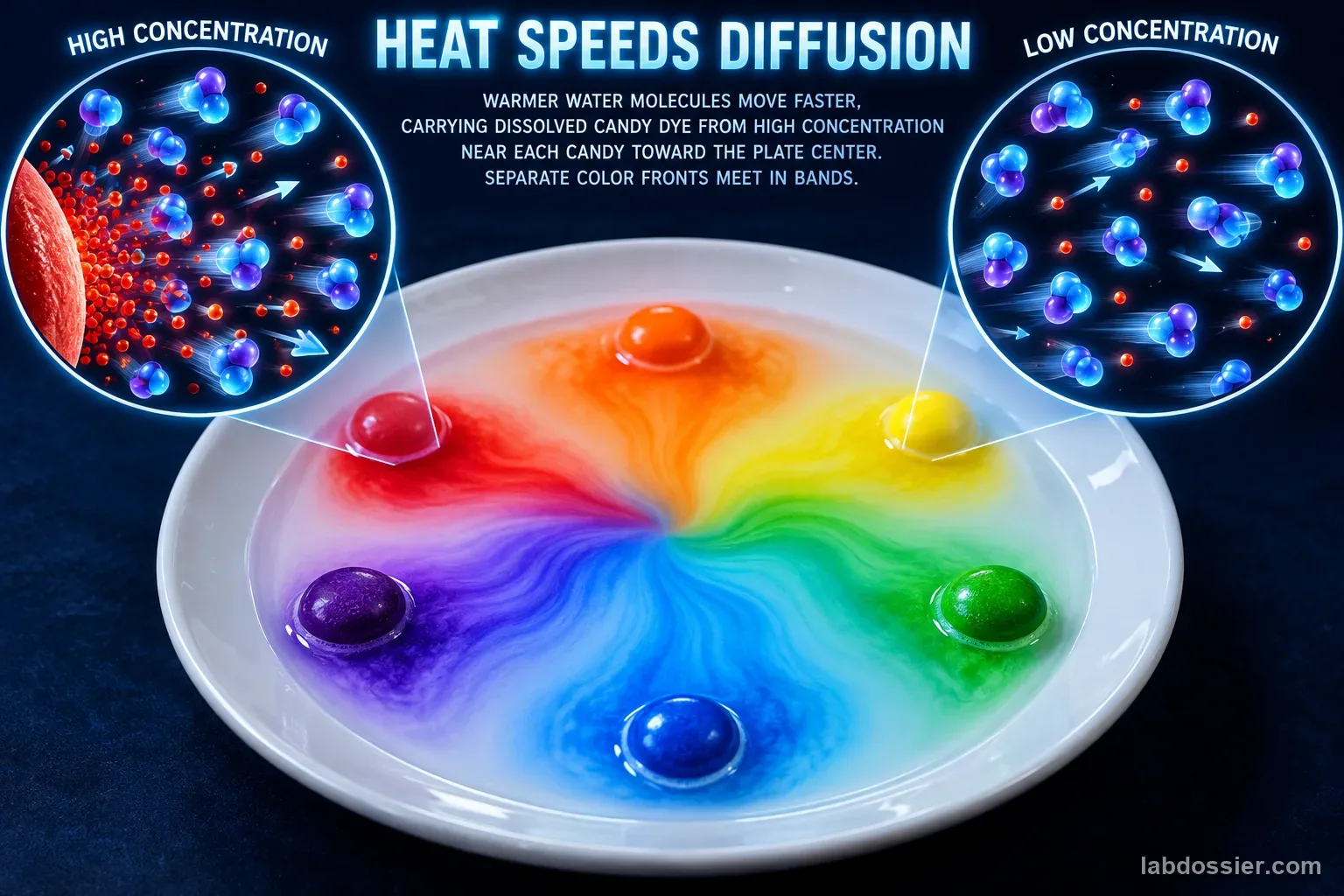
- Students explain why warmer water often speeds dissolving and spreading while recognizing that currents also move dye.
Standards
| Dimension | Alignment |
|---|---|
| Performance expectation | MS-PS1-4Develop a model that predicts and describes changes in particle motion, temperature, and state of a pure substance when thermal energy is added or removed. (Partial alignment: color often spreads faster in warm water, providing indirect evidence related to particle motion, but dissolved candy coating and dye are mixtures; this activity does not model a pure substance changing state.) |
| Practices | SEP 3Plan and carry out investigations. |
| Core idea | PS1.AThe changes of state that occur with variations in temperature or pressure can be described and predicted using these models of matter. |
| Crosscutting | Cause and effectCause and effect relationships may be used to predict phenomena in natural or designed systems. |
Standards text paraphrased from nextgenscience.org. Alignment is partial; this hands-on activity does not cover every part of the performance expectation.
State standards crosswalk
Use the row as a planning crosswalk, then confirm local district pacing and grade placement. “Partial” labels describe a skill connection, not full mastery of the complete standard.
| State | Verified standard | How this lesson aligns | Official source |
|---|---|---|---|
| California | CA NGSS MS-PS1-2 | Partial. Students compare visible color spreading after candy coatings dissolve, but do not analyze the full set of substance properties before and after interaction to determine whether a chemical reaction occurred. | Open standard ↗ |
| Texas | Science.7.6(E) | Partial. Students vary temperature and measure visible color spreading, but do not model all three named factors of temperature, surface area, and agitation or isolate dissolution rate from water currents. | Open standard ↗ |
| Florida | SC.5.P.8.2 | Partial. The investigation changes water temperature and observes dissolving and spreading, but does not test a range of materials that dissolve and do not dissolve or identify all conditions that affect the process. | Open standard ↗ |
| New York | MS-PS1-4 | Limited. Students compare temperature-related spreading, but do not develop a particulate model of changes in particle motion, temperature, and phase of a substance. | Open standard ↗ |
| Pennsylvania | 3.2.6-8.B | Partial. Students plan and record a controlled temperature comparison, but the color-front test does not cover the full middle-grade matter expectations or distinguish diffusion from fluid currents. | Open standard ↗ |
Materials and prep timeline
PER GROUP
- White plate with a level, clean, dry surface
- Twelve Skittles in the same color sequence for every trial
- 100 mL each of cold, room-temperature and comfortably warm water
- Thermometer, measuring cup, timer and data sheet
- Paper towels and a tray or wipeable work surface
TEACHER ONLY
- Check food allergies and school food-handling rules before providing candy; students must not eat candy used in the experiment.
- An adult prepares and pours comfortably warm water at 35–40°C, never hot; measure and record every starting temperature.
- Model a level, still plate and the same gentle five-second pour for each 100 mL sample. Start timing when pouring ends and stop when the first visible color front reaches center. Provide fresh candy and a completely dry plate for each repeat.
CLASS-SIZE KIT PLANNER
One per-group kit contains every item in the team materials list above. Groups are balanced around the listed 3–4 students target.
| Students | Groups | Per-group kits | Student sheets | Suggested group split |
|---|---|---|---|---|
| 20 | 5 | 5 complete kits | 20 copies | 5 groups of 4 |
| 25 | 7 | 7 complete kits | 25 copies | 4 groups of 4 and 3 groups of 3 |
| 30 | 8 | 8 complete kits | 30 copies | 6 groups of 4 and 2 groups of 3 |
Identify water temperature as the planned change and time to center as the measurement. Agree on a ring pattern, candy count, plate and water volume before testing.
Check allergies and handwashing. Label cold, room-temperature and warm water, measure equal volumes and arrange the first candy ring on a level white plate.
Use 100 mL of measured water per run and the same gentle five-second center pour. Start timing when the pour ends; stop when the first front reaches center. Record time and starting temperature; replace candies and fully dry the plate before each trial.
Compare the two times at each temperature. Sketch the colored fronts and discuss how pouring currents or plate tilt could affect the pattern.
Use results as indirect evidence about warmer water and spreading, without claiming a pure-substance state change. Do not eat tested candy; wipe spills and wash hands.
Lab figures and data visuals
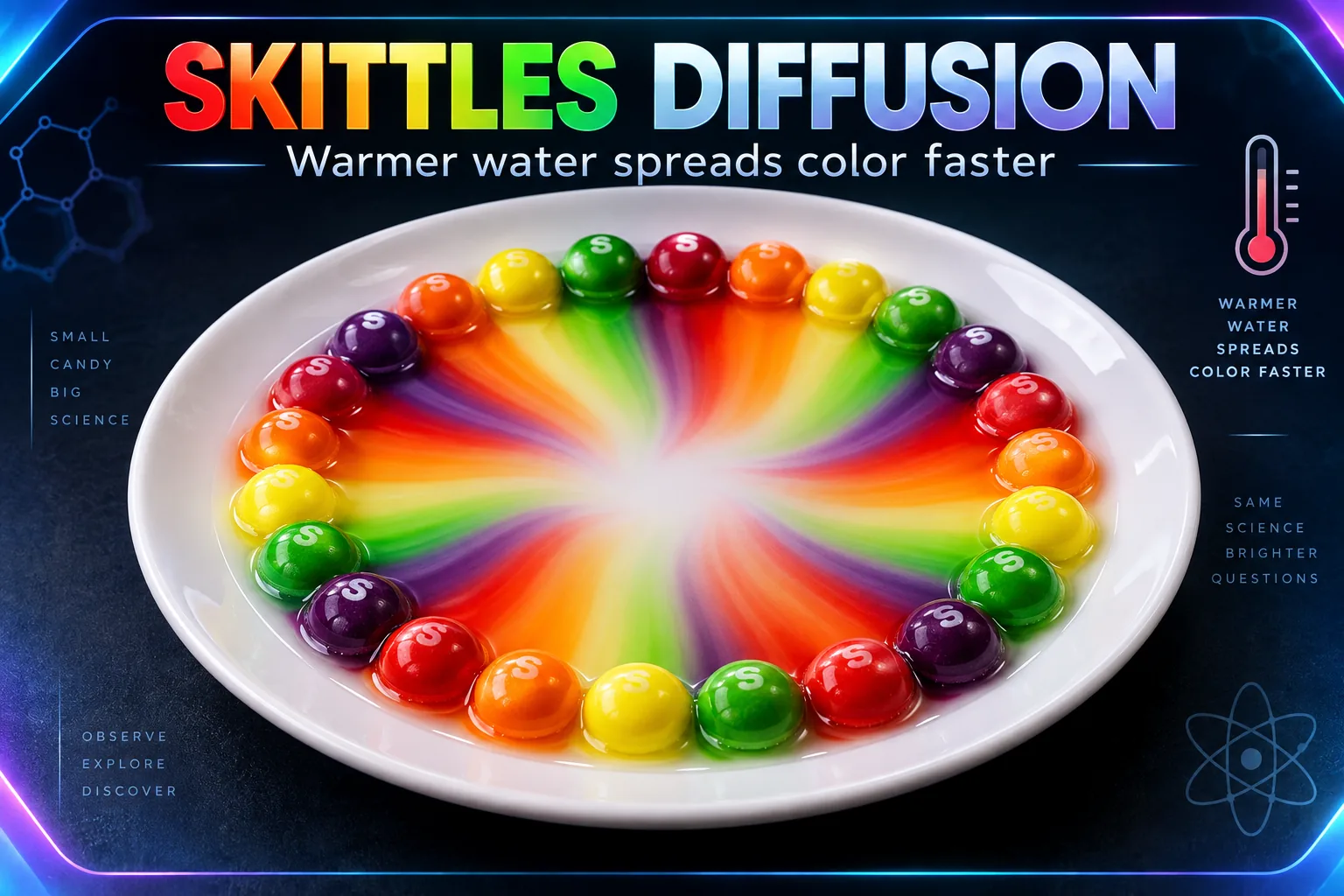
Reviewed article images support the lesson flow. Use the tables and student sheet to record actual observations; pictured patterns are not target results.
Printable shopping list
Shopping and staging checklist
Multiply the per-group kit contents by the class-size planner. The teacher section includes teacher-provided materials and setup or safety notes.
PER-GROUP KITS
- White plate with a level, clean, dry surface
- Twelve Skittles in the same color sequence for every trial
- 100 mL each of cold, room-temperature and comfortably warm water
- Thermometer, measuring cup, timer and data sheet
- Paper towels and a tray or wipeable work surface
TEACHER-PROVIDED MATERIALS + SETUP RULES
- Check food allergies and school food-handling rules before providing candy; students must not eat candy used in the experiment.
- An adult prepares and pours comfortably warm water at 35–40°C, never hot; measure and record every starting temperature.
- Model a level, still plate and the same gentle five-second pour for each 100 mL sample. Start timing when pouring ends and stop when the first visible color front reaches center. Provide fresh candy and a completely dry plate for each repeat.
QUANTITIES BY CLASS SIZE
| Material | Per group kit | 20 students | 25 students | 30 students |
|---|---|---|---|---|
| White plates, one shared per group | 1 plate | 5 plates | 7 plates | 8 plates |
| Skittles, 12 per ring across six trials | 72 candies | 360 candies | 504 candies | 576 candies |
| Cold, room-temperature, and warm water, 100 milliliters per trial | 600 milliliters | 3 liters | 4.2 liters | 4.8 liters |
| Thermometers, measuring cups, and timers | 1 of each | 5 of each | 7 of each | 8 of each |
| Paper towels and recording sheets | 6 towels; sheet per student | 30 towels; 20 sheets | 42 towels; 25 sheets | 48 towels; 30 sheets |
Prepare 5 kits for 20 · 7 kits for 25 · 8 kits for 30 students.
Lesson flow
| Minutes | What happens |
|---|---|
| 0–4 | Engage Ask how water temperature may change the time for a Skittles color front to reach the center. Record a prediction and name the controls. |
| 4–7 | Explore Check allergies and food rules, label cold, room-temperature and comfortably warm water, measure equal volumes, and arrange a matched ring on a level white plate. |
| 7–21 | Explore For two trials at each temperature, use 100 mL and the same gentle five-second center pour. Start timing when pouring ends; stop when the first color front reaches the center. Use fresh candies and a clean, completely dry plate each time. |
| 21–26 | Explain Compare both times per temperature and sketch the color fronts. Discuss dissolving, spreading, and how currents or plate tilt may change the result. |
| 26–30 | Evaluate Explain the observed pattern as indirect evidence related to particle motion, not as a pure substance changing state. Do not eat test candies; wipe spills and wash hands. |
Discussion questions
1. Why use the same candy count and ring arrangement each time?
2. Why does the color often reach the center sooner in warm water?
3. What could make one trial faster for reasons other than temperature?
4. How does this lab relate only partly to MS-PS1-4?
Common misconceptions
Differentiation
SUPPORT
- Provide a plate diagram with marked candy positions and have students place each color in the same sequence.
- Use a visual timer and let partners divide timing, pouring and recording roles.
- Offer the frame: “At __ temperature, the colors met the center in __ and __ seconds; the __ water was faster in these trials.”
EXTEND
- Measure the distance a color front travels after a fixed 60 seconds as a separate version of the dependent variable.
- Compare the two trial times at each temperature and describe the size and consistency of the difference without assuming causation is isolated.
- Design a follow-up that keeps the water still after a gentle pour and explains how this may reduce, but not eliminate, convection.
Assessment rubric
| Criterion | Beginning | Developing | Secure |
|---|---|---|---|
| Controlled comparison | Does not identify temperature or changes several conditions. | Names temperature but leaves a key control inconsistent. | Compares all three temperatures with matched candy count, ring, plate, water volume and gentle pour. |
| Timing record | Leaves most times or temperatures blank. | Records some times but omits seconds, repeat or center status. | Records two trial times in seconds and center status for each water temperature. |
| Pattern and limits | States a result without comparing times. | Compares temperatures but ignores trials or possible currents. | Uses both trials to describe the pattern and notes how currents or tilt may affect it. |
| Scientific explanation and care | Claims a new substance or eats tested candy. | Mentions dissolving or spreading but overstates what the model shows. | Explains warm-water effects as indirect evidence related to motion, notes partial alignment and follows allergy and spill precautions. |
Vocabulary
- Dissolve – When particles of a substance spread through a liquid to make a solution.
- Diffusion – Net spreading of particles from a region of higher concentration toward lower concentration.
- Convection – Movement within a fluid that can carry dye as water flows.
- Temperature – A measure related to the average kinetic energy of particles in a substance.
- Control variable – A condition kept the same so a planned comparison is easier to interpret.
- Trial – One run of an investigation under a stated set of conditions.
Safety, cleanup and troubleshooting
BEFORE STUDENTS TOUCH ANYTHING
- Check for candy or food-coloring allergies and follow school food-handling rules. Do not eat candy that has touched the plate or test water.
- Keep small candies away from young children who could choke; follow the teacher's age-appropriate handling directions.
- Use comfortably warm, not hot, water. Keep the plate level on a stable surface, pour gently to avoid splashes and wipe spills promptly.
Troubleshooting: If colors reach the center unusually quickly, check whether the plate tilted or the pour created currents; record what happened and repeat on a level, fully dry plate with a gentle center pour. If color remains after a trial, wash and dry the plate before starting again. Discard all test candy and wash hands.