LF-11 · TEACHER LESSON PLAN
Walking water experiment
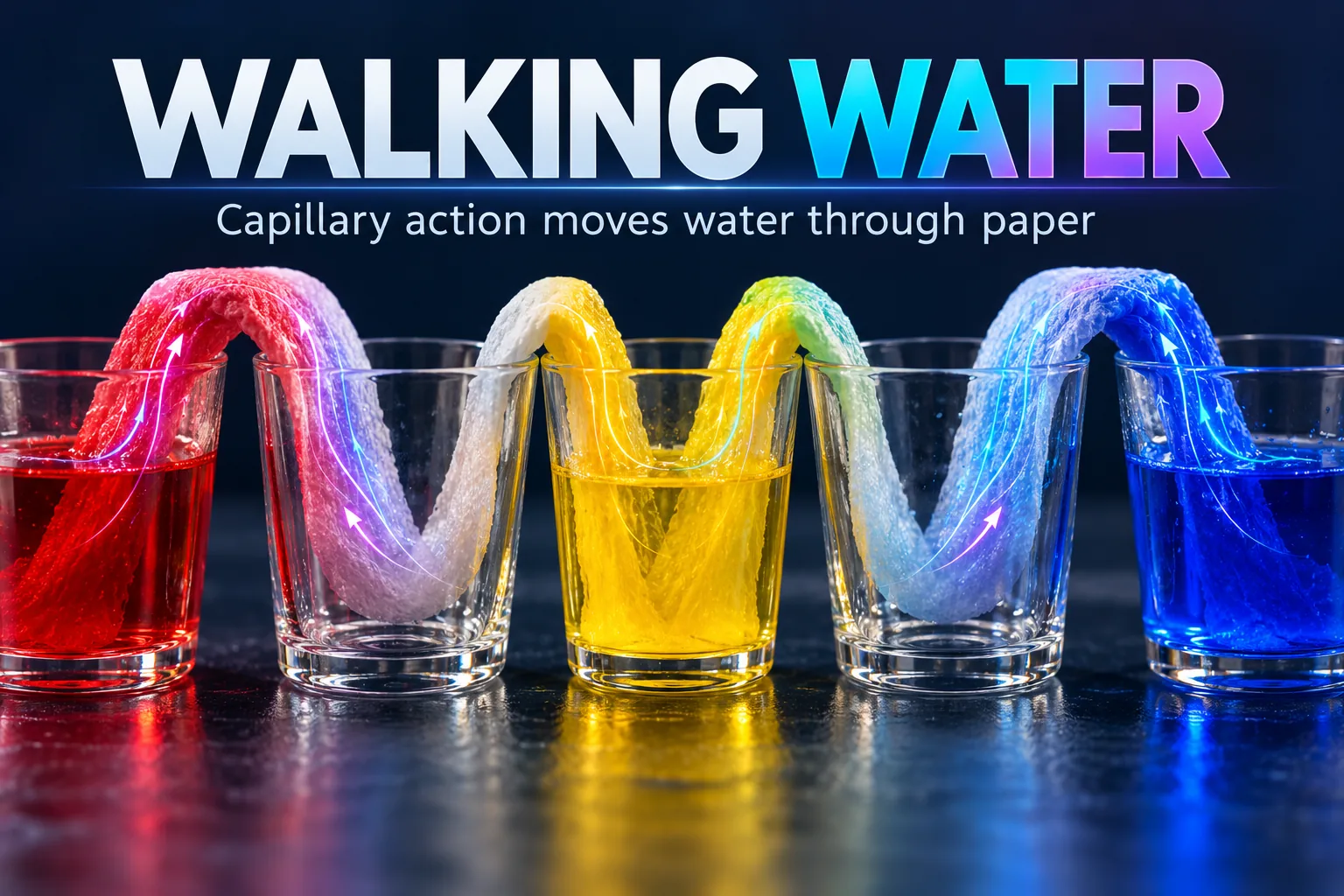
Why water climbs up a paper towel and "walks" into an empty cup
Driving question
Learning objectives
- Students set up three independent matched bridges for each of three named paper-towel products, with equal cup size, water volume, dye, strip dimensions and cup gap.
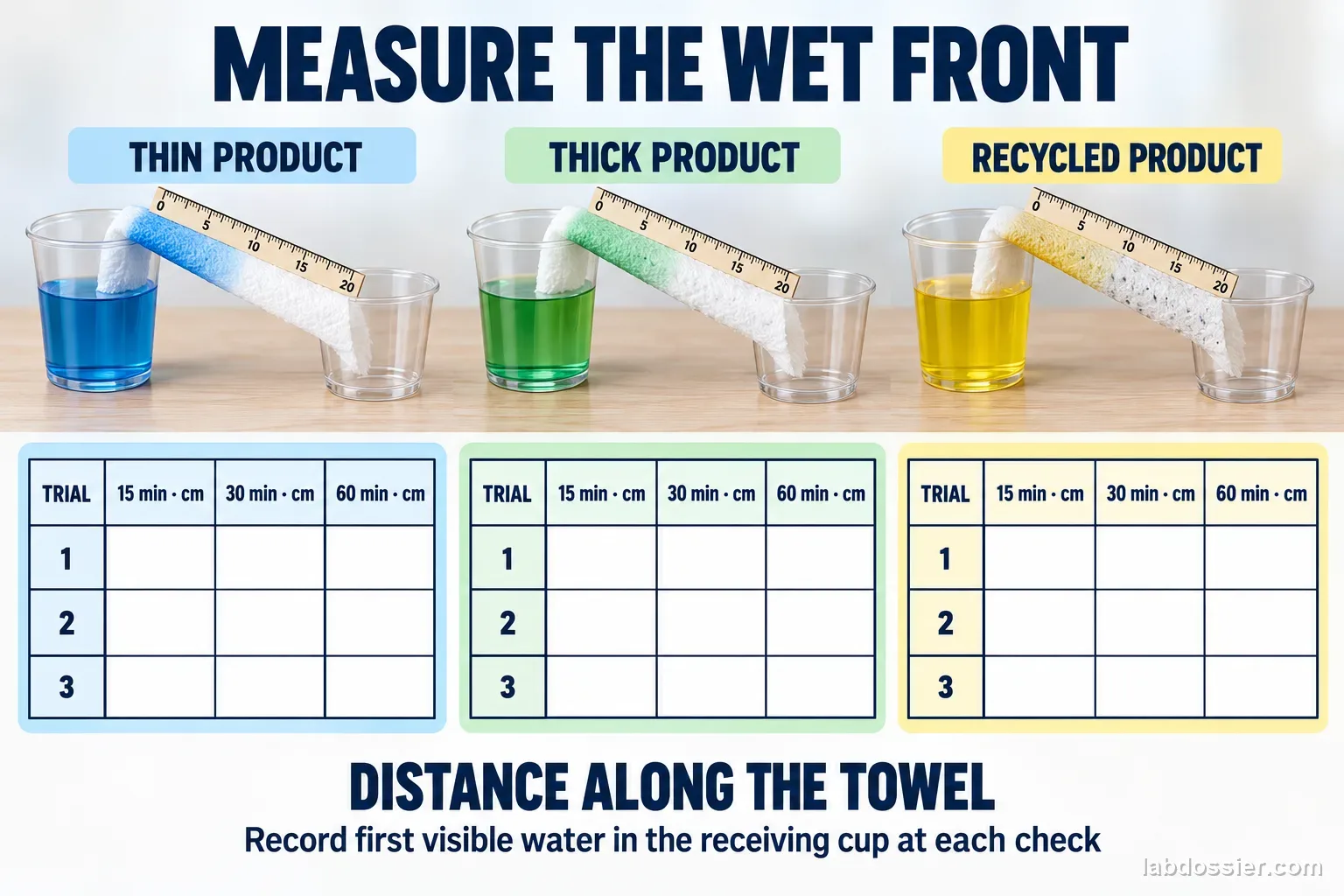
- Students measure wet-front distance along each towel at 15, 30 and 60 minutes and compare the three-trial mean and range at 60 minutes.
- Students record the first scheduled check with a visible drop in each receiving cup, plus the preceding dry check, for up to six hours.
Standards
| Dimension | Alignment |
|---|---|
| Performance expectation | 2-PS1-2Analyze data obtained from testing different materials to determine which materials have the properties best suited for an intended purpose. (Partial alignment: students compare the wicking performance of three selected paper-towel products for a defined bridge task, but do not test a broader range of material properties or intended purposes.) |
| Practices | SEP 3Plan and carry out investigations. |
| Core idea | PS1.AEach pure substance has characteristic physical and chemical properties (for any bulk quantity under given conditions) that can be used to identify it. |
| Crosscutting | Cause and effectCause and effect relationships are routinely identified, tested, and used to explain change. |
Standards wording and clarification checked against the official NGSS 2-PS1-2 page. Alignment is partial; this task tests wicking performance in one setup and does not cover a broad set of materials or purposes.
State standards crosswalk
Use the row as a planning crosswalk, then confirm local district pacing and grade placement. “Partial” labels describe a skill connection, not full mastery of the complete standard.
| State | Verified standard | How this lesson aligns | Official source |
|---|---|---|---|
| California | CA NGSS 5-PS1-3 | Limited. Students measure water movement, but do not identify materials by the full set of properties in the expectation. | Open standard ↗ |
| Texas | Science.8.6(C) | Partial, with a grade-band caveat. The standard names capillary action and water properties; this grade 2–6 lesson models movement through paper fibers, not transport through plant tissues. | Open standard ↗ |
| Florida | SC.5.P.8.1 | Limited. Students observe liquid movement and material interaction, but do not address the benchmark's full properties-of-matter scope. | Open standard ↗ |
| New York | 5-PS1-3 | Limited. The class measures a visible change, but does not identify materials by their properties as the standard expects. | Open standard ↗ |
| Pennsylvania | 3.2.5.B | Limited. The investigation produces observations and measurements, but does not identify an unknown material from its properties. | Open standard ↗ |
Materials and prep timeline
PER GROUP
- Nine matched source/receiver pairs (18 plastic or glass cups); never use paper cups
- 1.35 L water: 150 mL in each source cup, with 3 drops of food coloring in each
- Nine equal bridges: three separate strips from each of three selected towel products
- Ruler, measuring cup, labels for product/ply/trial, timer and recording sheet
- Level tray or washable table cover and paper towels for cleanup
TEACHER ONLY
- Choose a stable location where all nine pairs can remain undisturbed through checks over six hours; secure the tray away from edges and walkways.
- Select and record a specific product/brand and its supplied ply structure for each condition. Cut three equal-length and equal-width strips per product; use the same fold, immersion depth, source level and cup gap.
- Use matching plastic or glass cups so the cups do not absorb water. Food coloring can stain hands and counters; provide a washable cover and cleanup supplies. Schedule the later checks before class ends.
CLASS-SIZE KIT PLANNER
One per-group kit contains every item in the team materials list above. Groups are balanced around the listed 3–4 students target.
| Students | Groups | Per-group kits | Student sheets | Suggested group split |
|---|---|---|---|---|
| 20 | 5 | 5 complete kits | 20 copies | 5 groups of 4 |
| 25 | 7 | 7 complete kits | 25 copies | 4 groups of 4 and 3 groups of 3 |
| 30 | 8 | 8 complete kits | 30 copies | 6 groups of 4 and 2 groups of 3 |
Record each selected product's name and ply. Predict which may move water farthest by 60 minutes; the prediction is not a guaranteed towel ranking.
Label three pairs per product. Use 18 matching plastic or glass cups, equal 150 mL source volumes and dye, matched strip length/width/fold and the same cup gap.
Place each strip with one end in source water and one in its receiver. Record a start time as each bridge first touches water; put all pairs on the level tray.
At 15, 30 and 60 elapsed minutes per bridge, measure the leading wet edge in centimeters along the towel path. Record first observed drops separately; do not move the cups.
After the 15-, 30- and 60-minute checks, check again at 2, 4 and 6 hours. Record the preceding dry check and first check with a visible drop, or 'not reached by 6 h.' Compare each product's three distances and clean the tray.
Lab figures and data visuals
Reviewed article images support the lesson flow. Use the tables and student sheet to record actual observations; pictured patterns are not target results.
Printable shopping list
Shopping and staging checklist
Multiply the per-group kit contents by the class-size planner. The teacher section includes teacher-provided materials and setup or safety notes.
PER-GROUP KITS
- Nine matched source/receiver pairs (18 plastic or glass cups); never use paper cups
- 1.35 L water: 150 mL in each source cup, with 3 drops of food coloring in each
- Nine equal bridges: three separate strips from each of three selected towel products
- Ruler, measuring cup, labels for product/ply/trial, timer and recording sheet
- Level tray or washable table cover and paper towels for cleanup
TEACHER-PROVIDED MATERIALS + SETUP RULES
- Choose a stable location where all nine pairs can remain undisturbed through checks over six hours; secure the tray away from edges and walkways.
- Select and record a specific product/brand and its supplied ply structure for each condition. Cut three equal-length and equal-width strips per product; use the same fold, immersion depth, source level and cup gap.
- Use matching plastic or glass cups so the cups do not absorb water. Food coloring can stain hands and counters; provide a washable cover and cleanup supplies. Schedule the later checks before class ends.
QUANTITIES BY CLASS SIZE
| Material | Per group kit | 20 students | 25 students | 30 students |
|---|---|---|---|---|
| Cups | 18 matching plastic or glass cups (9 source/receiver pairs) | 90 cups | 126 cups | 144 cups |
| Water | 1.35 L, 150 mL in each of 9 source cups | 6.75 L | 9.45 L | 10.8 L |
| Food coloring | 27 drops, 3 in each source cup | 135 drops | 189 drops | 216 drops |
| Paper towel bridges | 9 equal strips; 3 independent bridges per product | 45 strips | 63 strips | 72 strips |
| Student recording sheets | 1 per student | 20 sheets | 25 sheets | 30 sheets |
| Shared measuring/setup tools | 1 ruler, measuring cup, timer and tray per class | 1 set | 1 set | 1 set |
Prepare 5 kits for 20 · 7 kits for 25 · 8 kits for 30 students.
Lesson flow
| Minutes | What happens |
|---|---|
| 0–5 min | Engage Ask which named towel product may move water farthest in 60 minutes. Record its label/ply and define wet-front distance along the towel as the primary measure. |
| 5–12 min | Explore Prepare three pairs per product. Match cup material/size, water and dye amounts, measured strip length/width, fold, immersion depth and cup gap. |
| 12–25 min | Explore Bridge each source to its empty neighbor. Record the start as each strip first touches source water; set the level covered tray where it can remain stable. |
| 15–60 min | Explore At 15, 30 and 60 elapsed minutes for each bridge, record wet-front distance in centimeters and check separately for a visible receiving-cup drop. |
| 2, 4 and 6 h | Explain After the 15-, 30- and 60-minute checks, record the last dry and first wet check at 2, 4 and 6 hours, or 'not reached by 6 h.' Compare mean and range of the three distance trials at each fixed time; explain capillary action and gravity. |
Discussion questions
1. What is the wet front, and how is it measured?
2. Why keep the cup gap and strip dimensions the same?
3. Why might a thick towel not be fastest?
4. How should first arrival be recorded?
5. How is this related to water moving in plants?
Common misconceptions
Differentiation
SUPPORT
- Pre-label the nine pairs with product A/B/C and trial 1/2/3; post check times on a class timer.
- Use a ruler with centimeter marks and a transparent ruler guide to locate the leading wet front along the towel.
- Offer the frame: “At 60 min, the three fronts measured __, __ and __ cm for product __; the mean was __ cm.”
EXTEND
- Repeat one product's three-bridge set with a different measured cup gap while keeping strip dimensions and source volume fixed.
- Compare water collected at a fixed six-hour endpoint as a separate investigation, measuring the receiver volume and keeping the same bridge length.
- Test a different product from the same category and explain why one product cannot represent every towel in that category.
Assessment rubric
| Criterion | Beginning | Developing | Secure |
|---|---|---|---|
| Matched setup | Uses unmatched cups/strips and does not label trials. | Labels products but leaves a key setup condition unmatched. | Uses three independent pairs per named product and matches cup, liquid, strip dimensions, fold and cup gap. |
| Time observations | Leaves check times, units or trials unrecorded. | Records some distances but confuses towel front with cup level or exact arrival. | Records three wet-front distances at 15, 30 and 60 minutes and separately bounds first cup arrival or the 6-hour endpoint. |
| Comparison | Names a fastest towel without evidence. | Compares some readings but overlooks spread or setup limits. | Uses each product's three readings, mean/range at 60 minutes and the bounded arrival checks; limits the conclusion to the tested products. |
| Explanation and care | Attributes movement only to gravity or uses absorbent paper cups. | Mentions capillary action but omits the role of the setup or cleanup. | Explains capillary movement through fibers and gravity down the bridge, uses non-absorbent cups and prevents staining or spills. |
Vocabulary
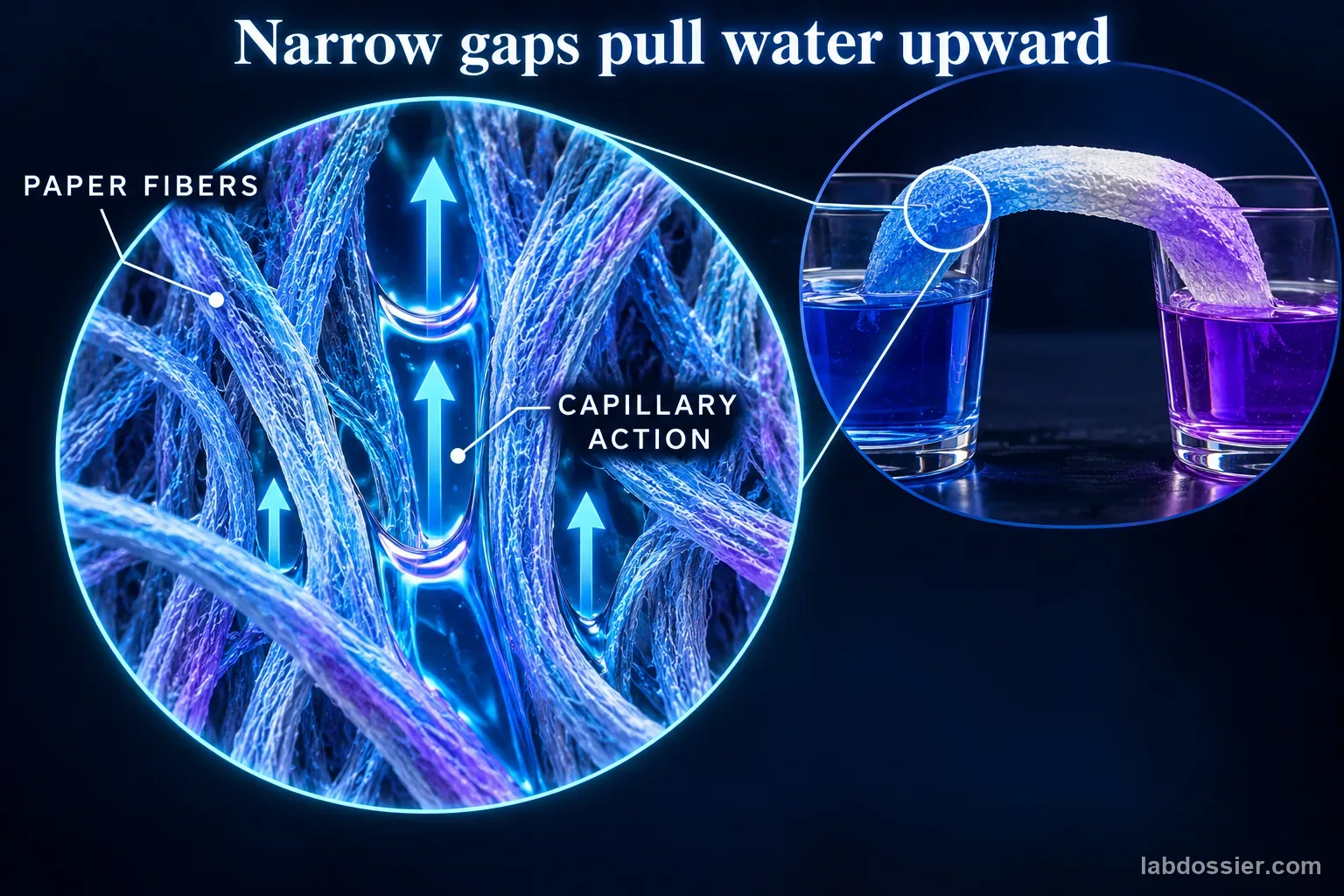
- Capillary action – Movement of liquid through narrow spaces, such as gaps between paper fibers.
- Cellulose – The plant-based material that makes up paper towel fibers.
- Wet front – The leading edge of the water that has traveled into a dry towel.
- Absorb – To take liquid into a material or its spaces.
- Control variable – A condition kept the same so the planned comparison is meaningful.
- Diffusion – Net spreading of particles, such as dye, from higher to lower concentration.
Safety, cleanup and troubleshooting
BEFORE STUDENTS TOUCH ANYTHING
- Food coloring can stain hands and countertops. Work over a covered, washable surface, keep all 18 cups on a stable tray and wipe spills promptly.
- Use plastic or glass cups rather than paper cups so the cups do not absorb water or collapse as the test runs.
- Place the setup away from table edges and walkways where it can remain undisturbed for checks through six hours. Do not drink the test water; wash hands after cleanup.
Troubleshooting: If a bridge stops wicking, check that both towel ends still touch the liquid and that the strip is not folded shut or pulled loose. If the cups were bumped, note it and restart with matched fresh strips. Keep the covered tray level and wipe colored spills before they stain.