LF-23 · TEACHER LESSON PLAN
Yeast balloon experiment
Track balloon circumference as yeast uses sugar across cool, room-temperature and comfortably warm conditions
Driving question
Learning objectives
- Students set up nine matched yeast, sugar and water bottles across cool, room and comfortably warm conditions, with three bottles per condition.
- Students measure balloon circumference at five-minute intervals through 20 minutes without squeezing the balloon.
- Students interpret condition means and ranges as indirect evidence of gas release, while describing exactly which tested setups were compared.
Standards
| Dimension | Alignment |
|---|---|
| Performance expectation | MS-LS1-7Develop a model to describe how food is rearranged through chemical reactions forming new molecules that support growth and/or release energy as this matter moves through an organism. (Partial alignment: students observe gas produced when yeast uses sugar, which is evidence of food being broken down; the activity does not build the molecular model the performance expectation asks for.) |
| Practices | SEP 3Plan and carry out investigations. |
| Core idea | LS1.CWithin individual organisms, food moves through a series of chemical reactions in which it is broken down and rearranged to form new molecules, to support growth, or to release energy. |
| Crosscutting | Energy and matterMatter is conserved because atoms are conserved in physical and chemical processes. |
Standards text paraphrased from nextgenscience.org. Alignment is partial; this hands-on activity does not cover every part of the performance expectation.
State standards crosswalk
Use the row as a planning crosswalk, then confirm local district pacing and grade placement. “Partial” labels describe a skill connection, not full mastery of the complete standard.
| State | Verified standard | How this lesson aligns | Official source |
|---|---|---|---|
| California | CA NGSS MS-LS1-7 | Partial. Balloon circumference is indirect evidence that yeast uses sugar and releases gas, but students do not model food molecules being rearranged or energy transfer. | Open standard ↗ |
| Texas | B.11(A) | Limited. The high-school expectation asks students to model matter conservation and energy transfer in photosynthesis and cellular respiration with equations; this shorter yeast fermentation trial uses balloon change as indirect evidence and develops neither model nor equation. | Open standard ↗ |
| Florida | SC.912.L.18.8 | Partial. Yeast fermentation is an anaerobic sugar-use process, but this lesson does not identify and compare the reactants, products, and functions of both aerobic and anaerobic cellular respiration. | Open standard ↗ |
| New York | MS-LS1-7 | Partial. Students use gas evidence to discuss yeast using food, but they do not develop the required model of molecule rearrangement and energy release. | Open standard ↗ |
| Pennsylvania | 3.1.9-12.J | Limited. The single yeast condition set provides a fermentation example, but students do not explain matter cycling and energy flow across both aerobic and anaerobic conditions. | Open standard ↗ |
Materials and prep timeline
PER GROUP
- 9 matching 500 mL bottles and identical balloons (3 per condition)
- 9 level teaspoons active dry yeast and 9 level teaspoons sugar, one teaspoon of each per bottle
- 1.35 L mixture water total, 150 mL per bottle at cool (~12°C), room (~22°C), or comfortably warm (~35°C)
- Three shared water baths with enough water to surround the bottle mixtures; thermometer, teaspoon measure, labels and tray
- String or flexible tape for circumference, ruler and timer
TEACHER ONLY
- Use adult-prepared cool, room-temperature and comfortably warm tap water near 12°C, 22°C and 35°C; verify each measured mixture-water portion before adding yeast and sugar. No stove, kettle or boiling water. Log the shared bath separately at 0, 10 and 20 minutes.
- Use a tray, check for latex allergy, fit balloons snugly, and never use a rigid cap.
- Provide one student sheet per student and set a 20-minute timer for the time series.
CLASS-SIZE KIT PLANNER
One per-group kit contains every item in the team materials list above. Groups are balanced around the listed 3–4 students target.
| Students | Groups | Per-group kits | Student sheets | Suggested group split |
|---|---|---|---|---|
| 20 | 6 | 6 complete kits | 20 copies | 2 groups of 4 and 4 groups of 3 |
| 25 | 7 | 7 complete kits | 25 copies | 4 groups of 4 and 3 groups of 3 |
| 30 | 8 | 8 complete kits | 30 copies | 6 groups of 4 and 2 groups of 3 |
Ask how measured temperature may change yeast activity. Students predict a pattern, check for latex sensitivity, and review balloon handling.
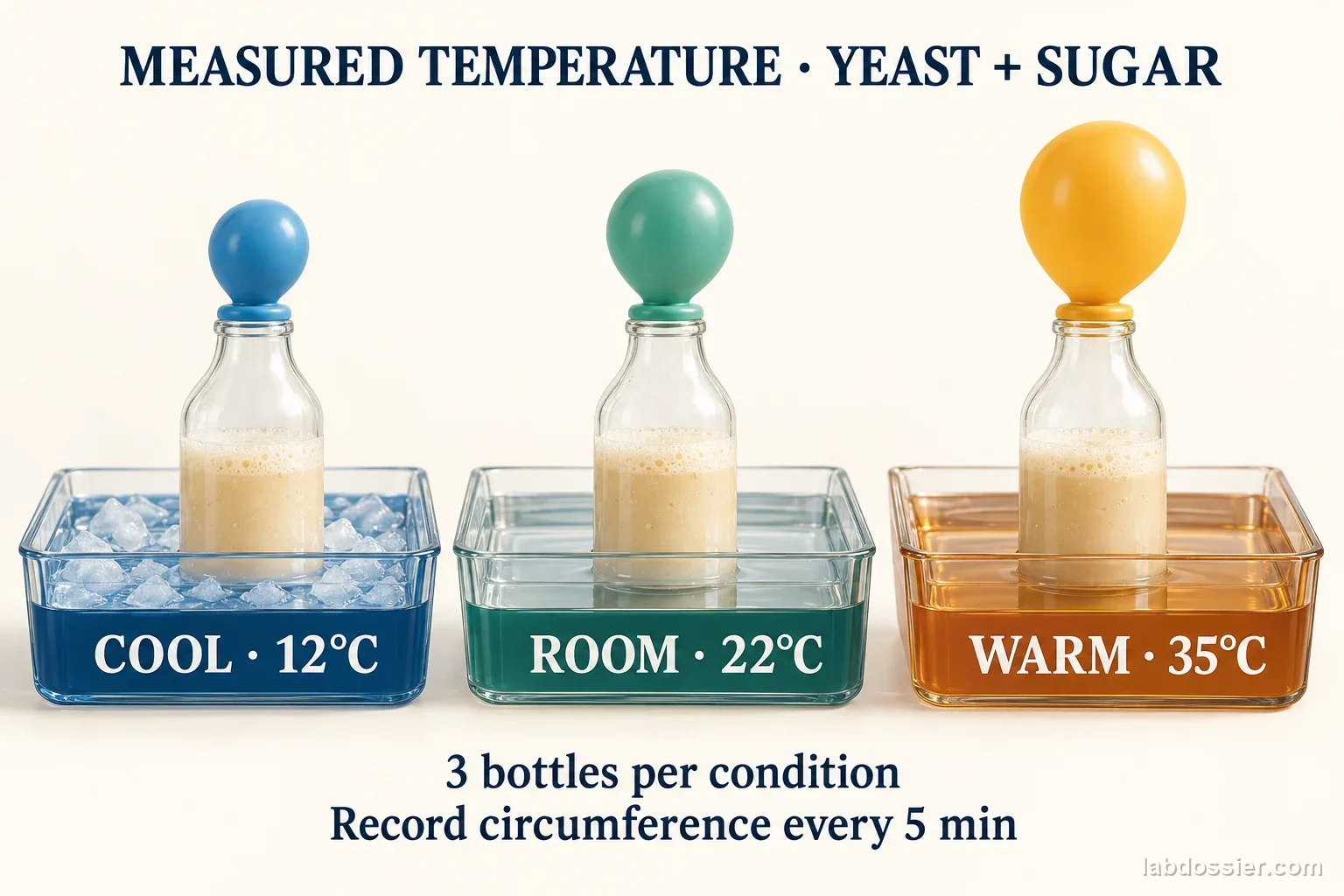
Prepare nine bottles across three shared baths near 12°C, 22°C and 35°C. Record each condition's actual mixture-water starting temperature before adding yeast and sugar; log bath temperature separately. Match ingredients and fit identical balloons.
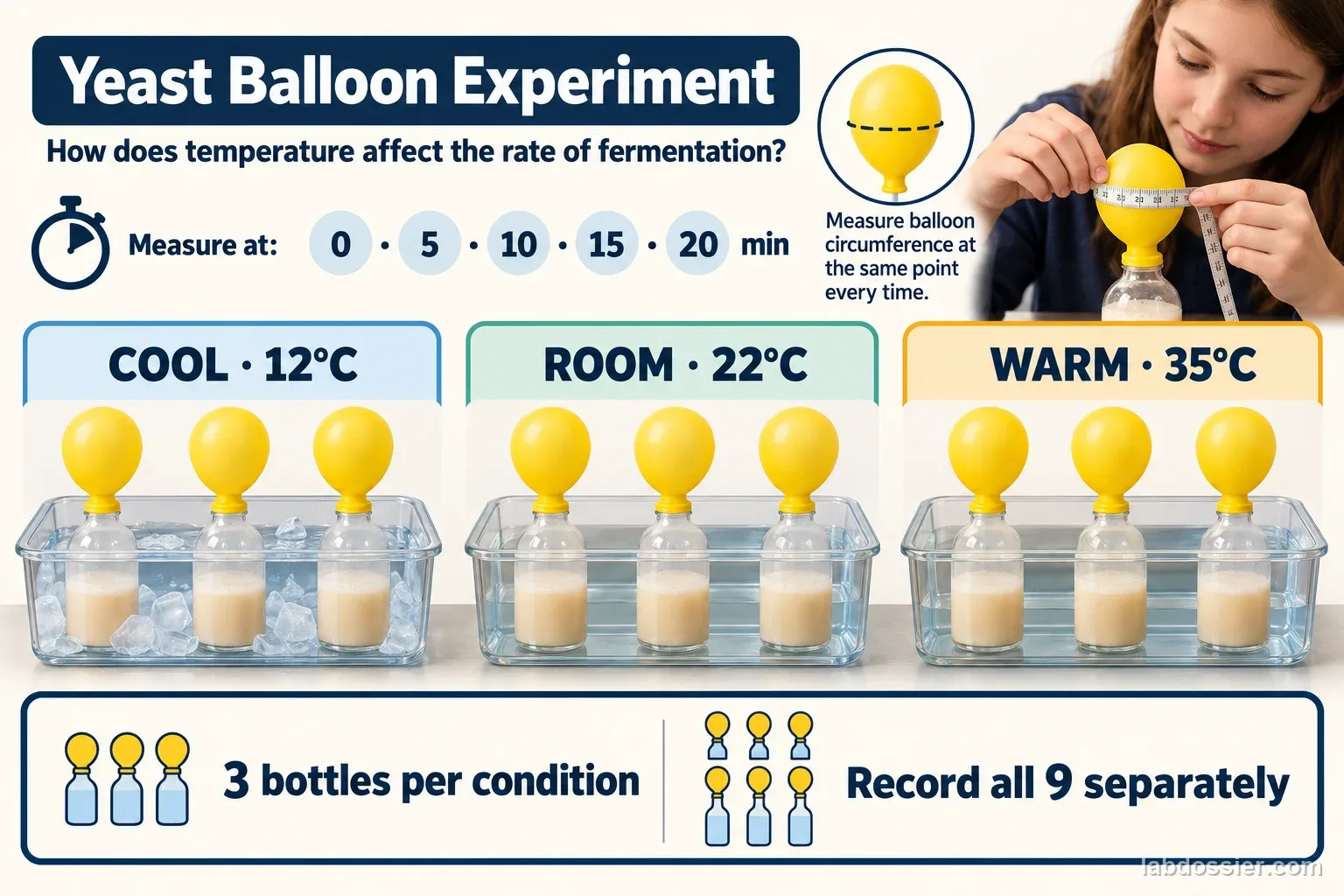
Measure all nine circumferences at 0, 5, 10, 15 and 20 minutes. Recheck bath temperatures at 10 and 20 minutes and flag leaks.
Graph condition means, include the range, and explain that three bottles in one bath are not independent bath-level repeats.
Lab figures and data visuals
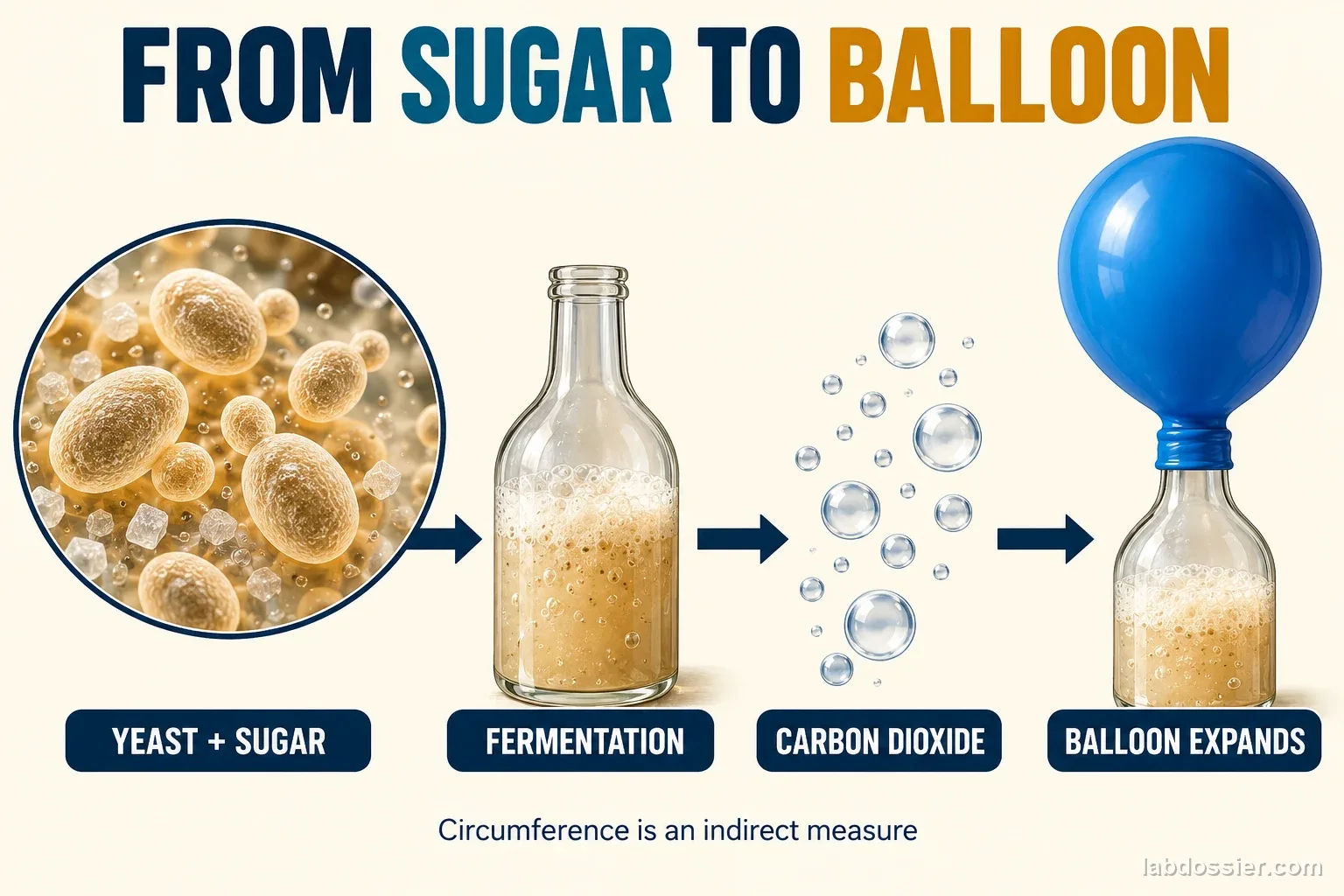
Reviewed article images support the lesson flow. Use the tables and student sheet to record actual observations; pictured patterns are not target results.
Printable shopping list
Shopping and staging checklist
Multiply the per-group kit contents by the class-size planner. The teacher section includes teacher-provided materials and setup or safety notes.
PER-GROUP KITS
- 9 matching 500 mL bottles and identical balloons (3 per condition)
- 9 level teaspoons active dry yeast and 9 level teaspoons sugar, one teaspoon of each per bottle
- 1.35 L mixture water total, 150 mL per bottle at cool (~12°C), room (~22°C), or comfortably warm (~35°C)
- Three shared water baths with enough water to surround the bottle mixtures; thermometer, teaspoon measure, labels and tray
- String or flexible tape for circumference, ruler and timer
TEACHER-PROVIDED MATERIALS + SETUP RULES
- Use adult-prepared cool, room-temperature and comfortably warm tap water near 12°C, 22°C and 35°C; verify each measured mixture-water portion before adding yeast and sugar. No stove, kettle or boiling water. Log the shared bath separately at 0, 10 and 20 minutes.
- Use a tray, check for latex allergy, fit balloons snugly, and never use a rigid cap.
- Provide one student sheet per student and set a 20-minute timer for the time series.
QUANTITIES BY CLASS SIZE
| Material | Per group kit | 20 students | 25 students | 30 students |
|---|---|---|---|---|
| Active dry yeast | 9 level teaspoons | 54 tsp | 63 tsp | 72 tsp |
| Sugar | 9 level teaspoons | 54 tsp | 63 tsp | 72 tsp |
| Water | 1.35 L | 8.1 L | 9.45 L | 10.8 L |
| Shared water baths for the three temperature conditions | 3 shallow basins + enough water to surround the bottle mixtures | 18 basins + bath water | 21 basins + bath water | 24 basins + bath water |
| Matching bottles, balloons, and condition labels | 9 of each | 54 of each | 63 of each | 72 of each |
| Thermometer, measuring spoons, and tray | 1 of each | 6 of each | 7 of each | 8 of each |
| Flexible tape or string, ruler, and timer | 1 of each | 6 of each | 7 of each | 8 of each |
| Student data sheets | 1 per student | 20 copies | 25 copies | 30 copies |
Prepare 6 kits for 20 · 7 kits for 25 · 8 kits for 30 students.
Lesson flow
| Minutes | What happens |
|---|---|
| 0–3 | Engage Ask how temperature may affect yeast using sugar. Predict a pattern without treating a balloon as a gas-volume meter. |
| 3–7 | Explore Prepare three shared baths near 12°C, 22°C and 35°C. Record the actual starting temperature of each measured mixture-water portion before adding yeast and sugar; log bath temperature separately. Place three matched bottles in each bath and start one timer. |
| 7–27 | Explore At 0, 5, 10, 15 and 20 minutes, measure all nine balloons at the same point. Log bath temperature at 10 and 20 minutes; flag leaks as setup failures. |
| 27–29 | Explain Graph mean circumference over time for cool, room and warm conditions; show the range and compare the full pattern. |
| 29–30 | Evaluate Explain that yeast using sugar can release CO₂, while balloon circumference is indirect and the three bottles share one bath setup. |
Discussion questions
1. Why record circumference at several times instead of only at 20 minutes?
2. What do the ingredients and conditions hold constant?
3. What does balloon inflation suggest, and why is it indirect?
4. Why can bottles in the same group differ?
Common misconceptions
Differentiation
SUPPORT
- Use five labeled time cards (0, 5, 10, 15 and 20 min) and one recorder per bottle condition.
- Demonstrate a gentle string measurement at a marked point without squeezing the balloon.
- Offer the frame: “By minute __, the ___ condition changed from __ to __ cm; this suggests ___.”
EXTEND
- Repeat the entire three-bath setup on separate days; that adds independent bath-level runs beyond the three bottles sharing one bath.
- Compare equal yeast and sugar amounts at two sugar types while choosing one safe, suitable temperature.
- Use a teacher-managed gas syringe to compare captured gas with balloon circumference and discuss measurement limits.
Assessment rubric
| Criterion | Beginning | Developing | Secure |
|---|---|---|---|
| Controlled setup | Omits ingredients or does not label temperatures. | Labels conditions but leaves one key amount or balloon unmatched. | Matches yeast, sugar, water volume, bottle, balloon and records measured temperatures. |
| Time-series data | Records only a final balloon size. | Records several times but misses a condition or units. | Records all three conditions at five shared times with circumference units. |
| Graph and pattern | Does not plot circumference against time. | Plots some conditions or times but axes are unclear. | Shows all three condition means over time, reports the ranges, and describes onset, growth or plateau. |
| Explanation and limits | Treats circumference as exact gas volume or says hotter is always better. | Mentions yeast or heat without using the data and measurement limits. | Connects yeast and sugar to CO₂ evidence, identifies circumference as indirect, and limits conclusions to the tested conditions. |
Vocabulary
- Yeast – A living single-celled fungus that can use sugar and release carbon dioxide during fermentation.
- Fermentation – A process in which yeast breaks down sugar to release energy and carbon dioxide without using oxygen.
- Carbon dioxide – A gas released during yeast activity that can stretch the balloon.
- Time series – Measurements of the same quantity taken at multiple times.
- Circumference – The distance around a shape; here it is an indirect indicator of balloon expansion.
- Control variable – A condition kept the same so the planned temperature comparison is meaningful.
Safety, cleanup and troubleshooting
BEFORE STUDENTS TOUCH ANYTHING
- Use adult-prepared cool, room-temperature and comfortably warm tap water; verify temperatures with a thermometer. No stove, kettle or boiling water. Keep bottles on a tray.
- Check for latex allergies before using a balloon, keep balloons away from faces, and do not taste the mixture. Do not block the bottle opening with a rigid cap.
- Measure mixture-water starting temperatures and shared-bath temperatures separately. Check for latex sensitivity; keep balloons away from faces and wash hands after cleanup.
Troubleshooting: If no circumference change occurs, check yeast activity, temperature, sugar addition and each seal. Record a loose or leaking seal as a setup failure; never use a rigid cap.