SCIENCE EXPLAINER · NUCLEAR PHYSICS
Can mercury be turned into gold?
Yes, in a narrow nuclear-physics sense. No, not by heating, chemistry, a secret powder, or a practical money-making method.
Stories about making gold from mercury mix three different ideas: what chemistry can change, what nuclear physics can change, and what a reactor proposal predicts. Keeping those categories separate makes the headline easier to judge.
The clearest answer is: mercury can be transmuted into gold under nuclear conditions, but turning a useful amount into a safe, sellable product is a different problem. Scientists have created gold isotopes in experiments. A 2025 paper proposed a fusion-reactor route and estimated its output with computer simulations. That paper did not demonstrate a commercial fusion plant making gold.
Here is what the evidence says, what the numbers mean, and why a “gold-making machine” claim deserves careful checking.
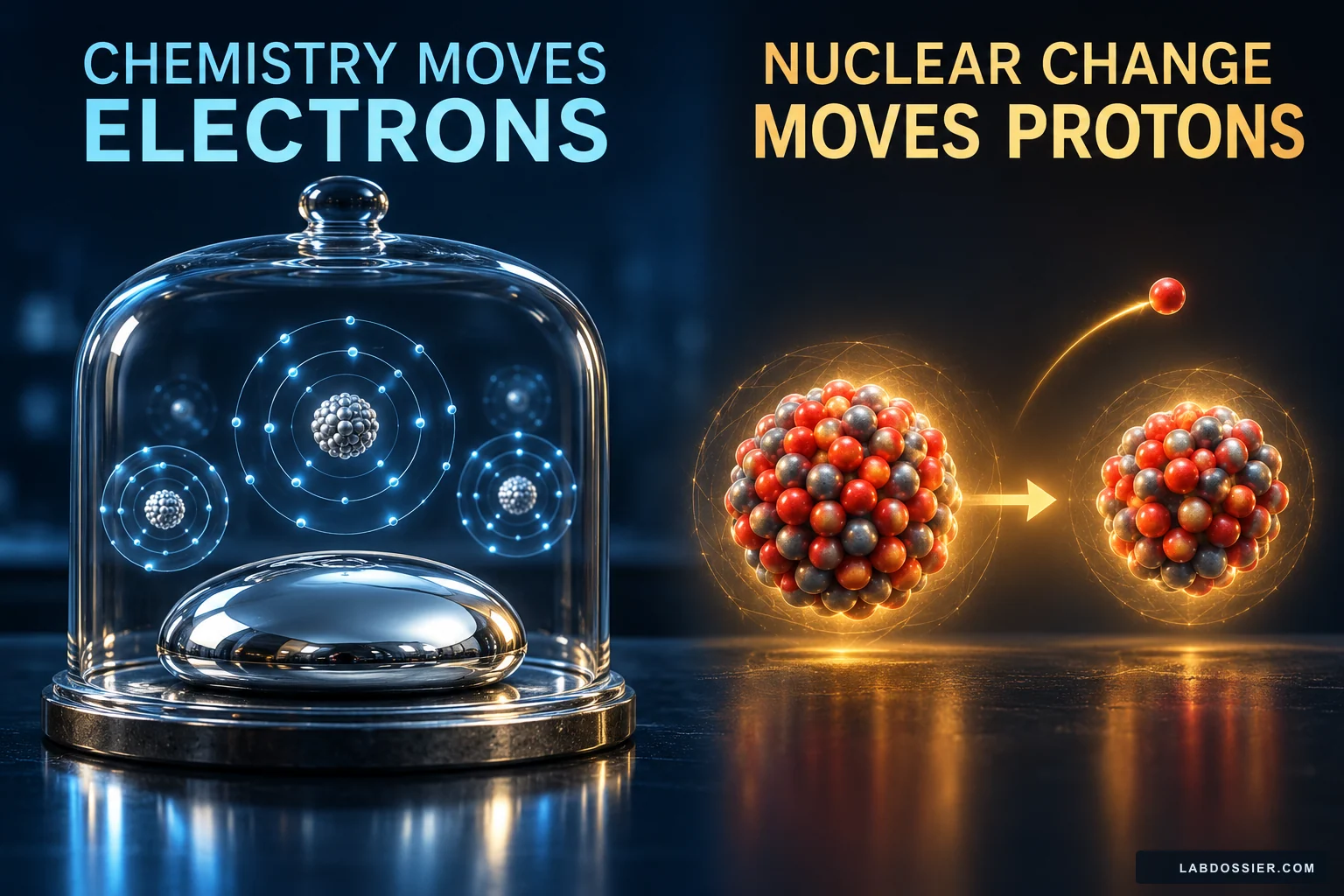
Chemistry changes electrons; transmutation changes nuclei
Each element is defined by its atomic number: the number of protons in its nucleus. A neutral atom also has electrons, but electron count can change during ionization and chemical bonding without changing which element it is. A mercury atom with 80 protons remains mercury whether it is a liquid droplet, part of a compound, or missing some electrons. Gold has 79 protons. One proton fewer means a different element.
Chemical reactions rearrange electrons and the bonds between atoms. They can make a metal dissolve, form a compound, or combine physically with another metal. None of those changes alters the proton count. A gold-colored coating, alloy, or residue is not newly created gold unless independent elemental analysis shows gold atoms were present in the first place.
Nuclear reactions involve the nucleus. They can add or remove protons and neutrons, or change a proton into a neutron or vice versa through radioactive decay. Those processes can change one element into another. They require nuclear interactions and produce isotope mixtures that must be identified with suitable instruments.
This distinction also explains why heating mercury cannot make gold. Heat can change mercury’s state and increase its vapour. It does not remove a proton. Because mercury vapour is harmful, heating it is especially unsafe; it is not a transmutation method.
| Question | Chemical process | Nuclear process |
|---|---|---|
| What changes? | Electron arrangement and chemical bonds | The nucleus: proton/neutron composition or nuclear state |
| Does element identity change? | No; atoms keep their proton count | It can, if the proton count changes |
| Can it turn Hg into Au? | No | In principle and in laboratory reactions, yes |
| Can a home chemical trick do it? | No | No safe home demonstration exists |
What a nuclear route from mercury to gold means
Isotopes of an element have the same number of protons but different numbers of neutrons. The number after an isotope symbol is its mass number, the total count of protons and neutrons. So mercury-198 and mercury-197 are both mercury, but they have different neutron counts.
The 2025 proposal focuses on mercury-198, which is abundant compared with rare mercury-196. Its modeled pathway uses a fast neutron reaction written (n,2n): a neutron enters the nucleus and two neutrons leave. The mass number therefore falls by one, from 198 to 197, while the element remains mercury at that first step. Mercury-197 is radioactive. It decays by electron capture: the nucleus captures an inner electron and a proton becomes a neutron. The proton count falls from 80 to 79, yielding gold-197, the stable gold isotope.
The notation describes a nuclear reaction, not a set of instructions. A reader cannot reproduce it with a furnace, lamp, chemical reagent, or ordinary electrical supply. The relevant neutron energies and fluxes belong to specialized nuclear facilities. The 2025 paper studies reactor blanket configurations using neutronics simulations.
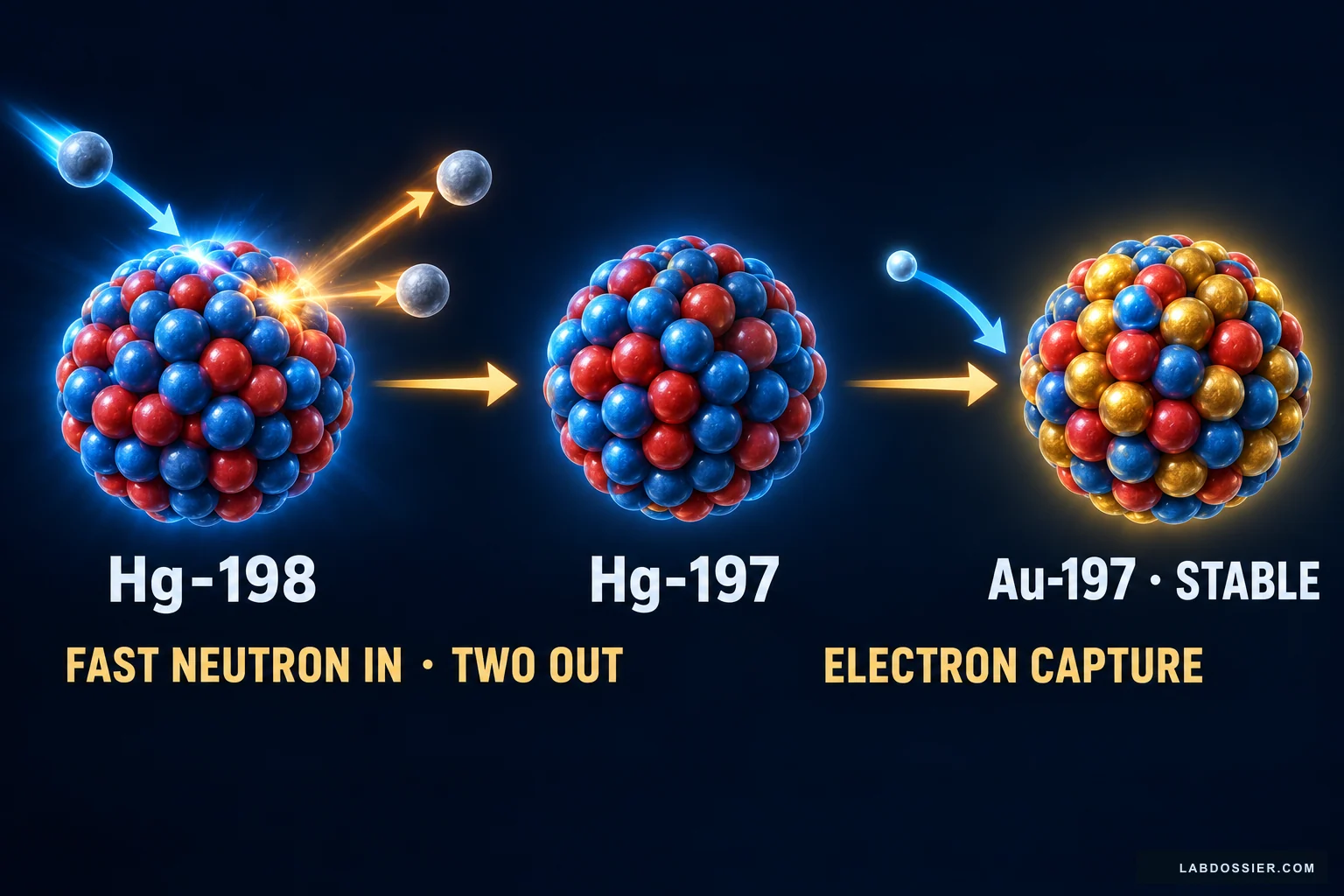
Important: this is the pathway studied in one reactor proposal. It does not mean every mercury isotope follows the same route or that a power plant has produced a marketable gold sample.
What earlier experiments actually made
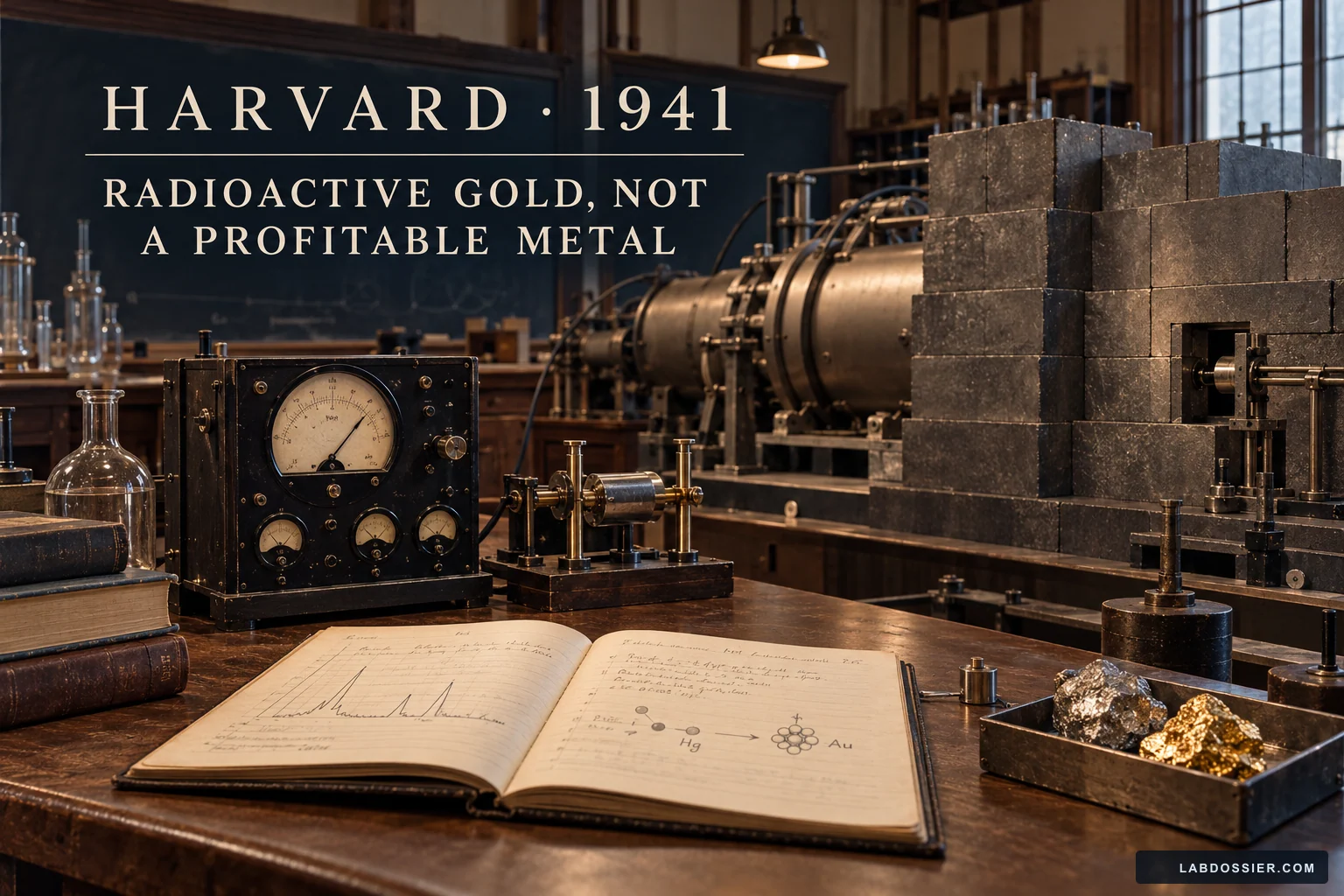
In 1941, R. Sherr, K. T. Bainbridge, and H. H. Anderson published “Transmutation of Mercury by Fast Neutrons” in Physical Review. They investigated products created when mercury was exposed to fast neutrons. Their abstract reports three radioactive gold isotopes, including gold-198 and gold-199, formed in neutron-proton reactions. It also discusses radioactive platinum and mercury products and uncertainties in assigning some observed activities.
That historical result is easy to misstate. The team did not report a lump of stable bullion or a chemical recipe. They studied radioactive products and identified them through nuclear measurements. The paper is a landmark demonstration that nuclear reactions can change mercury into gold nuclei, not evidence that ordinary mercury can be economically refined into jewelry.
In 1980, Glenn Seaborg and collaborators produced gold isotopes while studying relativistic heavy-ion collisions with a bismuth target. Bismuth is not mercury, and the result is often retold too broadly as “Seaborg turned mercury into gold.” The distinction matters: it shows that nuclear fragmentation can make gold from another heavy element, but it is not a mercury process and it did not produce a visible quantity.
Modern collider experiments add a third example. In 2025, CERN’s ALICE collaboration reported a systematic measurement of gold nuclei produced when lead nuclei pass close to one another at the Large Hadron Collider. In these near-miss events, electromagnetic interactions can eject protons from lead. Removing three protons changes lead (82) to gold (79). The gold nuclei leave with high energy and rapidly strike the beam pipe or collimators, where they fragment.
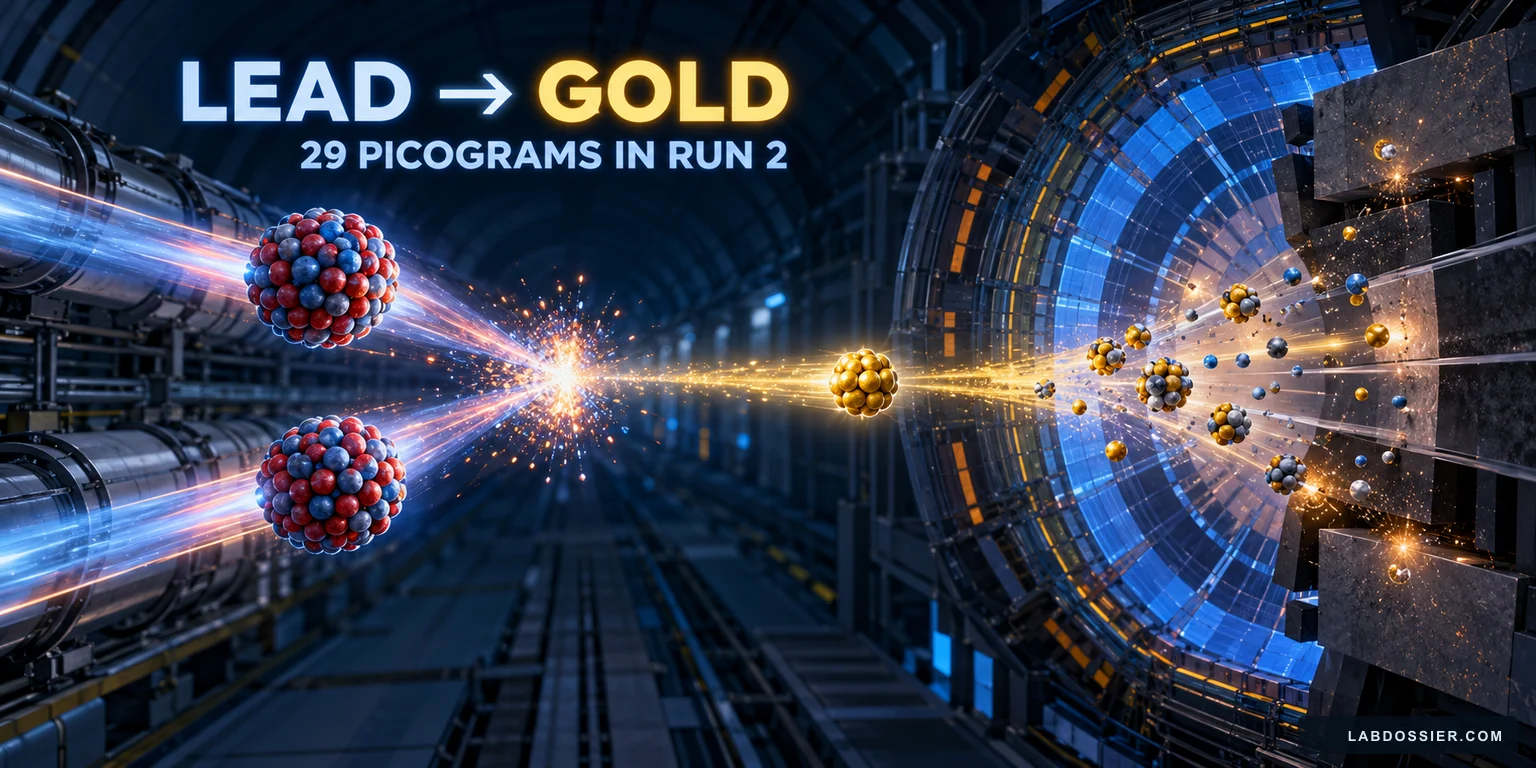
CERN calculated that about 86 billion gold nuclei were created across the four large experiments during Run 2 from 2015 to 2018. That corresponds to 29 picograms. A picogram is one-trillionth of a gram. The number sounds large because it counts billions of nuclei; the total mass remains far below what a person could see, collect, or sell.
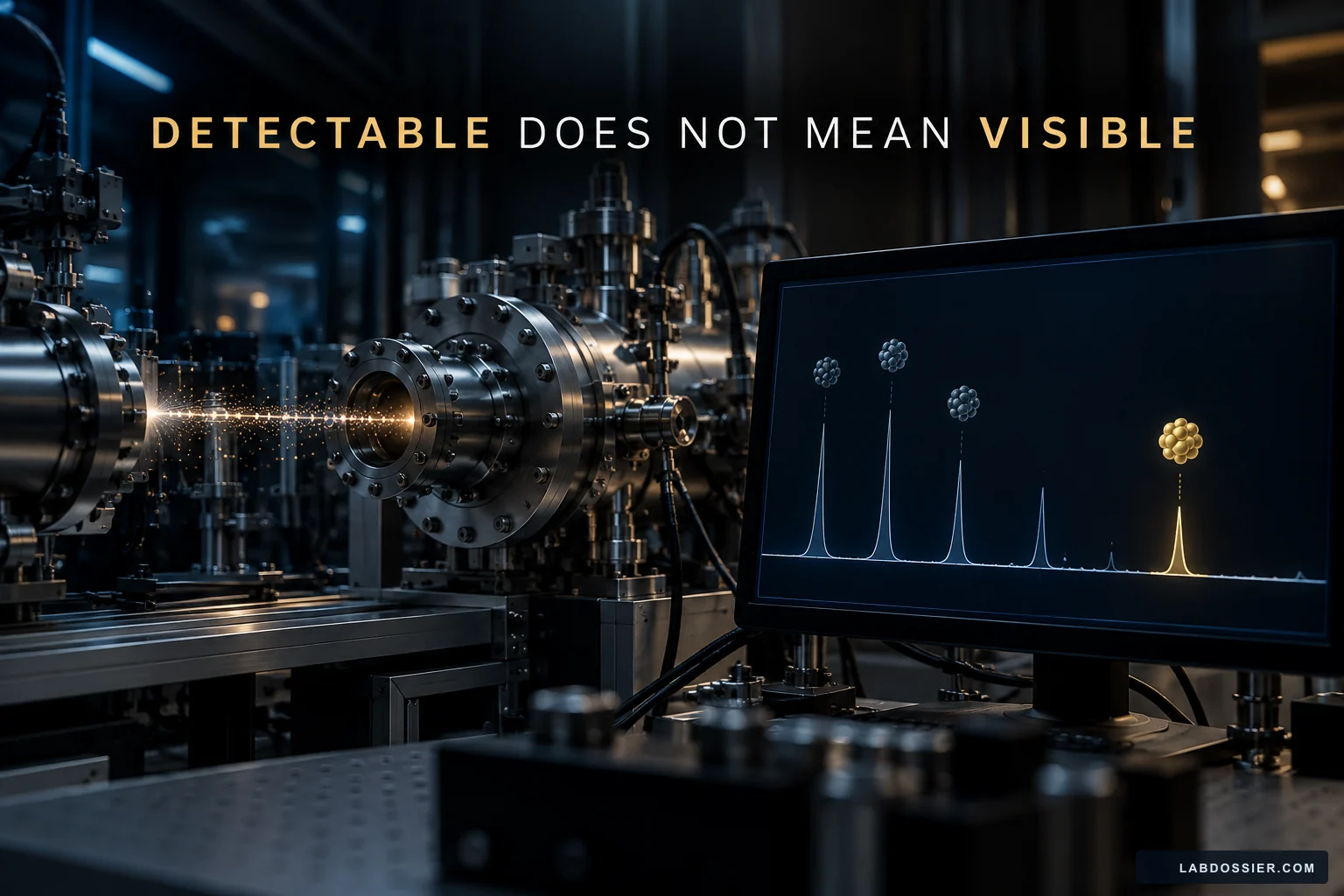
“Detected” and “recovered” are different verbs. A detector can identify characteristic signals from nuclei that are created in a beam collision and then destroyed downstream. That is strong evidence for a nuclear process, but it does not mean CERN separated a sample of gold. This distinction is useful when reading any headline that reports a surprising material by its detector signature.
| Example | Starting material | What was shown | What it does not show |
|---|---|---|---|
| Harvard, 1941 | Mercury under fast-neutron reactions | Radioactive gold isotopes identified | Stable bullion or a practical chemical method |
| Seaborg team, 1980 | Bismuth under relativistic heavy-ion bombardment | Gold isotope production during nuclear fragmentation work | A mercury-to-gold process |
| CERN ALICE, Run 2 | Lead ions in near-miss collider events | Measured signatures; 29 pg estimated across major experiments | Recoverable gold; nuclei fragmented downstream |
What the 2025 fusion paper proposes—and what it does not
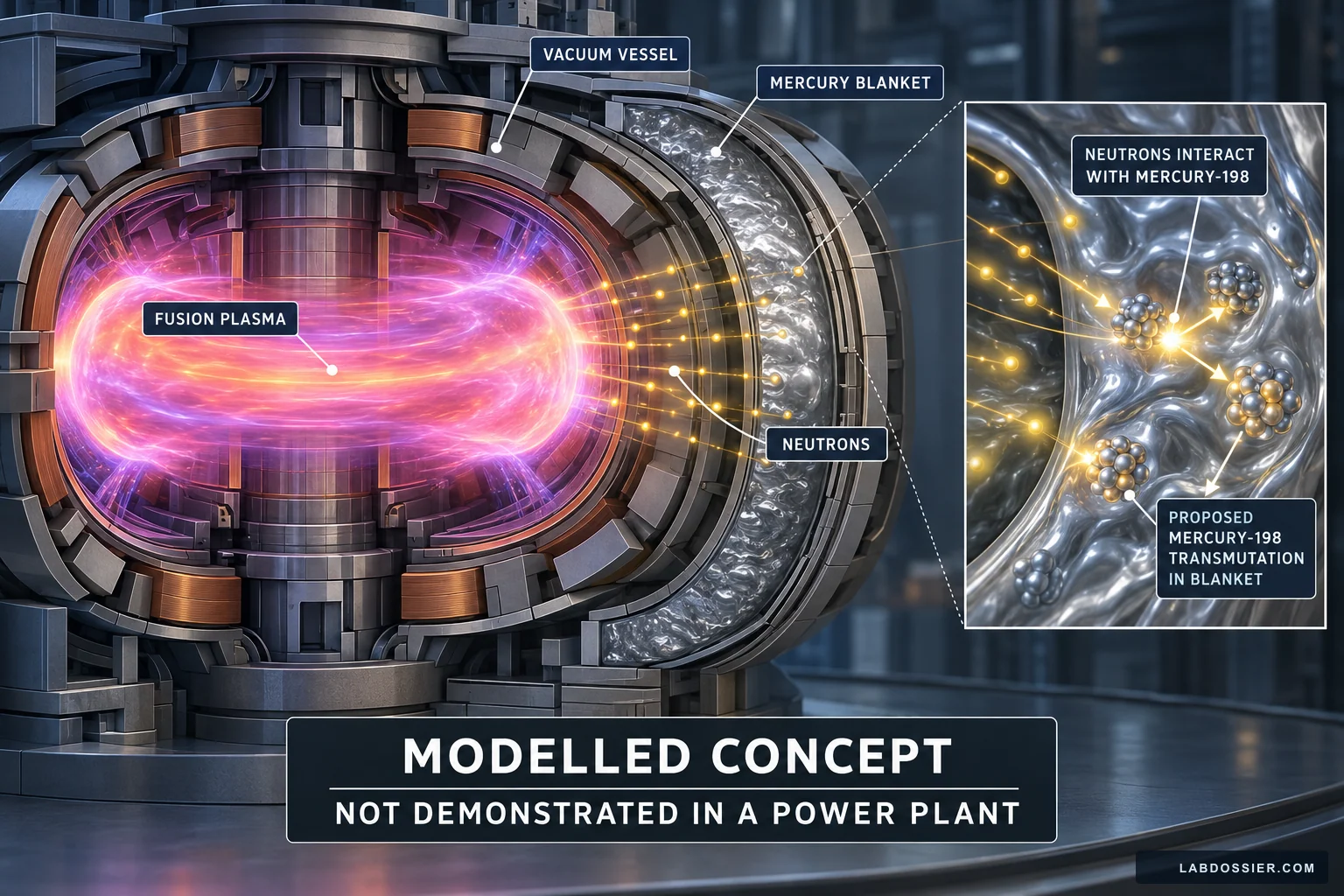
A paper by Adam Rutkowski, Jake Harter, and Jason Parisi, posted to arXiv in July 2025, proposes using fast neutrons from deuterium-tritium fusion to drive the mercury-198 (n,2n) route. The authors use neutronics simulations of a specialized fusion blanket and report a modeled production rate of about two tonnes of gold per gigawatt of thermal power per year for their chosen configuration. Their calculations also discuss neutron multiplication and tritium-breeding compatibility.
Those are model results under stated design assumptions. They are not a measured plant output, a guaranteed commercial yield, or independent proof that the full system will operate as modeled. A simulation can test consistency and compare designs, but it cannot replace validation against real reactor materials, neutron fields, operating cycles, fuel systems, maintenance conditions, and product assays. The paper’s own inventory and decay calculations also show that product composition matters; its model includes some radioactive gold products alongside stable gold.
Fusion power plants also remain a major engineering challenge. The proposal does not establish a commercial fusion plant producing electricity and gold. The central uncertainty is not whether nuclear physics permits transmutation. It is whether the complete reactor concept can be built, run reliably, and meet its energy, materials, isotope-management, and cost targets.
| Claim type | Status in the cited work | What would strengthen it |
|---|---|---|
| Nuclear pathway | Based on established nuclear reactions | Independent review of reaction data and assumptions |
| Annual production rate | Calculated from neutronics simulations | Benchmarked calculations and measured irradiation results |
| Reactor integration | Proposed blanket configuration | Demonstrated materials, fuel cycle, maintenance and system performance |
| Commercial gold supply | Not demonstrated | Verified output, isotope assay, recovery, licensing and full lifecycle economics |
Use careful verbs. “The paper proposes,” “the authors model,” and “the simulation estimates” describe the evidence. “A fusion plant makes two tonnes of gold” does not.
What changed in October 2026?
On October 21, 2026, Marathon Fusion posted that it had turned mercury into “real, stable gold” using fusion neutrons, at ten times a CERN record. The company wrote that the demonstration happened “last month.” This is a new company-reported experimental claim, distinct from the 2025 simulation paper. It would be a substantial research step if the sample, reaction pathway, and rate are verified.
The public post does not provide the mass of gold, the sample’s full isotope assay, recovery efficiency, neutron exposure details, or an independently replicated measurement. One news analysis of the post describes a gamma-ray spectrum with lines assigned to mercury-197 and gold-197, measured at several times after irradiation. A spectrum can be useful evidence, but by itself it does not establish how much stable gold was produced or prove that every competing isotope or background signal was excluded. The direct post is a company statement; the spectrum interpretation has not been published as an independent peer-reviewed study in the sources reviewed here.
Marathon’s “10 times CERN” comparison is also incomplete without a shared measurement definition. CERN’s reported peak was a rate of gold nuclei from lead-ion interactions, and its Run 2 total was estimated across years. Marathon has not specified in the post whether its multiple refers to an instantaneous production rate, an integrated sample, the same detector method, or another benchmark. A ratio without a common denominator cannot tell readers the amount of gold or whether production is commercially meaningful.
For now, the careful summary is: Marathon says it has demonstrated mercury-to-stable-gold transmutation; its public post makes a specific but not yet independently verifiable claim. The reaction is scientifically plausible and consistent with the company’s 2025 proposal. The quantity, purity, radioactivity, repeatability, and economics remain open questions. If new primary data or independent verification appear, this page should be updated.
| Evidence | What is public | What remains unestablished |
|---|---|---|
| 2025 paper | A proposed design and calculated reaction/production behavior using neutronics simulation | Operation in an integrated, commercial fusion power plant |
| Oct. 2026 company post | Marathon’s statement that it made stable gold and beat a CERN benchmark by 10× | Yield, purity, full methods, independent replication, and a comparable rate definition |
| Commercial supply | No verified market product or cost data in the reviewed sources | Recoverable mass, licensing, isotope cleanup, scale, and price |
Gold is not one isotope, and irradiation makes mixtures
When someone says “gold,” it is worth asking which isotope. Nearly all naturally occurring gold is gold-197, which is stable. Some nuclear reactions make radioactive gold isotopes instead. The 1941 mercury experiment reported gold-198 and gold-199, both radioactive. Their existence does not mean stable gold is radioactive, and it does not mean a modern reactor proposal yields a pure, ready-to-handle product.
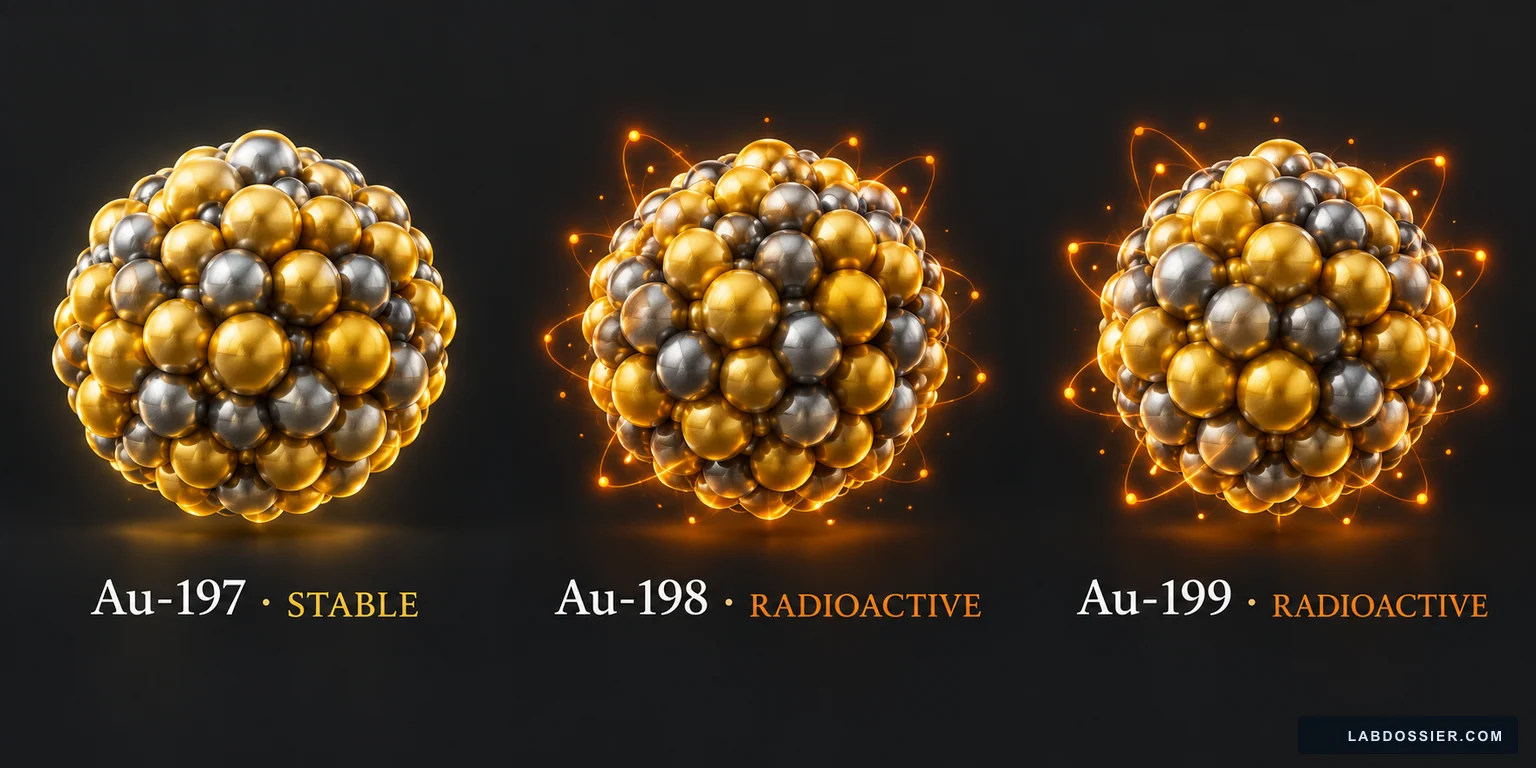
Reactors and accelerators can produce several reaction products at once. Depending on target isotopes and irradiation conditions, material may include radioactive mercury isotopes, gold isotopes, other elements, and activation products from nearby components. A product stream must be assayed: its isotope composition and activity cannot be inferred from color, mass, or a seller’s description.
Some mercury isotopes are radioactive for different lengths of time. For example, mercury-203 has a half-life of about 46.6 days and decays to stable thallium-203. That is not the mercury-197-to-gold-197 path, but it illustrates why the phrase “irradiated mercury” does not identify one uniform material. The 2025 simulation also tracks radioactive gold-195 produced through reactions involving the low-abundance mercury-196 isotope, along with other activation products. The presence or absence of a radionuclide must be established for the actual sample.
| Isotope | Status | Why it matters here |
|---|---|---|
| Hg-197 | Radioactive; electron capture to Au-197 | Intermediate in the modeled mercury-198 route |
| Hg-198 | Stable starting isotope | Target of the proposed fast-neutron (n,2n) reaction |
| Hg-203 | Radioactive; half-life about 46.6 days | Example of a different mercury activation product; decays to Tl-203 |
| Au-197 | Stable | The stable isotope sought in the 2025 proposal |
| Au-198 / Au-199 | Radioactive | Reported among products in the 1941 experiment |
| Au-195 | Radioactive; 186.1-day half-life in the cited proposal | Produced in the paper’s modeled inventory; not the stable product |
Why “possible” does not mean “profitable”
Transmutation answers an atomic-identity question. Profitability asks about the full path from energy input to certified product. The historical accelerator demonstrations required specialized facilities and produced minute quantities. ALICE’s measured gold nuclei were a by-product of research on heavy-ion interactions, not an attempt to fill a vault.
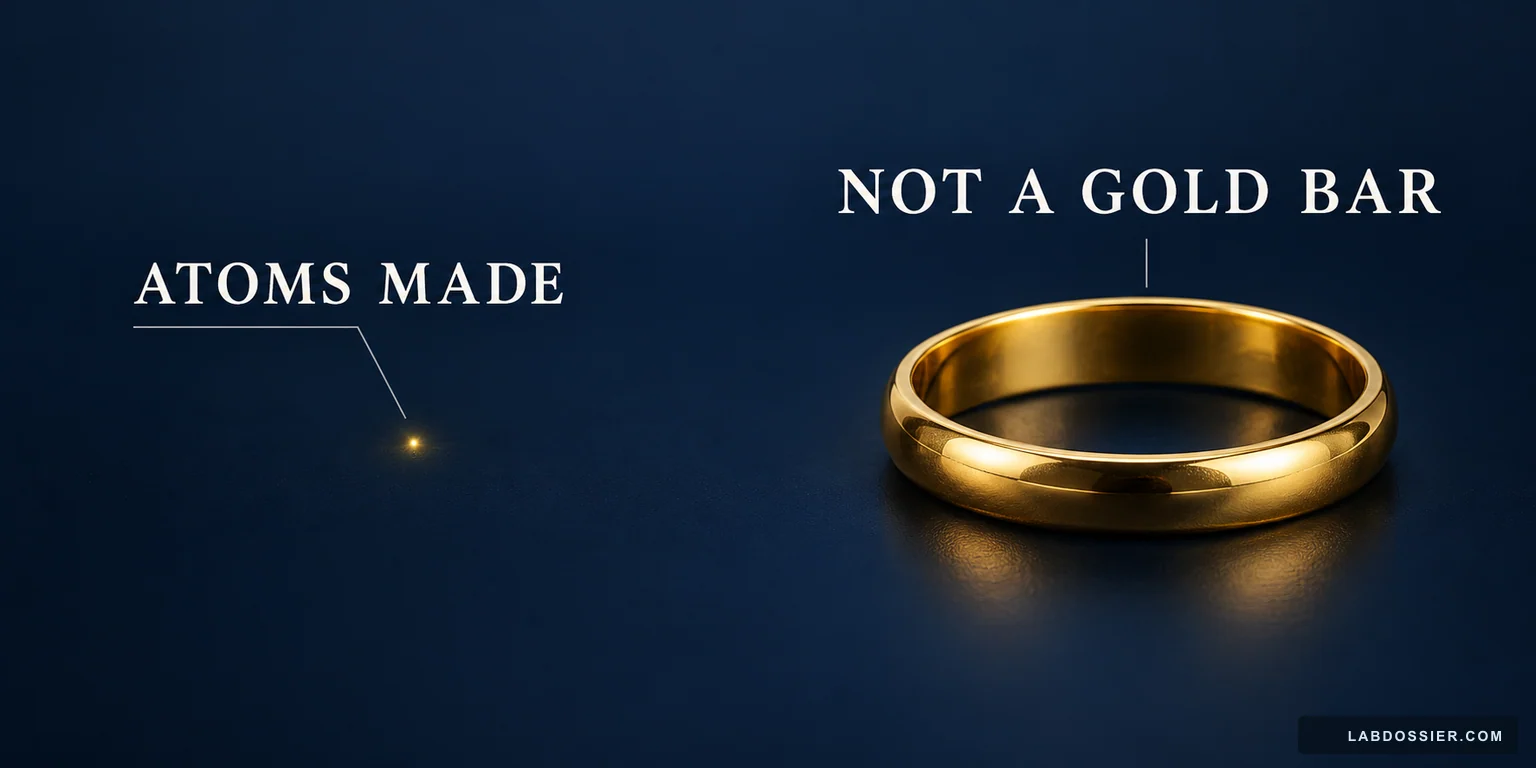
The fusion proposal makes a potentially larger model estimate, but several costs and constraints remain outside a headline number: constructing and operating the fusion system, sourcing and containing the target material, protecting nearby equipment from radiation, recovering product from the blanket, separating isotopes and impurities, measuring radioactivity, meeting licensing requirements, and waiting for any unwanted activity to decay where appropriate. Each step has to be demonstrated and costed.
Its selected model configuration estimates that some radioactive gold-195 accompanies stable gold-197, and calculates cooling periods for the modeled mixture under particular regulatory and handling benchmarks. Those times depend on the simulated isotope composition and assumptions. They are not a universal rule for every sample, and they do not substitute for radiological testing or a regulator’s decision.
Even if one modeled reactor eventually made gold, annual mass alone would not tell us its market effect. Analysts would need a real production rate, recovery fraction, operating uptime, product specification, licensing status, sale route, and the output of other gold producers. The quoted two tonnes per gigawatt of thermal power per year is an estimate for a modeled configuration. It is not a verified supply forecast or a prediction that the gold price will fall.
Ask what power rating it uses, whether the figure is thermal or electric, which blanket configuration was modeled, whether the result is simulated or measured, and what fraction is recoverable stable Au-197.
A brief note on alchemy and modern claims
Alchemists asked how materials could be transformed using the ideas and instruments available in their era. Their work helped build traditions of experimentation, craft, and observation, but it did not produce a reproducible chemical process for changing one element into another. Modern nuclear physics explains why: changing mercury into gold requires altering the nucleus.
Today’s misleading versions often reuse the old promise of a simple hidden method. Be wary of “red mercury,” secret powders, guaranteed gold machines, paid courses that refuse independent testing, or demonstrations that begin with a gold-bearing alloy and never provide a blinded assay. These are warning signs, not proof about a named seller; this article does not accuse particular people or companies.
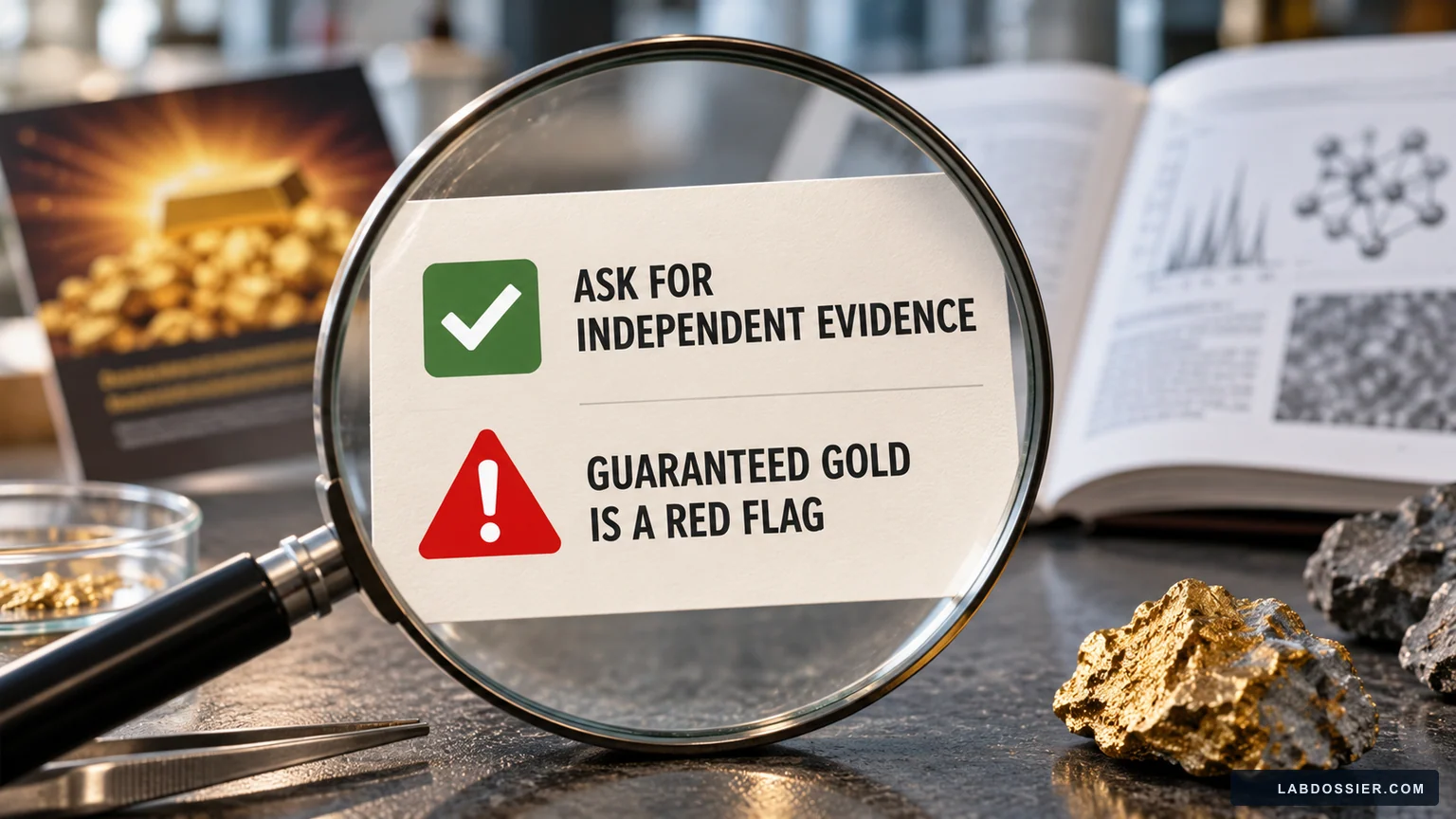
A trustworthy claim should say exactly what isotope was used, what reaction is proposed, whether the work is an experiment or a simulation, how products were identified, what independent laboratory repeated the measurement, and how the full sample was assayed. A photo of a shiny bead or a detector screenshot alone cannot answer those questions.
If you find mercury, treat it as a safety issue
Mercury has nothing to do with a safe home gold-making project. Metallic mercury can release vapour, and health effects depend on the form and level of exposure. Do not handle it, heat it, pour it down a drain, or experiment with it. If you discover a spill, keep people and pets away from the area and contact your local health, environmental, or fire authority for instructions. Follow the current guidance for your location and the size and setting of the spill.
The U.S. Environmental Protection Agency says not to vacuum mercury because a vacuum can spread it into air. Its instructions also say to contact local authorities for larger spills or when the mercury is on a soft surface. Use the relevant local agency’s directions; this article is not a cleanup or medical guide.

What the evidence supports
Mercury can become gold through nuclear reactions because those reactions can change the number of protons in an atom’s nucleus. Scientists demonstrated radioactive gold production from mercury in 1941. CERN later measured tiny quantities of gold nuclei as a by-product of lead-ion collisions. A 2025 paper proposed a fusion-blanket route from mercury-198 through mercury-197 to stable gold-197 using simulations. In October 2026, Marathon Fusion said it had demonstrated the route in an experiment, but the public details do not yet allow independent assessment of yield or scale.
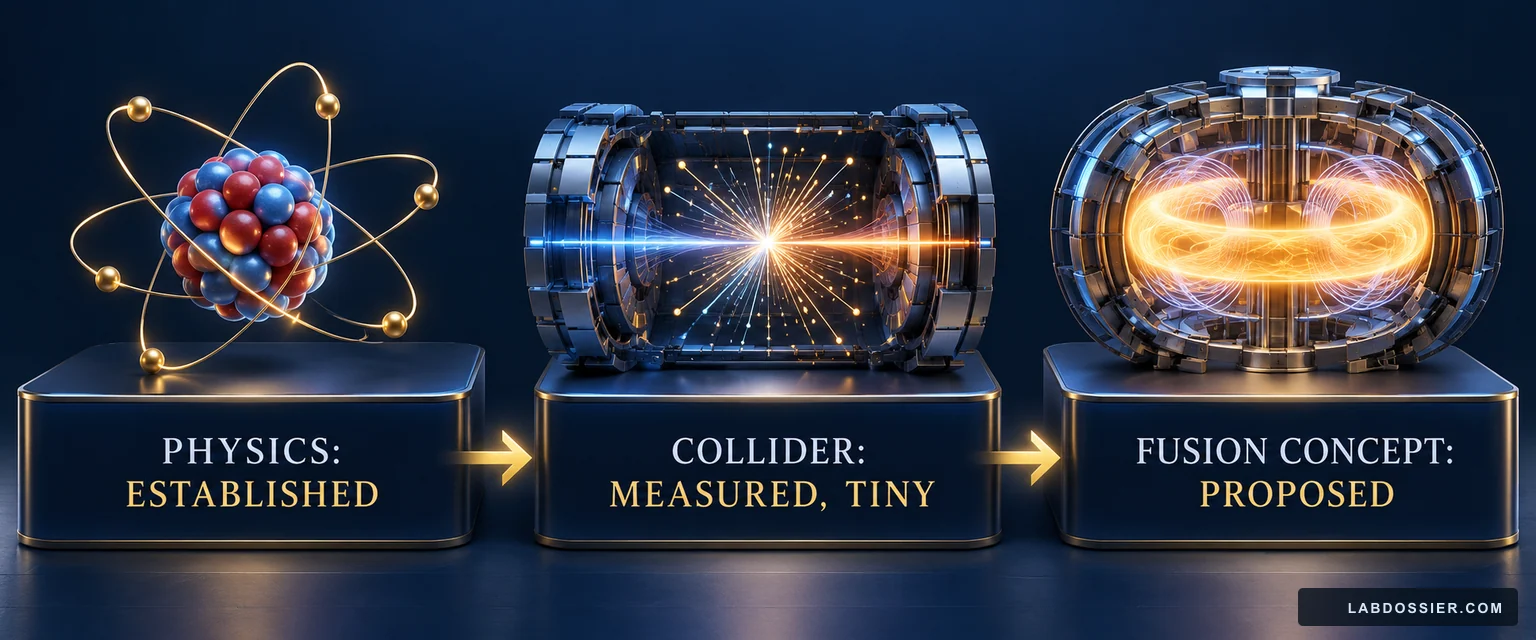
Those facts do not make a home recipe, a safe experiment, or an established commercial gold source. The careful conclusion is: elemental transmutation is real nuclear science; a new company claim merits attention but remains unverified in the materials reviewed; practical gold manufacturing at commercial scale remains unproven. The evidence ladder below separates what is established, measured, proposed, and newly claimed.
For a classroom connection, compare this explanation with the site’s hands-on lab investigations and its guide to the scientific method. Those activities use visible, low-risk evidence; none involves mercury or nuclear materials.
QUESTIONS READERS ASK
Mercury-to-gold questions
Can you turn mercury into gold with heat or a chemical reaction?
No. Ordinary chemical reactions rearrange electrons and bonds. They cannot change mercury's 80 protons into gold's 79. Heating mercury can create dangerous vapour; it does not make gold.
Has mercury ever been transmuted into gold?
Yes, in nuclear experiments. A 1941 Harvard paper reported radioactive gold isotopes produced by fast-neutron reactions on mercury. This was laboratory nuclear physics, not a chemical recipe or a source of commercial gold.
What is the mercury-198 route proposed for fusion reactors?
The 2025 paper proposes a fast-neutron (n,2n) reaction that changes mercury-198 into mercury-197, which decays by electron capture to stable gold-197. The paper models the system; it does not report a producing power plant.
Does the Large Hadron Collider make gold?
ALICE measured signatures consistent with lead nuclei losing three protons and becoming gold nuclei. CERN reports 29 picograms during Run 2 across the major experiments; the nuclei struck accelerator equipment and fragmented almost immediately.
Would synthesized gold be radioactive?
It depends on the isotope and on other nuclei produced in the same irradiation. Gold-197 is stable; gold-198 and gold-199 are radioactive. A real irradiated product stream would need isotope-specific measurement and regulatory controls.
Could gold from a fusion reactor lower gold prices?
That is unknown. The proposed annual output is a simulation result per unit of thermal power, not demonstrated production. Fusion plants themselves are not commercially operating power stations, and the paper does not establish market supply, separation costs, or product licensing.
Is mercury safe to handle because it is a metal?
No. Metallic mercury can release vapour, and exposure risks depend on the amount, setting, duration, and form. Do not touch or heat it. Follow current public-health or environmental authority guidance.
What should I do if I find a mercury spill?
Keep people and pets away, avoid disturbing it, and contact your local health, environmental, or fire authority for instructions. EPA's current guidance says never vacuum mercury. Local rules and spill circumstances matter.
What does 'red mercury' mean?
The phrase is used in fraudulent and sensational claims, not as a recognized shortcut for making gold. Treat guaranteed-transmutation or secret-material sales claims as unsupported unless independent laboratories publish reproducible measurements.
Can a home experiment demonstrate nuclear transmutation?
No safe household activity can demonstrate changing one element into another. Do not handle mercury, attempt irradiation, dismantle equipment, or follow instructions for extracting metals from amalgams. Learn the concepts using published experiments, diagrams, and classroom-safe models.
PRIMARY AND OFFICIAL SOURCES
Sources and further reading
- Sherr, Bainbridge & Anderson, “Transmutation of Mercury by Fast Neutrons,” Physical Review (1941) — primary report of radioactive gold and other reaction products.
- Rutkowski, Harter & Parisi, “Scalable Chrysopoeia via (n,2n) Reactions Driven by Deuterium-Tritium Fusion Neutrons” (2025) — proposal and neutronics simulation; not a commercial plant result.
- Marathon Fusion, October 21, 2026 public announcement — first-party claim of an experimental result; direct X access was blocked during this review, and the claim is not independently established here.
- The Oregon Group, “Fusion start-up turns mercury into gold, but can’t say what it costs” (October 22, 2026) — analyzes the announcement and identifies what the public comparison and spectrum do not establish.
- CERN, “ALICE detects the conversion of lead into gold at the LHC” (2025) — collaboration report of the Run 2 measurement and mass estimate.
- Brookhaven National Nuclear Data Center, Evaluated Nuclear Structure Data File — evaluated nuclear decay data.
- U.S. EPA, What to Do If You Spill More Mercury Than the Amount in a Thermometer — official U.S. spill-response information; local guidance may differ.
- World Health Organization, Mercury and Health — forms of mercury and health context.
- Seaborg & collaborators, “Energy dependence of ²⁰⁹Bi fragmentation in relativistic nuclear collisions,” Physical Review C (1981) — primary context for heavy-ion fragmentation research.
Images are AI-generated editorial illustrations. Reaction steps are simplified, labeled as concepts, and do not depict measured apparatus data.