Read a Safety Data Sheet
01 // Use the sheet for the exact product
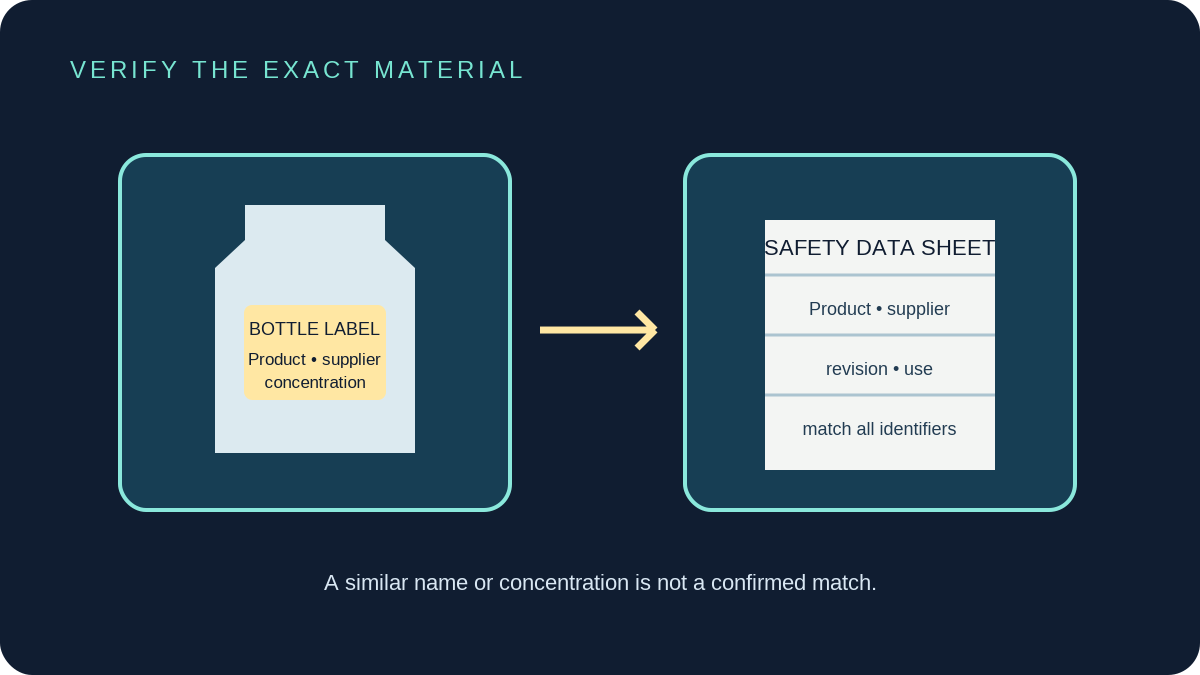
A Safety Data Sheet (SDS) is a supplier document about a chemical product: its identity, hazards, protective measures, first-aid information, storage and other properties. Start by matching the product name and supplier on the sheet to the container label and the material named in the approved procedure. Similar names can refer to different concentrations, mixtures, or product grades. A sheet for pure ethanol, for example, is not automatically the right sheet for a branded cleaner that contains ethanol plus other ingredients.
Check the supplier, product identifier, recommended use, and revision date. A search result that matches only one word is not enough. If the label and sheet do not match, the sheet is missing, or the version cannot be confirmed, do not guess which one applies. Bring the discrepancy to the teacher or designated lab supervisor. The current container label and the school's procedure must be considered together with the SDS.
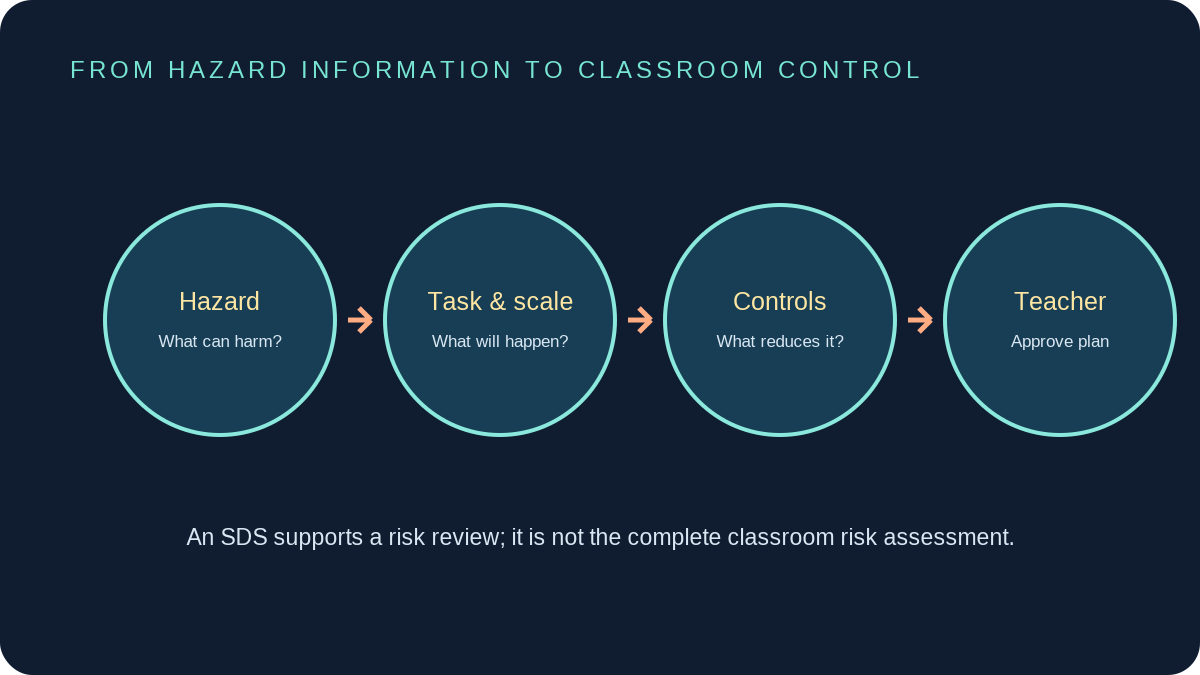
An SDS communicates hazards and recommended controls; it is not by itself a complete risk assessment or permission for a student to handle a chemical. The American Chemical Society's RAMP framework asks educators to recognize hazards, assess risks, minimize them, and prepare for emergencies. Students can learn to locate information and ask focused questions while the teacher decides whether an activity and its controls are appropriate for that room and group.
03 // Find the sections that answer a pre-lab question
| Section | What it helps you locate | Student use before the activity |
|---|---|---|
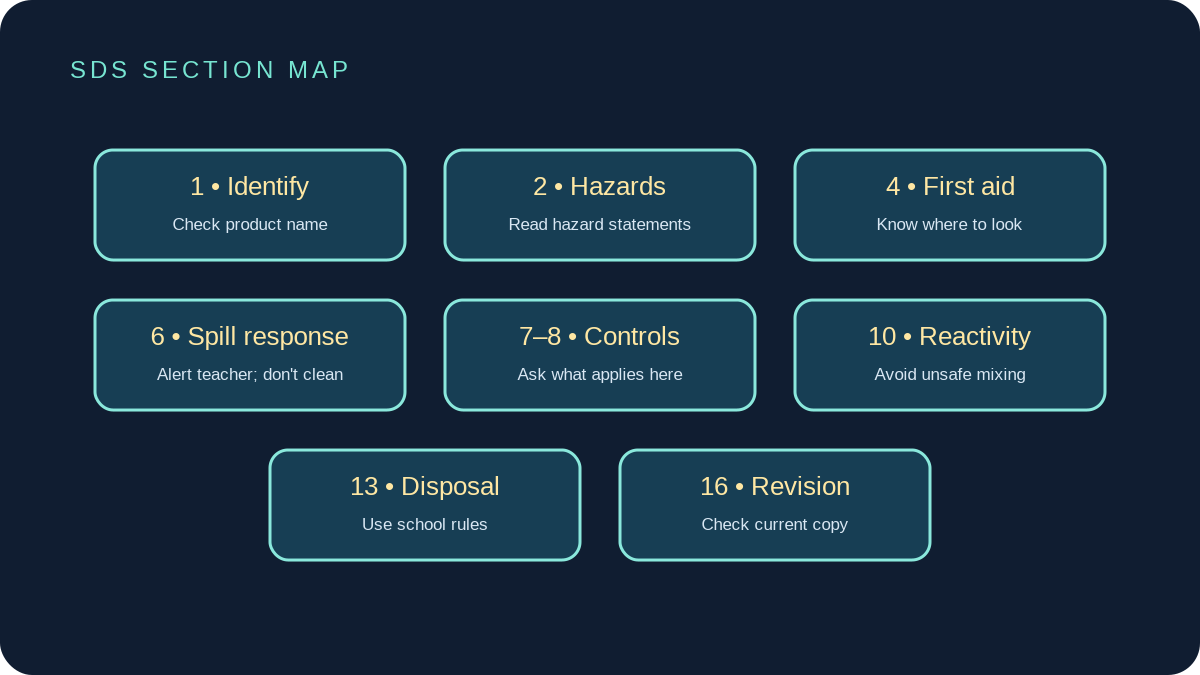
| 1 — Identification | Product identifier, supplier, recommended use and emergency contact | Confirm the sheet is for the labeled product |
| 2 — Hazard identification | Classification, signal word, hazard statements and pictograms | Ask what the listed hazards mean for this specific task |
| 4 — First-aid measures | Supplier's first-aid guidance by exposure route | Know where this information is; follow the teacher and posted emergency plan |
| 6 — Accidental release | Supplier guidance for an accidental release | Do not clean a spill; alert the teacher and keep away |
| 7 and 8 — Handling, storage, exposure controls | Recommended practices and protective equipment information | Ask which controls apply in the school procedure |
| 10 — Stability and reactivity | Conditions or materials that may be incompatible | Never combine substances based on a guess |
| 13 — Disposal considerations | Supplier disposal information | Use the school's labeled waste containers and teacher direction |
| 16 — Other information | Revision and other supplemental notes | Check the date and whether the copy is current |
OSHA's standard SDS format has 16 numbered sections. Some information in sections 12–15 is governed by agencies other than OSHA in the United States. Follow local school rules and the current document for the product.
05 // Read in a safe order before work begins
1. Match the product
Compare the container name, supplier and concentration or mixture with Section 1 and the procedure. Stop if one does not match.
2. Read the hazard statements
Use Section 2 to identify the hazard classification, signal word, statements and pictograms. A pictogram alone does not tell you the complete risk or the right PPE.
3. Find the protective controls
Use Sections 7 and 8 to locate handling, storage and exposure-control information, then ask the teacher which measures apply to this small-scale activity.
4. Locate response and incompatibility notes
Know where Sections 4, 6 and 10 appear. If exposure, a spill, unexpected reaction, or broken container occurs, alert the teacher and follow the room's emergency procedure.
5. Resolve uncertainty before starting
Compare the SDS with the written method, labels, waste plan and posted emergency equipment. Ask the teacher to resolve any mismatch; do not improvise.
07 // Turn an SDS reading into a question, not a guess
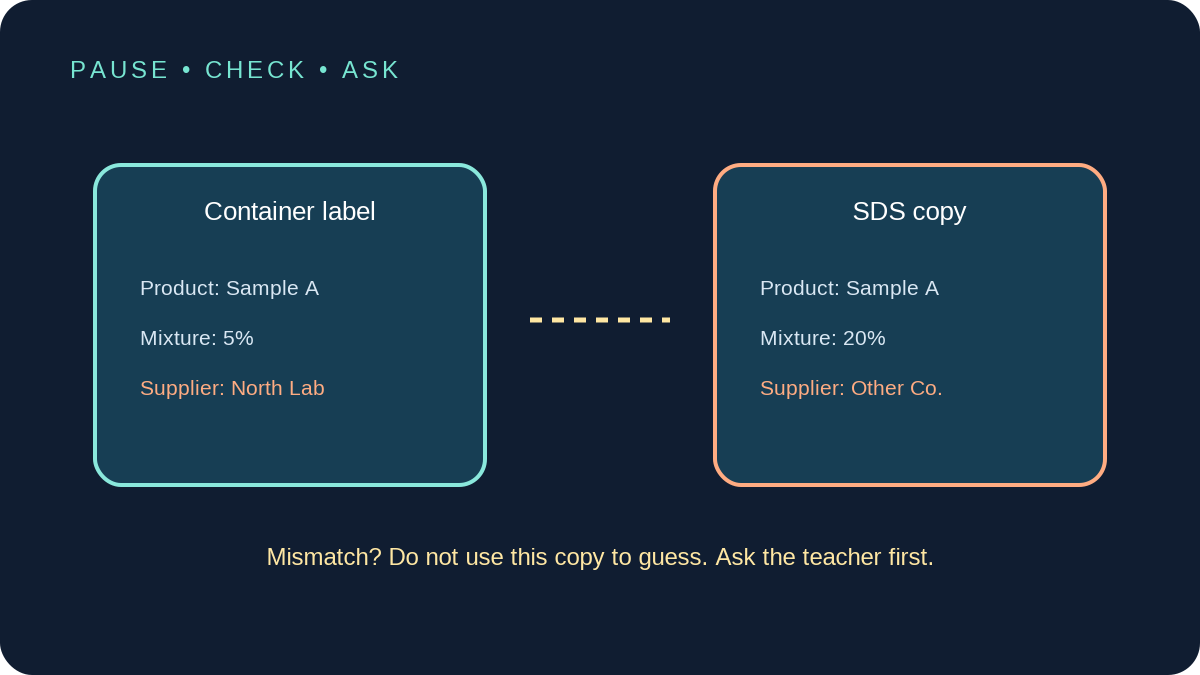
Suppose a teacher-approved demonstration lists a bottle named “Product A, 5% solution,” while a search result is for the pure concentrated ingredient.
| Container label | Product A, 5% solution |
| Search result | Pure ingredient, supplier B |
| Mismatch | Product and concentration do not match |
Formula pre-lab check = exact product + procedure + teacher-approved controls
09 // Keep the SDS in its proper role
- Hazard classification is not the whole risk assessment. Amount, concentration, route, duration, activity, ventilation, equipment and people present can change what controls a teacher needs.
- A pictogram or signal word summarizes hazard information; it does not replace the written statements or the procedure. Do not infer that a missing pictogram means a product is risk-free.
- For a spill, eye exposure, inhalation concern, fire, damaged container or unexpected reaction, stop, move as instructed and alert the teacher. Students should not use the SDS as permission to clean, treat, or contain an incident.
- Disposal language in Section 13 does not authorize a student to pour a material into a sink. The school's waste plan, local rules and teacher direction control the classroom action.
06 // Turn the document into a short pre-lab checklist
Before the activity, write down the exact product identifier and the SDS revision date. Mark which sections you checked and note questions in plain language: Which exposure route matters in this procedure? What eye protection is required? Where is the eyewash? Which waste container is assigned? The teacher can then connect supplier information to the amount, container, room ventilation, equipment, and students involved.
Keep this checklist separate from an emergency response plan. A student should know how to alert the teacher and where the posted emergency equipment is, but should not use supplier spill advice to decide independently how to contain or clean a release. If the procedure or label changes, the earlier check may no longer apply; compare the new product and method before starting.
07 // Treat missing or conflicting information as a stop signal
A missing Section 8, an unreadable concentration, an expired school copy, or a container with a handwritten name can prevent a reliable match. Do not fill gaps by borrowing a web page for a similar chemical. Record what is missing and bring the bottle and procedure to the teacher or chemical hygiene lead. The responsible adult can obtain the supplier's current sheet and decide whether the activity should be changed or postponed.
The SDS may use technical terms, exposure limits, or protective equipment recommendations that do not directly describe a small classroom demonstration. That does not make the information irrelevant, and it does not mean every listed control automatically applies. Ask the instructor to explain how the recommendation was evaluated for this task. Only begin after the exact material, procedure, controls, emergency steps, and waste route are clear and approved.
08 // Questions people ask
What is a Safety Data Sheet?
An SDS is a supplier document that describes a chemical product's identity, hazards, protective information, first-aid guidance, handling, storage and other properties. Match it to the exact container and mixture before using it as a reference.
Which SDS sections should a student read first?
First match Section 1 to the product label, then read Section 2 for hazard information. Locate Sections 4, 6, 7, 8, 10 and 13 for emergency, release, handling, protection, reactivity and disposal information. Ask the teacher which controls apply.
Is an SDS the same as a risk assessment?
No. An SDS reports supplier information about a product. A risk assessment considers the actual task, amount, concentration, route of exposure, room, controls and people involved. In a school lab, the teacher or designated supervisor evaluates those conditions.
Can I use an SDS for a concentrated ingredient when the bottle is diluted?
Do not assume it matches. Check the exact product name, supplier and concentration or mixture on the container and sheet. Ask the teacher to provide the correct document or clarify the procedure before work begins.
Does Section 13 mean I can pour the chemical down a drain?
No. Use the school's labeled waste plan and teacher direction. Section 13 is supplier disposal information, not authorization for an individual student to choose a drain or container.
Should students clean up a spill by following Section 6?
No. Section 6 contains accidental-release information for the product, but students should not use it as permission to clean a spill. Step away, keep others clear, alert the teacher, and follow the classroom emergency procedure.