LF-08 · TEACHER LESSON PLAN
Egg drop challenge
Compare padding designs with the same safe, controlled drop
Driving question
Learning objectives
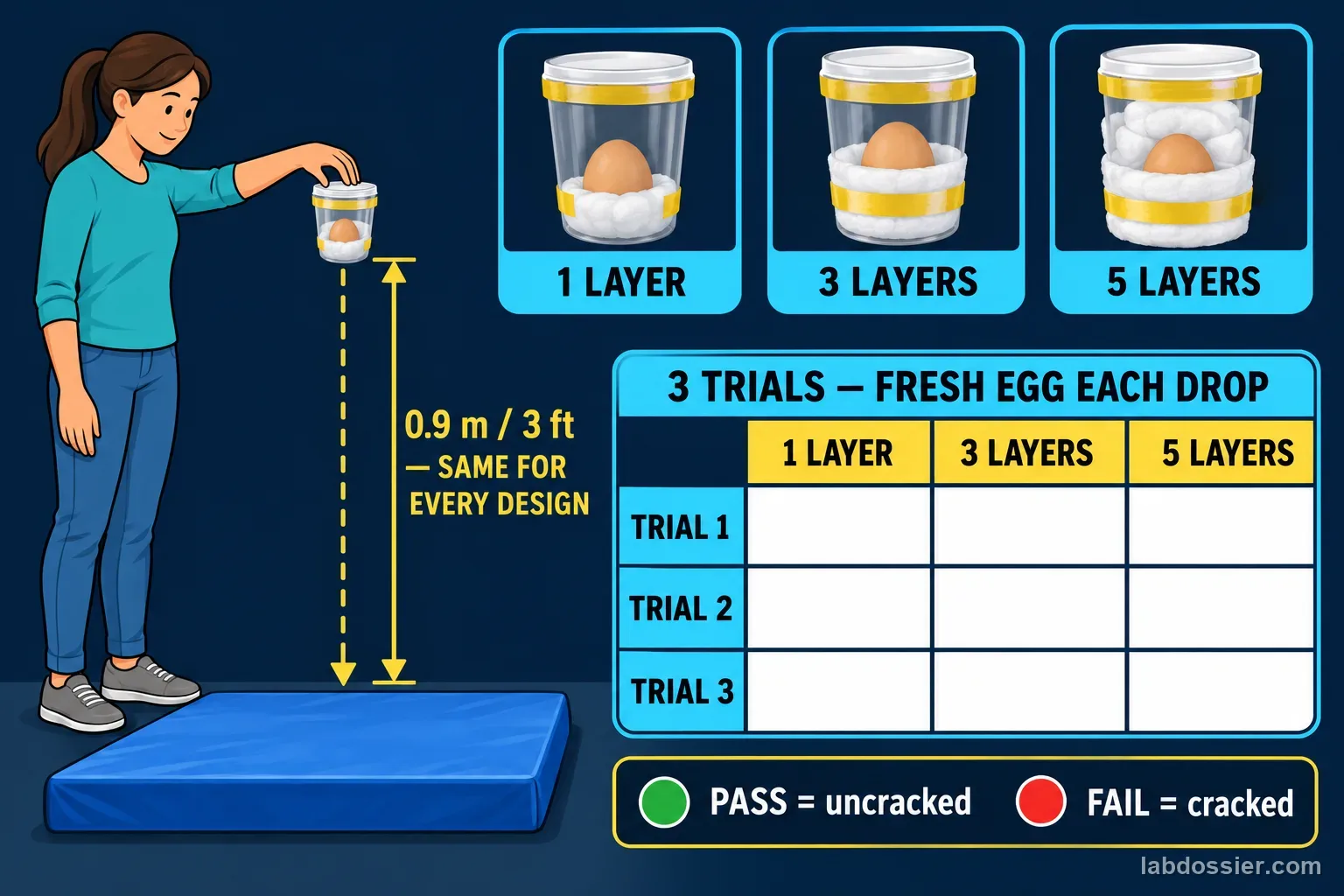
- Students build three matched containers that differ only in padding amount: one, three or five layers.
- Students test each design in three independent trials at one adult-reachable 0.9 m (3 ft) height, using a fresh egg for every drop.
- Students compare pass counts and visible damage as evidence about this setup, not as a force measurement or safety certification.
Standards
| Dimension | Alignment |
|---|---|
| Performance expectation | MS-ETS1-2Evaluate competing design solutions using a systematic process to determine how well they meet the criteria and constraints of the problem. (Partial alignment: students compare three padding designs against egg survival and visible damage at one fixed, low height, but the class does not jointly define a broader set of criteria and constraints or complete a redesign cycle.) |
| Practices | SEP 3Plan and carry out investigations. SEP 4Analyze and interpret data. |
| Core idea | ETS1.BA solution needs to be tested, and then modified on the basis of the test results, in order to improve it. |
| Crosscutting | Structure and functionThe way an object is shaped or structured determines many of its properties and functions. |
Standard text paraphrased from the Next Generation Science Standards. Alignment is partial because this lesson compares tested designs but does not require students to revise and retest a solution.
State standards crosswalk
Use the row as a planning crosswalk, then confirm local district pacing and grade placement. “Partial” labels describe a skill connection, not full mastery of the complete standard.
| State | Verified standard | How this lesson aligns | Official source |
|---|---|---|---|
| California | CA NGSS MS-ETS1-2 | Partial connection: students compare competing protective designs with test evidence, but do not jointly define all criteria and constraints or redesign the selected solution. | Open standard ↗ |
| Texas | Science.7.1(B) | Strong practice connection: students plan a comparative investigation and use engineering practices to design solutions; this is a practice standard, not a content-specific impact standard. | Open standard ↗ |
| Florida | SC.6.N.1.1 | Partial connection: students define the design question, identify the changed condition, collect and interpret results, and defend a conclusion; the lesson is not a full investigation sequence across all listed skills. | Open standard ↗ |
| New York | NYSSLS MS-ETS1-2 | Partial connection: the pass/fail table is a systematic comparison, but the class does not jointly set multiple criteria and constraints or redesign after testing. | Open standard ↗ |
| Pennsylvania | STEELS 3.5.6-8.P | Partial connection: teams use a repeated height test to compare designs, but do not evaluate a complete set of jointly specified criteria and constraints. | Open standard ↗ |
Materials and prep timeline
PER GROUP
- Nine fresh, similar-size raw eggs, one per drop
- Matched outer containers with one, three or five padding layers
- Paper, cardboard, straws, tape and rubber bands
- Scissors, ruler and design labels
- Same stable floor-level landing tray or padded area
- Goggles and cleanup gloves
TEACHER ONLY
- Choose a low height the adult can reach while standing on the floor; use 0.9 m (3 ft) only if comfortable. Do not use a ladder, stairs, chair, balcony or raised platform.
- Quarantine and mark the drop zone; keep students and bystanders outside the fall path. The adult performs all releases straight down.
- Require eye protection and closed-toe shoes; provide gloves for egg cleanup and at least nine fresh eggs per group.
CLASS-SIZE KIT PLANNER
One per-group kit contains every item in the team materials list above. Groups are balanced around the listed 3–4 students target.
| Students | Groups | Per-group kits | Student sheets | Suggested group split |
|---|---|---|---|---|
| 20 | 6 | 6 complete kits | 20 copies | 2 groups of 4 and 4 groups of 3 |
| 25 | 7 | 7 complete kits | 25 copies | 4 groups of 4 and 3 groups of 3 |
| 30 | 8 | 8 complete kits | 30 copies | 6 groups of 4 and 2 groups of 3 |
Build one-, three- and five-layer versions with the same shell and payload placement. Label each version and inspect for loose parts.
The adult chooses a low height they can reach while standing on the floor, marks 0.9 m (3 ft) only if comfortable, lays the landing area and clears the drop zone. No climbing or elevated platform.
At the same height, the adult releases three fresh eggs per design straight down without throwing. Record PASS/FAIL and visible crack location after every drop.
Count passes out of three for each padding amount and compare the damage notes. Describe the observed pattern without calling any design a guaranteed winner.
Lab figures and data visuals
Reviewed article images support the lesson flow. Use the tables and student sheet to record actual observations; pictured patterns are not target results.

Printable shopping list
Shopping and staging checklist
Multiply the per-group kit contents by the class-size planner. The teacher section includes teacher-provided materials and setup or safety notes.
PER-GROUP KITS
- Nine fresh, similar-size raw eggs, one per drop
- Matched outer containers with one, three or five padding layers
- Paper, cardboard, straws, tape and rubber bands
- Scissors, ruler and design labels
- Same stable floor-level landing tray or padded area
- Goggles and cleanup gloves
TEACHER-PROVIDED MATERIALS + SETUP RULES
- Choose a low height the adult can reach while standing on the floor; use 0.9 m (3 ft) only if comfortable. Do not use a ladder, stairs, chair, balcony or raised platform.
- Quarantine and mark the drop zone; keep students and bystanders outside the fall path. The adult performs all releases straight down.
- Require eye protection and closed-toe shoes; provide gloves for egg cleanup and at least nine fresh eggs per group.
QUANTITIES BY CLASS SIZE
| Material | Per group kit | 20 students | 25 students | 30 students |
|---|---|---|---|---|
| Fresh raw eggs for nine drops | 9 | 54 | 63 | 72 |
| Matched outer containers | 3 | 18 | 21 | 24 |
| Padding stock for 1, 3 and 5 layers | 9 layer units | 54 layer units | 63 layer units | 72 layer units |
| Tape, rubber bands and labels | 1 group set | 6 group sets | 7 group sets | 8 group sets |
| Scissors, ruler and catch tray | 1 of each | 6 of each | 7 of each | 8 of each |
| Safety glasses | 1 per student | 20 | 25 | 30 |
| Adult floor-level release point and drop-zone barrier | 1 shared classroom station | 1 | 1 | 1 |
Prepare 6 kits for 20 · 7 kits for 25 · 8 kits for 30 students.
Lesson flow
| Minutes | What happens |
|---|---|
| Build · 0–8 | Engage Identify the planned variable (padding layers) and response (survival and visible damage). Review matched eggs, fixed adult-reachable release height, capsule and landing area. |
| Build · 8–30 | Explore Construct matched one-, three- and five-layer containers. Label the versions and record where each layer is placed. |
| Build · 30–45/60 | Inspect every container and prepare nine fresh, similar-size eggs per group, one for each drop. The adult marks a floor-level release height they can reach safely, clears the drop zone and checks the landing area; nobody climbs. |
| Test · 0–4 | Explore Confirm eye protection, tray or padded landing area, boundary and one low release height the adult can reach from the floor. Lower the height if there is any need to stretch, climb or use a platform. |
| Test · 4–15 | Run three trials for each padding design at the same marked height. The adult releases a fresh egg straight down each time; students record PASS/FAIL and crack location from outside the boundary. |
| Test · 15–18 | Explain Report passes out of three for each design and compare the observed damage. Describe the pattern as a result from these trials, not a guarantee. |
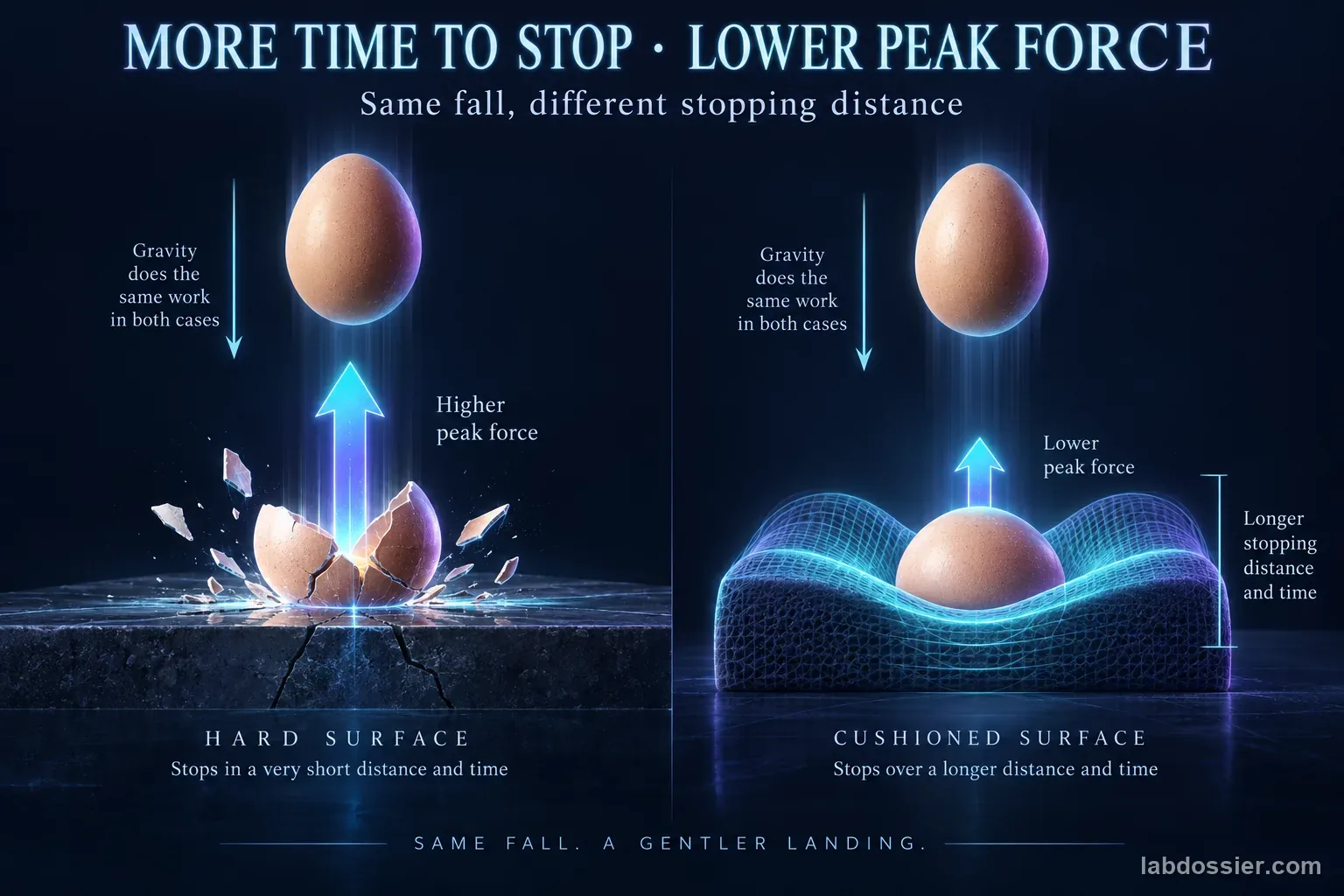
| Test · 18–20 | Evaluate Explain how well-fitted padding may lengthen stopping time or spread contact; egg survival is not a force measurement or real-world safety certification. |
Discussion questions
1. How do you compare the results?
2. Why use a fresh egg for every drop?
3. Why use one fixed, low height?
4. How might cushioning help, and what does this test not measure?
Common misconceptions
Differentiation
SUPPORT
- Provide a three-row padding checklist and a nine-cell PASS/FAIL recording card before testing.
- Use green PASS and red FAIL cards for each of the three trials per design, then count passes out of three.
- Offer the frame: “The ___-layer design passed ___ of 3 trials; I observed ___ damage at the same release height.”
EXTEND
- After comparing the results, change one feature such as an internal restraint and repeat at the same adult-reachable height with fresh eggs.
- Weigh the three designs and discuss how extra padding changes both protection and capsule mass.
- Repeat with more matched fresh eggs per design and compare whether the pass-rate pattern holds.
Assessment rubric
| Criterion | Beginning | Developing | Secure |
|---|---|---|---|
| Matched designs | Does not identify padding amount or uses unmatched containers. | Labels padding amounts but omits an important controlled condition. | Compares one, three and five layers with matched shell, egg size, release and landing surface. |
| Trial record | Leaves results blank or reuses an egg. | Records most trials but misses a fresh egg or crack note. | Records three PASS/FAIL trials per design with a fresh egg each time and notes visible damage. |
| Evidence comparison | Names a winner without using the table. | Counts passes but does not compare damage notes. | Compares pass counts out of three and visible crack patterns without claiming a guaranteed result. |
| Explanation and safety | Claims universal protection or ignores the drop-zone rules. | Names cushioning but gives an incomplete safety account. | Explains that padding may lengthen stopping or spread contact; follows adult floor-level release, clear-zone, and cleanup rules. |
Vocabulary
- Cushioning – Material around a payload that can lengthen stopping time and spread contact during impact.
- Impact – A collision in which objects exert forces on one another.
- Payload – The item a designed container carries or protects; here, the egg.
- Controlled condition – A factor kept the same so the planned comparison is meaningful.
- Pass rate – The number of successful trials divided by the total number of trials in the comparison.
- Trial – One individual drop under the planned conditions, using a fresh egg.
Safety, cleanup and troubleshooting
BEFORE STUDENTS TOUCH ANYTHING
- Choose one low release height that the adult can reach while standing on the floor; use 0.9 m (3 ft) only if it is comfortable and controlled. Never use a ladder, stairs, chair, balcony or elevated platform. The adult performs every release; lower the height if needed.
- Mark and clear the drop zone so students and bystanders stay out of the fall path. Release straight down without throwing onto the same stable floor-level landing area. Wear eye protection and closed-toe shoes; use gloves for broken-egg cleanup.
- Use one new, similar-size egg for every drop. Raw egg can carry Salmonella; keep eggs away from food, wash hands with soap and water, and clean/disinfect the landing area after a break.
Troubleshooting: If an egg breaks, keep students outside the boundary while the adult uses gloves to clean and disinfect the landing area. If the release point, landing area or barrier is unstable, stop and reset it. Never use a ladder or platform, and never reuse a dropped egg.