How does drop height change an impact crater?
01 // Question
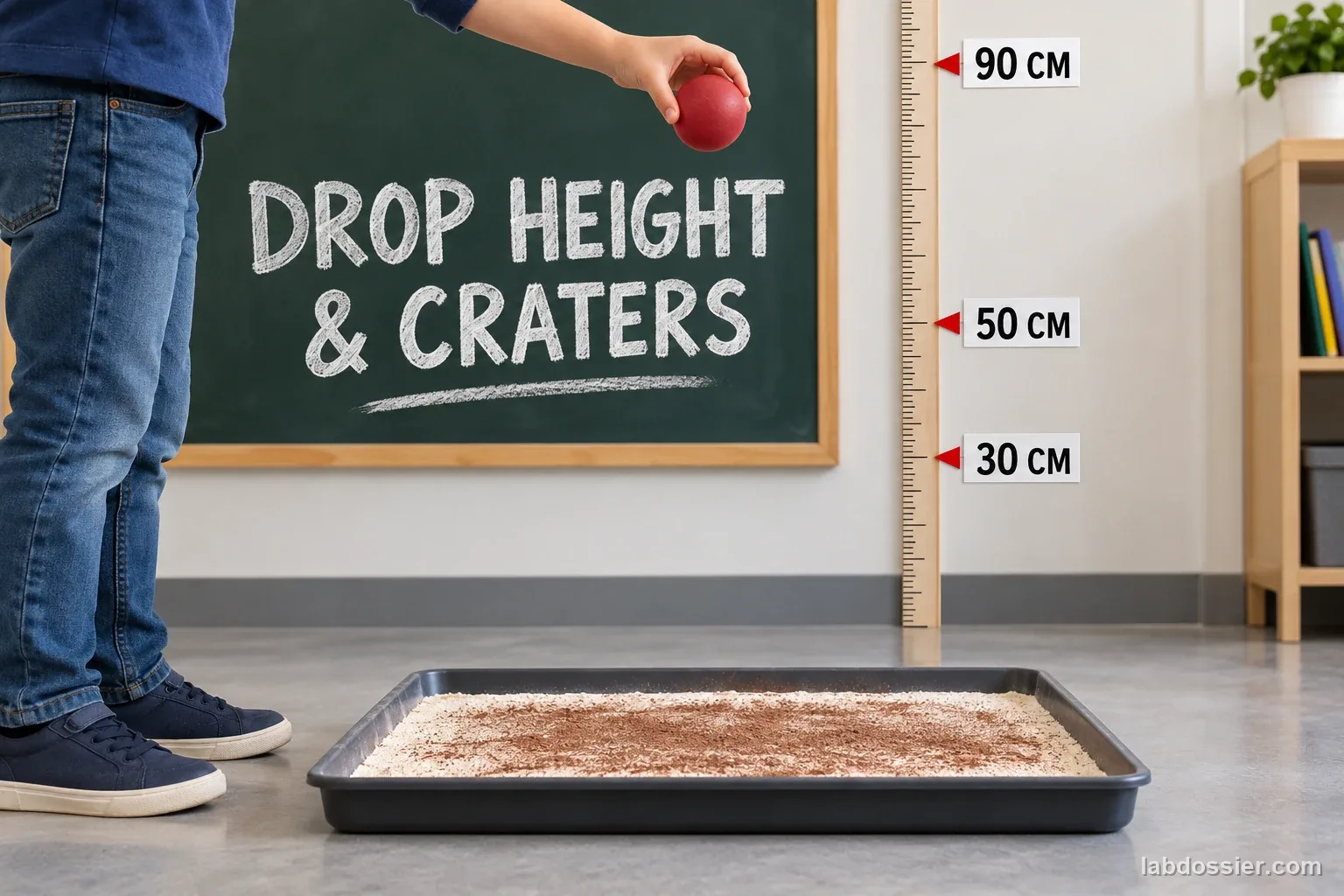
How does the drop height of the same impactor affect the diameter and depth of the crater it makes in a prepared surface?
This tabletop model compares conditions on Earth. It is not a scale replica of lunar gravity, impact speed, rock, or crater formation.
02 // Variables
Independent
Drop height measured from the bottom of the ball to the surface- 30 cm
- 50 cm
- 90 cm
Dependent
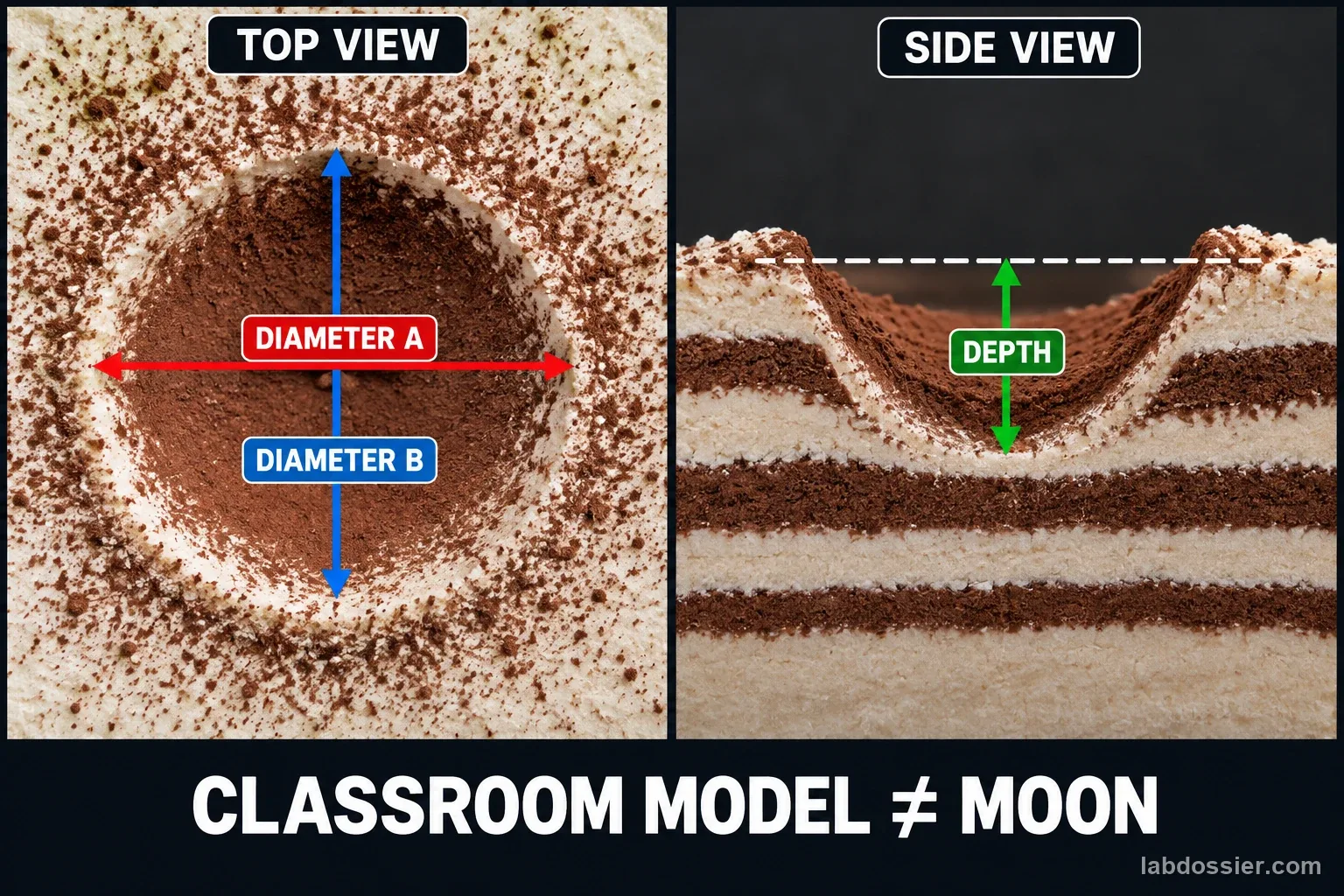
Crater dimensions after impact- Two crater diameters at right angles; report their mean
- Crater depth from a straightedge across the rim
- Three independent trials per drop height
03 // Hypothesis
IF the same ball is released from a greater measured height onto the same prepared surface, THEN its crater dimensions may increase, BECAUSE a higher release gives the ball more gravitational potential energy before impact, but the amount transferred into a crater depends on the material and collision.
04 // Procedure
1. Prepare one contained impact surface
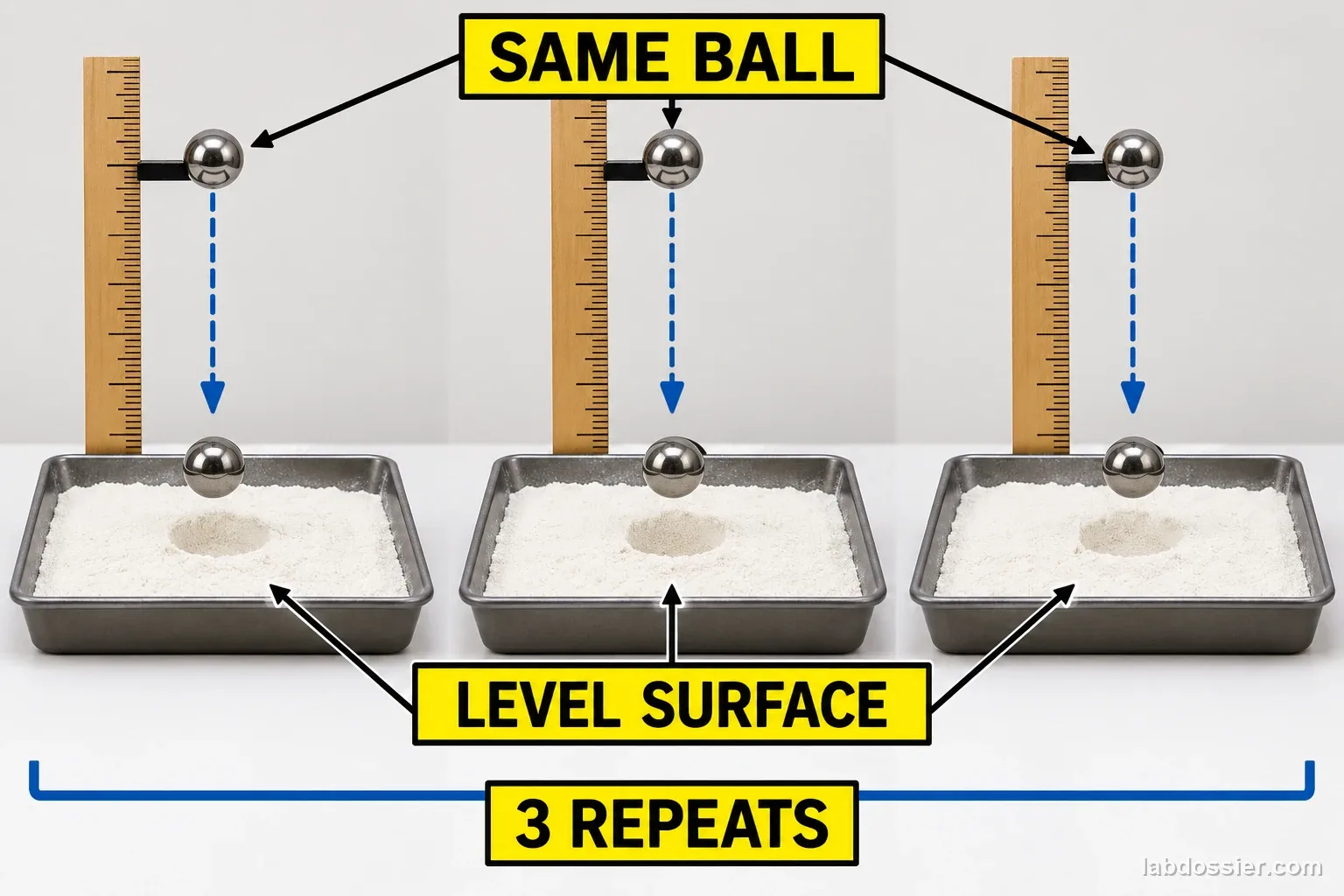
Set a wide tray on the floor over newspaper. Add a measured, even layer of flour or baking soda and a very thin contrasting cocoa or dry tempera layer. Keep the top surface level and do not blow or sift powder near faces.
2. Measure the impactor and heights
Use the same smooth ball at least 7 cm across for every run. Measure release height from the ball's bottom to the undisturbed surface: 30, 50 and 90 cm. Use the same vertical point above the center of the tray.
3. Release without adding a push
Hold the ball still at the selected height and let it go without throwing or spinning it. Keep hands and faces clear of the tray. Use an adult-supervised release if the height or equipment is difficult to manage safely.
4. Measure each crater consistently
Before removing the ball, note the rim and any visible ejecta. Measure crater diameter across the rim in two perpendicular directions and average them. Lay a straightedge across the rim to measure depth gently from the straightedge to the lowest point.
5. Reset and repeat three times
Record the crater, lift out the ball, restore the same measured surface depth, smooth it level and reapply the same thin top layer. Run three separate trials at each height, changing no other planned variable.
6. Compare mean, range and limits
For each height, calculate the mean and range of the three crater diameters and depths. Plot height against each measured outcome separately. Keep all raw readings and describe the model limits before connecting it to lunar craters.
Materials // Prepare the bench
- wide stable tray placed on the floor
- same smooth ball at least 7 cm across
- teacher-approved flour or baking soda
- a very thin cocoa or dry tempera contrast layer if allergies permit
- metric ruler
- straightedge
- eye protection
- newspaper or washable floor covering
- notebook or printed data table
- adult supervision
05 // Data table
| Drop height (cm) | Trial | Diameter A (cm) | Diameter B (cm) | Mean diameter (cm) | Depth (cm) | Surface reset? |
|---|---|---|---|---|---|---|
| 30 | 1 | ____ | ____ | ____ | ____ | yes / no |
| 30 | 2 | ____ | ____ | ____ | ____ | yes / no |
| 30 | 3 | ____ | ____ | ____ | ____ | yes / no |
| 50 | 1 | ____ | ____ | ____ | ____ | yes / no |
| 50 | 2 | ____ | ____ | ____ | ____ | yes / no |
| 50 | 3 | ____ | ____ | ____ | ____ | yes / no |
| 90 | 1 | ____ | ____ | ____ | ____ | yes / no |
| 90 | 2 | ____ | ____ | ____ | ____ | yes / no |
| 90 | 3 | ____ | ____ | ____ | ____ | yes / no |
What the classroom model does and does not represent
| Classroom observation | Connection to impact science | Important limit |
|---|---|---|
| A ball makes a depression and moves surface grains. | An impact can excavate material and leave a crater with surrounding ejecta. | Flour grains, low drop speeds and Earth gravity are unlike a high-speed lunar impact. |
| A higher drop may change measured crater size. | Release height changes the ball's gravitational energy before impact. | This test does not isolate every factor in natural crater formation or create a scale conversion to Moon crater size. |
Formula Mean diameter = (diameter A + diameter B) ÷ 2; range = largest reading − smallest reading
06 // What to expect
A greater drop height may produce a wider or deeper crater, but the trend is not guaranteed in every small trial. Surface preparation, compaction, ball release, tray movement and measurement technique all affect the result. Report the three raw trials, mean and range instead of presenting one drop as proof.
Impact craters form when a bolide collides with a planetary surface; mass and velocity matter. The flour-and-cocoa setup makes a visible depression and ejecta-like pattern, but it cannot reproduce the Moon's gravity, near-vacuum environment, high impact velocities, rock strength or geological scale. Use the model to compare controlled classroom conditions, not to predict a real crater's size.
07 // Lab notes
- Do not eat the materials. Wash hands after the activity and follow school cleanup and disposal directions.
08 // Remember
A model makes one process visible. It does not reproduce the Moon or scale a classroom dent into a lunar crater.
09 // Set up a repeatable impact model
Place the tray on the floor over a washable covering. Add the same measured depth of flour or baking soda for every trial, smooth it level without compacting it, then use the same very thin contrasting surface layer if the teacher approves it. Keep the tray, ball, impact point and preparation procedure fixed. Measure the release height from the bottom of the stationary ball to the undisturbed surface, not from the hand or top of the ball.
Use the same ball for the 30, 50 and 90 cm conditions and release it without a push or spin above the same point. After each impact, measure the visible depression before resetting the surface. Smooth and rebuild the powder to the same starting depth and apply the same top layer. Complete three independent trials per height. Record a preparation problem or an impact outside the tray rather than quietly replacing a value.
10 // Measure crater dimensions consistently
Crater rims are rarely perfect circles. Measure one diameter across the rim, then a second diameter at right angles; calculate their mean as (A + B) ÷ 2. To estimate depth, place a straightedge across the undisturbed rim and measure vertically to the lowest visible point without pressing the surface down. Use the same ruler placement and units for every trial. If the rim is unclear, note that measurement as uncertain rather than inventing a precise edge.
For each release height, keep all three crater readings, then calculate the mean and range separately for mean diameter and depth. A graph can show height on the horizontal axis and a chosen crater measurement on the vertical axis. Diameter and depth are distinct outcomes, so do not combine them into one score. A small number of trials is descriptive; it cannot establish a universal mathematical law from classroom powder.
11 // Compare the model with real planetary craters
A higher release gives the same ball more gravitational potential energy before impact, but crater formation also depends on impactor mass and speed, target material and structure, and how energy is transferred. NASA classroom activities use powders to make the pattern visible, but their procedures are demonstrations and models. The measurements from this tray are not a scale conversion for lunar crater size.
Earth gravity, a slow classroom ball, loose flour or baking soda and a shallow tray differ from high-speed impacts into rock in the Moon's environment. The setup does not reproduce lunar gravity, vacuum, geological materials, impact velocity or crater scale. Explain the comparison as a model: it helps investigate one controlled relationship and observe displaced surface grains, while its limitations set the boundary of the conclusion.
12 // Questions people ask
Why do craters form on the Moon?
A meteoroid or other impactor strikes the surface and excavates material. Crater size and features depend on properties such as impactor mass and velocity as well as the target surface; erosion and other processes later change craters.
Why use the same ball for every drop?
Changing the ball's mass, size or material at the same time as drop height would make it harder to tell which factor affected the measurement. Keep one impactor and change only the measured height.
Why measure two crater diameters?
Small craters are often irregular. Two measurements at right angles give a more representative classroom diameter than choosing only the widest direction.
Does a taller drop always make a larger crater?
Not necessarily in every trial. A higher release changes the ball's energy before impact, but surface preparation, compaction and measurement variation can affect the crater. Record all repeats and describe the observed pattern.
Does flour reproduce a real lunar impact?
No. It is a visible classroom model on Earth with a low-speed ball and granular powder. It does not reproduce lunar gravity, rock properties, impact speed or crater scale.
13 // Keep going
Can you explain the investigation?
How does drop height change an impact crater? · Student Data Sheet
Question: How does the drop height of the same impactor affect the diameter and depth of the crater it makes in a prepared surface?
Hypothesis: If the same ball is released from a greater measured height onto the same prepared surface, then its crater dimensions may increase, because a higher release gives the ball more gravitational potential energy before impact, but the amount transferred into a crater depends on the material and collision.
Materials
- wide stable tray placed on the floor
- same smooth ball at least 7 cm across
- teacher-approved flour or baking soda
- a very thin cocoa or dry tempera contrast layer if allergies permit
- metric ruler
- straightedge
- eye protection
- newspaper or washable floor covering
- notebook or printed data table
- adult supervision
Safety before starting
- Work over a wide tray on the floor, wear eye protection and have an adult supervise. Drop the ball vertically without throwing it; keep hands, faces and feet outside the tray and drop path.
- Check classroom allergy rules before using flour, baking soda or cocoa. Pour slowly to avoid dust, do not blow or sift powder near faces, and clean with the teacher-approved damp method. Do not eat the materials; wash hands after cleanup.
- Use a smooth ball at least 7 cm across and store it where young children cannot access it without adult supervision. Never use a ladder, chair or raised platform to reach a drop height.
Lab notes
- Do not eat the materials. Wash hands after the activity and follow school cleanup and disposal directions.
Variables
Independent: Drop height measured from the bottom of the ball to the surface · Dependent: Crater dimensions after impact
Keep constant: same smooth ball at least 7 cm across · same tray and flour depth · same thin cocoa layer · same level surface · same release point and no push · fresh, leveled surface for each trial
Procedure
- Prepare one contained impact surface: Set a wide tray on the floor over newspaper. Add a measured, even layer of flour or baking soda and a very thin contrasting cocoa or dry tempera layer. Keep the top surface level and do not blow or sift powder near faces.
- Measure the impactor and heights: Use the same smooth ball at least 7 cm across for every run. Measure release height from the ball's bottom to the undisturbed surface: 30, 50 and 90 cm. Use the same vertical point above the center of the tray.
- Release without adding a push: Hold the ball still at the selected height and let it go without throwing or spinning it. Keep hands and faces clear of the tray. Use an adult-supervised release if the height or equipment is difficult to manage safely.
- Measure each crater consistently: Before removing the ball, note the rim and any visible ejecta. Measure crater diameter across the rim in two perpendicular directions and average them. Lay a straightedge across the rim to measure depth gently from the straightedge to the lowest point.
- Reset and repeat three times: Record the crater, lift out the ball, restore the same measured surface depth, smooth it level and reapply the same thin top layer. Run three separate trials at each height, changing no other planned variable.
- Compare mean, range and limits: For each height, calculate the mean and range of the three crater diameters and depths. Plot height against each measured outcome separately. Keep all raw readings and describe the model limits before connecting it to lunar craters.
Record your observations
| Drop height (cm) | Trial | Diameter A (cm) | Diameter B (cm) | Mean diameter (cm) | Depth (cm) | Surface reset? |
|---|---|---|---|---|---|---|
What the classroom model does and does not represent
| Classroom observation | Connection to impact science | Important limit |
|---|---|---|
Formula: Mean diameter = (diameter A + diameter B) ÷ 2; range = largest reading − smallest reading
Answer key and expected pattern
A greater drop height may produce a wider or deeper crater, but the trend is not guaranteed in every small trial. Surface preparation, compaction, ball release, tray movement and measurement technique all affect the result. Report the three raw trials, mean and range instead of presenting one drop as proof.
Impact craters form when a bolide collides with a planetary surface; mass and velocity matter. The flour-and-cocoa setup makes a visible depression and ejecta-like pattern, but it cannot reproduce the Moon's gravity, near-vacuum environment, high impact velocities, rock strength or geological scale. Use the model to compare controlled classroom conditions, not to predict a real crater's size.
Remember: A model makes one process visible. It does not reproduce the Moon or scale a classroom dent into a lunar crater.