LF-17 · TEACHER LESSON PLAN
Magic milk experiment
Why a drop of dish soap sends color swirling across a plate of milk
Driving question
Learning objectives
- Students predict which milk condition may show the clearest color movement without assuming whole milk must win.
- Students classify swirl intensity on the same anchored 1–5 scale and record how long visible motion lasts.
- Students explain how soap changes surface conditions and milk interactions while food coloring traces the fluid movement.
Standards
| Dimension | Alignment |
|---|---|
| Performance expectation | 5-PS1-3Make observations and measurements to identify materials based on their properties. (Partial alignment: students observe and compare how different milks behave with soap; the lesson is about surface behavior, not identifying an unknown material.) |
| Practices | SEP 3Plan and carry out investigations (investigations that control variables, observations and measurements as evidence). SEP 4Analyze and interpret data. |
| Core idea | 5-PS1 core ideaMeasurements of a variety of properties can be used to identify materials. |
| Crosscutting | Cause and effectCause and effect relationships are routinely identified, tested, and used to explain change. |
Standards text paraphrased from nextgenscience.org. Alignment is partial; this hands-on activity does not cover every part of the performance expectation.
State standards crosswalk
Use the row as a planning crosswalk, then confirm local district pacing and grade placement. “Partial” labels describe a skill connection, not full mastery of the complete standard.
| State | Verified standard | How this lesson aligns | Official source |
|---|---|---|---|
| California | CA NGSS 5-PS1-3 | Limited connection: students observe and compare sample behavior, but this investigation does not identify an unknown material by its properties. | Open standard ↗ |
| Texas | Science.6.6(B) | Partial connection: students compare liquid samples after mixing, but do not classify pure substances and homogeneous or heterogeneous mixtures. | Open standard ↗ |
| Florida | SC.8.P.8.4 | Limited connection: the activity observes surface behavior, but does not classify substances using the listed characteristic physical properties. | Open standard ↗ |
| New York | NYSSLS 5-PS1-3 | Limited connection: students make observations of material behavior, but do not identify unknown materials as required by this expectation. | Open standard ↗ |
| Pennsylvania | STEELS 3.2.2.A | Partial connection: students investigate observable behavior of materials, but compare milk formulations rather than classify different materials by their properties. | Open standard ↗ |
Materials and prep timeline
PER GROUP
- 10 identical level shallow plates: 3 fresh trials each for whole, 2% and skim milk plus 1 whole-milk clean-swab control; 60 mL per plate
- Food coloring: 3 colors, 1 drop of each color per plate; use marked spacing and the same wait
- 10 fresh cotton swabs (one clean control, nine soapy trials)
- Dish soap: exactly 1 drop on each test swab; 1 dropper and 1 timer
- Eye protection for each student
- Paper towels and a spill tray
TEACHER ONLY
- Check dairy and food-coloring allergies before setup
- One printed student sheet per student
CLASS-SIZE KIT PLANNER
One per-group kit contains every item in the team materials list above. Groups are balanced around the listed 2–3 students target.
| Students | Groups | Per-group kits | Student sheets | Suggested group split |
|---|---|---|---|---|
| 20 | 7 | 7 complete kits | 20 copies | 6 groups of 3 and 1 group of 2 |
| 25 | 9 | 9 complete kits | 25 copies | 7 groups of 3 and 2 groups of 2 |
| 30 | 10 | 10 complete kits | 30 copies | 10 groups of 3 |
Prepare the no-soap control and nine fresh test plates. Add equal 60 mL portions, matched dye drops, then use one measured soap drop and center touch for each trial.
Time until movement has been absent for five seconds (cap at 60 s), apply the shared 1–5 visual anchors, and compare every raw trial, each mean, and range.
Lab figures and data visuals
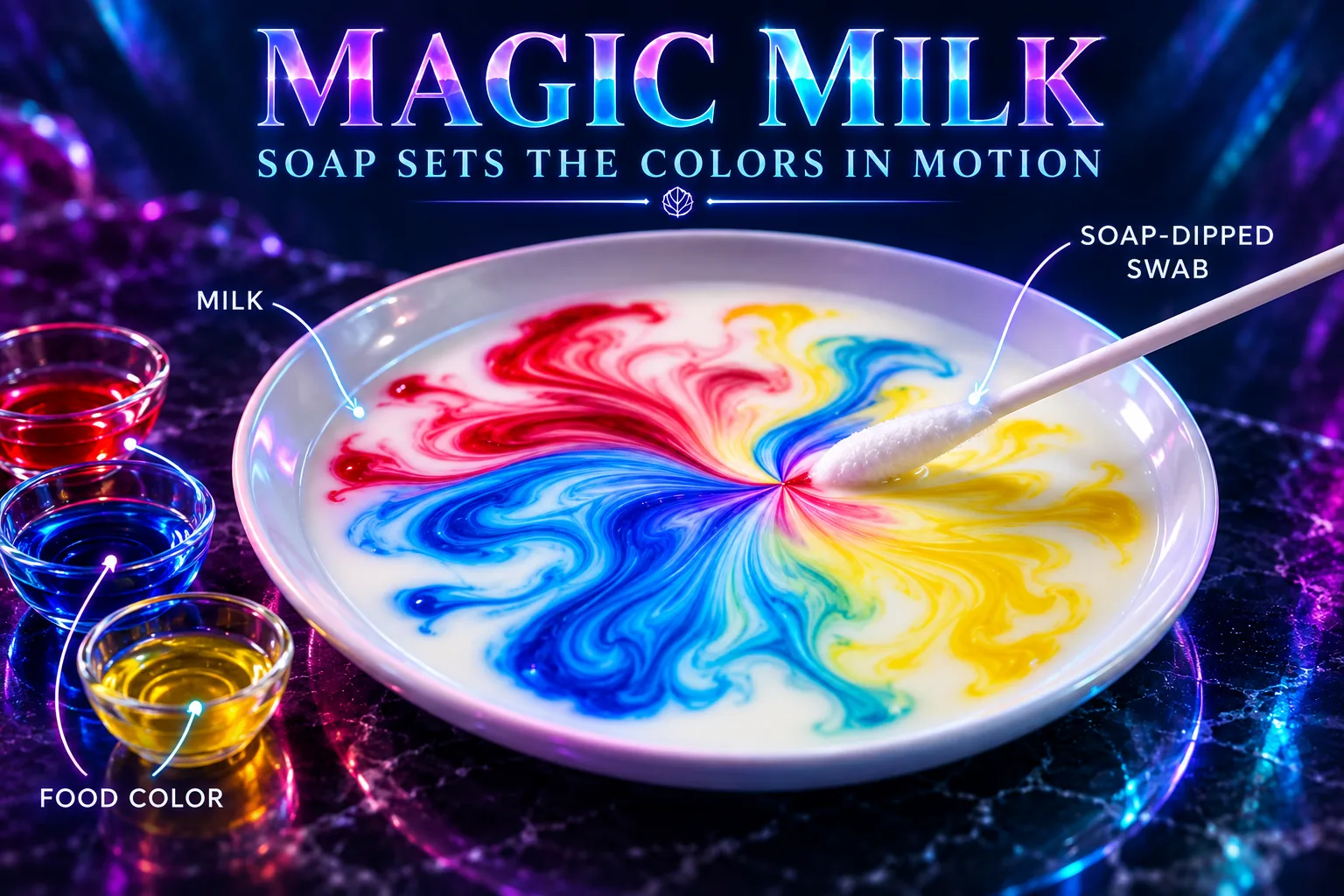
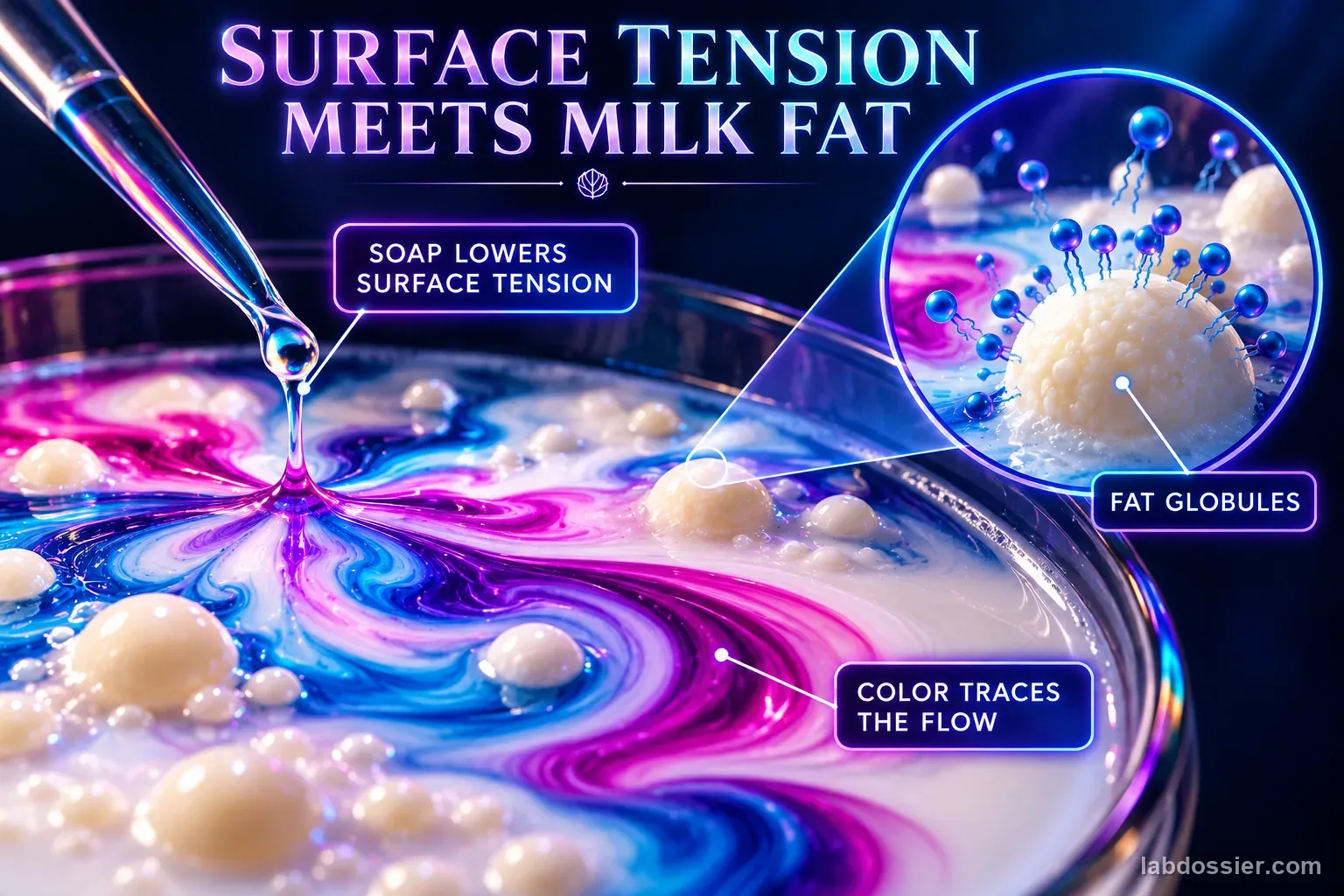
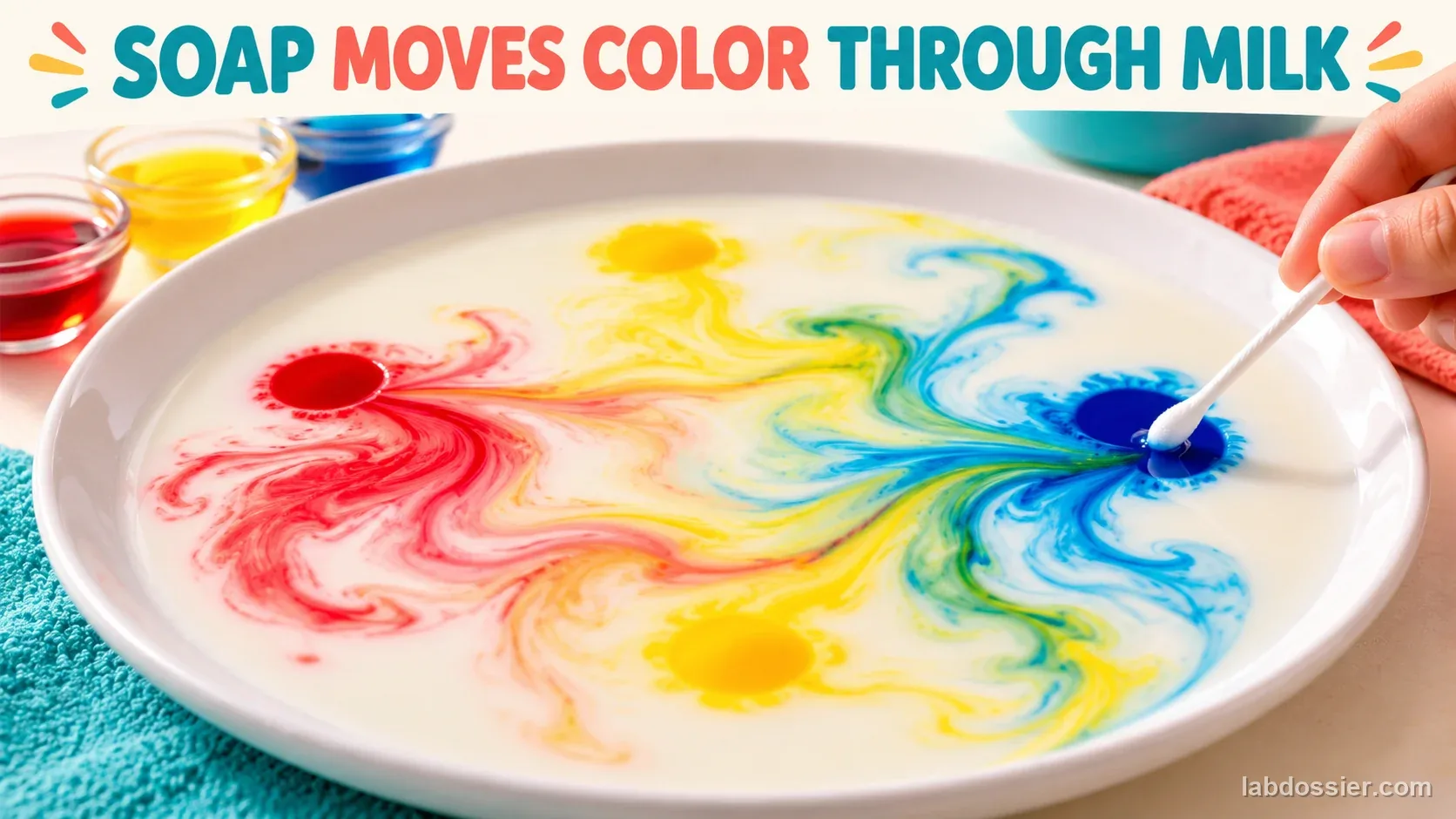
Reviewed article images support the lesson flow. Use the tables and student sheet to record actual observations; pictured patterns are not target results.
Printable shopping list
Shopping and staging checklist
Multiply the per-group kit contents by the class-size planner. The teacher section includes teacher-provided materials and setup or safety notes.
PER-GROUP KITS
- 10 identical level shallow plates: 3 fresh trials each for whole, 2% and skim milk plus 1 whole-milk clean-swab control; 60 mL per plate
- Food coloring: 3 colors, 1 drop of each color per plate; use marked spacing and the same wait
- 10 fresh cotton swabs (one clean control, nine soapy trials)
- Dish soap: exactly 1 drop on each test swab; 1 dropper and 1 timer
- Eye protection for each student
- Paper towels and a spill tray
TEACHER-PROVIDED MATERIALS + SETUP RULES
- Check dairy and food-coloring allergies before setup
- One printed student sheet per student
QUANTITIES BY CLASS SIZE
| Material | Per group kit | 20 students | 25 students | 30 students |
|---|---|---|---|---|
| Shallow plates (9 tests + 1 clean-swab control) | 10 | 70 | 90 | 100 |
| Milk (10 × 60 mL) | 600 mL | 4.2 L | 5.4 L | 6 L |
| Fresh cotton swabs | 10 | 70 | 90 | 100 |
| Dish soap | 9 measured drops | 63 drops | 81 drops | 90 drops |
| Eye protection (one pair per student) | 2–3 pairs | 20 pairs | 25 pairs | 30 pairs |
| Food coloring (3 colors) | 10 drops per color | 70 drops per color | 90 drops per color | 100 drops per color |
| Soap dropper and timer | 1 of each | 7 of each | 9 of each | 10 of each |
| Spill tray and paper towels | 1 tray + 2 towels | 7 trays + 14 towels | 9 trays + 18 towels | 10 trays + 20 towels |
| Student sheets | 1 per student | 20 | 25 | 30 |
Prepare 7 kits for 20 · 9 kits for 25 · 10 kits for 30 students.
Lesson flow
| Minutes | What happens |
|---|---|
| S1 · 0–2 | Engage Show the first soap touch and ask what the moving color reveals. Students predict whether one milk type will stand out or whether the results may be similar. |
| S1 · 2–5 | Explore Pour 60 mL into each identical level plate; use the same three dye drops at marked positions and the same wait time. |
| S1 · 5–8 | Use a clean dry swab on the separate control plate. Test each milk type on three fresh plates, with a new swab and exactly one soap drop each time. |
| S1 · 8–15 | Explore Touch the center once and start the timer at contact. Stop after five seconds without visible motion; record 60+ if the one-minute cap is reached first. |
| S2 · 0–5 | Explain Rate each pattern with shared anchors: 1 no streaking, 2 short/local, 3 about one-third of the plate, 4 about two-thirds, 5 vigorous streaks across most. |
| S2 · 5–10 | Evaluate Compare the three raw observations, means and ranges. Describe how surface flow carries the dye and why the score does not measure fat directly. |
Discussion questions
1. What did the food coloring show after a soap touch?
2. How can we compare whole, 2% and skim milk fairly?
3. Does a stronger swirl prove that sample has more fat?
4. What is a limit of this demonstration as a model of cleaning?
Common misconceptions
Differentiation
SUPPORT
- Use a photo card with one plate for each milk type and point to where the color first moves.
- Offer intensity choices with picture anchors: 1 no streaking, 3 about one-third of the plate, 5 vigorous streaks across most of it.
- Assign one student to touch the swab, one to time, and one to describe the pattern before swapping roles.
EXTEND
- Keep whole milk fixed and compare a tiny versus a larger soap amount using fresh matched plates.
- Use equal whole-milk samples at two temperatures and record both duration and intensity.
- Repeat one milk condition three times and compare the ratings' range instead of selecting a single dramatic swirl.
Assessment rubric
| Criterion | Beginning | Developing | Secure |
|---|---|---|---|
| Observation detail | Writes only “it moved.” | Names a color path or duration but leaves the milk condition unclear. | Records milk type, visible path and active-swirl time in seconds. |
| Classification | Uses no rating or changes the scale. | Rates the swirls but gives no shared meaning for a score. | Applies the same 1–5 anchors to whole, 2% and skim milk. |
| Explanation | Says the dye reacted or soap simply pushed color. | Mentions soap and movement without saying dye traces the flow. | Links soap's surface interaction to fluid motion that carries the dye, while avoiding a direct fat measurement claim. |
| Communication | Does not identify which milk was tested. | Shares a rating without describing the comparison conditions. | Uses the milk labels, rating scale and control observation to explain the comparison clearly. |
Vocabulary
- Surfactant – A substance such as dish soap that changes surface behavior and interacts with fats.
- Surface tension – A property of a liquid surface that affects how it moves and holds together.
- Emulsion – A mixture with tiny droplets of one liquid dispersed through another, as milk has fat droplets in water.
- Tracer – A visible material used to show where a fluid moves.
- Intensity scale – A set of shared score descriptions used to compare how strong an observation looks.
- Control – A comparison condition, here a clean swab, used to notice motion without soap.
Safety, cleanup and troubleshooting
BEFORE STUDENTS TOUCH ANYTHING
- Check for dairy or food-coloring allergies before setup. Do not drink or eat the milk after soap or test materials have touched it.
- Wear eye protection. Use only one small drop of dish soap per test swab, keep it away from eyes, and wipe milk spills promptly to prevent a slippery surface.
Troubleshooting: If every plate looks similarly active, check whether the swab carried too much soap; the lesson notes that excess soap can hide differences. If dye spreads before the test, keep plates undisturbed after placing the drops and before the swab touches.