LF-12 · TEACHER LESSON PLAN
Mentos and soda geyser
Why dropping Mentos into soda triggers an instant eruption
Driving question
Learning objectives
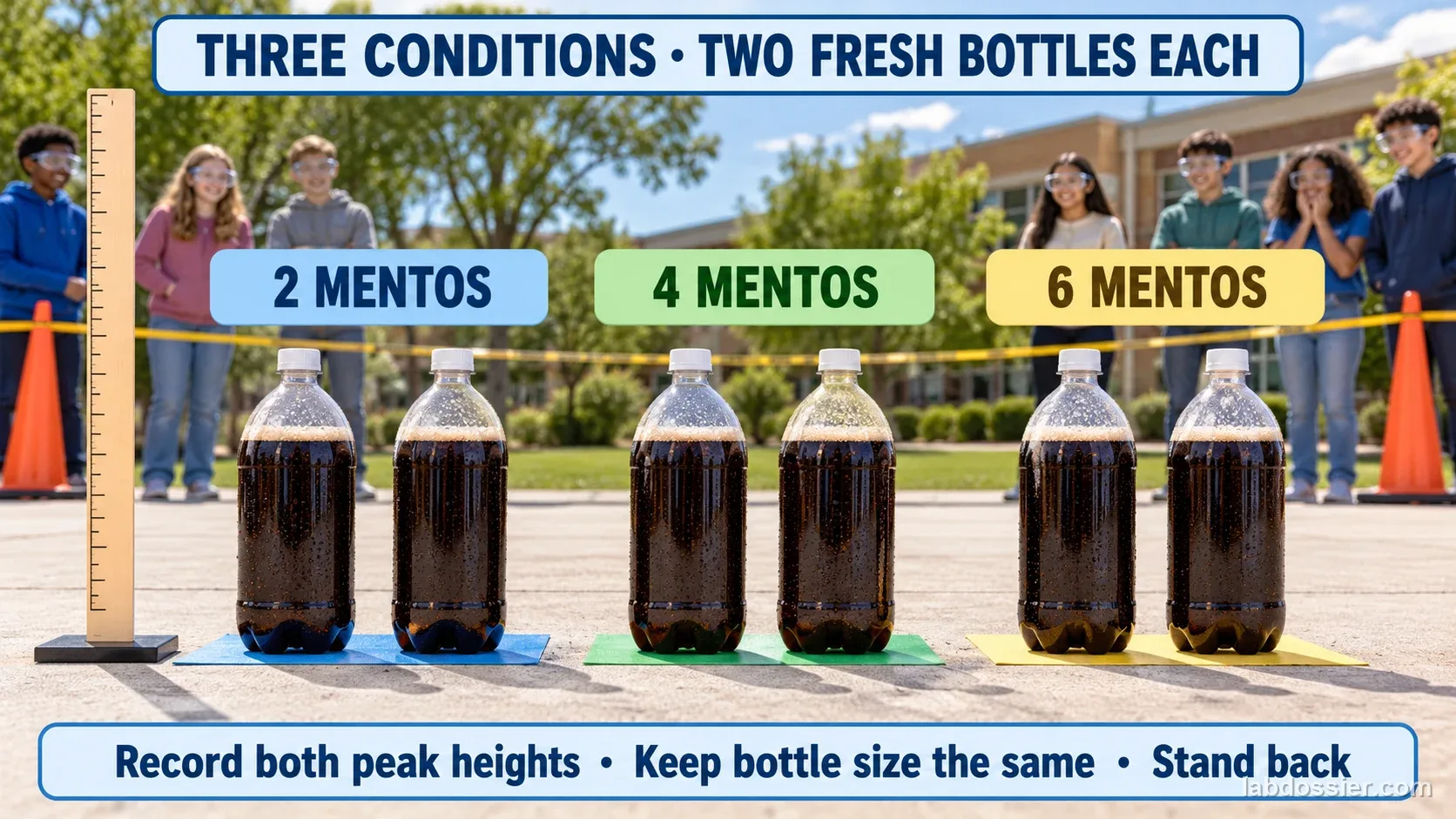
- Students plan a safe outdoor comparison using 2, 4 and 6 Mentos while matching soda brand, bottle size, temperature and drop method.
- Students measure peak plume height against a marked backdrop in inches for three fresh-bottle trials at each candy amount and calculate the mean and range.
- Students explain the eruption as rapid carbon dioxide bubble formation at nucleation sites, not a new chemical reaction or a pure-substance state-change test.
Standards
| Dimension | Alignment |
|---|---|
| Performance expectation | MS-PS1-4Develop a model that predicts and describes changes in particle motion, temperature, and state of a pure substance when thermal energy is added or removed. (Partial alignment: the lab lists this expectation, but the eruption is mainly rapid bubble nucleation and release of dissolved carbon dioxide, not a thermal-energy change to a pure substance.) |
| Practices | SEP 6Construct explanations. |
| Core idea | PS1.AThe changes of state that occur with variations in temperature or pressure can be described and predicted using these models of matter. |
| Crosscutting | Cause and effectCause and effect relationships may be used to predict phenomena in natural or designed systems. |
Standards text paraphrased from nextgenscience.org. Alignment is partial; this hands-on activity does not cover every part of the performance expectation.
State standards crosswalk
Use the row as a planning crosswalk, then confirm local district pacing and grade placement. “Partial” labels describe a skill connection, not full mastery of the complete standard.
| State | Verified standard | How this lesson aligns | Official source |
|---|---|---|---|
| California | CA NGSS MS-PS1-2 | Use the activity to distinguish physical gas release from a chemical reaction; this lab does not itself meet the reaction-analysis expectation. | Open standard ↗ |
| Texas | SCIENCE.8.1.F | Organize repeated measurements and use means to identify patterns; directly supports three trials at each candy count. | Open standard ↗ |
| Florida | SC.8.P.9.2 | Differentiate physical and chemical changes; the lesson explicitly explains that Mentos release dissolved carbon dioxide without making a new substance. | Open standard ↗ |
| New York | MS-PS1-2 | Use the lesson's physical-versus-chemical distinction as a contrast; the eruption does not itself satisfy the chemical-reaction performance expectation. | Open standard ↗ |
| Pennsylvania | 3.2.6-8.D | Use as a contrast case when discussing physical versus chemical change; this eruption is not itself a chemical reaction investigation. | Open standard ↗ |
Materials and prep timeline
PER GROUP
- Nine unopened bottles of one soda product, same brand and size; bring to the same starting temperature
- Mentos candies in portions of 2, 4 and 6, each portion prepared three times
- Rolled-paper drop tube or teacher-approved drop tool
- Low freestanding marked height board; set it from ground level
- Eye protection, open hoseable outdoor area, towels and timer
TEACHER ONLY
- Run the eruption outdoors only on level grass or pavement that can be hosed off; keep the activity well away from anyone's face.
- Require eye protection and clear the bottle opening area before each release. Students step back immediately; an adult supervises uncapped bottles and the release.
- Use a fresh matching bottle for each trial, never cap or hold down an active bottle, and clean the sugary spill so the ground is not slippery.
CLASS-SIZE KIT PLANNER
One per-group kit contains every item in the team materials list above. Groups are balanced around the listed 3–4 students target.
| Students | Groups | Per-group kits | Student sheets | Suggested group split |
|---|---|---|---|---|
| 20 | 5 | 5 complete kits | 20 copies | 4 students per group |
| 25 | 7 | 7 complete kits | 25 copies | 4 or 3 students per group |
| 30 | 8 | 8 complete kits | 30 copies | 4 or 3 students per group |
State the question and identify candy count as the change and peak plume height as the measure. Review outdoor-only setup, eye protection, clear faces and immediate step-back.
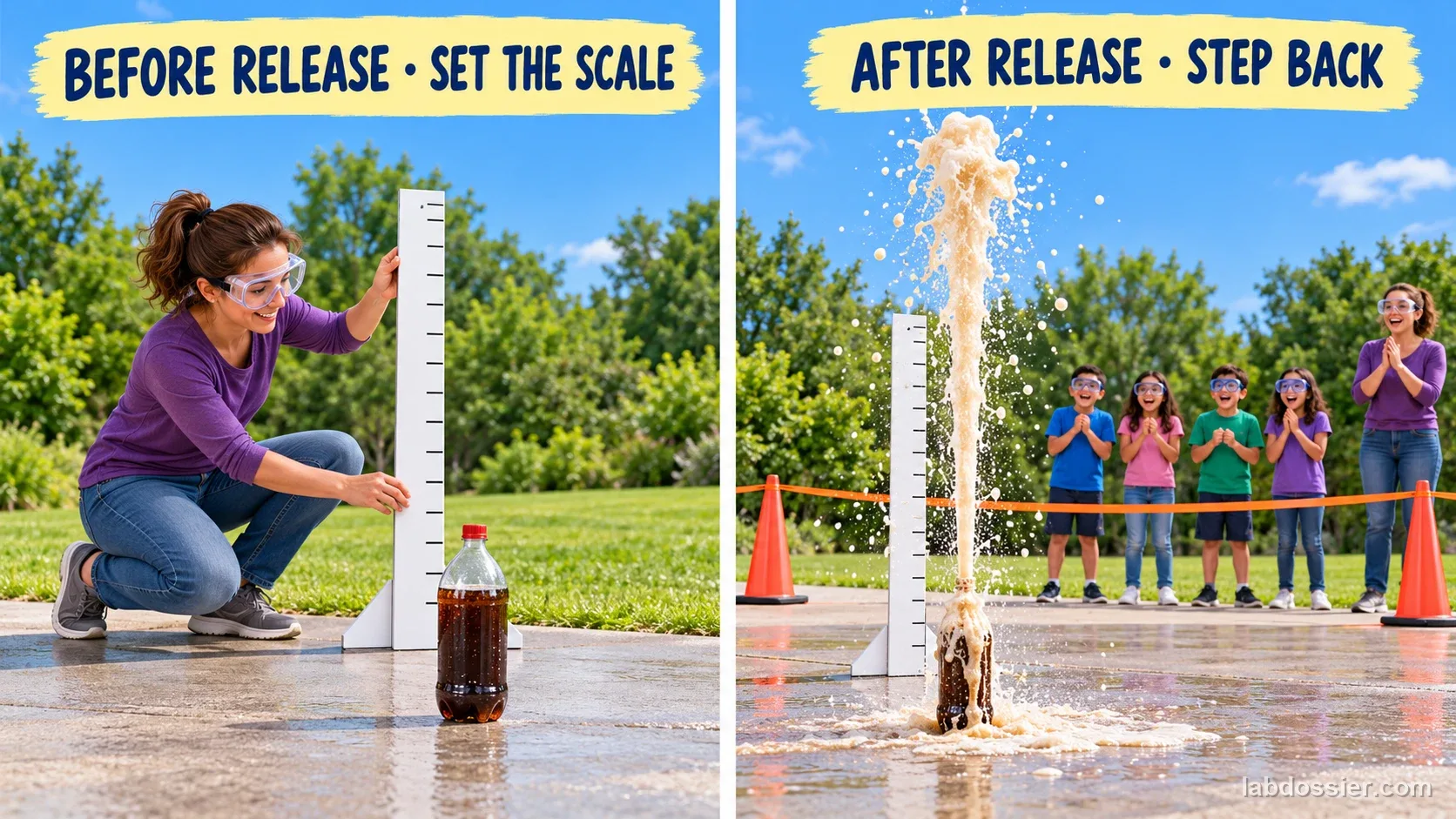
In an open hoseable area away from people, buildings, windows, overhangs and wires, place a low freestanding height board behind the bottle position. Match soda product, bottle size and starting temperature; prepare three portions each of 2, 4 and 6 candies.
An adult runs each trial with a fresh bottle while everyone wears eye protection and remains behind the safe line. Drop candies together, step back immediately, then record peak height from the fixed viewing point. Run three fresh bottles per count.
Calculate the mean and range of the three peak heights for each candy amount. Keep every reading visible, compare the pattern and note measurement uncertainty.
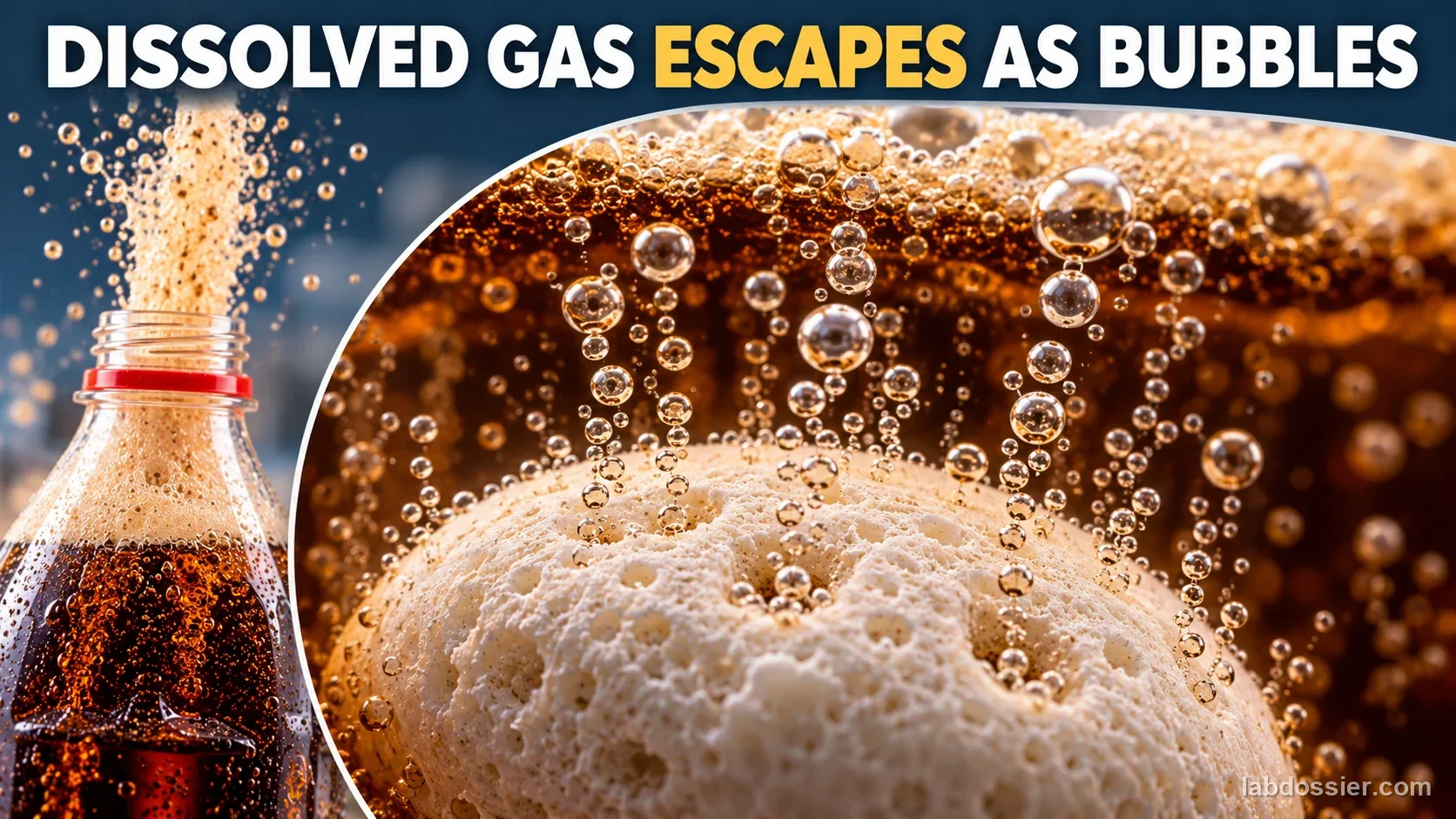
Explain how candy surfaces help dissolved CO₂ form bubbles quickly; no new substance is created. Hose away soda and confirm the surface is not slippery.
Lab figures and data visuals
Reviewed article images support the lesson flow. Use the tables and student sheet to record actual observations; pictured patterns are not target results.
Printable shopping list
Shopping and staging checklist
Multiply the per-group kit contents by the class-size planner. The teacher section includes teacher-provided materials and setup or safety notes.
PER-GROUP KITS
- Nine unopened bottles of one soda product, same brand and size; bring to the same starting temperature
- Mentos candies in portions of 2, 4 and 6, each portion prepared three times
- Rolled-paper drop tube or teacher-approved drop tool
- Low freestanding marked height board; set it from ground level
- Eye protection, open hoseable outdoor area, towels and timer
TEACHER-PROVIDED MATERIALS + SETUP RULES
- Run the eruption outdoors only on level grass or pavement that can be hosed off; keep the activity well away from anyone's face.
- Require eye protection and clear the bottle opening area before each release. Students step back immediately; an adult supervises uncapped bottles and the release.
- Use a fresh matching bottle for each trial, never cap or hold down an active bottle, and clean the sugary spill so the ground is not slippery.
Prepare 5 kits for 20 · 7 kits for 25 · 8 kits for 30 students.
Lesson flow
| Minutes | What happens |
|---|---|
| 0–4 | Engage Ask how 2, 4 or 6 Mentos may affect peak eruption height. Identify the changed and measured variables and review the outdoor-only safety boundaries. |
| 4–8 | Explore Set a low freestanding scale in a level, open, hoseable area away from people, buildings, windows, overhangs and wires. Match soda product, bottle size and temperature; prepare three portions of 2, 4 and 6 candies. |
| 8–18 | Explore An adult runs three trials per candy amount using a fresh bottle each time. Students wear eye protection, stay behind the boundary and record from a fixed safe point after the adult steps back. |
| 18–22 | Explain Calculate each three-trial mean and range and compare the results. Explain that Mentos surfaces provide sites for dissolved carbon dioxide bubbles to form. |
| 22–25 | Evaluate Describe the eruption as a physical release of existing gas, not a chemical reaction or thermal state-change demonstration. Hose the area and remove slippery soda residue. |
Discussion questions
1. Why can more Mentos make the plume taller?
2. Why use a fresh bottle for every trial?
3. Why calculate a mean and range from three trials?
4. Is the geyser a chemical reaction that tests MS-PS1-4?
Common misconceptions
Differentiation
SUPPORT
- Prepare labeled sets of three 2-, 4- and 6-candy portions and a backdrop scale before students enter the outdoor area.
- Assign roles for candy loading, recording and height reading while everyone remains clear of the bottle opening.
- Offer the frame: “With __ candies, the three heights were __, __ and __ inches; the mean was __ inches and the range was __ inches.”
EXTEND
- Compare the three-trial range at each candy count and identify which amount had the most repeatable heights.
- Explain why three trials still provide only a small sample of natural variation.
- Design a controlled follow-up that varies soda temperature while holding candy count constant, under the same outdoor safety controls.
Assessment rubric
| Criterion | Beginning | Developing | Secure |
|---|---|---|---|
| Safe controlled plan | Plans an indoor test or omits basic controls. | Works outdoors but misses a control or plume precaution. | Works outdoors, matches soda conditions, uses eye protection, keeps people clear and steps back immediately. |
| Peak height data | Leaves heights blank or reports no units. | Records some peak heights but misses trials or confuses the scale. | Records three peak heights in inches for each of 2, 4 and 6 candies against the backdrop. |
| Mean and pattern | Does not calculate a mean or compare amounts. | Calculates some means but does not show all trial values or pattern. | Calculates correct three-trial means and ranges and uses the measurements to describe the pattern and variation. |
| Causal explanation | Claims Mentos create a new substance or gas. | Mentions bubbles without explaining nucleation or alignment limits. | Explains release of dissolved CO₂ at nucleation sites and notes this is not a thermal state-change model of a pure substance. |
Vocabulary
- Carbon dioxide – A gas dissolved in a carbonated drink under pressure.
- Nucleation site – A surface location where bubbles can begin forming more readily.
- Plume – A rising column of liquid droplets and gas released during the eruption.
- Peak height – The greatest vertical height reached by the eruption during a trial.
- Mean – The sum of measured values divided by the number of values.
- Controlled variable – A condition kept the same while testing the planned change.
Safety, cleanup and troubleshooting
BEFORE STUDENTS TOUCH ANYTHING
- Perform the activity outdoors only on level grass or pavement that can be hosed off, well away from anyone's face. Wear eye protection and stand back immediately after dropping candies; the plume starts within about a second.
- Keep everyone away from the bottle opening and plume. Do not lean over, hold down or recap the bottle; release the candies and step back without delay.
- Soda makes pavement or grass slippery. Hose or wipe the area after the activity and check that no sticky spill remains before anyone walks there.
Troubleshooting: If candies do not enter together or the bottle is disturbed, mark the trial as a setup problem and use a fresh matched bottle only after the area is clear. Never retrieve candies from an active bottle or lean over its opening. If soda spills, keep people away until an adult has cleaned the surface and confirmed it is not slippery.