Which gripper surface holds an object with the least slip?
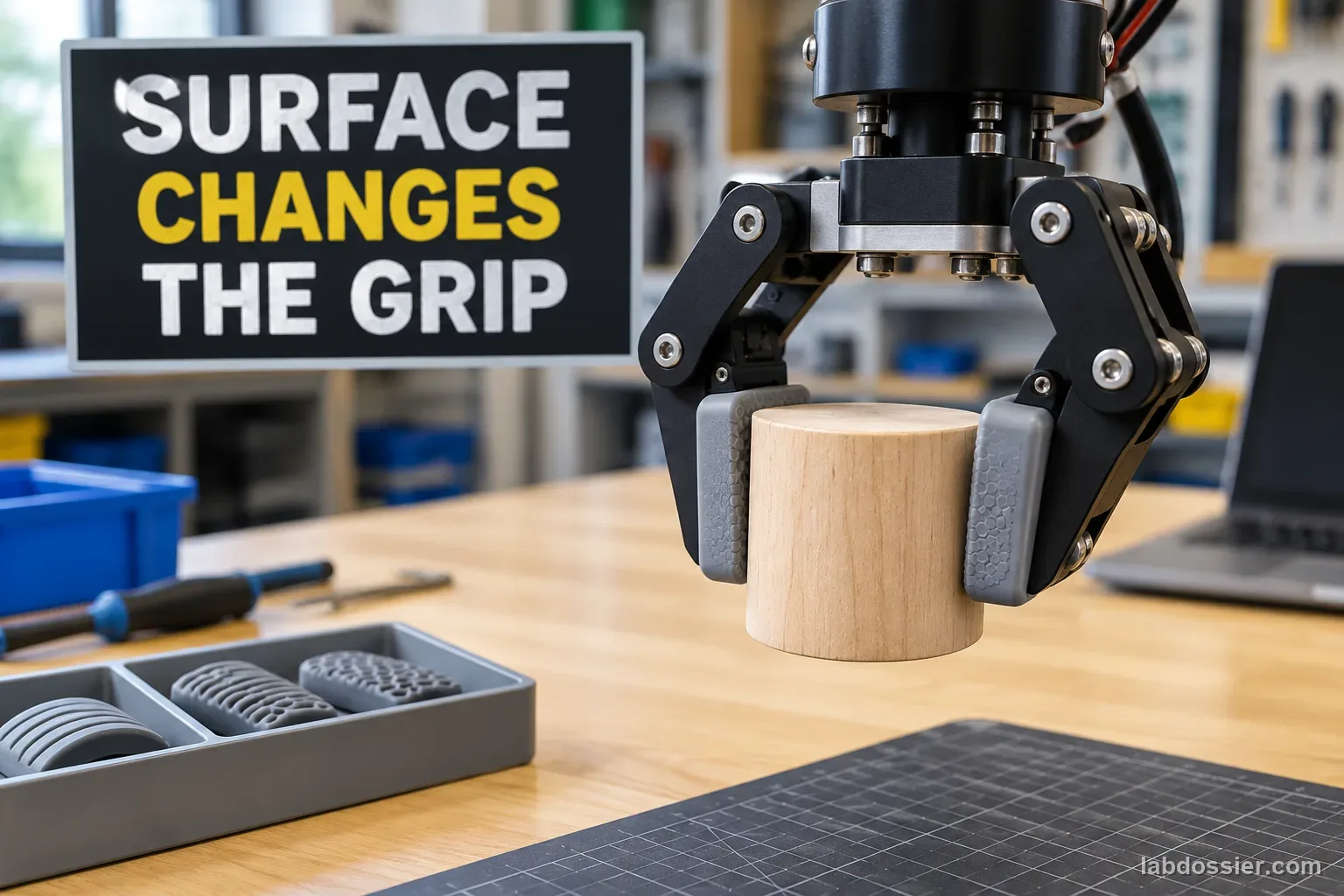
01 // Question
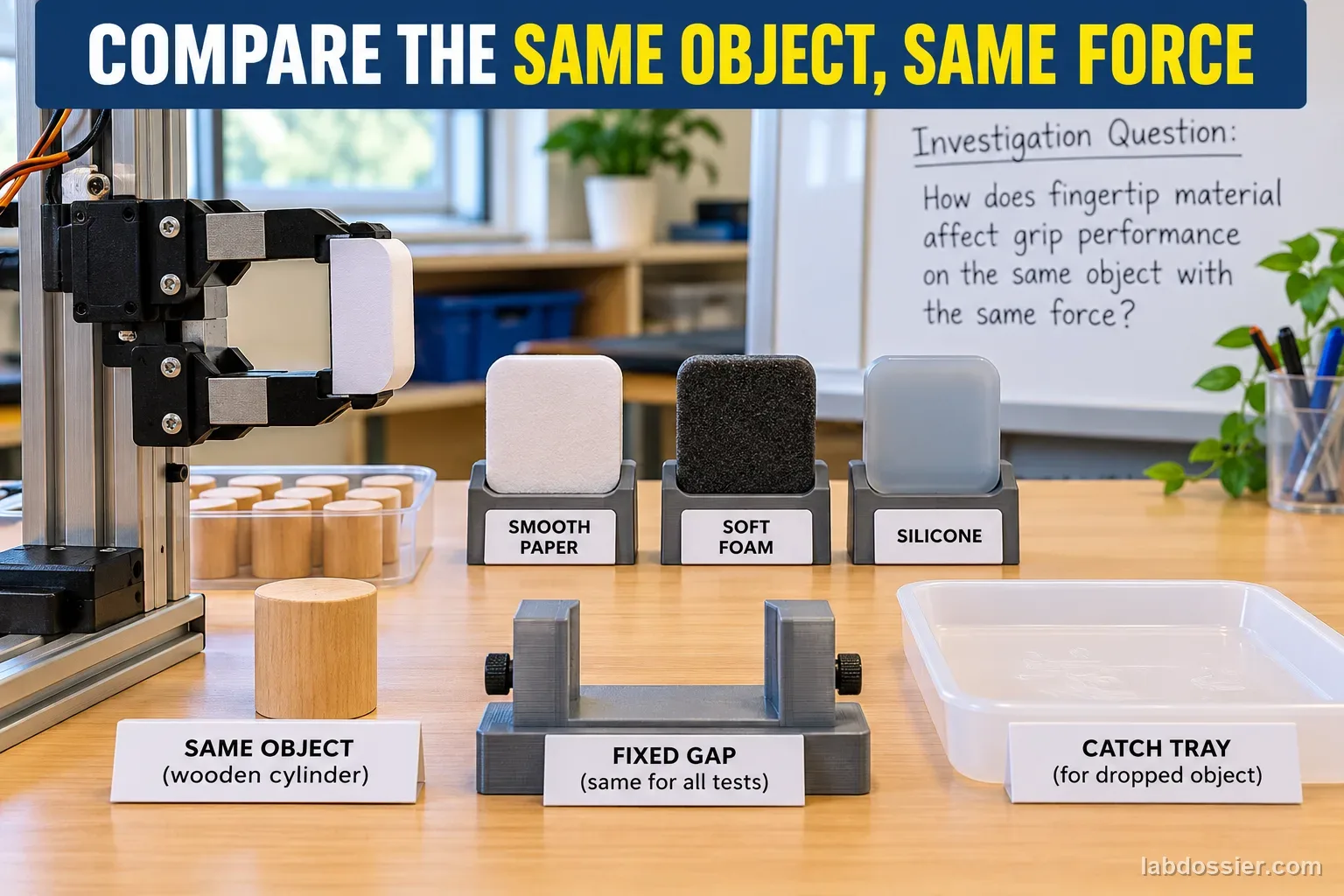
Under the same measured pinch force, which fingertip surface resists the greatest downward pull before a lightweight object begins to slip?
Use a low-force hand-powered gripper or teacher-approved bench fixture, not a powered industrial robot. Catch the object in a shallow padded tray; this comparison is not a safe load rating.
02 // Variables
Independent
Replaceable gripper-contact surface- Smooth paper
- Soft craft foam
- Silicone shelf liner or teacher-approved textured rubber
Dependent
Downward pull force at the first 5 mm of object movement- Five force readings per surface at a target 0.5 N pinch
- Median force and range
- Visible slip or object damage notes
03 // Hypothesis
IF the gripper fingertips use different replaceable surfaces while object, dry condition and measured pinch force stay constant, THEN the downward force at first slip may differ, and the surface with greatest average friction may not have the steadiest movement, BECAUSE compliance, real contact area and surface texture affect friction and stick-slip behavior.
04 // Procedure
1. Set up a low-energy gripper test
Use a paper/cardboard classroom gripper or a teacher-approved hand-powered two-finger fixture secured to a bench. Choose one lightweight wooden cylinder and attach small identical contact pads to the two fingertips. Set a shallow padded catch tray directly below the object. Keep fingers out of pinch points and do not test around faces, fragile objects or powered machinery.
2. Choose and control the surface condition
Compare smooth paper, soft craft foam and a small piece of silicone shelf liner or teacher-approved textured rubber. Keep every pad the same size and alignment. Use dry, clean, room-temperature surfaces only; do not add water, oil, powders or sticky coatings. Record the actual materials instead of assuming a household material has a universal friction value.
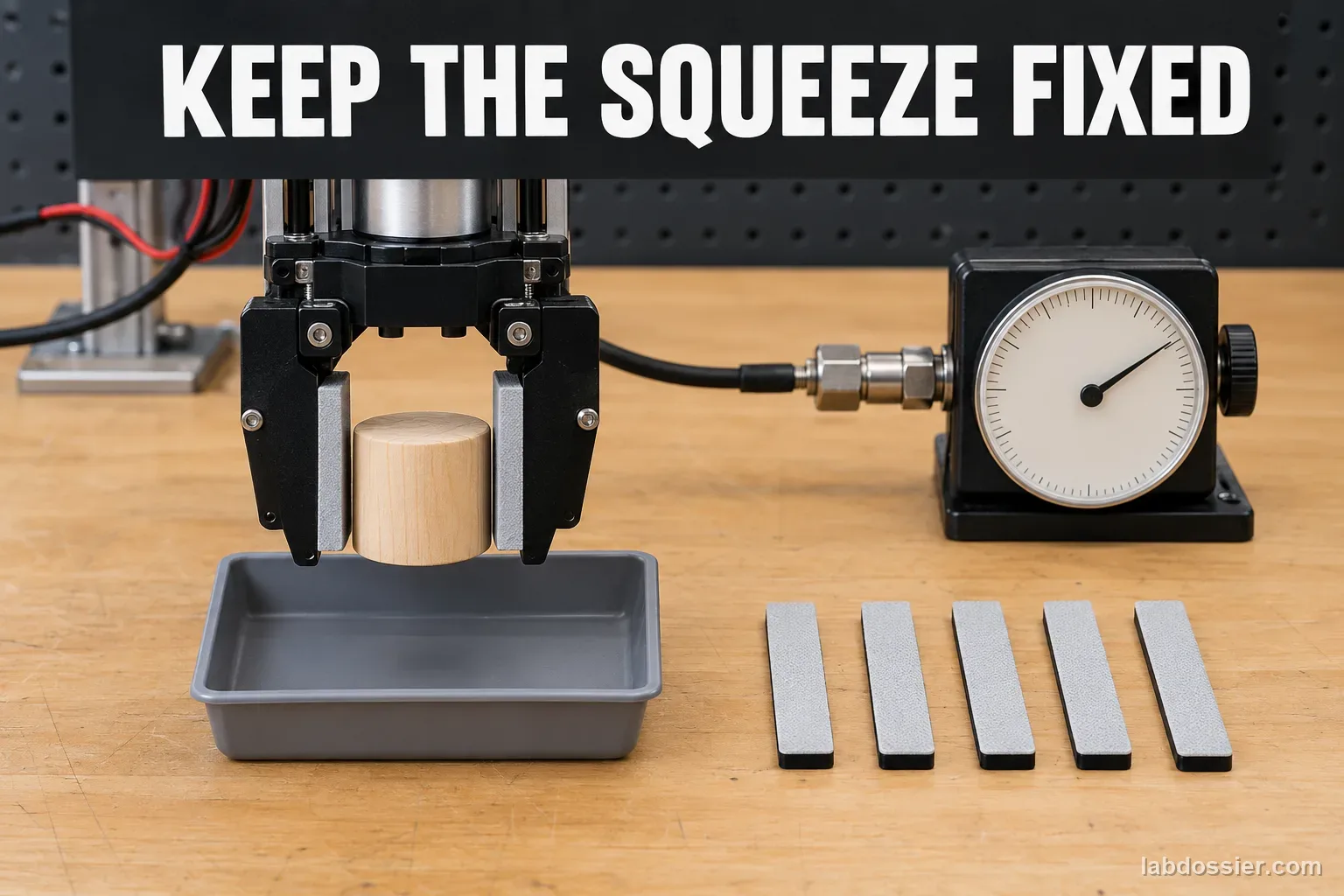
3. Calibrate the same pinch force
With a low-range force gauge or spring scale and teacher guidance, set the same gentle pinch force for each surface (target 0.5 N per the fixture's stated reading convention). Confirm it before every pull. If no force gauge is available, use the same fixed closure stop and label pinch force as uncontrolled; do not claim a force-matched comparison.
4. Measure force at the first slip
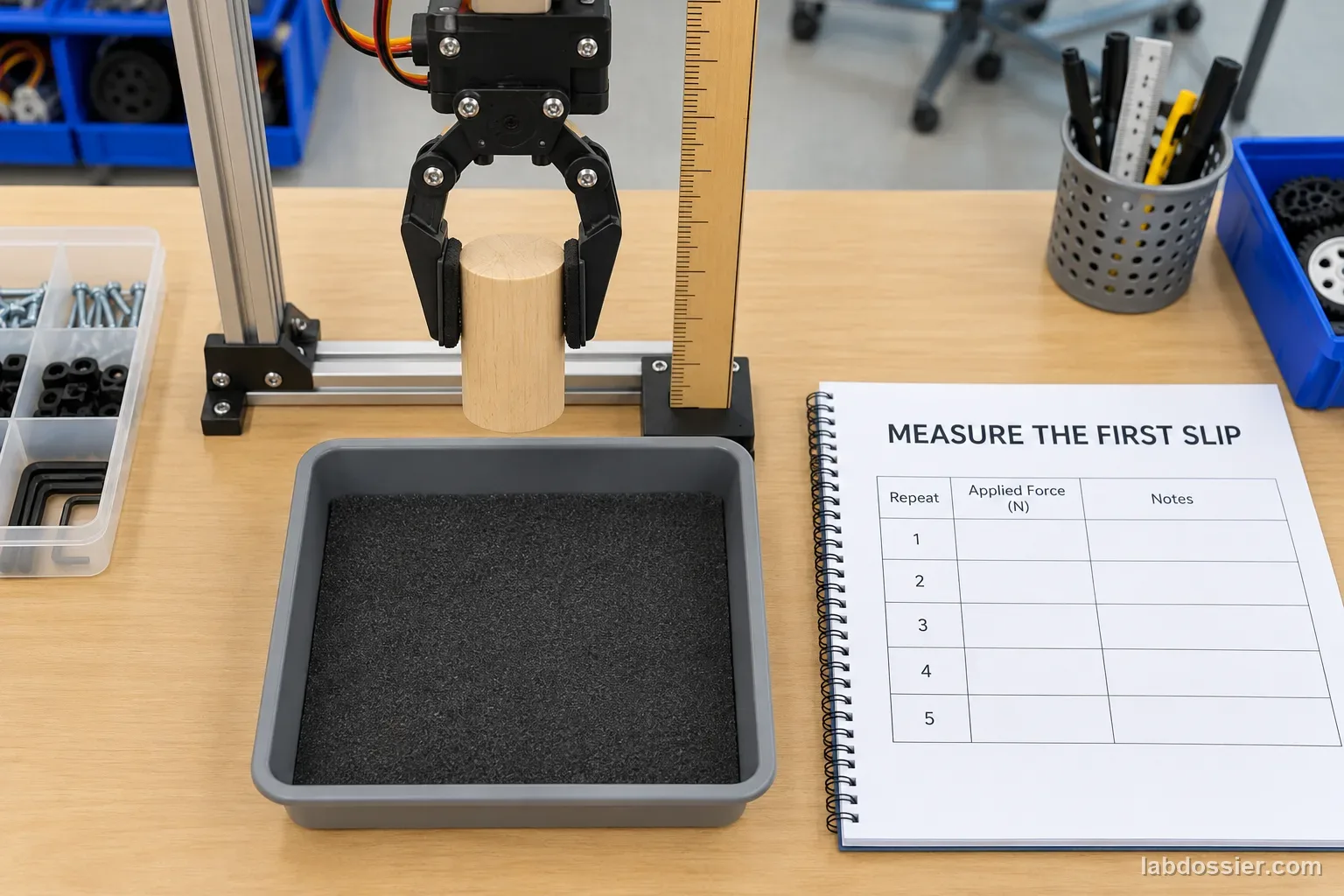
Hold the cylinder just above the tray and connect a spring scale to its lower end. Pull straight down smoothly over about 3 seconds. Record the scale reading when the cylinder first moves 5 mm relative to a ruler. Stop immediately; do not pull until the object drops. Reset the grip and repeat five times per pad, alternating the pad order to reduce order effects.
5. Compare medians and trial spread
For each surface calculate the median of five first-slip forces and the range (highest minus lowest). Keep every trial value. A larger median means the object resisted a greater downward pull in this specific fixture, while a wide range means less repeatable behavior. Note any sudden stick-slip jump, pad wrinkling or visible cylinder damage separately.
6. Connect the classroom result to research carefully
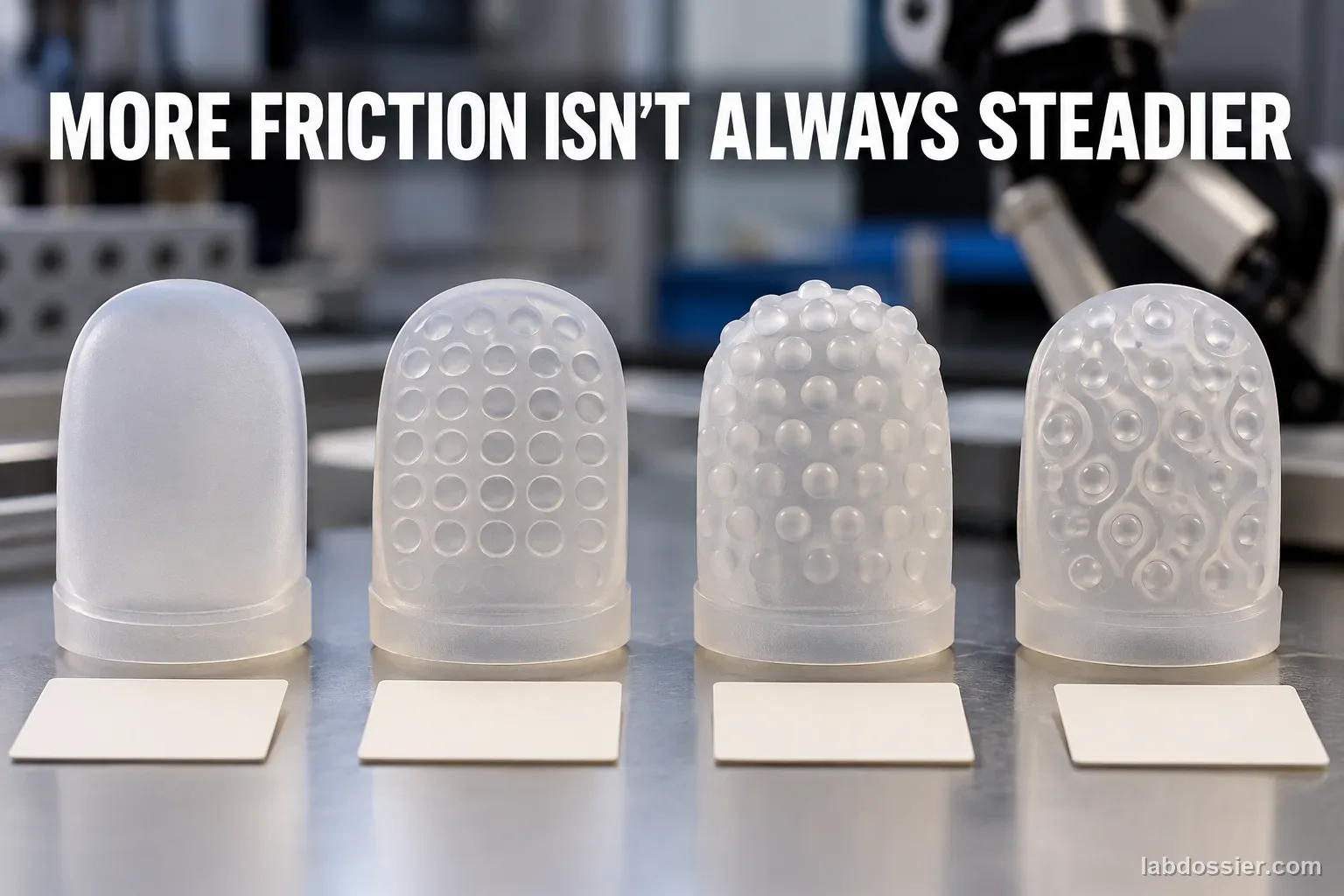
Kargar and Berselli tested silicone pads with flat, cavity, protrusion and hybrid textures at multiple loads, speeds and dry/wet conditions. They reported that flat pads could have greater mean friction while also showing stronger stick-slip fluctuations, and that the preferred texture depended on conditions. This classroom pull test is simpler: it uses three available materials, one object and one low pulling rate. It cannot recreate their 192 tests, calculate the paper's Friction Stability Index, rank industrial pads or establish a safe payload.
Materials // Prepare the bench
- teacher-approved paper gripper or hand-powered low-force fixture
- smooth paper, soft craft foam and silicone-like grip pad
- light wooden cylinder
- low-range spring scale or force gauge
- ruler
- shallow padded catch tray
- data table
05 // Data table
| Fingertip surface | Trial 1 (N) | Trial 2 (N) | Trial 3 (N) | Trial 4 (N) | Trial 5 (N) | Median (N) | Range (N) |
|---|---|---|---|---|---|---|---|
| Smooth paper | |||||||
| Soft craft foam | |||||||
| Textured silicone-like pad |
What the comparison means
| Observation | Interpretation for this test | What it does not prove |
|---|---|---|
| Higher median first-slip pull | More downward force was needed before 5 mm movement in this fixture | A universal coefficient of friction or safe payload |
| Wider trial range | Performance was less repeatable across the five trials | A formal reliability estimate from a small class sample |
| Sudden jumps before slip | Possible stick-slip behavior worth noting | The paper's instrument-measured friction oscillation or FSI |
Keep these factors fixed
| Factor | Control |
|---|---|
| Pinch force | Measure the same low force before every pull; otherwise state that this variable was uncontrolled |
| Contact pair | Use the same cylinder, clean dry surface and pad area |
| Pull | Use the same downward direction, gentle speed and 5 mm movement threshold |
| Safety | Hold above a padded tray, stop at first movement and use no powered or industrial robot |
Formula Range = highest first-slip force − lowest first-slip force. Use the median of five trials to reduce the influence of one unusually high or low reading.
06 // What to expect
Fingertip materials can change the measured first-slip force even when the object and pinch force stay fixed.
A high average friction value does not necessarily mean the grip moves smoothly; stick-slip variation can matter.
The result applies only to the tested pad, object, force, dry surface, pull rate and fixture.
07 // Lab notes
- The 2025 soft-pad study's wet, speed and load findings describe its specific silicone materials and apparatus; this activity deliberately uses dry household/classroom pads and does not transfer its ranking.
08 // Remember
Change one contact surface and measure what the same object can resist. The best grip depends on the pair of surfaces and how steadily they move.
09 // A gripping surface is a contact pair, not a material ranking
A pad's grip depends on both surfaces touching, the normal squeeze, pad compliance, contact area, texture, motion and environment. A surface that works well on one object may perform differently on another. The classroom comparison keeps one dry cylinder and a measured low pinch force so the contact pad is the main planned change.
Measure the downward force when the object first moves 5 mm. This is a simple fixture-specific performance measure, not a friction coefficient. If the pinch is not measured and held constant, label it uncontrolled and avoid concluding that the pad alone caused the difference.
10 // What the 2025 soft-pad study found
Kargar and Berselli tested flat, cavity, protrusion and hybrid silicone textures with two material stiffnesses. Their lab measured friction at several normal loads and sliding speeds under dry and wet conditions, across 192 trials. The authors report that flat pads often had the highest mean friction but could show stronger stick-slip fluctuations; some textured pads had more stable behavior in selected higher-load or moist conditions.
Those findings do not produce one winning pad for every object. The article's Friction Stability Index combines mean friction and fluctuation under a study-defined weighting. This classroom test uses first-slip force and five repeats instead; it cannot calculate that index or recreate the controlled actuator experiment.
11 // Why the other guides are useful but incomplete
Science Buddies' paper-gripper lesson shows students can modify a paper mechanism and add rubber bands to increase friction, but it does not compare matched pad materials at a fixed force. Robotiq's manufacturer article identifies its own aluminum and 60A silicone fingertips and says its textured silicone increases grip for selected parts, but it is product information rather than an independent head-to-head test.
Together, these sources support a controlled classroom comparison while showing why the article must name the exact pad, object, force and surface condition. Do not generalize the result into a universal statement that silicone, foam, paper or texture is always best.
12 // Questions people ask
Does the highest first-slip force mean a material has the highest friction coefficient?
Not by itself. The result also depends on the pinch force, pad area, object surface, pull rate, fixture and the chosen 5 mm slip threshold. This lesson compares the tested setup rather than measuring a universal coefficient.
Why keep the pinch force the same?
Changing the squeeze changes the normal force and can change how much friction is available. Measure and repeat the same low pinch force; if you only use a closure stop, report that the force was not directly controlled.
Could the smooth pad outperform a textured one?
Yes. A 2025 study found its flat silicone pads often had higher mean friction, while textured pads could show steadier friction under some conditions. Material, load, speed and moisture all mattered in that apparatus.
Can I use wet pads to make the test more realistic?
Not in this procedure. It uses dry pads to keep the comparison simple and reduce slipping or cleanup hazards. Wet friction depends on material and conditions and needs a separately approved procedure.
Does this tell me how much a real robot can carry?
No. A small classroom fixture cannot validate a robot's payload, motion, safety limits or industrial gripper rating.
13 // Keep going
Can you explain the investigation?
Which gripper surface holds an object with the least slip? · Student Data Sheet
Question: Under the same measured pinch force, which fingertip surface resists the greatest downward pull before a lightweight object begins to slip?
Hypothesis: If the gripper fingertips use different replaceable surfaces while object, dry condition and measured pinch force stay constant, then the downward force at first slip may differ, and the surface with greatest average friction may not have the steadiest movement, because compliance, real contact area and surface texture affect friction and stick-slip behavior.
Materials
- teacher-approved paper gripper or hand-powered low-force fixture
- smooth paper, soft craft foam and silicone-like grip pad
- light wooden cylinder
- low-range spring scale or force gauge
- ruler
- shallow padded catch tray
- data table
Safety before starting
- Use a teacher-approved low-force paper gripper or hand-powered fixture with a lightweight classroom object. Keep the padded catch tray directly below it, keep fingers clear of pinch points, and stop at the first measured movement; do not test around faces, people, animals, glass or heavy loads.
- Do not use a powered industrial robot or treat the class result as a payload or safety rating. Follow manufacturer limits and qualified validation for real machinery. Keep the test dry and clean; do not add oils, powders or unapproved liquids.
Lab notes
- The 2025 soft-pad study's wet, speed and load findings describe its specific silicone materials and apparatus; this activity deliberately uses dry household/classroom pads and does not transfer its ranking.
Variables
Independent: Replaceable gripper-contact surface · Dependent: Downward pull force at the first 5 mm of object movement
Keep constant: same gripper and finger spacing · same wooden cylinder and clean dry contact area · same measured pinch force · same pull direction/rate · same 5 mm slip criterion · same catch tray
Procedure
- Set up a low-energy gripper test: Use a paper/cardboard classroom gripper or a teacher-approved hand-powered two-finger fixture secured to a bench. Choose one lightweight wooden cylinder and attach small identical contact pads to the two fingertips. Set a shallow padded catch tray directly below the object. Keep fingers out of pinch points and do not test around faces, fragile objects or powered machinery.
- Choose and control the surface condition: Compare smooth paper, soft craft foam and a small piece of silicone shelf liner or teacher-approved textured rubber. Keep every pad the same size and alignment. Use dry, clean, room-temperature surfaces only; do not add water, oil, powders or sticky coatings. Record the actual materials instead of assuming a household material has a universal friction value.
- Calibrate the same pinch force: With a low-range force gauge or spring scale and teacher guidance, set the same gentle pinch force for each surface (target 0.5 N per the fixture's stated reading convention). Confirm it before every pull. If no force gauge is available, use the same fixed closure stop and label pinch force as uncontrolled; do not claim a force-matched comparison.
- Measure force at the first slip: Hold the cylinder just above the tray and connect a spring scale to its lower end. Pull straight down smoothly over about 3 seconds. Record the scale reading when the cylinder first moves 5 mm relative to a ruler. Stop immediately; do not pull until the object drops. Reset the grip and repeat five times per pad, alternating the pad order to reduce order effects.
- Compare medians and trial spread: For each surface calculate the median of five first-slip forces and the range (highest minus lowest). Keep every trial value. A larger median means the object resisted a greater downward pull in this specific fixture, while a wide range means less repeatable behavior. Note any sudden stick-slip jump, pad wrinkling or visible cylinder damage separately.
- Connect the classroom result to research carefully: Kargar and Berselli tested silicone pads with flat, cavity, protrusion and hybrid textures at multiple loads, speeds and dry/wet conditions. They reported that flat pads could have greater mean friction while also showing stronger stick-slip fluctuations, and that the preferred texture depended on conditions. This classroom pull test is simpler: it uses three available materials, one object and one low pulling rate. It cannot recreate their 192 tests, calculate the paper's Friction Stability Index, rank industrial pads or establish a safe payload.
Record your observations
| Fingertip surface | Trial 1 (N) | Trial 2 (N) | Trial 3 (N) | Trial 4 (N) | Trial 5 (N) | Median (N) | Range (N) |
|---|---|---|---|---|---|---|---|
What the comparison means
| Observation | Interpretation for this test | What it does not prove |
|---|---|---|
Keep these factors fixed
| Factor | Control |
|---|---|
Formula: Range = highest first-slip force − lowest first-slip force. Use the median of five trials to reduce the influence of one unusually high or low reading.
Answer key and expected pattern
Fingertip materials can change the measured first-slip force even when the object and pinch force stay fixed.
A high average friction value does not necessarily mean the grip moves smoothly; stick-slip variation can matter.
The result applies only to the tested pad, object, force, dry surface, pull rate and fixture.
Remember: Change one contact surface and measure what the same object can resist. The best grip depends on the pair of surfaces and how steadily they move.