How does a carried payload change humanoid balance and recovery?
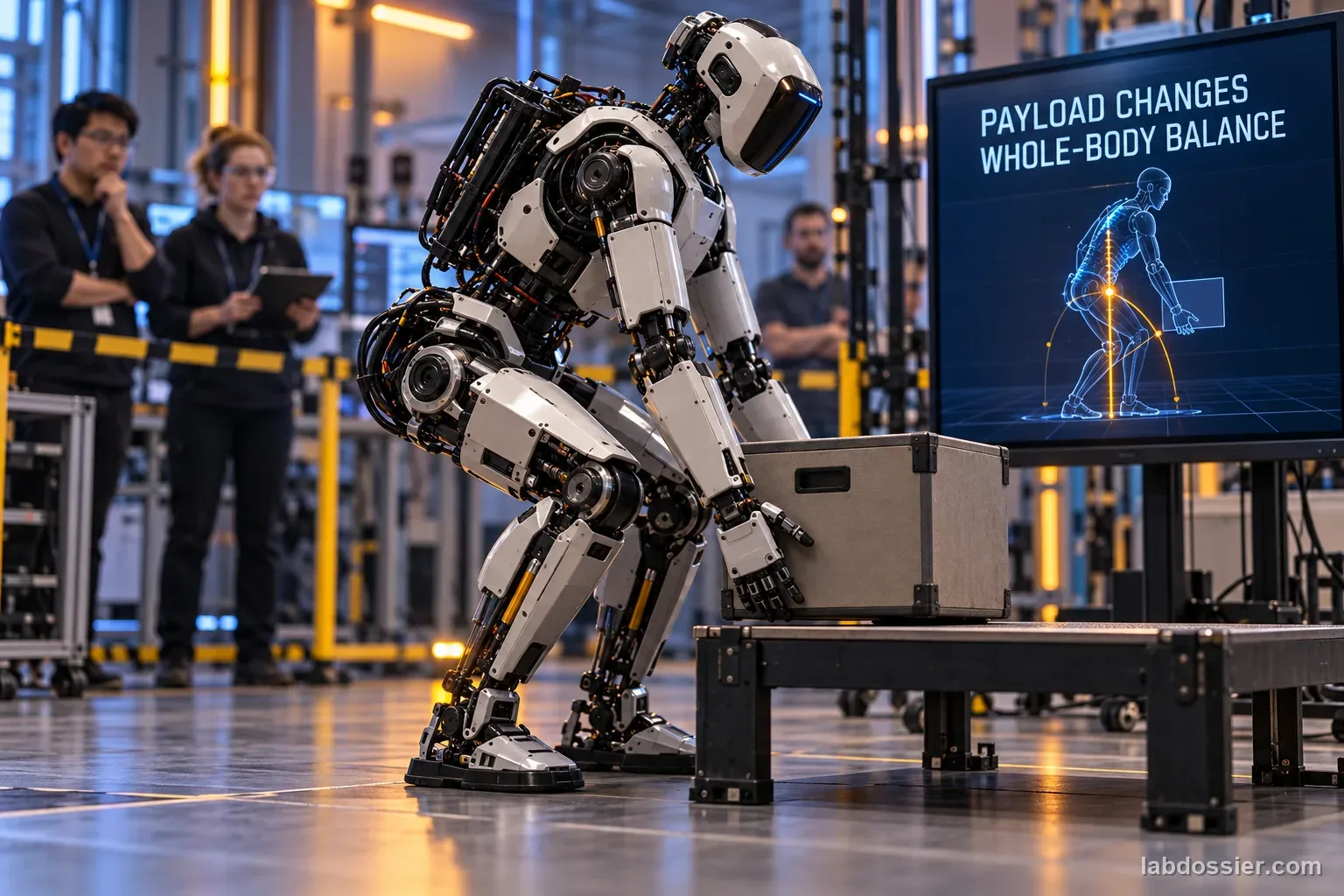
01 // Question
In recent humanoid-robot studies, how do payload and support conditions relate to balance and recovery, and what can the reported masses actually tell us?
This is a published-data investigation. It does not ask students to load, push, disable, or operate a real humanoid robot.
02 // Variables
Independent
Payload and modeled support condition in the cited studies- Object mass in the ROBOTIS-OP3 balance model
- Reported sagittal support length: 1.0× or 1.5× the foot-length reference
- Separate hardware task in the other papers
Dependent
Source-defined dynamic balance capability, lifting/recovery behavior and task completion evidence- Study-reported critical object mass for maximum modeled balanced-state basin
- Changes in pelvis height, torso pitch and recovery during lifting
- Whether walking/carrying is included in the reported task
03 // Hypothesis
IF payload mass, load position, posture or support conditions change, THEN the balance controller and modeled recovery margin may change, and greater mass does not guarantee a simple linear increase or decrease, BECAUSE payload shifts whole-body mass and inertia while contact area, joint torque limits, posture and control strategy constrain the robot's ability to recover.
04 // Procedure
1. Identify each robot and its task
Read the methods and results of the three cited sources. Record which results come from a ROBOTIS-OP3 humanoid model, a different full-sized humanoid with hardware experiments, or a humanoid riding a two-wheeled hoverboard. Note whether each value is a model threshold, a carried mass demonstrated in a particular task, or a platform-specific upper demonstration. These are different measures.
2. Extract the modeled balance result
From Song et al. (2026), transcribe the reported object mass where the ROBOTIS-OP3 model's balanced-state basin reaches its maximum: 1.2 kg for the paper's 1.0× foot-length sagittal support reference and 0.6 kg for its 1.5× reference. The model describes the payload as point mass split between the two hand/arm ends and analyzes specified poses and constraints. Copy the authors' terms and preserve the study boundary.
3. Check the denominator and meaning
The paper gives robot mass as 3.5 kg and reports the two critical masses as about 34.28% and 17.14% of robot mass. Recalculate each ratio from the rounded masses and compare with the paper's percentages. A critical mass is the object mass at which this model's defined balance capability is greatest under the stated conditions; it is not the maximum safe load, a falling threshold, or a manufacturer's payload rating.
4. Plot the source values without inventing a curve
Plot only the two reported critical-mass points as separate support-condition categories. Add a note that these points identify the location of each modeled maximum; the classroom table does not contain the complete basin-area series. Do not connect them into a continuous measured trend or infer unreported values. Beside this plot, list each condition and metric in words.
5. Compare hardware recovery without ranking robots
A separate 2026 preprint reports 7 kg and 10 kg lift trials and a 7 kg lift-and-walk task on its own humanoid hardware; it describes extra control effort and small initial pelvis/pitch oscillations in the 10 kg lift. The TUM IROS 2025 hoverboard study reports payload delivery up to 20 kg on a two-wheeled platform. Record each result beside its platform and task. Do not compare 1.2, 10 and 20 kg as if they were measurements of one robot or the same balance metric.
6. State what the evidence can support
A careful conclusion names the study, robot or model, support condition, task and exact metric. Explain that more mass can change balance in competing ways: it shifts center of mass and inertia but can also alter momentum, contact forces and actuator demands. Static balance, dynamic recovery, walking while carrying and platform payload demonstrations are distinct. The cited findings do not establish one universal payload limit or a classroom safety procedure.
Materials // Prepare the bench
- three cited research papers/pages
- calculator or spreadsheet
- run/source comparison table
- graph paper or a plotting tool
- teacher-approved browser
05 // Data table
| Source condition | Object mass at reported modeled stability maximum (kg) | Robot mass (kg) | Source-reported object/robot mass (%) | What the value means |
|---|---|---|---|---|
| ROBOTIS-OP3 model · support reference 1.0× foot length | 1.2 | 3.5 | 34.28 | Critical mass for maximum balanced-state basin in this model |
| ROBOTIS-OP3 model · support reference 1.5× foot length | 0.6 | 3.5 | 17.14 | Critical mass for maximum balanced-state basin in this model |
Keep unlike payload results separate
| Study/system | Reported payload and task | Evidence type | Do not infer |
|---|---|---|---|
| Song et al. (2026), ROBOTIS-OP3 model | 1.2 kg and 0.6 kg are critical masses under two modeled support-length conditions | Model-derived balance capability; paper also reports simulation and lifting demonstrations | Not a maximum load rating or universal tipping threshold |
| Nguyen et al. (2026), different full-sized humanoid | 7 kg and 10 kg lifting; 7 kg lift-and-walk | Hardware experiment and simulation in a preprint accepted for Humanoids 2026 | Not directly comparable with another robot's mass threshold |
| Armleder et al. (IROS 2025), humanoid on hoverboard | Payload delivery up to 20 kg | Hardware system uses two-wheeled hoverboard and whole-body grasping | Not a bipedal walking payload result |
Separate a balance measure from a payload rating
| Term | Meaning in this activity | Question to ask before comparing |
|---|---|---|
| Critical object mass | Mass where a study-specific modeled stability metric reaches its maximum | What exact model and metric define the maximum? |
| Demonstrated carried payload | Mass used successfully for a named robot, controller and task in a reported trial | Was it lifting, walking, riding, or a different maneuver? |
| Maximum rated payload | A manufacturer/platform limit under specified conditions | Does the source provide an explicit rating and operating conditions? |
Formula Object-to-robot mass ratio (%) = object mass ÷ robot mass × 100%; preserve the source's rounding and label the study condition
06 // What to expect
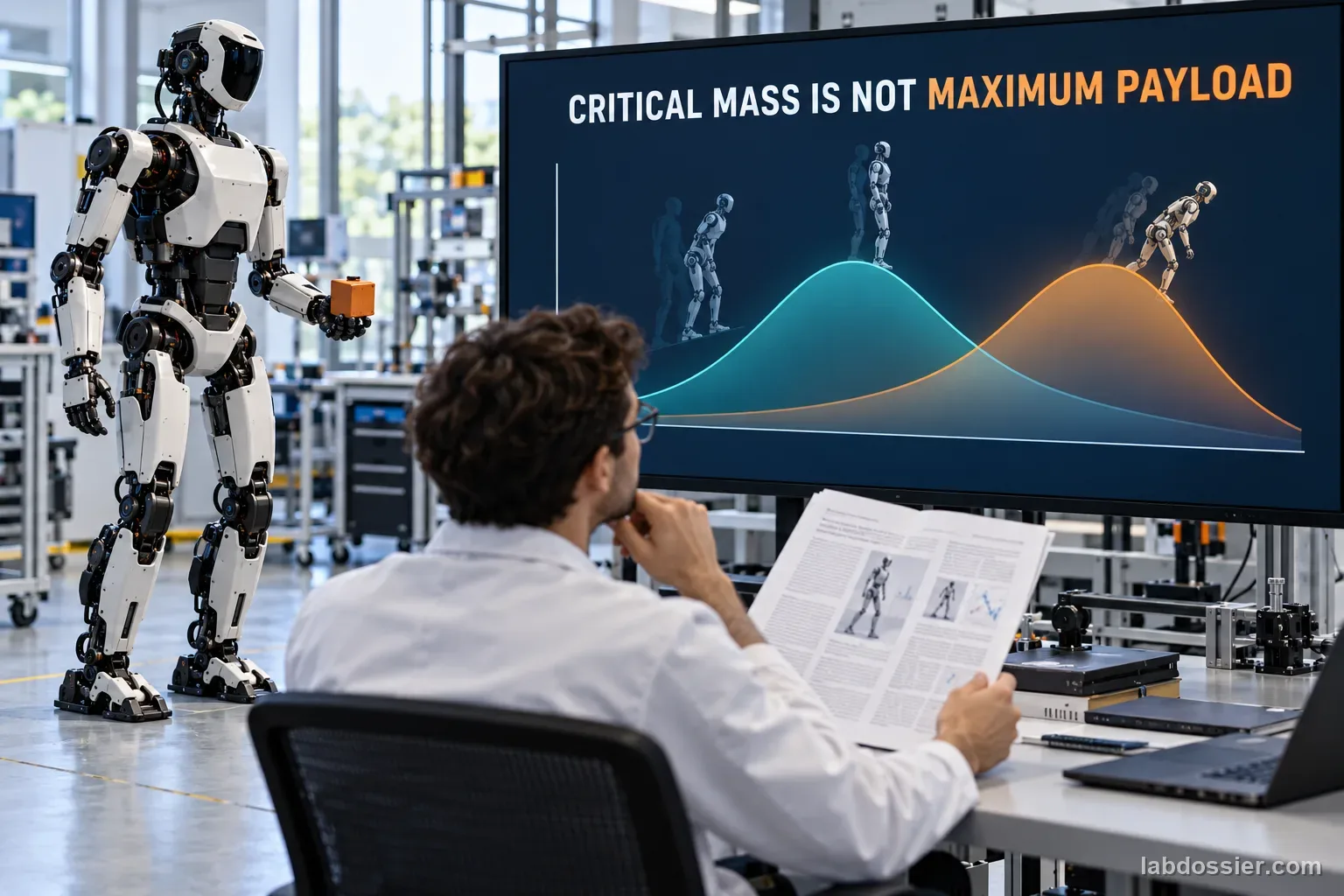
The cited ROBOTIS-OP3 model reports critical masses of 1.2 kg and 0.6 kg under two different sagittal support-length conditions; these are not payload ratings.
Other humanoid studies report larger carried masses under different robots, controllers, supports and tasks; those values cannot be directly ranked against the model thresholds.
Balance and recovery depend on more than payload mass, including center of mass, posture, support contacts, actuator limits and control strategy.
07 // Lab notes
- The 2026 arXiv studies are research preprints/current conference submissions. Label their publication status and distinguish reported model outputs from hardware experiments.
08 // Remember
Always name the robot, task, support condition and metric. A study-specific critical mass is not a universal robot payload limit.
09 // What balance means in humanoid robotics
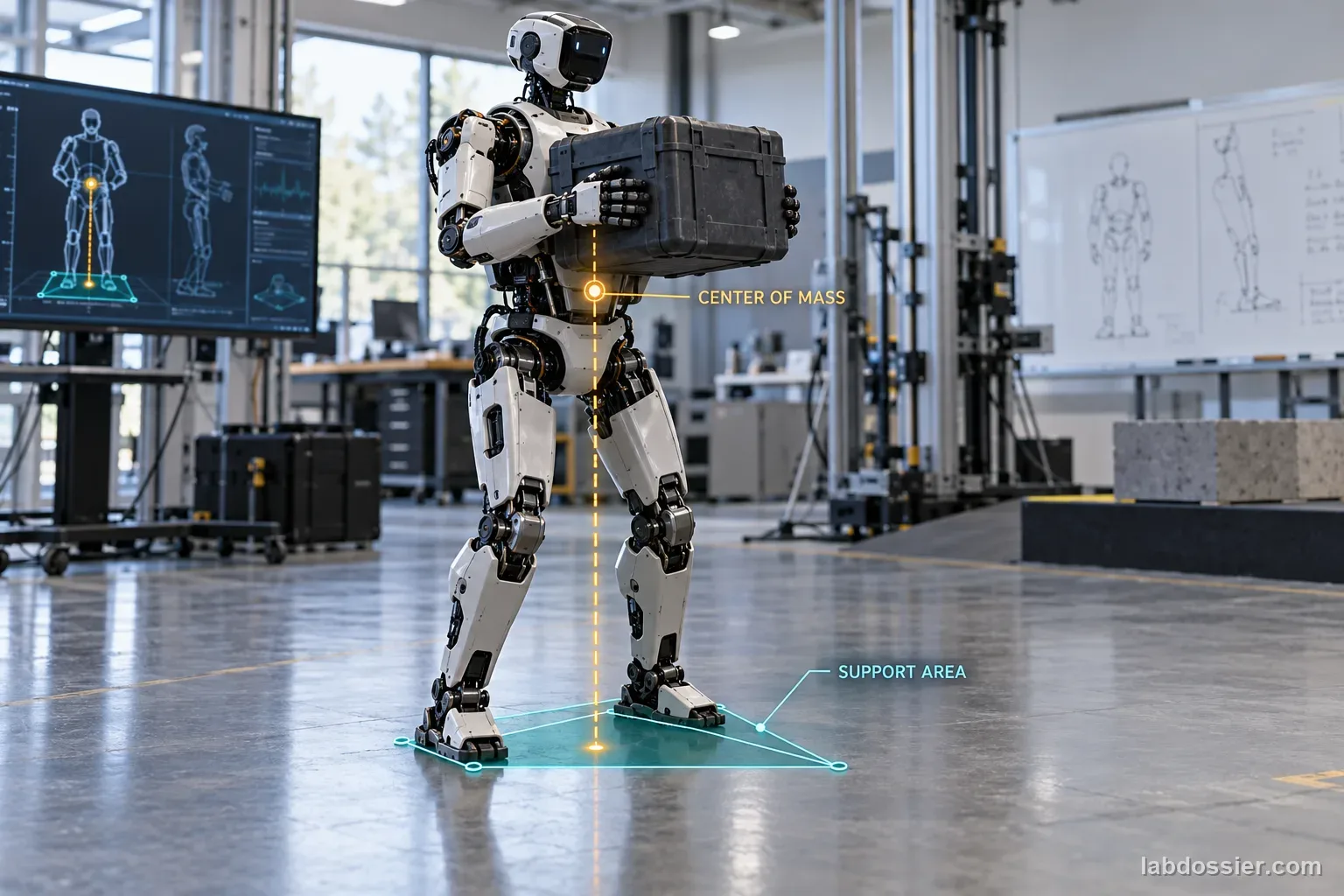
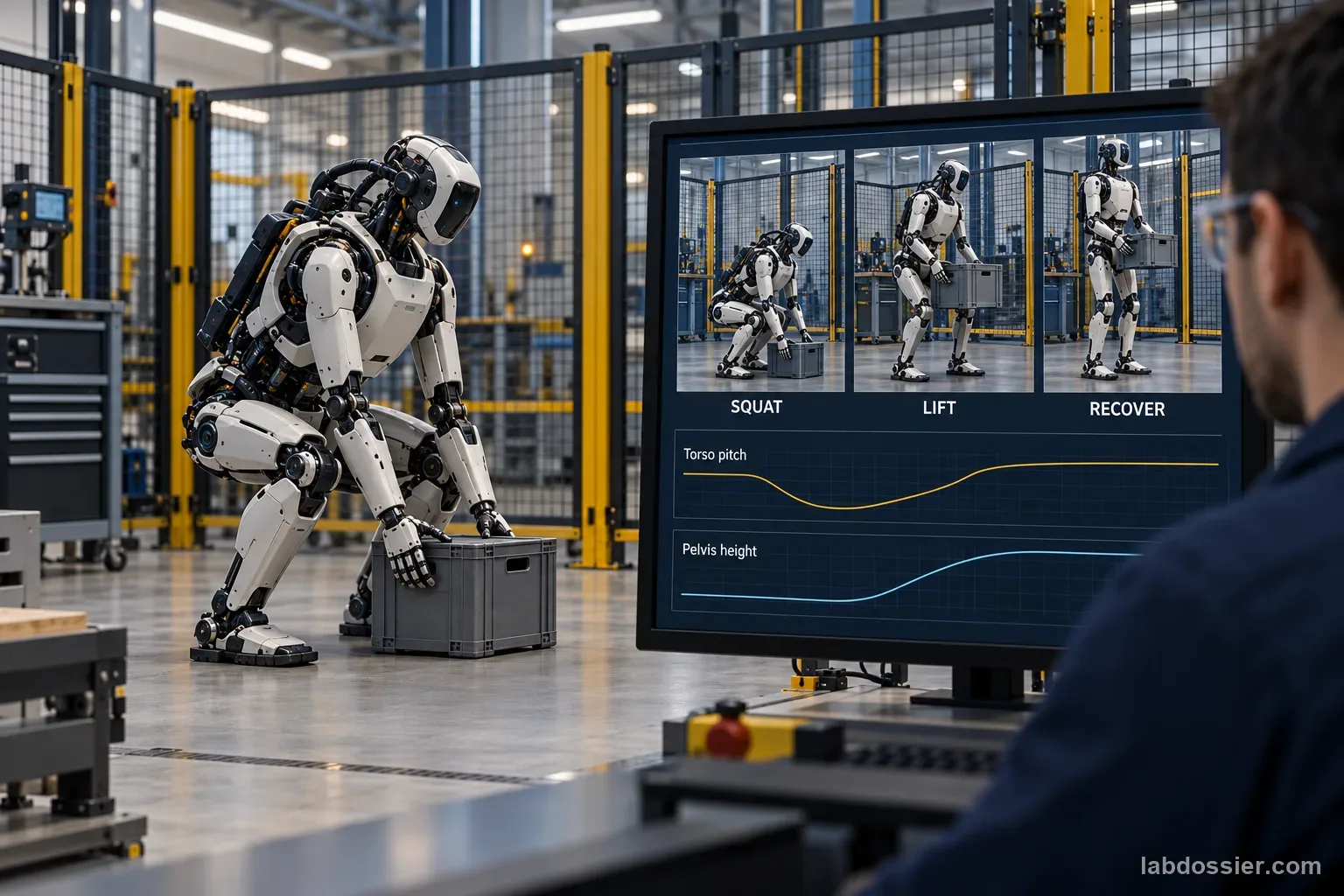
A biped carries its center of mass through changing foot contacts. During lifting, an object can shift the whole-body center of mass and inertia; posture, stance, joint limits, actuator torque and controller response also matter. A robot may lower its body, change torso pitch, adjust leg torques or step to recover, depending on its design and task.
Researchers do not always use the same balance metric. Song et al. (2026) define a balanced-state basin over allowed center-of-mass states for a modeled humanoid and analyze how its size changes with object mass and support conditions. A basin is not a payload label, a physical tip angle or a guarantee that a robot will recover from every push.
10 // Read the modeled mass result
The study uses a 3.5 kg ROBOTIS-OP3 model and represents the object as point mass distributed at the distal ends of the arms. Its reported object mass for the maximum modeled balance basin is 1.2 kg with the reference support length equal to one foot length and 0.6 kg with a 1.5-times reference length. The paper reports these as about 34.28% and 17.14% of robot mass.
The authors report that balance-basin size increases and then decreases as object mass rises for their humanoid model. They analyze specific stances, poses, support contacts and actuation constraints. Do not turn the two critical masses into a maximum payload or use them as values for a different robot.
11 // Check the mass ratios
Calculate object-to-robot mass ratio = object mass ÷ robot mass × 100%. For the source's rounded masses, 1.2 ÷ 3.5 × 100 is about 34.3%, and 0.6 ÷ 3.5 × 100 is about 17.1%. Small last-digit differences come from rounding; preserve the source values and label your recalculated percentages as approximate.
Plot only the two reported critical-mass points against their support-length categories. The paper's full stability-basin curves contain more information than the two points in this summary. Do not connect these two points to imply an unreported trend or claim the 1.5-times condition has a universally lower critical mass.
12 // Compare the other payload demonstrations
A separate 2026 preprint reports 7 kg and 10 kg lifting trials on different full-sized humanoid hardware and a 7 kg lift-and-walk sequence. Its authors describe increased control effort and small pelvis-height and torso-pitch oscillations early in the 10 kg lift before the robot returns toward an upright pose. This is a controller-and-platform demonstration, not the same balance-basin metric used in the ROBOTIS-OP3 model.
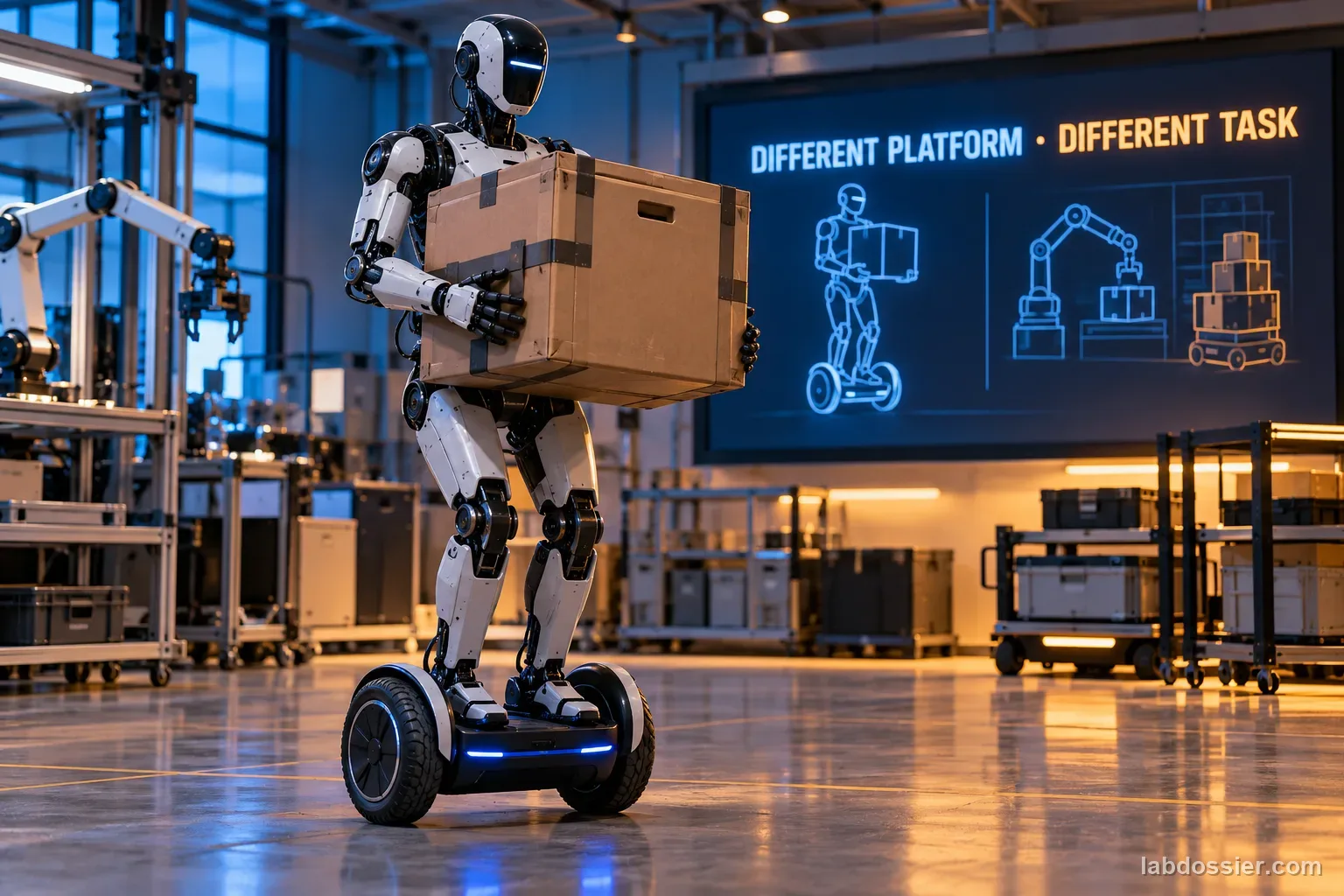
The Technical University of Munich record for an IROS 2025 study describes a humanoid riding a two-wheeled hoverboard and delivering payloads up to 20 kg. Its riding mode, whole-body grasp and wheel contacts make it a different task. The 1.2 kg, 10 kg and 20 kg values are therefore not a direct robot payload ranking.
13 // Write a conclusion with the right limits
State whether a value came from a model, simulation or a physical hardware trial; name the robot, support condition and task. Explain why payload may change center of mass, momentum and actuator demand together. A system's recovery ability depends on its controller, pose, contact area, floor, speed and disturbance as well as object mass.
These sources show that a study-specific balance metric can vary nonlinearly and that controllers can adapt during lifting and walking. They do not establish one universal payload limit or a safe classroom test. This activity uses published information only; never load, push or enter the work zone of a robot for this lesson.
14 // Questions people ask
Does critical mass mean the robot's maximum safe payload?
No. In the cited model it is the object mass at which one defined balanced-state-basin measure is greatest under specified assumptions. It is not a safety limit or manufacturer rating.
Why can a heavier object sometimes improve a balance metric?
The 2026 model study analyzes how added mass can change momentum and contact-wrench regulation, while support and actuator limits constrain the result. Its reported pattern is model-specific and should not be generalized to every robot.
Can I compare 1.2 kg, 10 kg and 20 kg from these sources?
Not as a direct ranking. They refer to different robots, balance measures, support conditions and tasks, including a hoverboard system.
What does a balance basin measure?
In the cited paper it describes a study-defined region of center-of-mass states from which balance can be maintained under stated contacts and constraints. It is not the same as a robot's rated payload.
Can I test this by adding weights to a school robot?
No. This lesson analyzes papers and does not authorize loading or perturbing hardware. Any real test requires the platform's approval, an authorized lab and trained supervision.
15 // Keep going
Can you explain the investigation?
How does a carried payload change humanoid balance and recovery? · Student Data Sheet
Question: In recent humanoid-robot studies, how do payload and support conditions relate to balance and recovery, and what can the reported masses actually tell us?
Hypothesis: If payload mass, load position, posture or support conditions change, then the balance controller and modeled recovery margin may change, and greater mass does not guarantee a simple linear increase or decrease, because payload shifts whole-body mass and inertia while contact area, joint torque limits, posture and control strategy constrain the robot's ability to recover.
Materials
- three cited research papers/pages
- calculator or spreadsheet
- run/source comparison table
- graph paper or a plotting tool
- teacher-approved browser
Safety before starting
- This activity uses published data only. Do not place objects on a robot, push it, disable a controller or enter a robot's guarded work area.
- Any authorized hardware demonstration must follow that platform's manufacturer limits, institutional risk assessment and trained-lab supervision; cited research masses are not safety limits for classroom equipment.
Lab notes
- The 2026 arXiv studies are research preprints/current conference submissions. Label their publication status and distinguish reported model outputs from hardware experiments.
Variables
Independent: Payload and modeled support condition in the cited studies · Dependent: Source-defined dynamic balance capability, lifting/recovery behavior and task completion evidence
Keep constant: Preserve each paper's robot, stance, controller, model assumptions, support condition, task and stated metric; compare only within a source unless the platforms and tasks are demonstrably matched
Procedure
- Identify each robot and its task: Read the methods and results of the three cited sources. Record which results come from a ROBOTIS-OP3 humanoid model, a different full-sized humanoid with hardware experiments, or a humanoid riding a two-wheeled hoverboard. Note whether each value is a model threshold, a carried mass demonstrated in a particular task, or a platform-specific upper demonstration. These are different measures.
- Extract the modeled balance result: From Song et al. (2026), transcribe the reported object mass where the ROBOTIS-OP3 model's balanced-state basin reaches its maximum: 1.2 kg for the paper's 1.0× foot-length sagittal support reference and 0.6 kg for its 1.5× reference. The model describes the payload as point mass split between the two hand/arm ends and analyzes specified poses and constraints. Copy the authors' terms and preserve the study boundary.
- Check the denominator and meaning: The paper gives robot mass as 3.5 kg and reports the two critical masses as about 34.28% and 17.14% of robot mass. Recalculate each ratio from the rounded masses and compare with the paper's percentages. A critical mass is the object mass at which this model's defined balance capability is greatest under the stated conditions; it is not the maximum safe load, a falling threshold, or a manufacturer's payload rating.
- Plot the source values without inventing a curve: Plot only the two reported critical-mass points as separate support-condition categories. Add a note that these points identify the location of each modeled maximum; the classroom table does not contain the complete basin-area series. Do not connect them into a continuous measured trend or infer unreported values. Beside this plot, list each condition and metric in words.
- Compare hardware recovery without ranking robots: A separate 2026 preprint reports 7 kg and 10 kg lift trials and a 7 kg lift-and-walk task on its own humanoid hardware; it describes extra control effort and small initial pelvis/pitch oscillations in the 10 kg lift. The TUM IROS 2025 hoverboard study reports payload delivery up to 20 kg on a two-wheeled platform. Record each result beside its platform and task. Do not compare 1.2, 10 and 20 kg as if they were measurements of one robot or the same balance metric.
- State what the evidence can support: A careful conclusion names the study, robot or model, support condition, task and exact metric. Explain that more mass can change balance in competing ways: it shifts center of mass and inertia but can also alter momentum, contact forces and actuator demands. Static balance, dynamic recovery, walking while carrying and platform payload demonstrations are distinct. The cited findings do not establish one universal payload limit or a classroom safety procedure.
Record your observations
| Source condition | Object mass at reported modeled stability maximum (kg) | Robot mass (kg) | Source-reported object/robot mass (%) | What the value means |
|---|---|---|---|---|
Keep unlike payload results separate
| Study/system | Reported payload and task | Evidence type | Do not infer |
|---|---|---|---|
Separate a balance measure from a payload rating
| Term | Meaning in this activity | Question to ask before comparing |
|---|---|---|
Formula: Object-to-robot mass ratio (%) = object mass ÷ robot mass × 100%; preserve the source's rounding and label the study condition
Answer key and expected pattern
The cited ROBOTIS-OP3 model reports critical masses of 1.2 kg and 0.6 kg under two different sagittal support-length conditions; these are not payload ratings.
Other humanoid studies report larger carried masses under different robots, controllers, supports and tasks; those values cannot be directly ranked against the model thresholds.
Balance and recovery depend on more than payload mass, including center of mass, posture, support contacts, actuator limits and control strategy.
Remember: Always name the robot, task, support condition and metric. A study-specific critical mass is not a universal robot payload limit.