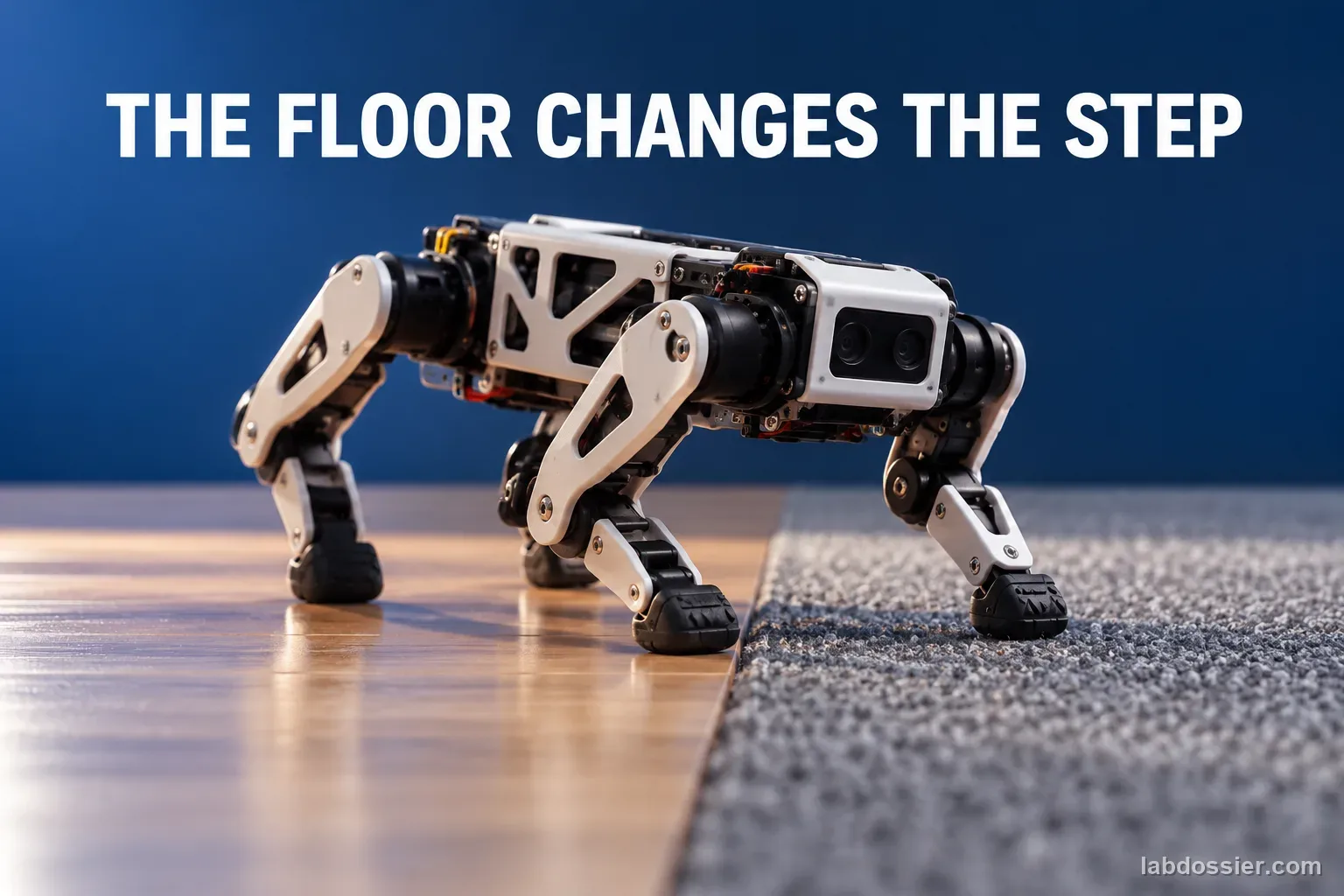
How does floor texture affect a small legged robot's traction and walking?
01 // Question
How does the texture of a dry floor surface affect visible foot slip and walking performance for one small legged robot?
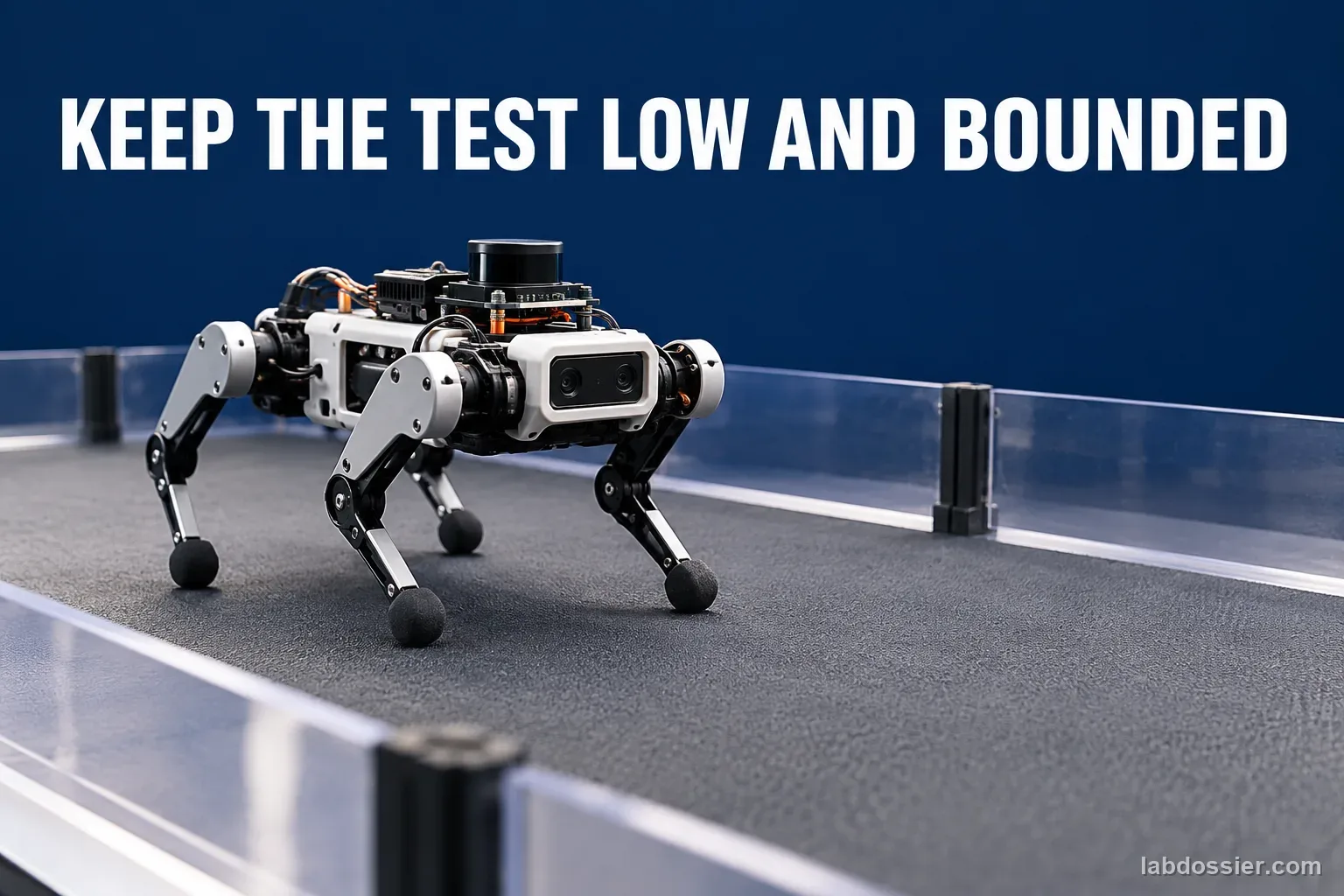
Use a light, slow educational robot on a flat, bounded test surface under adult supervision. Never test on wet floors, slopes, stairs, public walkways, or near people or fragile objects.
02 // Variables
Independent
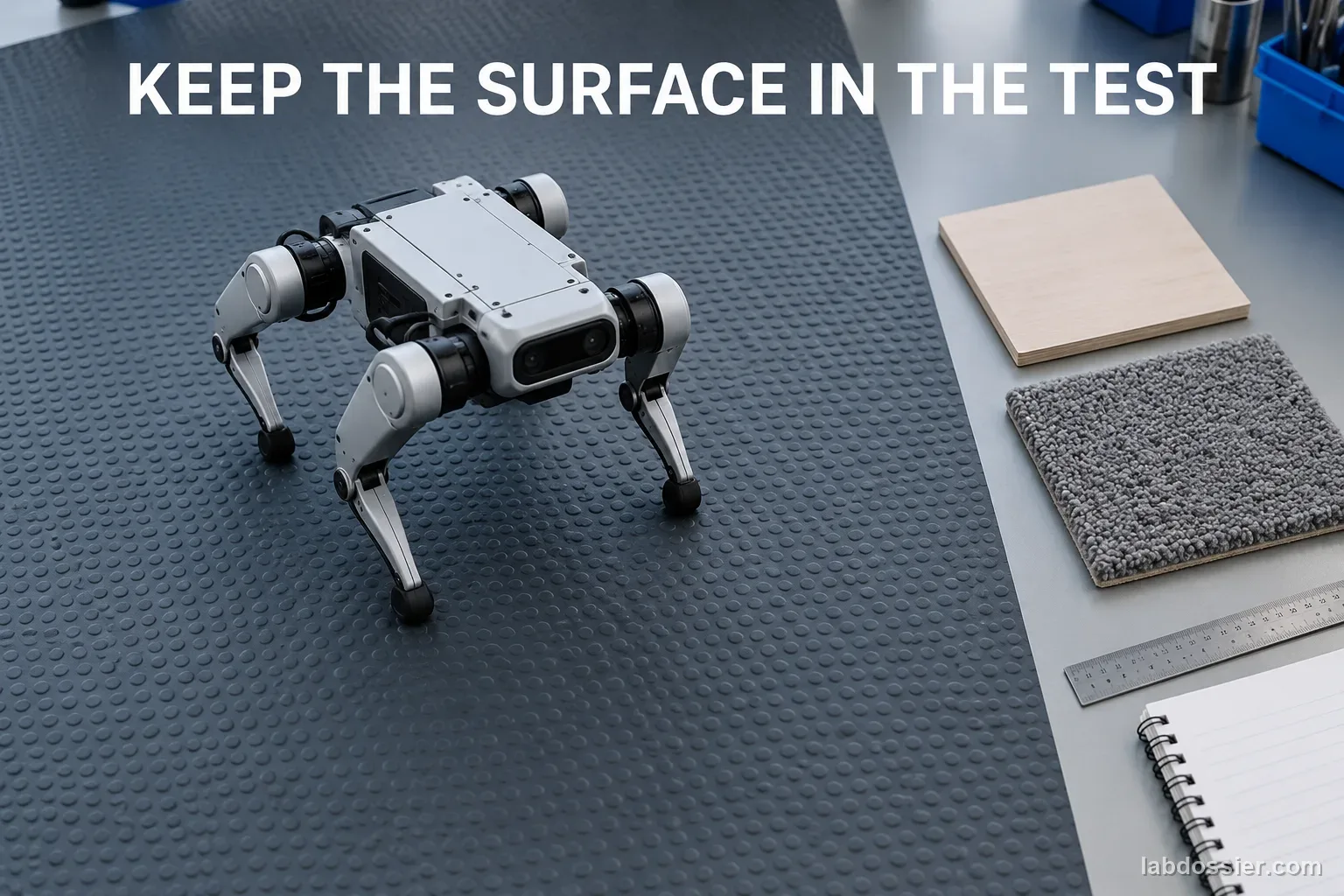
Dry floor surface material- Flat smooth board
- Short-pile carpet panel secured flat
- Flat textured rubber mat
Dependent
Run performance and observed stance-foot movement- Distance completed in a fixed time or time to cross a fixed lane
- Number of obvious backward foot slides during stance per run
- Course departures, pauses or incomplete runs
03 // Hypothesis
IF the floor material and texture change while the robot, gait and lane remain the same, THEN the robot's visible stance-foot slide count, distance or completion time may change, BECAUSE surface compliance and contact texture change the foot-ground interaction, while the gait and controller are tuned for particular contact assumptions.
04 // Procedure
1. Choose a small, bounded robot test
Use only a light classroom legged robot whose manufacturer permits the test surface and walking speed. Secure a short flat lane on a floor or broad table with a clear edge barrier; keep people and breakables outside the test area. Do not use a heavy research robot, stairs, ramps, wet floors, dust, oil, loose gravel or improvised traction attachments. Stop and power down before changing panels or handling the battery.
2. Mount three dry surface panels
Prepare smooth board, short-pile carpet and a flat textured rubber mat. Secure every panel so the edges cannot curl, slide or form a trip ridge. Keep the course length and width identical; use only dry clean materials. Mark the same start and finish line on each panel and check that the robot has room to stop before the lane ends.
3. Freeze the gait and define a slip event
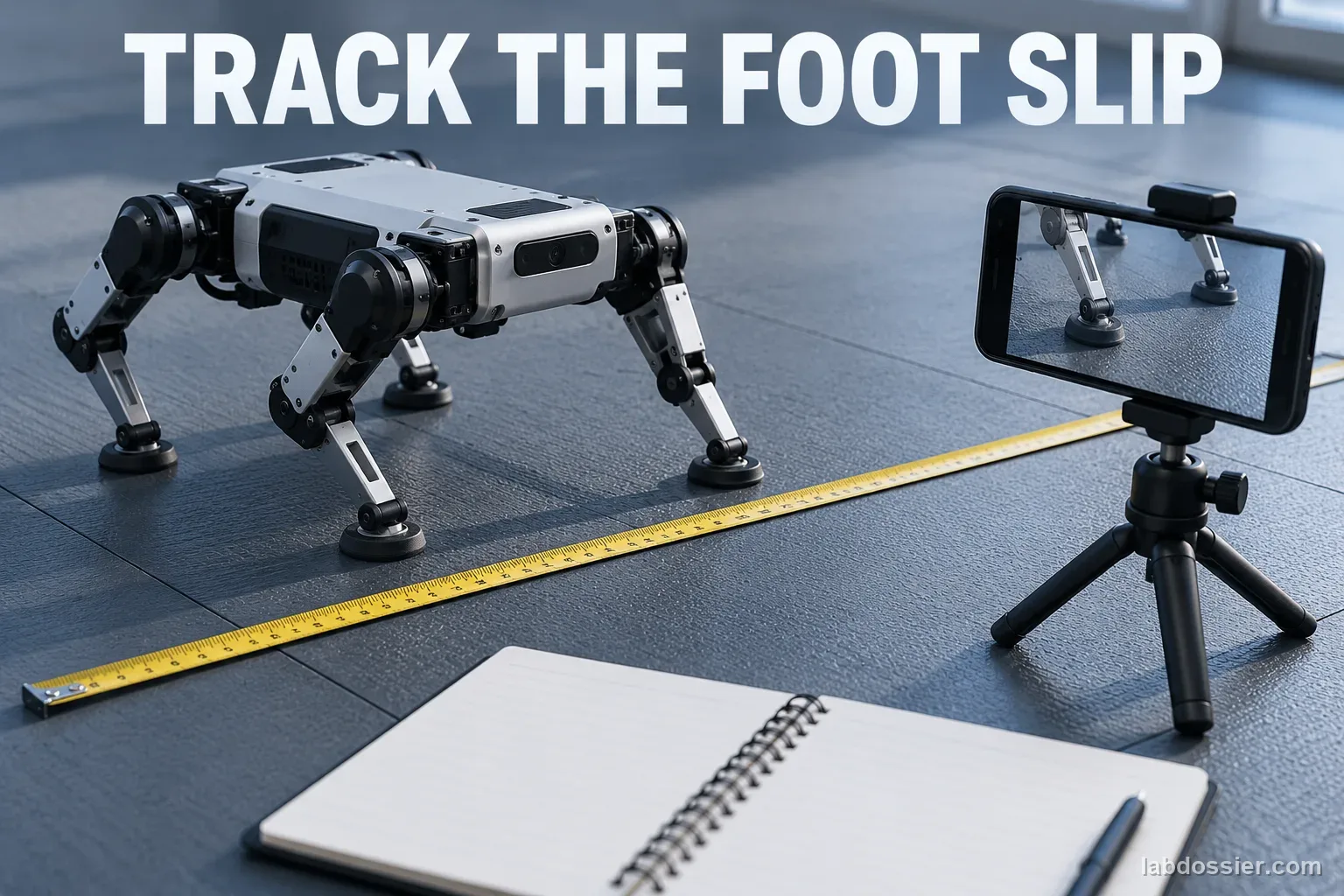
Use the same approved walking program and the robot's standard feet for every run. Check the battery and foot fasteners once before testing. Position a phone or camera side-on at the same distance for each panel. Before the first trial, define an obvious stance-foot slide as a foot that is in contact with the floor yet visibly shifts backward relative to a nearby tape mark before lifting; if the view cannot resolve a foot, record the event as unclear rather than guessing.
4. Choose one run endpoint and repeat five trials
Before the first trial, choose either a fixed-time run or a one-lane crossing; use the same endpoint for every surface. Randomize the order of the three panels. Start with the same robot orientation and mark. For a fixed-time run, measure distance for every trial and separately mark whether it finished the lane; for a crossing run, record completion and time, leaving time blank for an incomplete run. In both modes, record obvious stance-foot slides, pauses and course exits. Repeat five times per surface, letting the robot cool or rest as required by its instructions. Keep every run, including failed or unclear trials, and explain any exclusion rather than silently removing it.
5. Compare the repeated outcomes
For fixed-time runs, calculate mean distance across all five trials, including the distance achieved before any course exit, and report completion count and visible-slide count separately. For lane-crossing runs, calculate median time only among completed runs and report completion count out of five. Plot each individual result and show the small sample size. A visible slide count depends on camera resolution and observer rules, so it is a classroom indicator—not a measured friction coefficient.
6. Connect the result to robot-foot research carefully
The AMP-IT-UP BioBot classroom activity uses the same plastic feet and Walk60 program across carpet, board and rubber-mat surfaces, five trials per surface, and records average time and distance. A Frontiers study of an inchworm-like magnetic pipe crawler compared toe designs and metal pipe/plate surfaces, measured friction ten times per condition and repeated locomotion scenarios five times; its soft toes changed contact and crawling success. A 2023 lunar-soil paper instead simulated triangular, arc and rectangular tread patterns in loose soil. These sources address related contact questions but use different robots, surfaces, metrics and methods.
Materials // Prepare the bench
- teacher-approved lightweight educational quadruped
- smooth flat board panel
- short-pile carpet panel
- flat textured rubber mat
- tape to secure panel edges and mark start/finish
- phone or camera for side-view recording
- ruler or tape measure
- data table
05 // Data table
| Surface | Trial 1: distance / time | Trial 2 | Trial 3 | Trial 4 | Trial 5 | Visible stance slides (total) | Completed runs / 5 | Mean distance or median time |
|---|---|---|---|---|---|---|---|---|
| Smooth board | ||||||||
| Short-pile carpet | ||||||||
| Textured rubber mat |
Keep this comparison fair
| Keep constant | Change / record | Why it matters |
|---|---|---|
| Robot, gait and feet | Dry panel material | Avoid changing surface and foot design together |
| Lane, start and program duration | Distance, time and visible slip count | Keep course geometry and observation rule consistent |
| Camera view and battery check | Trial order and any resets | Reduce measurement and order effects |
| Surface mounting and cleanliness | Unclear video as unclear | Do not infer a slip that the recording cannot show |
What related sources measure
| Source setting | Reported approach | Limit for this activity |
|---|---|---|
| AMP-IT-UP BioBot lesson | Same plastic feet/program; five trials on carpet, board and rubber mat; time and distance averages | Classroom guide does not directly measure foot-ground force |
| Frontiers pipe crawler study | Toe designs on metal pipes/plate; ten friction-gage repeats per condition and five locomotion repeats | Magnetic attachment and curved metal pipes are unlike a small classroom quadruped |
| Lunar loose-soil study | Numerical simulation compares triangular, arc and rectangular foot patterns | Simulated lunar soil is not carpet, board or a classroom rubber floor |
Formula Choose one endpoint before testing. Fixed-time mode: mean distance = sum of all five distances ÷ 5; report lane completions separately. Lane-crossing mode: median time = median of completed runs only; also report completions ÷ 5 × 100%. One run changes the completion rate by 20 percentage points.
06 // What to expect
Surface changes may affect a robot's distance, completion time or visible foot movement, but the direction depends on its gait, foot material and floor properties.
Soft or textured contact can improve some robot designs on some surfaces; that does not mean every rough surface always provides greater traction.
Five repeats describe only this small robot and the specific dry panels. They cannot measure a general friction coefficient or predict a different robot's stability.
07 // Lab notes
08 // Remember
Traction comes from the foot, floor, load and gait working together. A surface result belongs to the tested robot and course.
09 // A robot's traction comes from both sides of the contact
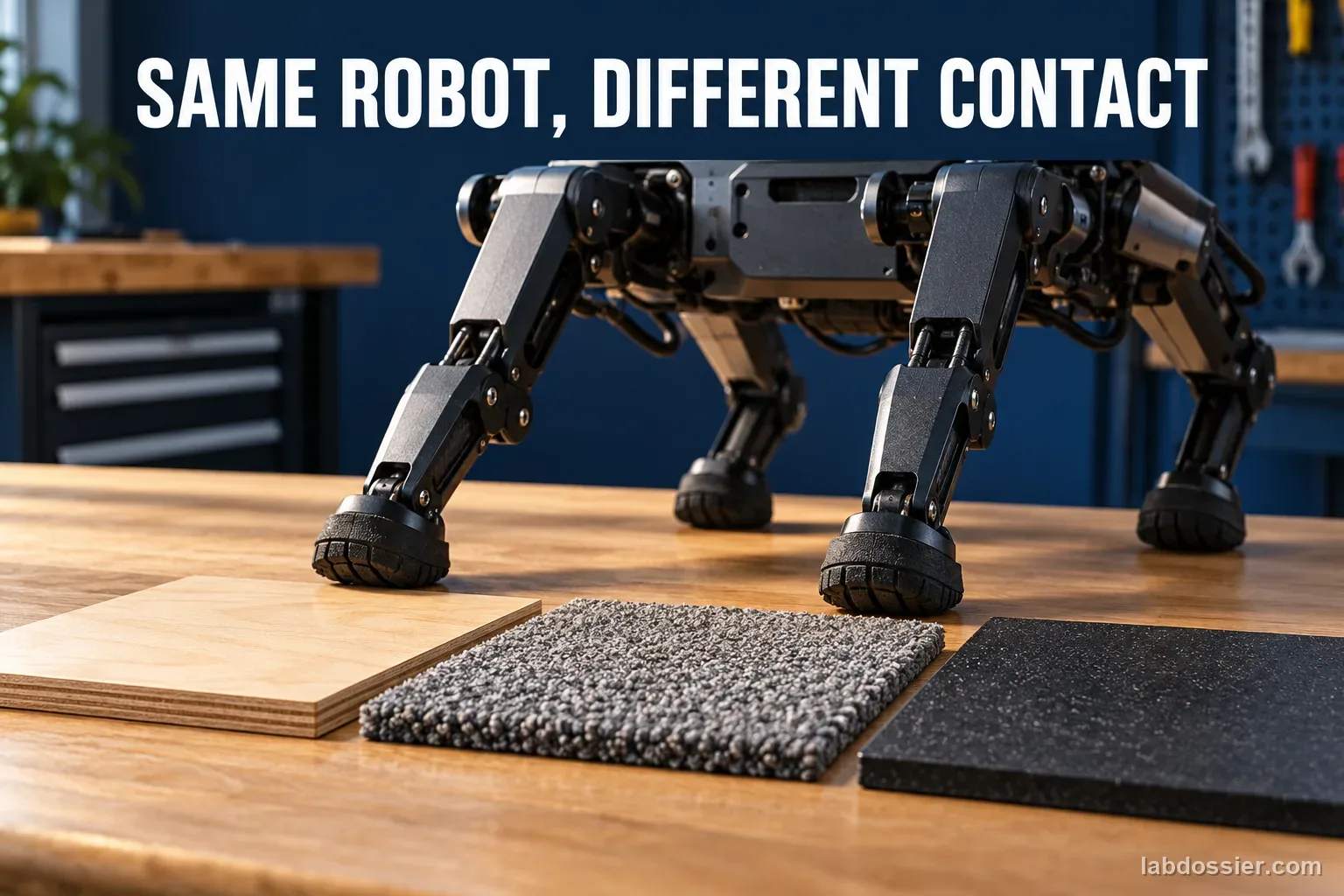
A robot foot pushes on the floor while the floor pushes back. The useful grip depends on the foot material and shape, surface texture and softness, contact force, gait timing and whether the floor itself shifts or deforms. A carpet may provide more mechanical engagement for one foot while increasing leg resistance or altering timing for another.
That is why the classroom investigation keeps one robot, gait and foot set unchanged while changing dry surface panels. It records travel and visible stance-foot motion rather than claiming to measure the coefficient of friction.
10 // How the classroom guide measures surface effects
The AMP-IT-UP STEM-ID BioBot activity asks how surface affects robot movement. It holds the robot's basic plastic feet and Walk60 program constant, tests carpet, board and rubber mat, runs five trials on each, and asks students to average time and distance. That is a useful classroom starting point, but it does not directly measure foot force or a material friction coefficient.
This lesson keeps its repeated comparison and adds a pre-defined visible stance-slip observation, randomized panel order, fixed course geometry, retained failed runs and a statement of the small five-run sample. Before testing, choose either a fixed-time distance run or a lane-crossing time run and keep that endpoint for every surface; otherwise distance and time averages would mix different tasks. The added observation helps connect performance to contact while staying within what a video can actually show.
11 // Research shows why robot feet and terrain matter
Khan and colleagues tested an inchworm-inspired magnetic pipe crawler using flat, rigid-curved and hybrid rigid-soft toes across flat metal and several pipe surfaces. Their lab measured toe friction with a force gauge and repeated each surface/foot condition ten times; locomotion scenarios were repeated five times. The soft toe improved contact on the tested metal surfaces, but magnetic attachment and curved pipes make the system unlike a classroom quadruped.
Zhong and colleagues studied triangular, arc and rectangular foot patterns interacting with loose lunar soil using numerical simulation. Their paper reports differences in simulated settlement and slip, and its equivalent shear parameters depend on the pattern and same-settlement assumption. A loose regolith model does not predict carpet, board or rubber-mat performance.
12 // Use the result only for the robot and panels tested
Compare the individual trials as well as each surface summary. In fixed-time mode, include all five distances, even a run that exits the lane, and report lane completions separately. In crossing mode, summarize time only for completed runs and show how many of five completed. A shorter travel distance can coincide with visible foot sliding, a pause, a different gait phase, or increased resistance in a compliant mat. Note what the recording can resolve and keep unclear observations separate from definite events.
Five runs provide a small classroom comparison, not a long-term reliability estimate or a universal ranking of floor materials. A different robot, foot pad, gait, body load, battery, surface brand or cleaning condition may change the outcome. Do not use this setup to test human slip resistance or certify a mobile robot.
13 // Questions people ask
Does a rougher surface always give a robot more traction?
No. Surface texture, compliance, foot material, contact area, load and gait all interact. One robot may perform better on a mat while another foot design works better on a different surface.
Can visible foot slip tell me the friction coefficient?
No. It is a simple observation affected by camera view, foot contact and the robot's movement. Measuring friction requires a defined force and motion method, like the force-gage setup in the research study.
Why keep the robot's feet and gait unchanged?
If both the feet and floor change, you cannot tell which one contributed to the result. This comparison isolates the surface while holding the robot configuration steady.
Why does the lunar-soil research not predict carpet results?
Loose lunar soil deforms and shears differently from household floor panels. That paper uses a numerical soil-contact model and tread-pattern shapes; it is useful for understanding terrain-specific design, not for transferring a classroom surface ranking.
Can I make the robot slip on purpose with a wet or tilted surface?
No. Keep the activity on dry, level panels. Wet or inclined surfaces can let the robot fall or move unpredictably and require a different risk assessment.
14 // Keep going
Can you explain the investigation?
How does floor texture affect a small legged robot's traction and walking? · Student Data Sheet
Question: How does the texture of a dry floor surface affect visible foot slip and walking performance for one small legged robot?
Hypothesis: If the floor material and texture change while the robot, gait and lane remain the same, then the robot's visible stance-foot slide count, distance or completion time may change, because surface compliance and contact texture change the foot-ground interaction, while the gait and controller are tuned for particular contact assumptions.
Materials
- teacher-approved lightweight educational quadruped
- smooth flat board panel
- short-pile carpet panel
- flat textured rubber mat
- tape to secure panel edges and mark start/finish
- phone or camera for side-view recording
- ruler or tape measure
- data table
Safety before starting
- Use only a lightweight, teacher-approved educational robot at a low speed on dry level panels. Keep clear of stairs, table edges, people traffic and fragile objects; stop if it leaves the lane or behaves unexpectedly.
- Do not use wet, oily, dusty, loose or inclined surfaces or add spikes, loads or other unapproved parts. Power down before changing panels or touching the robot's feet, joints or battery.
- A five-run classroom comparison is not a human-floor slip test, safety certification or friction-coefficient measurement and must not be transferred to public or industrial robots.
Lab notes
Variables
Independent: Dry floor surface material · Dependent: Run performance and observed stance-foot movement
Keep constant: same robot, gait/program, foot material, battery state, start mark, course length, camera angle, observer rule and flat surface-panel mounting; randomize the surface order
Procedure
- Choose a small, bounded robot test: Use only a light classroom legged robot whose manufacturer permits the test surface and walking speed. Secure a short flat lane on a floor or broad table with a clear edge barrier; keep people and breakables outside the test area. Do not use a heavy research robot, stairs, ramps, wet floors, dust, oil, loose gravel or improvised traction attachments. Stop and power down before changing panels or handling the battery.
- Mount three dry surface panels: Prepare smooth board, short-pile carpet and a flat textured rubber mat. Secure every panel so the edges cannot curl, slide or form a trip ridge. Keep the course length and width identical; use only dry clean materials. Mark the same start and finish line on each panel and check that the robot has room to stop before the lane ends.
- Freeze the gait and define a slip event: Use the same approved walking program and the robot's standard feet for every run. Check the battery and foot fasteners once before testing. Position a phone or camera side-on at the same distance for each panel. Before the first trial, define an obvious stance-foot slide as a foot that is in contact with the floor yet visibly shifts backward relative to a nearby tape mark before lifting; if the view cannot resolve a foot, record the event as unclear rather than guessing.
- Choose one run endpoint and repeat five trials: Before the first trial, choose either a fixed-time run or a one-lane crossing; use the same endpoint for every surface. Randomize the order of the three panels. Start with the same robot orientation and mark. For a fixed-time run, measure distance for every trial and separately mark whether it finished the lane; for a crossing run, record completion and time, leaving time blank for an incomplete run. In both modes, record obvious stance-foot slides, pauses and course exits. Repeat five times per surface, letting the robot cool or rest as required by its instructions. Keep every run, including failed or unclear trials, and explain any exclusion rather than silently removing it.
- Compare the repeated outcomes: For fixed-time runs, calculate mean distance across all five trials, including the distance achieved before any course exit, and report completion count and visible-slide count separately. For lane-crossing runs, calculate median time only among completed runs and report completion count out of five. Plot each individual result and show the small sample size. A visible slide count depends on camera resolution and observer rules, so it is a classroom indicator—not a measured friction coefficient.
- Connect the result to robot-foot research carefully: The AMP-IT-UP BioBot classroom activity uses the same plastic feet and Walk60 program across carpet, board and rubber-mat surfaces, five trials per surface, and records average time and distance. A Frontiers study of an inchworm-like magnetic pipe crawler compared toe designs and metal pipe/plate surfaces, measured friction ten times per condition and repeated locomotion scenarios five times; its soft toes changed contact and crawling success. A 2023 lunar-soil paper instead simulated triangular, arc and rectangular tread patterns in loose soil. These sources address related contact questions but use different robots, surfaces, metrics and methods.
Record your observations
| Surface | Trial 1: distance / time | Trial 2 | Trial 3 | Trial 4 | Trial 5 | Visible stance slides (total) | Completed runs / 5 | Mean distance or median time |
|---|---|---|---|---|---|---|---|---|
Keep this comparison fair
| Keep constant | Change / record | Why it matters |
|---|---|---|
What related sources measure
| Source setting | Reported approach | Limit for this activity |
|---|---|---|
Formula: Choose one endpoint before testing. Fixed-time mode: mean distance = sum of all five distances ÷ 5; report lane completions separately. Lane-crossing mode: median time = median of completed runs only; also report completions ÷ 5 × 100%. One run changes the completion rate by 20 percentage points.
Answer key and expected pattern
Surface changes may affect a robot's distance, completion time or visible foot movement, but the direction depends on its gait, foot material and floor properties.
Soft or textured contact can improve some robot designs on some surfaces; that does not mean every rough surface always provides greater traction.
Five repeats describe only this small robot and the specific dry panels. They cannot measure a general friction coefficient or predict a different robot's stability.
Remember: Traction comes from the foot, floor, load and gait working together. A surface result belongs to the tested robot and course.