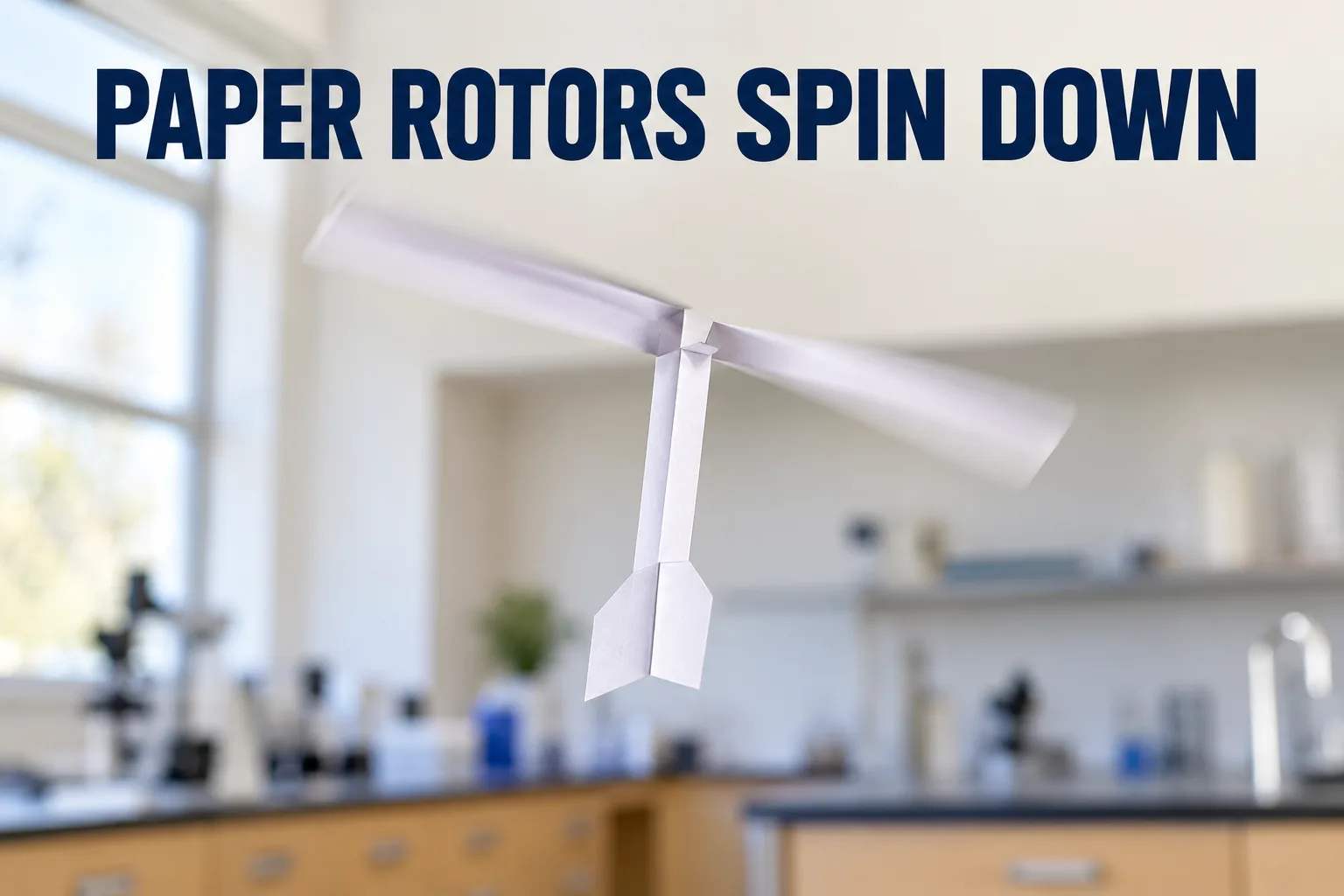
How do paper rotor dimensions affect fall time and stability?
01 // Question
How do paper-rotor blade length and width affect flight time and descent stability when the paper, body and release height stay the same?
Use a clear indoor drop zone and one fixed, reachable release mark. An adult should approve the setup; never climb to gain height or throw the rotor.
02 // Variables
Independent
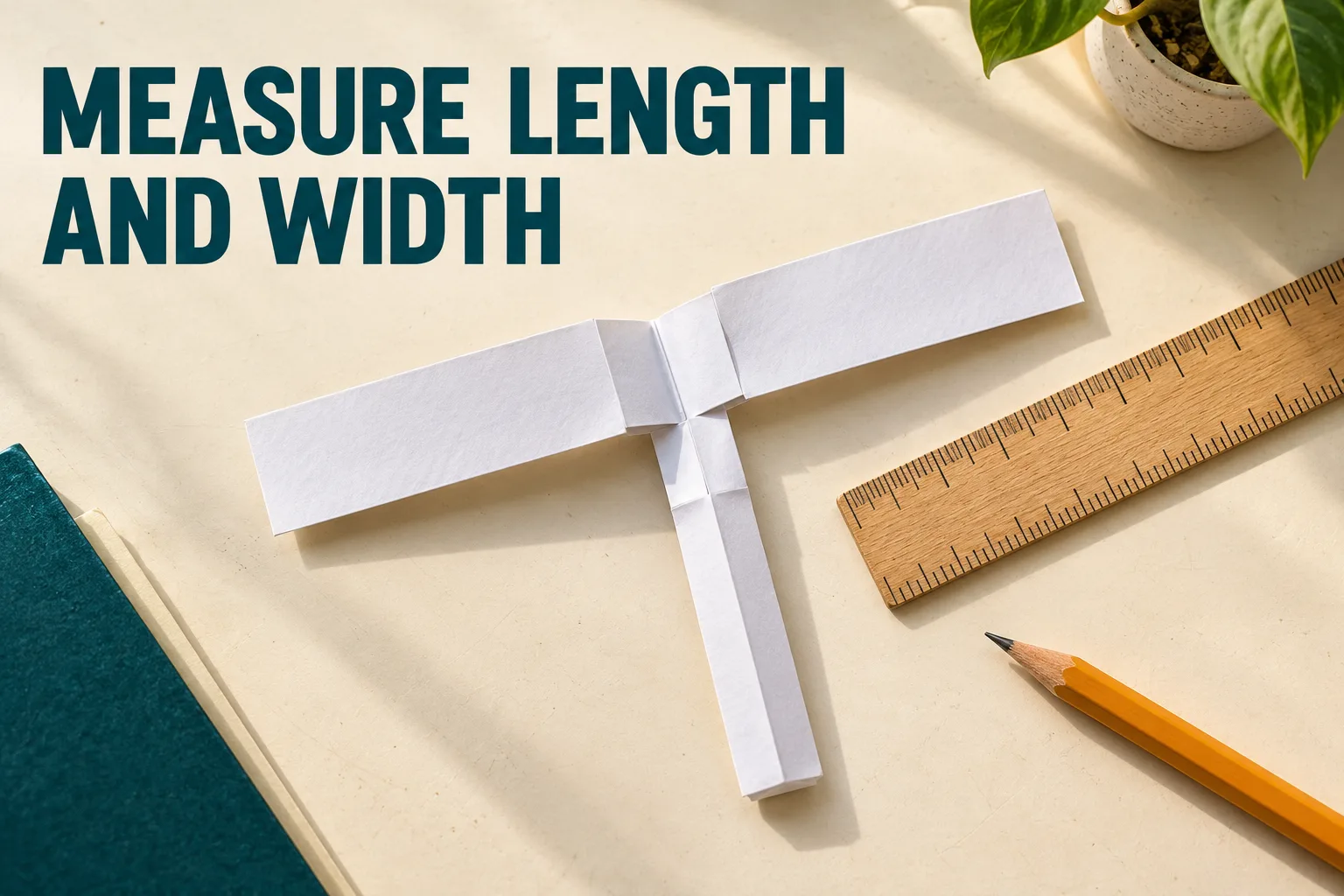
Blade geometry, tested as two separate dimensions- Blade length: 8 cm, 12 cm or 16 cm
- Blade width: 1 cm or 2 cm
Dependent
Descent outcome for each rotor design- Flight time from release to floor, in seconds
- Spin/stability category: steady spin, wobble, side drift, or no sustained spin
03 // Hypothesis
IF blade length and width change while the paper, body and release conditions stay fixed, THEN mean flight time and the share of steady-spin trials may change, and the relationship may not be a straight-line trend, BECAUSE blade area and shape affect air resistance and autorotation, while mass distribution, folds and release variation also influence the descent.
04 // Procedure
1. Set up a safe, reachable drop zone
Work indoors in a clear area with a level floor and no fans, open doors, stairs or fragile objects nearby. Mark one release height that the adult supervisor can reach without a stool or ladder; keep it the same for every run. Use blunt classroom scissors only with teacher approval, and keep people out of the landing zone.
2. Make six matched rotor designs
Use one teacher-approved paper type and the same two-blade paper-rotor template. Prepare blade lengths of 8, 12 and 16 cm at widths of 1 and 2 cm; keep the body length and fold pattern unchanged. Measure finished blades and remake any that differ from the target. Do not add clips or weights in this first comparison.
3. Fix the release and define stability
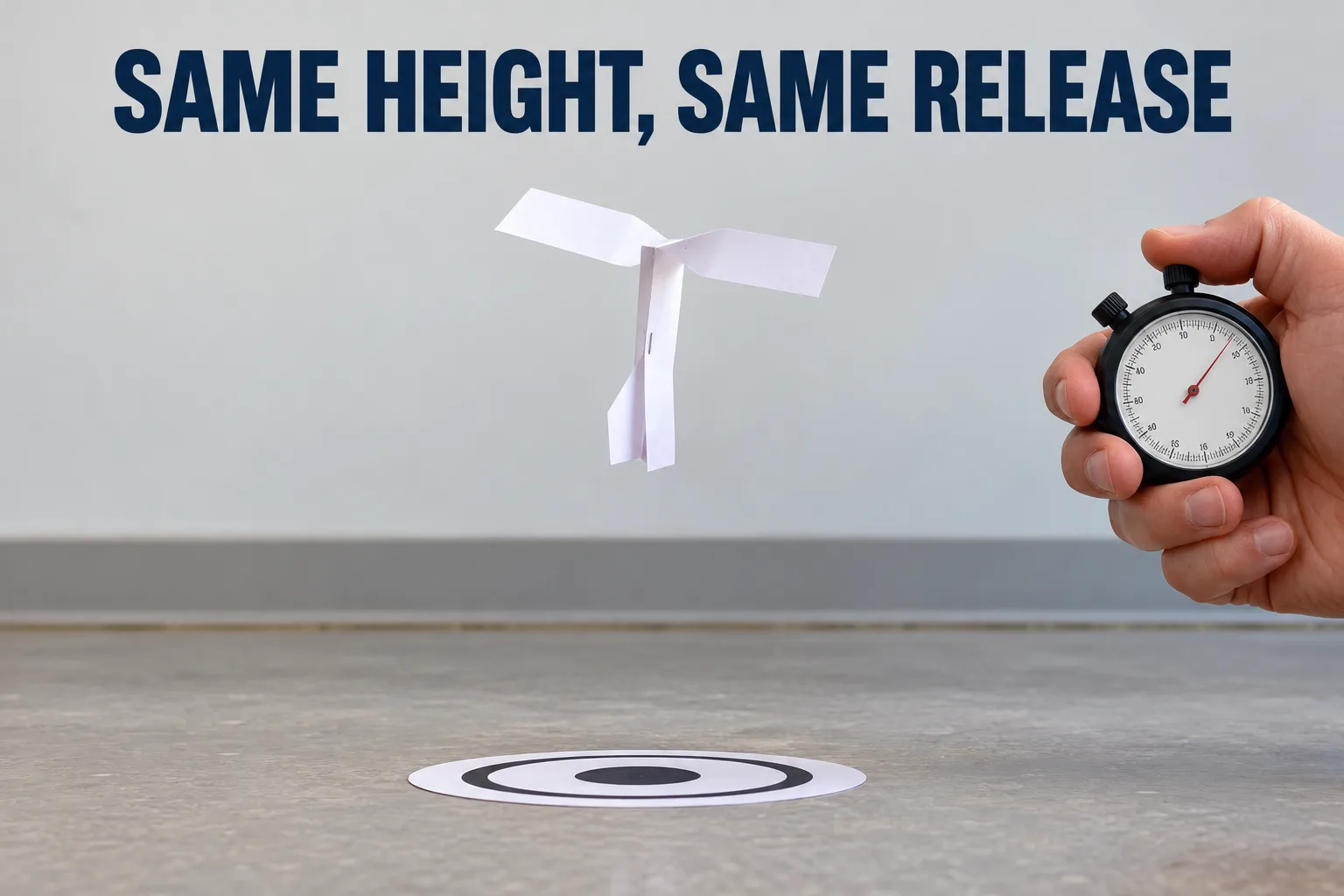
Mark the same release point on each rotor body. Hold the rotor upright with the same grip, release without pushing or spinning it by hand, and start timing at release. Before testing, define a steady spin as visible repeated rotation through most of the descent; separately mark wobble, side drift or no sustained spin. If a phone video is used, place it at the same side view for every trial.
4. Run five trials for each design
Shuffle the six designs into a trial order so one design is not always tested first. Drop each design five times from the marked height. Stop the timer when it first contacts the floor; record the time to the available precision and the stability category. If the release is pushed, obstructed or interrupted by a draft, mark the run invalid with a reason and repeat it; keep the original note.
5. Compare flight time and stability separately
For each design, report all five times, the mean and range, plus the count of steady-spin, wobble, drift and no-spin trials. Plot each trial as a point and show the small sample size. A longer time does not automatically mean a steadier or better rotor; treat stability as its own observed outcome.
6. Compare your pattern with published rotor studies
Nozaki and colleagues tested paper-rotor wing lengths over a broad range with 1 cm and 2 cm widths, five drops per condition, and a 150 cm release height. Their reported means vary across length and width; the authors identify selected 2 cm-wide designs around 11–16 cm as practical for their craft and also note sharp falls and unexplained variation. A Duke student project used a randomized 2⁴ factorial study with 80 paper-helicopter flights; it estimates effects for its own template and factors. Annis's paper-helicopter statistics article explains why design assumptions, engineering constraints and run-to-run variation matter. None supplies a universal best rotor or a stability measure for this exact classroom template.
Materials // Prepare the bench
- one teacher-approved paper type
- paper-rotor template
- ruler
- blunt classroom scissors with adult approval
- pencil and data sheet
- stopwatch or side-view phone video
- clear level indoor landing area
05 // Data table
| Blade width (cm) | Blade length (cm) | Trial 1 (s) | Trial 2 (s) | Trial 3 (s) | Trial 4 (s) | Trial 5 (s) | Steady / wobble / drift / no-spin counts | Mean time (s) | Range (s) |
|---|---|---|---|---|---|---|---|---|---|
| 1 | 8 | ||||||||
| 1 | 12 | ||||||||
| 1 | 16 | ||||||||
| 2 | 8 | ||||||||
| 2 | 12 | ||||||||
| 2 | 16 |
What each study can tell you
| Source | Design and reported method | Boundary for this activity |
|---|---|---|
| Nozaki et al. (2013), paper rotor craft study | 1 cm and 2 cm blade widths; many blade lengths; five drops per condition from 150 cm; flight time measured | Different template and height; the authors report variation and do not establish one universal optimum or a classroom stability score |
| Duke STA 522 student project (2025) | 2⁴ factorial design; 16 treatments × 5 flights = 80 observations; randomized within replicate blocks | Student project, not a peer-reviewed journal paper; effects belong to its own factor ranges and rotor design |
| Annis (2005), paper-helicopter engineering/statistics article | Discusses factorial design choices, engineering constraints, model assumptions and validation flights | A methodological discussion; not a direct test of these six dimensions or a classroom safety standard |
Interpret the two outcomes without mixing them
| Observation | What it supports | What it does not prove |
|---|---|---|
| A longer mean time in five drops | This design stayed aloft longer in this small test | That it was more stable or will win on another template |
| More steady-spin classifications | The rotor more often met the pre-set visual rule | A measured aerodynamic stability coefficient |
| One unusually long or short trial | A reason to inspect the raw run and release conditions | A result to discard without a recorded reason |
Formula Mean flight time = sum of valid trial times ÷ number of valid trials; range = longest time − shortest time. Report the number of valid trials and keep each stability count separate.
06 // What to expect
Blade length and width may change both the time in the air and how the rotor spins, but the response need not be linear. A larger blade is not automatically a better rotor because template geometry, paper, folds, mass distribution and release conditions all matter.
Nozaki and colleagues' measurements show that flight times varied across their tested widths and lengths, with repeated drops and some sharp falls. Use those source values as results for their design, not as predictions for a different paper template.
A five-trial classroom comparison is exploratory. Show the raw times, range, stability counts and any invalid-run notes; do not claim a universal best design from one small batch.
07 // Lab notes
- This is a small paper autorotation model. It does not test a real helicopter, certify a rotorcraft, or establish a general aerodynamic stability rating.
08 // Remember
Rotor size changes the flight, but the release and build matter too. Compare time and stability as separate outcomes.
09 // Why a paper rotor autorotates
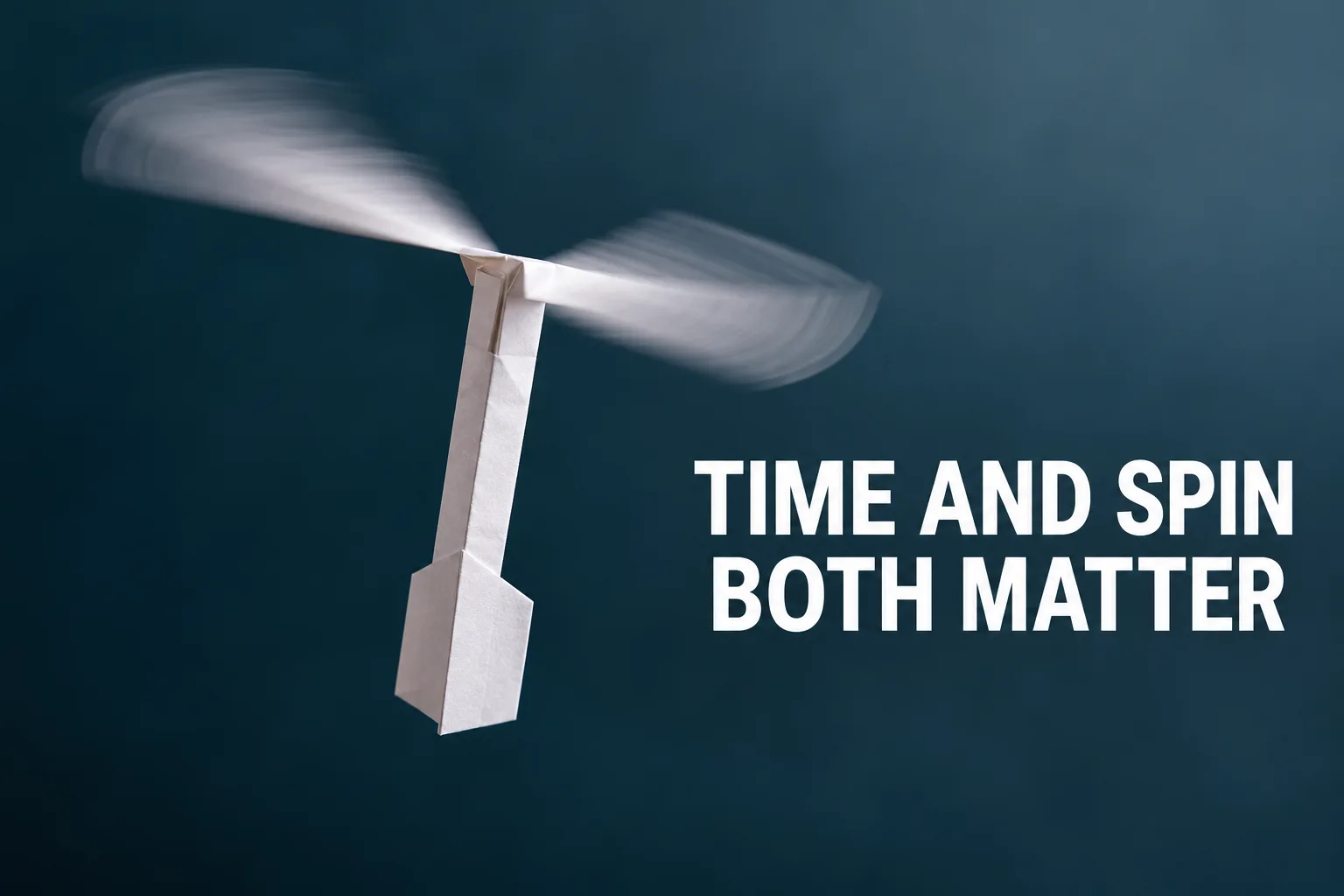
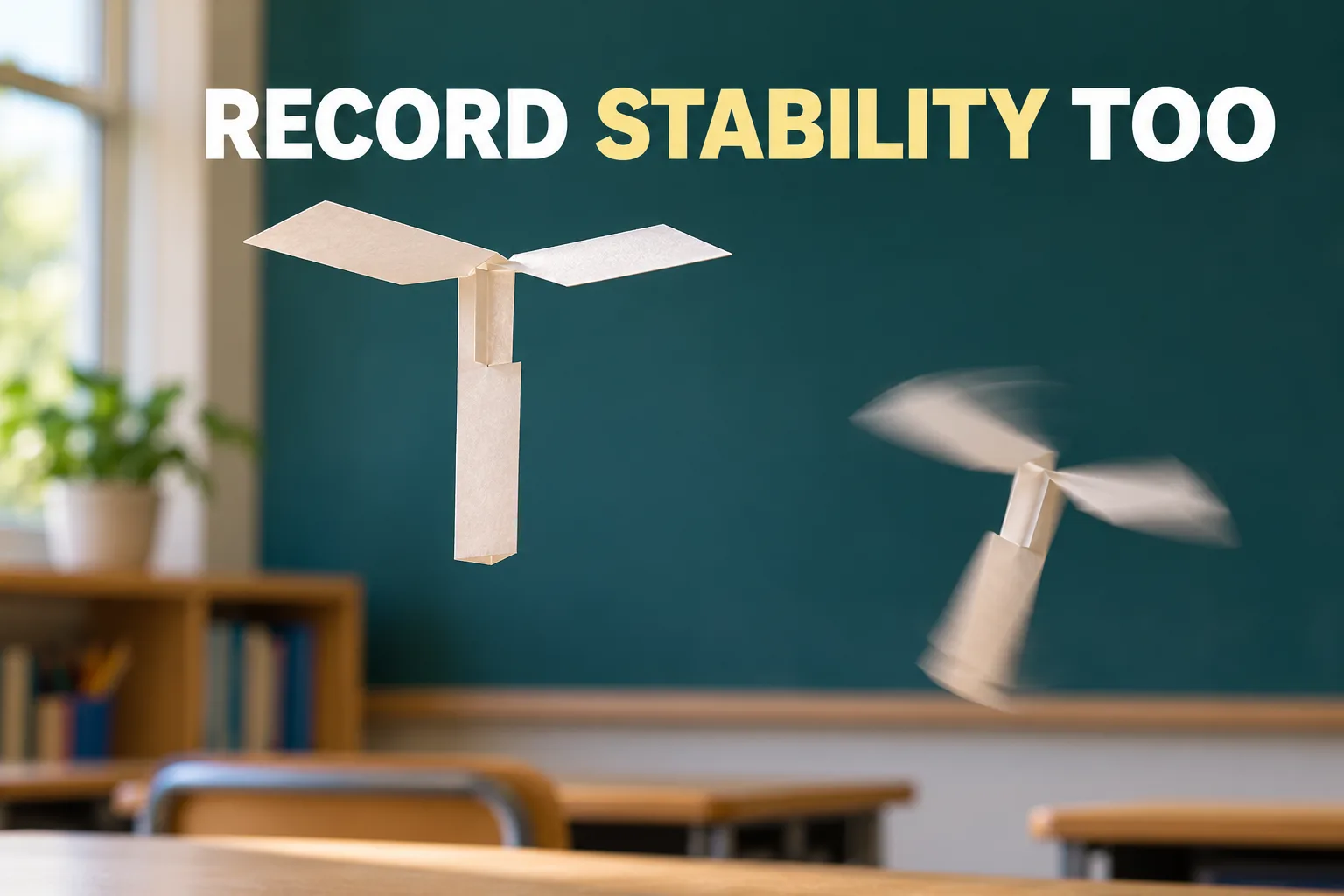
As the folded rotor falls, air pushes on its blades. The blade shape and orientation can create rotation while air resistance slows the descent. The paper body's mass distribution, folds and release orientation also matter, so changing only one dimension is important when comparing designs.
This activity tests blade length and width as two factors. It records time aloft and an observable spin category separately; a classroom visual category is not a formal aerodynamic stability measurement.
10 // What the three sources contribute
Nozaki and colleagues' 2013 paper-rotor study measured flight time over many wing lengths at 1 cm and 2 cm widths, with five drops per condition from 150 cm. The reported means vary across dimensions. The authors describe selected 2 cm-wide lengths around 11–16 cm as useful for their craft, while also noting sharp falls and variation without a clear single cause. The lesson's 8, 12 and 16 cm lengths overlap that region but use a lower reachable classroom release and a simplified six-design sample.
A 2025 Duke STA 522 student project randomized 16 combinations across four factors and collected five flights per combination, for 80 flights. It analyzes effects and interactions for its own template; label it as a student project rather than peer-reviewed research. Annis's 2005 paper-helicopter article discusses how engineering knowledge and statistical design choices affect conclusions, including the limits of optimizing only one outcome.
11 // Read the measurements without inventing a best design
For each of the six designs, show the five flight times as points, then summarize the mean and range. Keep the steady-spin, wobble, side-drift and no-sustained-spin counts visible. A longer mean can coexist with more wobbling, and one unusually long run should not be silently removed.
The source studies use different templates, materials, drop heights and factor ranges. Their reported times are useful comparisons of methods and patterns, not predictions for this rotor. A small set of classroom drops can suggest a follow-up question; it cannot establish a universal optimum or a real aircraft design rule.
12 // Questions people ask
Will a longer blade always keep the rotor in the air longer?
No universal rule follows. Longer blades may change the area interacting with air, but mass distribution, blade width, folds, paper and the release can affect the outcome. Compare repeated trials for the exact template.
Why test blade width and length together?
The six designs form a small two-factor comparison: each length is tested at each width. That lets you look for a length pattern and whether it changes with width while holding the other construction details fixed.
Does the longest flight mean the most stable rotor?
Not by itself. A rotor can stay aloft longer while wobbling or drifting. Record flight time and the pre-defined spin/stability category as separate results.
Why are the published times different from our results?
The papers use their own rotor templates, materials, release heights, timing methods and factor ranges. Your results also include small-sample and human-release variation. Compare methods and patterns rather than expecting the same exact seconds.
Can I add a paper clip to improve the design?
Keep clips out of the first six-design comparison because they change mass and balance. If a teacher approves a separate follow-up, change only clip presence or position, retain the same rotor dimensions, and reassess safety; do not mix that result into the first comparison.
13 // Keep going
Can you explain the investigation?
How do paper rotor dimensions affect fall time and stability? · Student Data Sheet
Question: How do paper-rotor blade length and width affect flight time and descent stability when the paper, body and release height stay the same?
Hypothesis: If blade length and width change while the paper, body and release conditions stay fixed, then mean flight time and the share of steady-spin trials may change, and the relationship may not be a straight-line trend, because blade area and shape affect air resistance and autorotation, while mass distribution, folds and release variation also influence the descent.
Materials
- one teacher-approved paper type
- paper-rotor template
- ruler
- blunt classroom scissors with adult approval
- pencil and data sheet
- stopwatch or side-view phone video
- clear level indoor landing area
Safety before starting
- Use an adult-approved release mark that can be reached from the floor. Never climb on furniture or use a ladder to gain height; do not throw or flick the rotor, and keep people and fragile objects outside the landing zone.
- Use paper and blunt classroom scissors only with teacher approval. An adult should supervise cutting, and sharp fasteners, weights, fans and motors are not part of this activity.
- Stop if a rotor drifts outside the clear area. This paper model is not a real aircraft or rotorcraft safety test.
Lab notes
- This is a small paper autorotation model. It does not test a real helicopter, certify a rotorcraft, or establish a general aerodynamic stability rating.
Variables
Independent: Blade geometry, tested as two separate dimensions · Dependent: Descent outcome for each rotor design
Keep constant: same paper sheet/type, rotor template and body, fold direction, release height, release orientation, indoor location, timer/video method and observer rule; use five trials per design and rotate through designs in a shuffled order
Procedure
- Set up a safe, reachable drop zone: Work indoors in a clear area with a level floor and no fans, open doors, stairs or fragile objects nearby. Mark one release height that the adult supervisor can reach without a stool or ladder; keep it the same for every run. Use blunt classroom scissors only with teacher approval, and keep people out of the landing zone.
- Make six matched rotor designs: Use one teacher-approved paper type and the same two-blade paper-rotor template. Prepare blade lengths of 8, 12 and 16 cm at widths of 1 and 2 cm; keep the body length and fold pattern unchanged. Measure finished blades and remake any that differ from the target. Do not add clips or weights in this first comparison.
- Fix the release and define stability: Mark the same release point on each rotor body. Hold the rotor upright with the same grip, release without pushing or spinning it by hand, and start timing at release. Before testing, define a steady spin as visible repeated rotation through most of the descent; separately mark wobble, side drift or no sustained spin. If a phone video is used, place it at the same side view for every trial.
- Run five trials for each design: Shuffle the six designs into a trial order so one design is not always tested first. Drop each design five times from the marked height. Stop the timer when it first contacts the floor; record the time to the available precision and the stability category. If the release is pushed, obstructed or interrupted by a draft, mark the run invalid with a reason and repeat it; keep the original note.
- Compare flight time and stability separately: For each design, report all five times, the mean and range, plus the count of steady-spin, wobble, drift and no-spin trials. Plot each trial as a point and show the small sample size. A longer time does not automatically mean a steadier or better rotor; treat stability as its own observed outcome.
- Compare your pattern with published rotor studies: Nozaki and colleagues tested paper-rotor wing lengths over a broad range with 1 cm and 2 cm widths, five drops per condition, and a 150 cm release height. Their reported means vary across length and width; the authors identify selected 2 cm-wide designs around 11–16 cm as practical for their craft and also note sharp falls and unexplained variation. A Duke student project used a randomized 2⁴ factorial study with 80 paper-helicopter flights; it estimates effects for its own template and factors. Annis's paper-helicopter statistics article explains why design assumptions, engineering constraints and run-to-run variation matter. None supplies a universal best rotor or a stability measure for this exact classroom template.
Record your observations
| Blade width (cm) | Blade length (cm) | Trial 1 (s) | Trial 2 (s) | Trial 3 (s) | Trial 4 (s) | Trial 5 (s) | Steady / wobble / drift / no-spin counts | Mean time (s) | Range (s) |
|---|---|---|---|---|---|---|---|---|---|
What each study can tell you
| Source | Design and reported method | Boundary for this activity |
|---|---|---|
Interpret the two outcomes without mixing them
| Observation | What it supports | What it does not prove |
|---|---|---|
Formula: Mean flight time = sum of valid trial times ÷ number of valid trials; range = longest time − shortest time. Report the number of valid trials and keep each stability count separate.
Answer key and expected pattern
Blade length and width may change both the time in the air and how the rotor spins, but the response need not be linear. A larger blade is not automatically a better rotor because template geometry, paper, folds, mass distribution and release conditions all matter.
Nozaki and colleagues' measurements show that flight times varied across their tested widths and lengths, with repeated drops and some sharp falls. Use those source values as results for their design, not as predictions for a different paper template.
A five-trial classroom comparison is exploratory. Show the raw times, range, stability counts and any invalid-run notes; do not claim a universal best design from one small batch.
Remember: Rotor size changes the flight, but the release and build matter too. Compare time and stability as separate outcomes.