How does payload change a robot's battery endurance?
01 // Question
How does a measured payload affect the time and distance a small wheeled robot can travel on one repeatable route before its normal low-battery warning?
Use only a slow educational ground robot with a published payload limit and user-visible low-battery warning. If its manual does not allow the payload or provide a safe stopping cue, use the published-data analysis instead of loading or draining the robot.
02 // Variables
Independent
Payload mass, set from the robot's published payload limit- No added payload
- One quarter of the published payload limit
- One half of the published payload limit
Dependent
Use before the first normal low-battery warning- Elapsed minutes from start to warning
- Completed laps on the same route
- Any stop, route departure or warning event
03 // Hypothesis
IF a robot carries a larger payload while following the same level route at the same approved speed, THEN it may reach its low-battery warning sooner or complete fewer laps, BECAUSE the drive system may need more power to move the added mass, although speed control, wheel slip, surface, turning and battery condition also affect the result.
04 // Procedure
1. Check that the robot is suitable
Read the robot manual with an adult. Use a small, slow ground robot with a published payload limit, a normal battery-status or low-charge warning and a flat top deck designed to carry items. If any of these are missing, do not add a load or run to battery exhaustion; use the source-comparison table and a teacher-provided dataset. Do not use a drone, human-carrying robot, industrial robot or modified battery system.
2. Choose and secure three approved loads
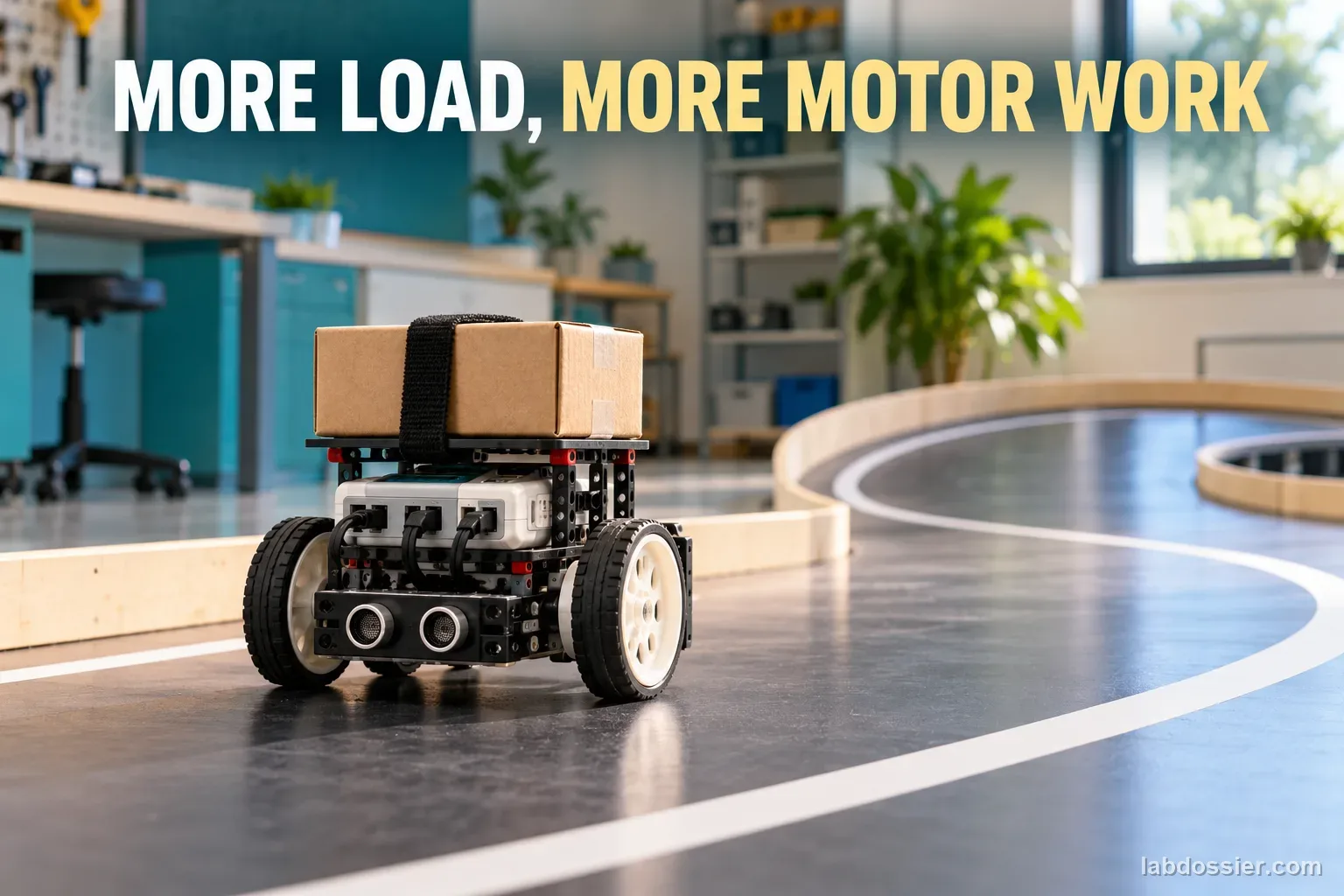
Weigh the empty robot with its normal battery installed. Calculate three conditions: no added load, one quarter of the published payload limit and one half of that limit. Include the strap or holder in the payload mass. Place the load low and centered on the approved deck, secure it so it cannot slide, and check that it does not cover sensors, wheels, ventilation or controls. Never exceed the maker's rating or improvise a mount.
3. Mark one short, level route
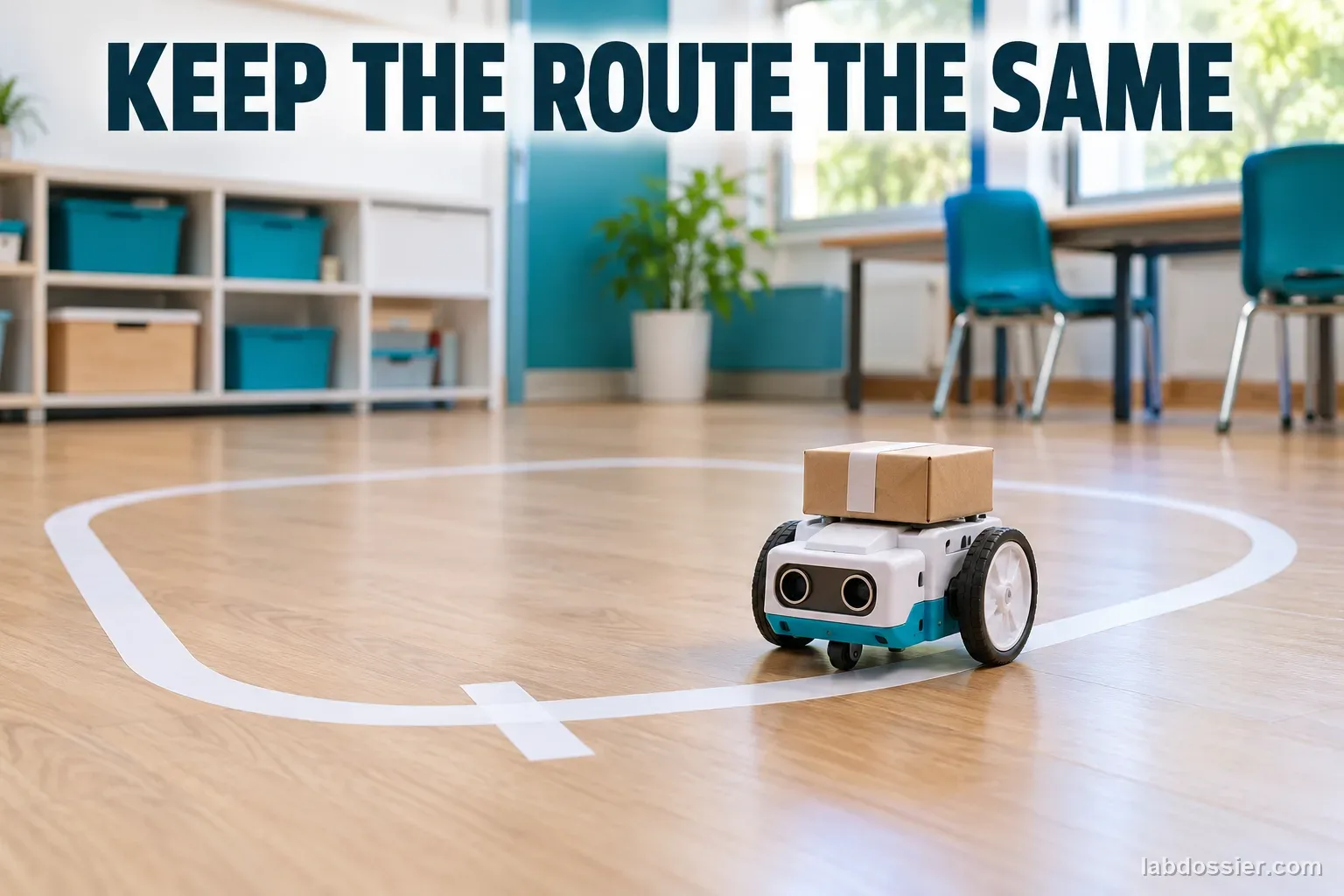
Create one flat loop with a start line and measured lap length. Remove obstacles, keep the robot away from steps and edges, and use the same manufacturer-approved low speed or fixed program for every run. Keep people and loose objects outside the lane. Write down the loop length and test conditions before starting.
4. Start from the same charge and run to the safe stop
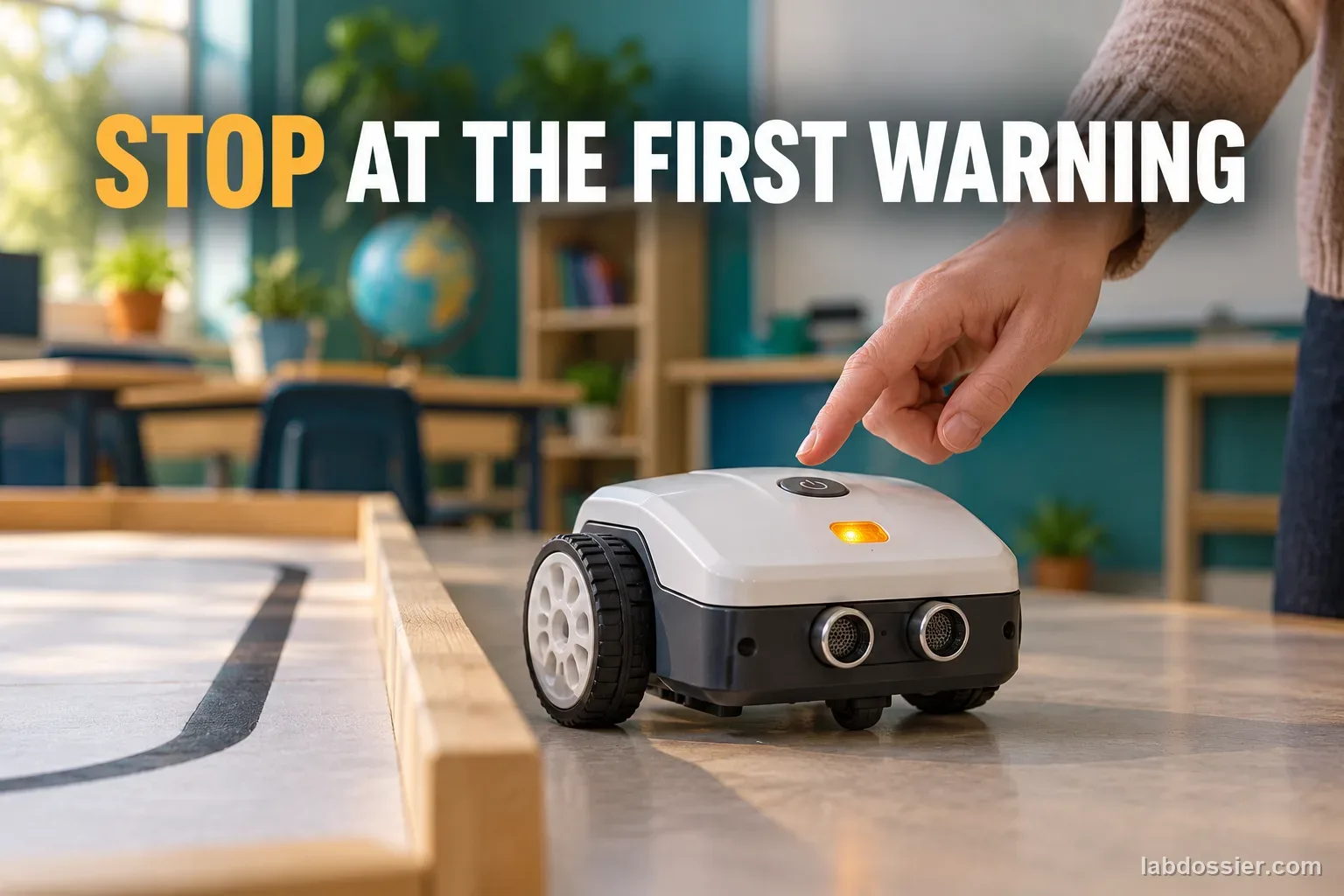
An adult charges the robot only with the supplied manufacturer-approved charger and procedure; do not open or probe the battery. Before testing, choose one short session limit that the adult approves (for example, 20 minutes) and use it for every run. Begin each trial from the same full-charge indication and after the same rest interval. Start the robot at the mark, record the time and lap count, and let it follow the loop. At the first normal low-battery warning, stop the run and power down as the manual directs. Do not continue to automatic cutoff or deep discharge. Record temperature, warning behavior and any route interruption.
5. Repeat each condition on a fresh charge
Run three trials for each of the three payload conditions. Shuffle the condition order across sessions; recharge the same battery to the same full indication and let the robot rest between trials. If the warning does not appear before the pre-set session limit, record a right-censored result such as “at least 20 minutes / 30 laps,” stop then, and do not infer its full battery life. Note any unusual wheel slip, motor sound or failure and stop immediately if the robot behaves unexpectedly.
6. Compare warning time as a limited proxy
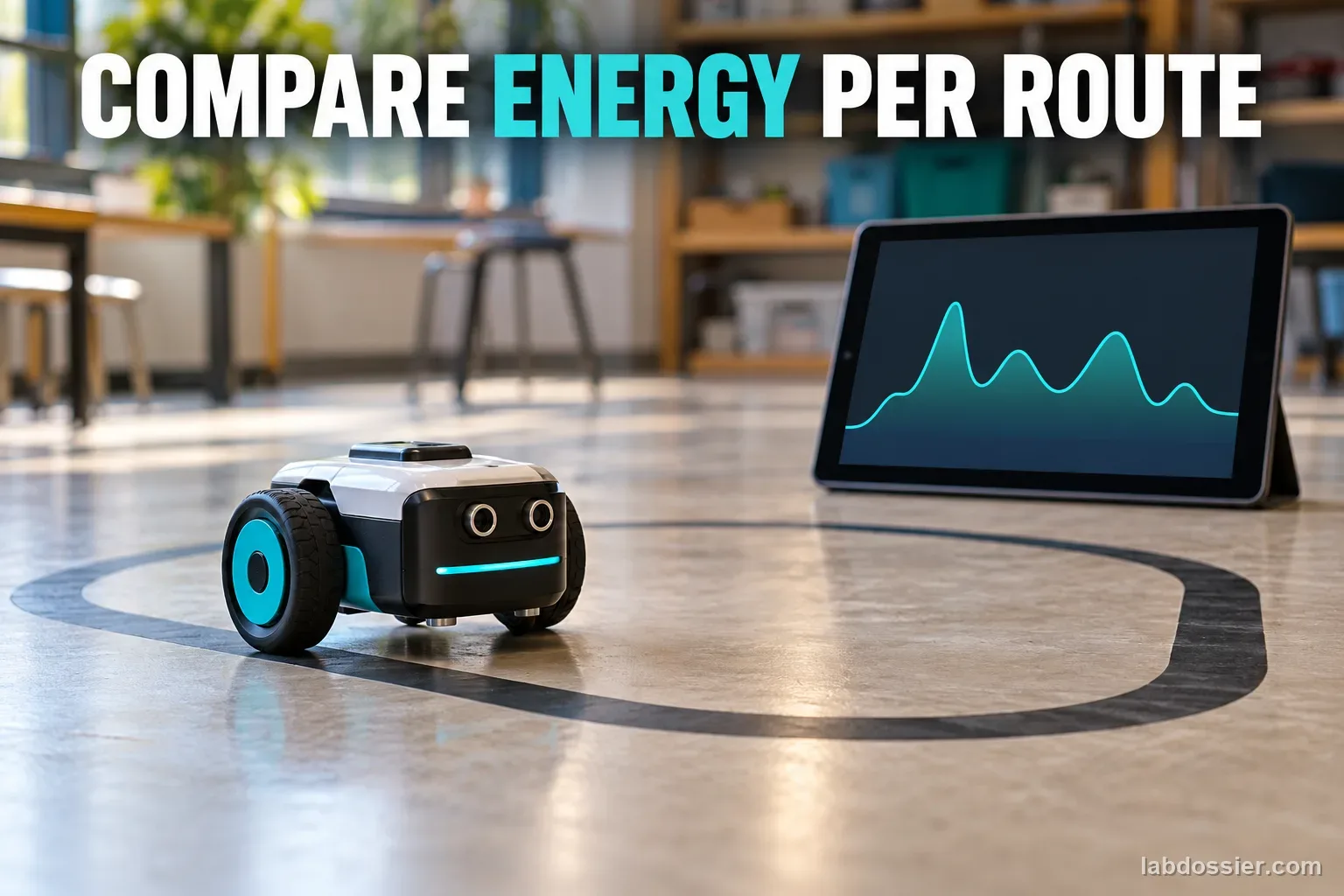
For each load, list all three elapsed times and lap counts. Calculate a mean and range only when all three trials reach the normal warning; if any trial stops at the session limit, mark it as right-censored (for example, “at least 20 minutes”), report how many of three reached the warning, and do not present a complete-condition mean or range. Plot every trial and identify the same battery pack, route and warning endpoint. A warning can depend on the robot's voltage threshold and battery state, so this is a comparative operating-time proxy—not a direct measurement of stored energy, battery capacity, or a guaranteed mission range. Never compare results as if they were a different robot's rating.
7. Connect the result to mobile-robot research
Mohamadi and colleagues' Journal of Field Robotics study experimentally measured a TurtleBot3 Burger on a fixed carpet route with no load and 2, 3 and 5 kg payload scenarios, using power sensors to separate actuation from static consumption. Their platform and research payloads are not classroom settings. A 2026 in-plant AMR study models battery use as load-dependent inside a scheduling and routing optimization; its insights come from simulation/modeling, not a classroom robot endurance test. UCAR's battery-lifetime lesson recommends repeated, similarly flown routes and records battery duration, while its companion payload lesson focuses on UAV lift and handling. This ground-robot activity adapts the fair-test idea but avoids student drone flight.
Materials // Prepare the bench
- small slow educational wheeled robot with a maker-rated payload deck
- same user-replaceable or integrated battery pack
- manufacturer-approved charger used by an adult
- small secured masses within the stated payload limit
- digital scale
- measured floor loop and tape markers
- timer and run sheet
- access to the robot's normal low-battery warning or status
05 // Data table
| Payload condition | Added mass (g) | Trial 1: min / laps | Trial 2: min / laps | Trial 3: min / laps | Mean warning time (min) | Range (min) | Stops or route notes |
|---|---|---|---|---|---|---|---|
| 0% of maker limit | 0 | ||||||
| 25% of maker limit | |||||||
| 50% of maker limit |
What the source studies measure
| Source | Evidence and setup | How it differs here |
|---|---|---|
| Mohamadi et al., Journal of Field Robotics (first published 2024; volume 2025) | Instrumented TurtleBot3 Burger; fixed carpet/flat grade, velocity profiles, no-load and 2/3/5 kg payload cases; models estimate actuation power | Research hardware and loads; power estimation is not a student's battery-warning runtime or a safe payload recommendation |
| Mao et al., Transportation Research Part C (2026) | Models load-dependent consumption in an in-plant AMR routing and charging optimization; evaluates the model and schedule computationally | A planning model, not a controlled classroom robot endurance trial |
| UCAR Center for Science Education, UAV Performance Test: Battery Lifetime | Students record flight duration on repeated flights/routes and the page recommends accounting for pilot, battery and UAV variation | A drone education activity; this lesson uses a ground robot and does not ask students to fly |
Keep an endurance comparison interpretable
| Control or record | Why it matters |
|---|---|
| Same battery pack and full-charge indication | Battery condition and charge state can shift warning time |
| Same route, speed, surface and turning | Drive effort and wheel slip change power demand |
| Load mass, position and attachment | The payload adds mass and may change balance or rolling resistance |
| First warning as the stop point | Avoids deep discharge and gives the same conservative endpoint |
| Run count and session limit | A trial stopped before warning is a minimum time, not full endurance |
Formula Only if all three trials reach the warning: mean warning time = sum of the three times ÷ 3; range = longest − shortest. If one or more runs stop at the session limit first, label each “at least” that time, report warning completions out of three, and do not calculate a complete-condition mean/range. Distance to warning = completed laps × measured loop length.
06 // What to expect
A heavier payload may shorten operating time or reduce laps for the tested robot and route because moving load can increase drive-system demand. The response may not be linear and depends on speed control, wheel/surface interaction, turns, battery condition, and accessory power.
A low-battery warning is a repeatable stop cue only for that robot and battery. Its time is not a direct energy-capacity measurement; voltage sag or a coarse warning threshold can affect when it appears.
Research on industrial and research robots uses instrumented power data, specific payloads and model assumptions. Do not transfer those values to a classroom robot or treat a small classroom test as a safe payload rating.
07 // Lab notes
08 // Remember
More payload can change power use along the route. The result belongs to one robot, battery, route and safe stop point.
09 // Payload can change how much work the drive system does
A wheeled robot uses its motors to accelerate, turn and keep moving against rolling resistance. An added payload raises total mass and may increase the force needed for motion; turns, wheel slip, surface, speed changes and the robot's control system also affect power demand. The direction and size of the battery-life change depend on the robot and route.
Battery warning time is an accessible classroom proxy, not a direct reading of stored energy. A warning may depend on voltage thresholds and the battery's condition as well as power use. Keep the endpoint and setup fixed, show the raw runs, and avoid describing the result as a general battery rating.
10 // What the published robot studies actually did
Mohamadi and colleagues' Journal of Field Robotics paper studied a differential-drive TurtleBot3 Burger. Its experiment used an instrumented platform, fixed carpet and flat grade, prescribed linear/angular velocity profiles, and no-load plus 2, 3 and 5 kg payload conditions. The authors separate static power (sensing, computing and communication) from actuation power and report estimation-error results for their method. Those heavy research payloads and power sensors are not classroom recommendations.
Mao and colleagues' 2026 in-plant AMR scheduling paper models battery consumption as a function of carried load and includes dynamic charging decisions in a routing/scheduling optimization. It uses data-derived modeling and computational experiments; it is not a physical classroom endurance test. UCAR's educational battery-lifetime activity stresses comparable route patterns, repeated trials and variation among batteries and aircraft. Its companion payload activity tests UAV handling and weight, not ground-robot battery runtime.
11 // Use the same safe endpoint and route
The activity records the time and lap count until the first normal low-charge warning. This conservative stopping rule avoids deliberate deep discharge. Begin each run at the same manufacturer-defined full-charge indication; keep the same battery pack, approved speed, level route, surface, start mark and rest interval. Change only the added payload, and randomize the order across recharged sessions.
If the session ends before the warning, record the time as a lower bound (for example, “at least 20 minutes”) instead of pretending it is the complete battery life. If the robot lacks a published payload limit, user-visible warning or maker-approved charging method, do not run the loaded test; analyze the published sources instead.
12 // Keep the conclusion tied to this robot
Compare each run as a point and report the mean and range for time and laps. Record unusual stops, slowdowns, slip, battery-state differences and room conditions. A pattern where heavier loads reach the warning sooner is consistent with increased drive demand in this tested setup; it does not isolate all power sources or establish a linear rule.
Industrial AMRs, instrumented research platforms, drones and classroom robots differ in motors, battery systems, payload mounts, speed profiles, route geometry and control. Do not rank their endurance figures directly or use the classroom result to choose a payload for a different machine.

13 // Questions people ask
Will a heavier payload always make the robot stop sooner?
It can increase the drive effort, but not every robot shows the same pattern. Motor control, route turns, wheel slip, surface, battery and extra electronics also affect the warning time; compare repeated runs for one setup.
Why use the first low-battery warning instead of running until the robot dies?
The warning gives a conservative, manufacturer-defined endpoint and avoids intentionally deep-discharging the pack. Do not bypass the cutoff or continue after the warning.
Is warning time the same as battery capacity?
No. Warning time is an operating-time proxy for that robot, battery, route and warning threshold. Capacity or energy use requires appropriate calibrated electrical measurements, which this classroom activity does not make.
Why must each trial start fully charged?
A partially charged battery has less usable energy before its warning. Use the same full-charge indication and rest interval, and keep the same pack to reduce battery-to-battery variation.
What if the robot has no payload limit or battery warning?
Do not add a payload or run it down to guess an endpoint. Use the published-data comparison in this lesson or select a robot whose maker provides the needed rating and safe stop cue.
14 // Keep going
Can you explain the investigation?
How does payload change a robot's battery endurance? · Student Data Sheet
Question: How does a measured payload affect the time and distance a small wheeled robot can travel on one repeatable route before its normal low-battery warning?
Hypothesis: If a robot carries a larger payload while following the same level route at the same approved speed, then it may reach its low-battery warning sooner or complete fewer laps, because the drive system may need more power to move the added mass, although speed control, wheel slip, surface, turning and battery condition also affect the result.
Materials
- small slow educational wheeled robot with a maker-rated payload deck
- same user-replaceable or integrated battery pack
- manufacturer-approved charger used by an adult
- small secured masses within the stated payload limit
- digital scale
- measured floor loop and tape markers
- timer and run sheet
- access to the robot's normal low-battery warning or status
Safety before starting
- Use a slow educational ground robot with a published payload limit and normal low-battery warning. Stay below the stated limit; do not use a drone, industrial robot, modified battery or improvised payload mount.
- Never open, probe, short, puncture, overcharge or deliberately exhaust a battery. An adult must charge it with the supplied approved charger; stop at the first normal low-battery warning and follow the manual.
- Keep the robot on a flat, clear, bounded course away from stairs, edges, people, pets and fragile objects. Secure the load and stop for heat, odor, damage, unusual sound or loss of control.
Lab notes
Variables
Independent: Payload mass, set from the robot's published payload limit · Dependent: Use before the first normal low-battery warning
Keep constant: same robot and battery pack, full-charge procedure and rest time, speed/program, level clean floor, loop length, payload position and attachment, start marker, observer, warning endpoint and room conditions; repeat each payload condition three times in randomized order across recharged sessions
Procedure
- Check that the robot is suitable: Read the robot manual with an adult. Use a small, slow ground robot with a published payload limit, a normal battery-status or low-charge warning and a flat top deck designed to carry items. If any of these are missing, do not add a load or run to battery exhaustion; use the source-comparison table and a teacher-provided dataset. Do not use a drone, human-carrying robot, industrial robot or modified battery system.
- Choose and secure three approved loads: Weigh the empty robot with its normal battery installed. Calculate three conditions: no added load, one quarter of the published payload limit and one half of that limit. Include the strap or holder in the payload mass. Place the load low and centered on the approved deck, secure it so it cannot slide, and check that it does not cover sensors, wheels, ventilation or controls. Never exceed the maker's rating or improvise a mount.
- Mark one short, level route: Create one flat loop with a start line and measured lap length. Remove obstacles, keep the robot away from steps and edges, and use the same manufacturer-approved low speed or fixed program for every run. Keep people and loose objects outside the lane. Write down the loop length and test conditions before starting.
- Start from the same charge and run to the safe stop: An adult charges the robot only with the supplied manufacturer-approved charger and procedure; do not open or probe the battery. Before testing, choose one short session limit that the adult approves (for example, 20 minutes) and use it for every run. Begin each trial from the same full-charge indication and after the same rest interval. Start the robot at the mark, record the time and lap count, and let it follow the loop. At the first normal low-battery warning, stop the run and power down as the manual directs. Do not continue to automatic cutoff or deep discharge. Record temperature, warning behavior and any route interruption.
- Repeat each condition on a fresh charge: Run three trials for each of the three payload conditions. Shuffle the condition order across sessions; recharge the same battery to the same full indication and let the robot rest between trials. If the warning does not appear before the pre-set session limit, record a right-censored result such as “at least 20 minutes / 30 laps,” stop then, and do not infer its full battery life. Note any unusual wheel slip, motor sound or failure and stop immediately if the robot behaves unexpectedly.
- Compare warning time as a limited proxy: For each load, list all three elapsed times and lap counts. Calculate a mean and range only when all three trials reach the normal warning; if any trial stops at the session limit, mark it as right-censored (for example, “at least 20 minutes”), report how many of three reached the warning, and do not present a complete-condition mean or range. Plot every trial and identify the same battery pack, route and warning endpoint. A warning can depend on the robot's voltage threshold and battery state, so this is a comparative operating-time proxy—not a direct measurement of stored energy, battery capacity, or a guaranteed mission range. Never compare results as if they were a different robot's rating.
- Connect the result to mobile-robot research: Mohamadi and colleagues' Journal of Field Robotics study experimentally measured a TurtleBot3 Burger on a fixed carpet route with no load and 2, 3 and 5 kg payload scenarios, using power sensors to separate actuation from static consumption. Their platform and research payloads are not classroom settings. A 2026 in-plant AMR study models battery use as load-dependent inside a scheduling and routing optimization; its insights come from simulation/modeling, not a classroom robot endurance test. UCAR's battery-lifetime lesson recommends repeated, similarly flown routes and records battery duration, while its companion payload lesson focuses on UAV lift and handling. This ground-robot activity adapts the fair-test idea but avoids student drone flight.
Record your observations
| Payload condition | Added mass (g) | Trial 1: min / laps | Trial 2: min / laps | Trial 3: min / laps | Mean warning time (min) | Range (min) | Stops or route notes |
|---|---|---|---|---|---|---|---|
What the source studies measure
| Source | Evidence and setup | How it differs here |
|---|---|---|
Keep an endurance comparison interpretable
| Control or record | Why it matters |
|---|---|
Formula: Only if all three trials reach the warning: mean warning time = sum of the three times ÷ 3; range = longest − shortest. If one or more runs stop at the session limit first, label each “at least” that time, report warning completions out of three, and do not calculate a complete-condition mean/range. Distance to warning = completed laps × measured loop length.
Answer key and expected pattern
A heavier payload may shorten operating time or reduce laps for the tested robot and route because moving load can increase drive-system demand. The response may not be linear and depends on speed control, wheel/surface interaction, turns, battery condition, and accessory power.
A low-battery warning is a repeatable stop cue only for that robot and battery. Its time is not a direct energy-capacity measurement; voltage sag or a coarse warning threshold can affect when it appears.
Research on industrial and research robots uses instrumented power data, specific payloads and model assumptions. Do not transfer those values to a classroom robot or treat a small classroom test as a safe payload rating.
Remember: More payload can change power use along the route. The result belongs to one robot, battery, route and safe stop point.