Which warehouse route layout reduces robot travel and waiting?

01 // Question
Which simple warehouse aisle layout gives a small group of robot tokens shorter routes and less waiting on the same set of pick-up jobs?
This activity uses a paper/grid or computer simulation only. Do not test a route by sending robots through a real warehouse, hallway, workplace, or pedestrian area. A grid model omits robot size, acceleration, sensing, load, human traffic and many real operating limits.
02 // Variables
Independent
Warehouse route-network design- A: one front cross-aisle; two-way parallel aisles
- B: front and rear cross-aisles; two-way parallel aisles
- C: front and rear cross-aisles; alternating one-way aisle directions
Dependent
Robot travel and congestion over the same pick-up task set- Total grid edges traveled
- Wait ticks caused by occupied cells or opposing moves
- Largest queue at a junction during one tick
- Ticks until all tasks in the set are complete
03 // Hypothesis
IF a warehouse model adds an alternate cross-aisle or directs traffic one way while the same robots repeat the same jobs, THEN some robots may travel farther but wait less, or finish the full task set sooner, BECAUSE alternate connections and direction rules can spread traffic away from a shared bottleneck, while detours can increase the distance per job.
04 // Procedure
1. Draw the same warehouse footprint
On graph paper, draw three parallel storage aisles, one front cross-aisle connected to the pick station, and marked storage cells. Copy this exact base map three times. Layout A keeps only the front cross-aisle; Layout B adds a rear cross-aisle joining the aisles; Layout C uses Layout B with alternating one-way aisle directions. Keep the storage cells and pick station in the same locations. The map treats an added connection as a graph change; it does not model the floor area or construction cost that a real aisle would require.
2. Prepare matched robot jobs
Use three labeled robot tokens at fixed start cells and prepare five task cards, each with three pick-up/drop-off pairs. Reuse each exact task set in all three layouts. Choose locations that remain reachable under the one-way directions in Layout C. Keep the task release order identical and write it down before the first run.
3. Agree on simple movement rules
Each robot may move one connected grid edge per tick or wait in place. Use the same shortest-path rule in every layout; when two routes are equally short, use one fixed direction order. A robot may not enter an occupied cell or swap edges with another robot in the same tick. When requests conflict, give priority in a fixed rotating order and count every denied move as one wait tick. These are teaching-model rules, not a complete fleet-control algorithm.
4. Run one matched task set
Set all three tokens at their start cells and release the first task card. Advance one tick at a time. For each robot, mark its chosen edge, any blocked move, and its pick/drop completion. Resolve same-cell or opposing-edge conflicts before moving any token. Count a robot in the junction queue only when its next planned edge enters that junction and the fixed conflict rule makes it wait; count distinct waiting robots at that junction for the tick, not repeated requests from the same robot. Record the total moves, wait ticks, largest such queue in any tick, and the final tick when every task is done. If a set stalls, record it rather than changing the rules mid-run.
5. Repeat every layout with the same jobs
Repeat all five task sets on Layouts A, B and C for 15 runs total. Shuffle the layout order separately for each matched task set to reduce order effects. Keep the starting positions, task release order, movement rule and priority schedule identical within each matched set. Use a second student to audit the move and wait tally if possible.
6. Compare distance against delay
For each layout, list the five task-set results and calculate the mean and range for total edges, waits and completion ticks. A layout with fewer movement edges may still finish later if robots spend more time waiting at a shared junction. Show each matched task set as a point and do not claim a meaningful difference from one run alone.
7. Explain the model boundary
Published warehouse studies also analyze multi-agent path finding, collisions, robot dynamics, task dependencies and layout structure. This grid activity keeps only simple cells, fixed jobs and a toy yielding rule, so it helps learners see a distance-versus-waiting trade-off; it does not reproduce those algorithms or predict a real warehouse's capacity, safety or throughput.
Materials // Prepare the bench
- graph paper or a dry-erase grid sheet
- three clearly labeled robot tokens
- warehouse map copies with identical storage and station cells
- five matched sets of pick-up/drop-off task cards
- pencil and tally sheet
- optional spreadsheet for grid-edge and wait counts
05 // Data table
| Layout | Matched task set | Travel edges | Wait ticks | Largest junction queue | Completion tick | Stall or rule notes |
|---|---|---|---|---|---|---|
| A: one cross-aisle, two-way | 1 | |||||
| B: two cross-aisles, two-way | 1 | |||||
| C: two cross-aisles, alternating one-way | 1 | |||||
| A: one cross-aisle, two-way | 2 | |||||
| B: two cross-aisles, two-way | 2 | |||||
| C: two cross-aisles, alternating one-way | 2 | |||||
| A: one cross-aisle, two-way | 3 | |||||
| B: two cross-aisles, two-way | 3 | |||||
| C: two cross-aisles, alternating one-way | 3 | |||||
| A: one cross-aisle, two-way | 4 | |||||
| B: two cross-aisles, two-way | 4 | |||||
| C: two cross-aisles, alternating one-way | 4 | |||||
| A: one cross-aisle, two-way | 5 | |||||
| B: two cross-aisles, two-way | 5 | |||||
| C: two cross-aisles, alternating one-way | 5 |
Compare the layout packages
| Layout | Network change | Trade-off to watch |
|---|---|---|
| A — one cross-aisle | Parallel two-way aisles connect to the pick station through one cross-aisle | Direct map, but several robots may need the same junction |
| B — second cross-aisle | Adds an alternate connection at the rear while preserving the marked storage locations | May distribute traffic; the classroom graph does not charge construction or lost floor area |
| C — alternating one-way aisles | Uses both cross-aisles and alternates the permitted direction in neighboring aisles | May reduce head-on conflicts but can lengthen a specific trip or require a detour |
What the research does and what this grid leaves out
| Source | Research evidence | Boundary of this activity |
|---|---|---|
| Zhang et al. (2024), warehouse layout design | Optimizes warehouse layouts for multi-robot path finding; the paper reports reduced simulated congestion and improved throughput in some cases | An extended abstract and large-scale simulation work; the hand-played map is not its algorithm or an industrial test |
| Asadi et al. (2025), congestion-aware multi-agent planning | Uses simulated pickup/delivery path planning with local collision handling and global congestion prediction; reports throughput gains in specific scenarios | It studies an algorithm and selected simulated scenarios, not a universal benefit from one aisle pattern |
| Erande & Tiwari (2026 preprint), TRACS | Proposes geometry-aware directed routing graphs with alternating one-way aisles to avoid some head-on/edge-swap conflicts by design | A recent preprint, not peer-reviewed here; its large benchmark claims are not measured by this classroom activity |
Formula Travel distance in the model = sum of robot grid edges moved. Wait share = total wait ticks ÷ (travel ticks + wait ticks). Makespan = the tick when the final task in the matched set is completed. These are model units; a grid edge is not a real-world meter or a validated warehouse throughput measure.
06 // What to expect
A second connection or one-way direction may lower queueing at a junction, but can make some routes longer. There is no universally best layout for every map, task mix and robot fleet.
One-way circulation can remove certain opposing-direction conflicts in this simplified graph, but other conflicts, such as two robots reaching the same node or workstation, still need a rule.
Real warehouses add robot footprint, turning radius, acceleration, loads, task timing, blocked aisles, charging, human movement and safety rules. The grid result is a demonstration of a trade-off, not a layout recommendation or safety approval.
07 // Lab notes
08 // Remember
A shorter route can still lose time in a queue. Compare the same jobs and count both movement and waiting.
09 // Shortest paths and fast jobs are different goals
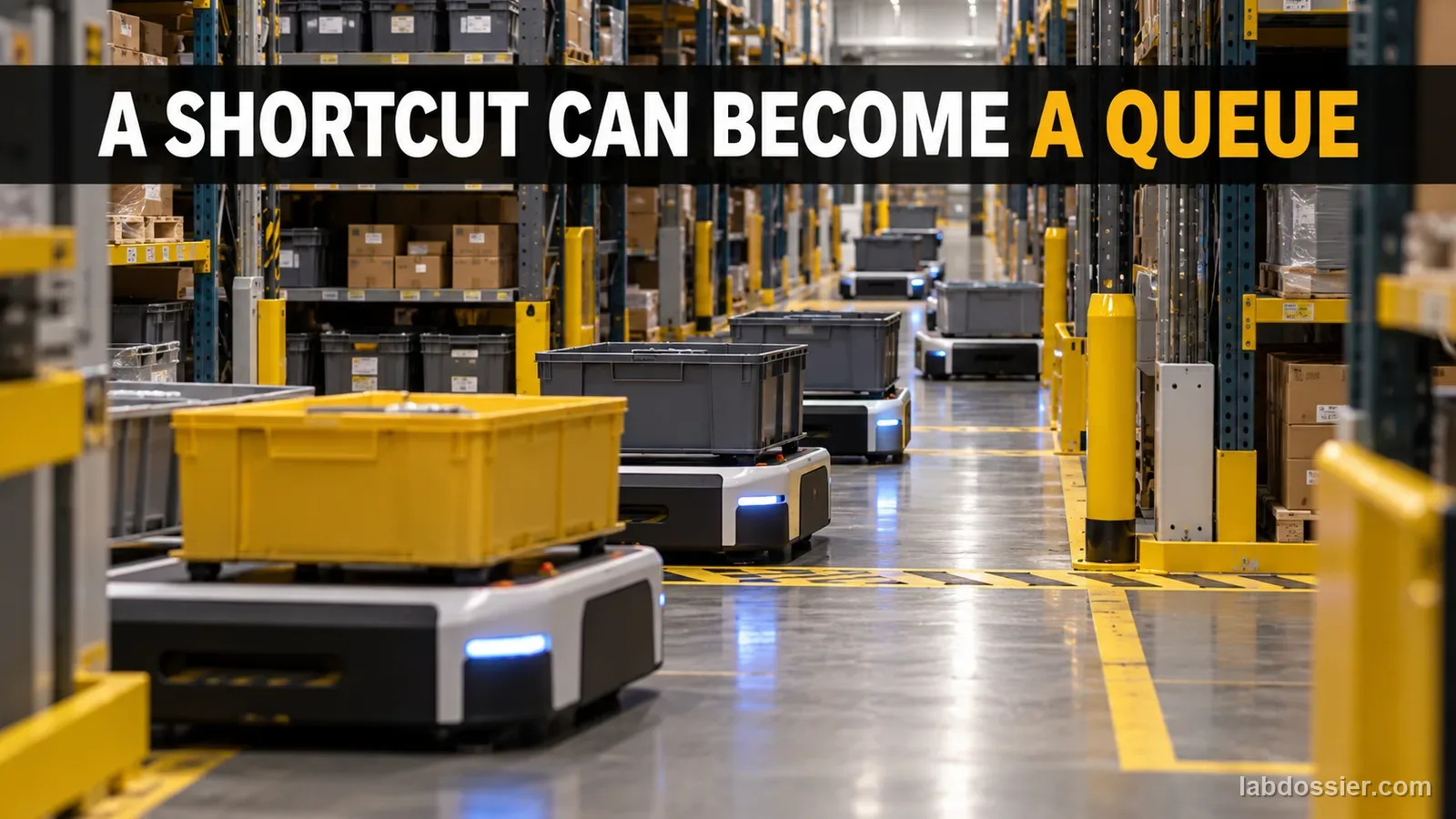
A route through a warehouse can be represented as connected nodes and edges. Shortest-path planning counts movement along that network, but several robots can choose the same narrow connection. One robot may then wait for another, so the group's completion time can be longer than the sum of its individual shortest routes suggests.
A cross-aisle creates another connection between parallel aisles; one-way directions remove some opposing flows but can force detours. A layout therefore trades directness against the chance to pass, queue and deliver tasks. The same map can favor different routes under a different number of robots or pick-up orders.
10 // What recent warehouse research actually tested
Zhang and colleagues' 2024 extended abstract focuses on optimizing automated warehouse layouts for multi-agent path finding. It reports simulated reductions in congestion and improvements in throughput for some optimized layouts, while also addressing scalability. This is evidence that layout itself can matter, but it is a short abstract and large-scale simulation—not proof that adding one aisle always helps a particular facility.
Asadi, Nowe and Ghofrani's 2025 GECCO paper describes a congestion-aware pickup-and-delivery path planner. The university record reports simulation experiments and throughput improvements, including an average doubling in specific scenarios. Those results concern a path-planning algorithm and selected scenarios, not one universal warehouse geometry; the publisher PDF was not accessible during this review, so the page relies on the accessible author-record abstract and omits extra numerical details.
The September 2026 TRACS preprint uses warehouse geometry and alternating one-way aisles in a directed routing graph to avoid some head-on and edge-swap conflicts by design. It is a recent preprint, not a peer-reviewed result in this article, and its benchmark claims are not classroom measurements. A 2024 ECAI warehouse-path paper also reports simulation plus preliminary tests in a real warehouse and explains that robot acceleration, turns, size, loads and task dependencies make simple grids incomplete.
11 // Use matched jobs to compare the networks
This lesson compares a single cross-aisle, a second cross-aisle, and the second connection plus alternating one-way directions. Reusing each same set of jobs across all three layouts helps show how the path network changes travel and waiting. A fixed conflict rule makes the classroom model repeatable, but it is intentionally much simpler than industrial multi-agent path-finding algorithms.
For each matched task set, show total edges moved and total wait ticks separately. Also record the largest queue at a junction in any one tick and the completion tick for the entire job set. A design can increase movement yet reduce waiting, or do the reverse. Do not add those outcomes into a single “best layout” score unless you first state how distance, time and floor space are weighted.
12 // Interpret results as a model, not an operations plan
The graph-paper warehouse leaves out turning radius, braking, acceleration, robot footprint, sensor uncertainty, obstacle detection, load changes, charging, station service times, human traffic and physical construction cost. Real robots can occupy several map nodes at once and may not stop or turn where a token can. A smooth simulation result is not a collision-safety validation.
If a layout has fewer wait ticks in one task set, repeat the matched comparison and inspect where the queues occurred. Report the task sets and rule choices with the mean/range. The conclusion should name the exact graph, robot count and job mix; a different facility or order stream could change the outcome.
13 // Questions people ask
Why can a shorter route take more time?
Robots can reach the same narrow aisle or junction at once. Waiting adds ticks even if each individual path uses fewer edges, so compare distance and completion time separately.
Does a second cross-aisle always reduce congestion?
No. It gives the model another connection, but its benefit depends on where jobs start and end, how many robots move at once, and how conflicts are resolved.
Why keep the same task cards across all layouts?
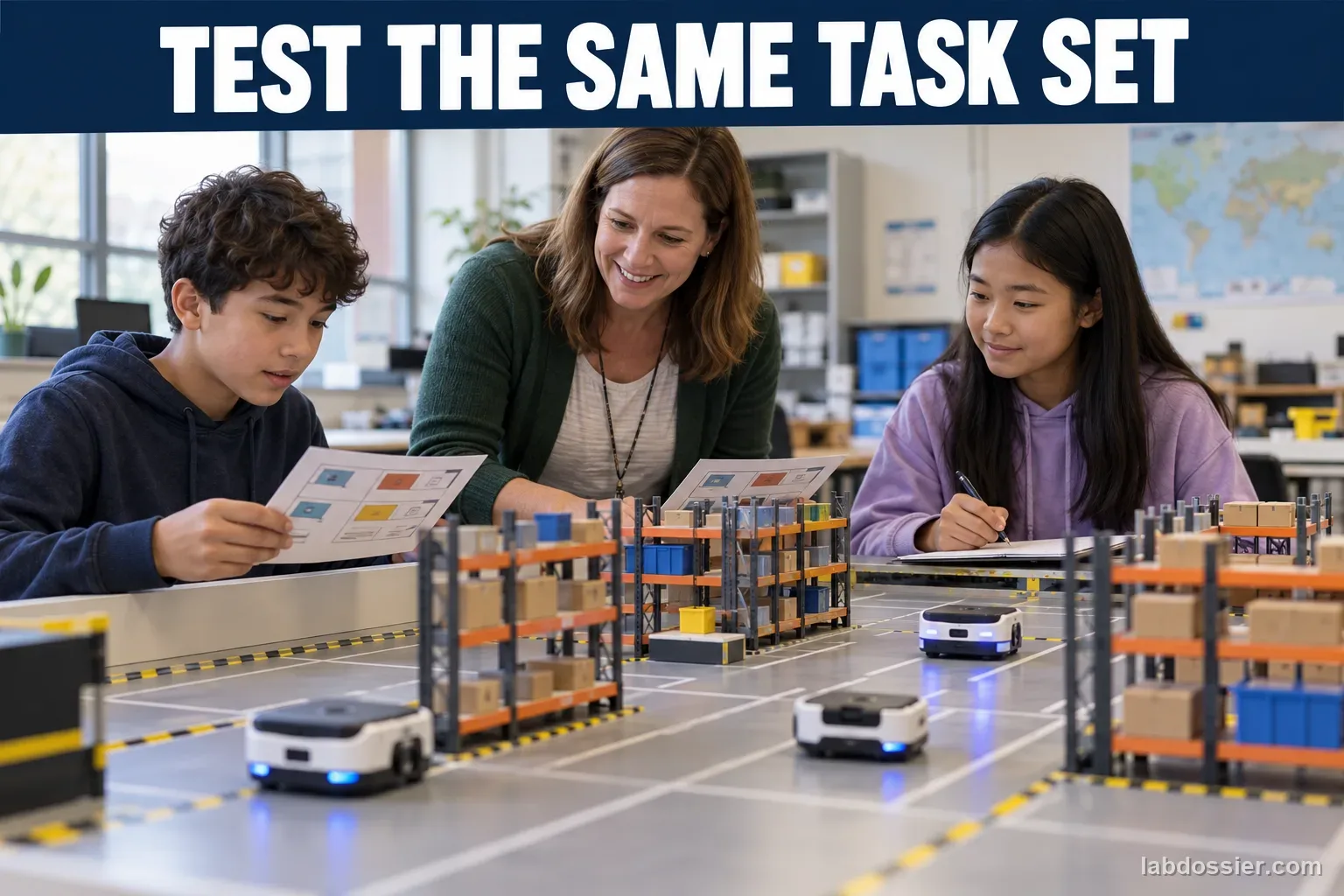
Changing the jobs can change route length and queue locations. Matched task sets help isolate how the network changes these measures.
Does a one-way system prevent all collisions?
No. It can prevent some opposing-direction conflicts in the model, but robots can still compete for the same cell, cross-aisle or workstation.
Can this activity tell a company how to design its warehouse?
No. It leaves out real robot size and dynamics, safety distances, people, payloads, work schedules, costs and many operating rules. It teaches a trade-off in a simplified model only.
14 // Keep going
Can you explain the investigation?
Which warehouse route layout reduces robot travel and waiting? · Student Data Sheet
Question: Which simple warehouse aisle layout gives a small group of robot tokens shorter routes and less waiting on the same set of pick-up jobs?
Hypothesis: If a warehouse model adds an alternate cross-aisle or directs traffic one way while the same robots repeat the same jobs, then some robots may travel farther but wait less, or finish the full task set sooner, because alternate connections and direction rules can spread traffic away from a shared bottleneck, while detours can increase the distance per job.
Materials
- graph paper or a dry-erase grid sheet
- three clearly labeled robot tokens
- warehouse map copies with identical storage and station cells
- five matched sets of pick-up/drop-off task cards
- pencil and tally sheet
- optional spreadsheet for grid-edge and wait counts
Safety before starting
- Use paper tokens, a tabletop grid or a computer simulation only. Do not conduct this comparison with live warehouse equipment or send robots into a hallway, workplace, public area or shared pedestrian route.
- Keep the map and tokens on a desk so nobody can trip over a floor course. Follow classroom rules for any scissors used to prepare map pieces.
- A simplified route model is not a real warehouse layout recommendation, collision-safety validation or operating approval. Actual facilities require qualified engineering review and site-specific safeguards.
Lab notes
Variables
Independent: Warehouse route-network design · Dependent: Robot travel and congestion over the same pick-up task set
Keep constant: same map boundary, storage locations, pick station, number and start cells of robots, task cards and order release sequence, move-one-edge-per-tick rule, shortest-path method, tie-breaking priority, and wait/collision rule; reuse five matched task sets in all three layouts and randomize layout order within each set
Procedure
- Draw the same warehouse footprint: On graph paper, draw three parallel storage aisles, one front cross-aisle connected to the pick station, and marked storage cells. Copy this exact base map three times. Layout A keeps only the front cross-aisle; Layout B adds a rear cross-aisle joining the aisles; Layout C uses Layout B with alternating one-way aisle directions. Keep the storage cells and pick station in the same locations. The map treats an added connection as a graph change; it does not model the floor area or construction cost that a real aisle would require.
- Prepare matched robot jobs: Use three labeled robot tokens at fixed start cells and prepare five task cards, each with three pick-up/drop-off pairs. Reuse each exact task set in all three layouts. Choose locations that remain reachable under the one-way directions in Layout C. Keep the task release order identical and write it down before the first run.
- Agree on simple movement rules: Each robot may move one connected grid edge per tick or wait in place. Use the same shortest-path rule in every layout; when two routes are equally short, use one fixed direction order. A robot may not enter an occupied cell or swap edges with another robot in the same tick. When requests conflict, give priority in a fixed rotating order and count every denied move as one wait tick. These are teaching-model rules, not a complete fleet-control algorithm.
- Run one matched task set: Set all three tokens at their start cells and release the first task card. Advance one tick at a time. For each robot, mark its chosen edge, any blocked move, and its pick/drop completion. Resolve same-cell or opposing-edge conflicts before moving any token. Count a robot in the junction queue only when its next planned edge enters that junction and the fixed conflict rule makes it wait; count distinct waiting robots at that junction for the tick, not repeated requests from the same robot. Record the total moves, wait ticks, largest such queue in any tick, and the final tick when every task is done. If a set stalls, record it rather than changing the rules mid-run.
- Repeat every layout with the same jobs: Repeat all five task sets on Layouts A, B and C for 15 runs total. Shuffle the layout order separately for each matched task set to reduce order effects. Keep the starting positions, task release order, movement rule and priority schedule identical within each matched set. Use a second student to audit the move and wait tally if possible.
- Compare distance against delay: For each layout, list the five task-set results and calculate the mean and range for total edges, waits and completion ticks. A layout with fewer movement edges may still finish later if robots spend more time waiting at a shared junction. Show each matched task set as a point and do not claim a meaningful difference from one run alone.
- Explain the model boundary: Published warehouse studies also analyze multi-agent path finding, collisions, robot dynamics, task dependencies and layout structure. This grid activity keeps only simple cells, fixed jobs and a toy yielding rule, so it helps learners see a distance-versus-waiting trade-off; it does not reproduce those algorithms or predict a real warehouse's capacity, safety or throughput.
Record your observations
| Layout | Matched task set | Travel edges | Wait ticks | Largest junction queue | Completion tick | Stall or rule notes |
|---|---|---|---|---|---|---|
Compare the layout packages
| Layout | Network change | Trade-off to watch |
|---|---|---|
What the research does and what this grid leaves out
| Source | Research evidence | Boundary of this activity |
|---|---|---|
Formula: Travel distance in the model = sum of robot grid edges moved. Wait share = total wait ticks ÷ (travel ticks + wait ticks). Makespan = the tick when the final task in the matched set is completed. These are model units; a grid edge is not a real-world meter or a validated warehouse throughput measure.
Answer key and expected pattern
A second connection or one-way direction may lower queueing at a junction, but can make some routes longer. There is no universally best layout for every map, task mix and robot fleet.
One-way circulation can remove certain opposing-direction conflicts in this simplified graph, but other conflicts, such as two robots reaching the same node or workstation, still need a rule.
Real warehouses add robot footprint, turning radius, acceleration, loads, task timing, blocked aisles, charging, human movement and safety rules. The grid result is a demonstration of a trade-off, not a layout recommendation or safety approval.
Remember: A shorter route can still lose time in a queue. Compare the same jobs and count both movement and waiting.