How do Artemis-era lunar observations distinguish surface brightness from camera exposure?
01 // Question
When the Moon looks brighter in a photograph, did the surface reflect more light, did the illumination change, or did the camera record the scene differently?
A controlled tabletop camera test isolates exposure. NASA lunar photographs provide a separate interpretation exercise; neither activity estimates lunar reflectance from ordinary displayed JPEG values.
02 // Variables
Independent
Camera exposure time for one unchanged, continuously illuminated target- Three shutter times selected within the camera's manual range
- Three repeated photographs at each time
- The same gray reference card included in every frame
Dependent
Recorded grayscale value from the same target and reference-card regions- Mean grayscale value on a stated 0–255 scale
- Optional count or percentage of clipped near-white pixels
- A note for blur, missed focus or any automatic camera adjustment
03 // Hypothesis
IF the scene and lighting remain fixed while the manual shutter time changes, THEN recorded pixel values will generally change even though the target surface and its illumination have not changed, BECAUSE exposure affects the signal recorded by the camera, while a lunar surface's observed radiance also depends on illumination, viewing geometry, reflectance and instrument calibration.
04 // Procedure
1. Build one steady, safe scene
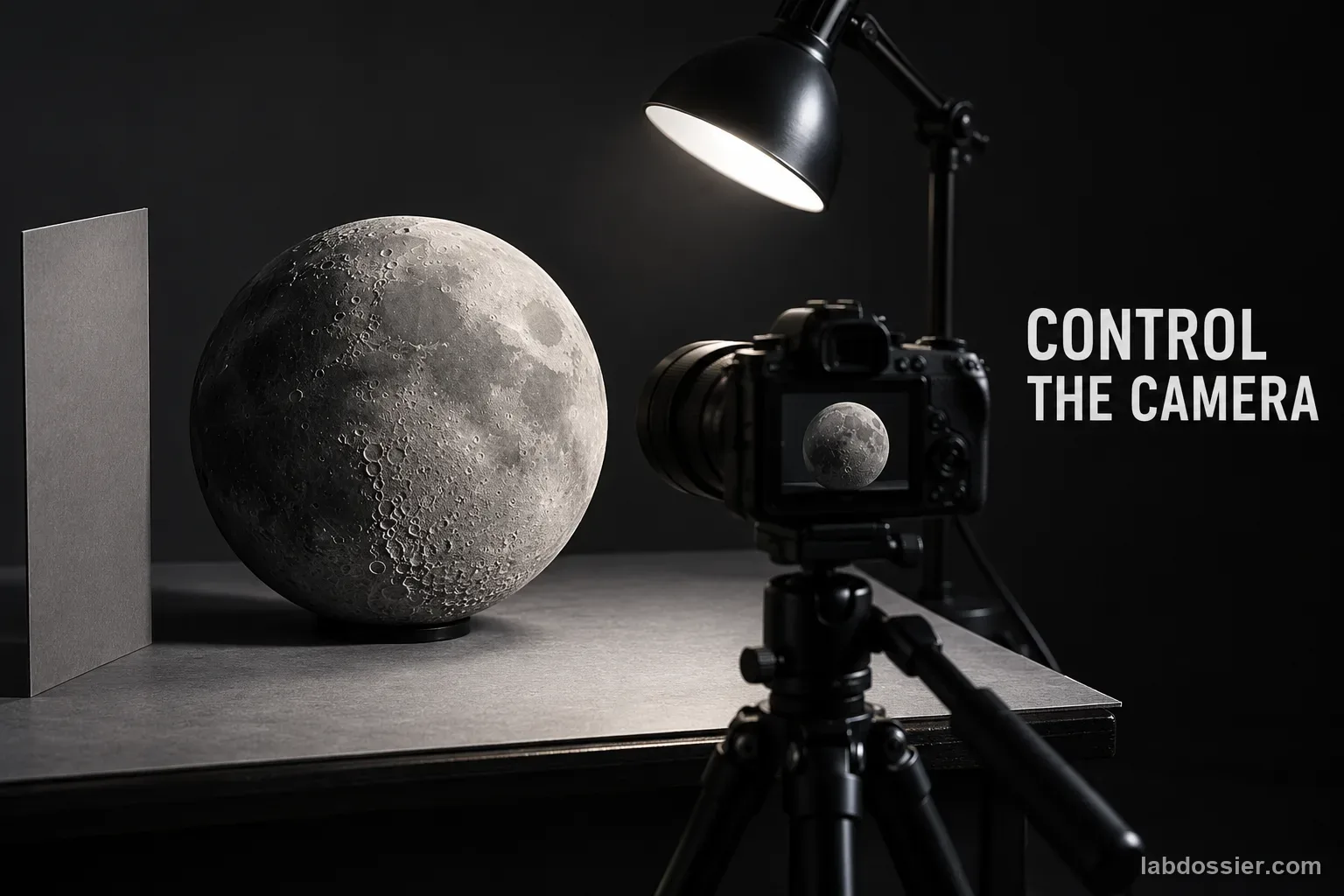
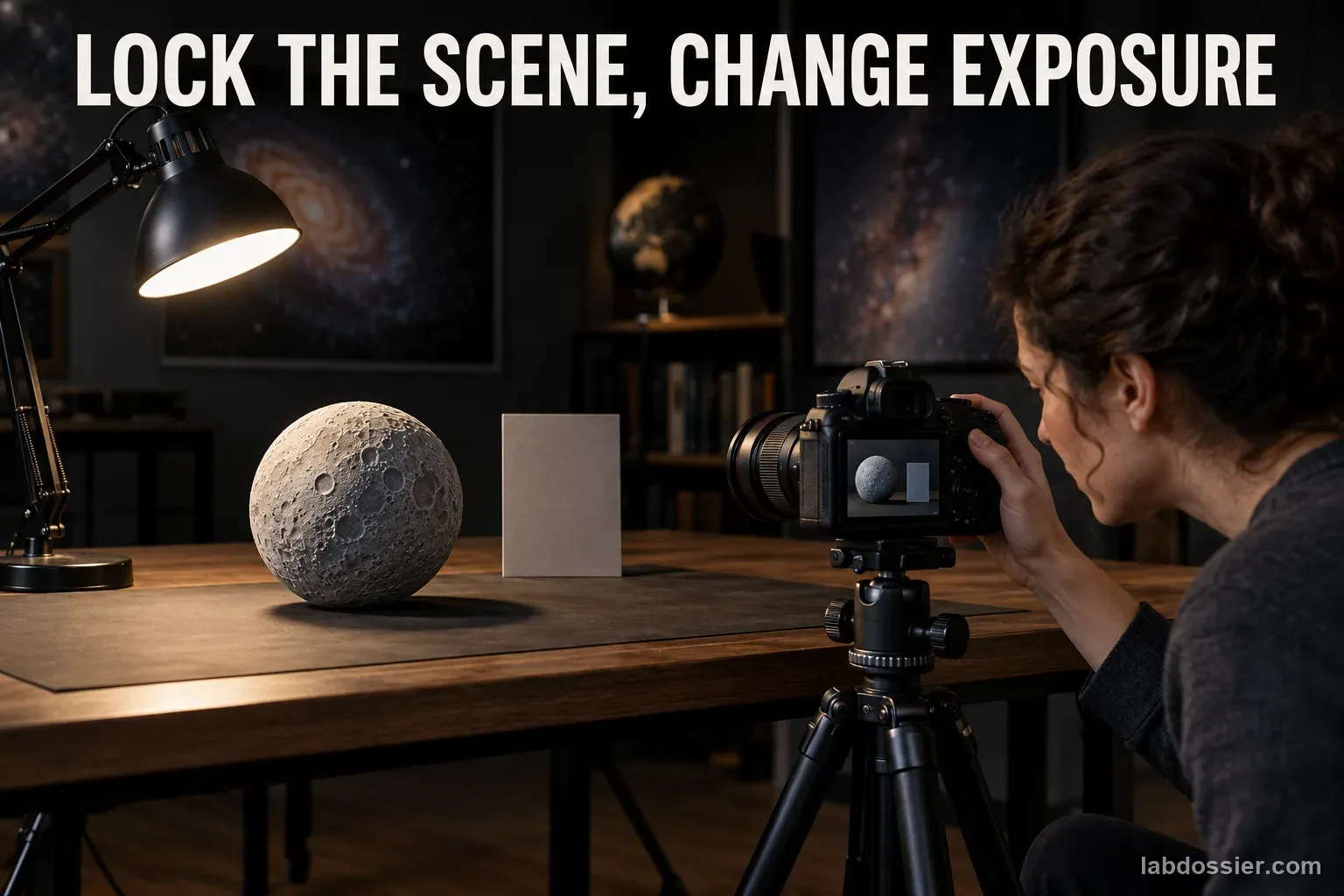
Place a matte gray crater-textured ball or relief beside a neutral gray reference card. Fix a cool desk lamp in one position and mount the camera on a tripod. Darken changing room light; do not use the Sun or a hot lamp. Keep target, card, camera and lamp still for every trial.
2. Lock everything except shutter time
Use a camera's manual mode or a trusted manual camera app. Set one ISO, aperture, focus, white balance and image-processing mode; turn off HDR, night mode, flash and automatic scene changes. Choose three shutter times within the camera's supported range, such as 1/60 s, 1/30 s and 1/15 s only if all three are available. If the camera cannot hold the other settings fixed, use the published-image analysis only and explain why the classroom exposure comparison is not controlled.
3. Take matched repeats
Photograph the same framed scene three times at each shutter time, changing no other setting. Use a mixed order such as short–long–middle, then repeat a different order, so slow lamp or camera drift is less likely to line up with one exposure. Keep the gray card visible and record any warning or automatic adjustment instead of silently accepting the frame.
4. Read the same pixels
With an image tool that reports grayscale values, mark the same small region on the target and card in every image. Record the mean on the chosen 0–255 scale; also note clipping if the tool can report it. Never compare screenshots taken at different display brightness. Keep the individual trial readings before calculating a mean and range for each shutter setting.
5. Separate camera exposure from lunar lighting
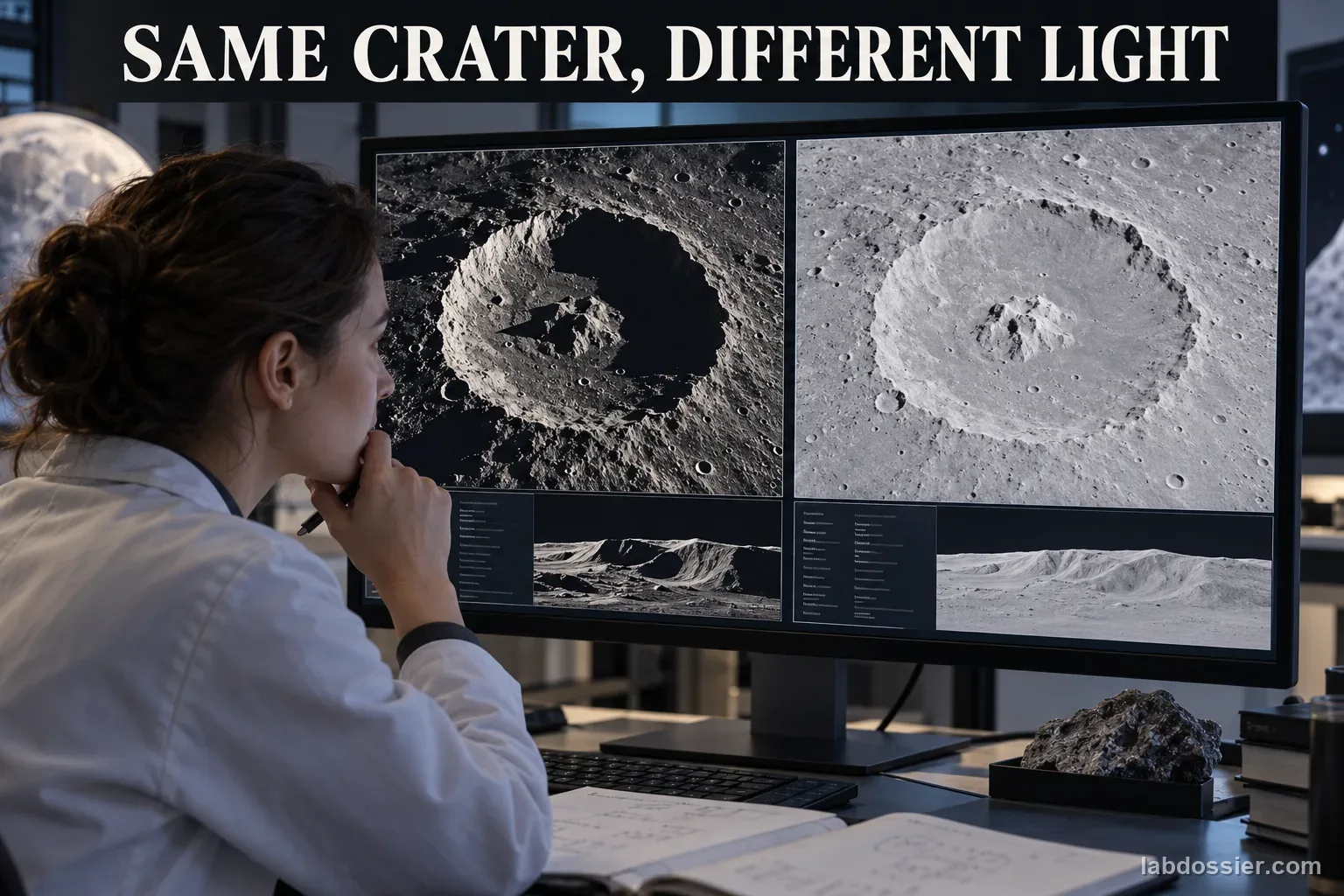
Open NASA's LRO image pair of the same mare crater taken under low-Sun and high-Sun illumination. Mark long shadows, terrain edges and areas where brightness contrast is prominent. NASA explains that low Sun makes roughness stand out, while high Sun makes reflectance variations dominate. The pair changes solar geometry, so it cannot isolate camera exposure by itself.
6. Write a claim with an evidence boundary
Use the tabletop readings to show that a fixed scene can record different pixel values when exposure changes. Use the lunar pair to identify lighting and topography effects. Artemis II's October 2026 public archive adds crew photographs, notes and observations, but a displayed image is not automatically a calibrated reflectance measurement. State what your evidence can distinguish and what it cannot.
Materials // Prepare the bench
- matte gray cratered sphere or low-relief target
- neutral gray reference card
- cool, stable desk lamp
- camera with manual shutter control and tripod
- image viewer that reports grayscale values
05 // Data table
| Trial | Shutter time | Target mean (0–255) | Gray-card mean (0–255) | Clipped pixels or note |
|---|---|---|---|---|
| 1 | short | |||
| 2 | short | |||
| 3 | short | |||
| 1 | middle | |||
| 2 | middle | |||
| 3 | middle | |||
| 1 | long | |||
| 2 | long | |||
| 3 | long |
What could make a lunar region look brighter?
| Possible cause | What changes | Evidence needed |
|---|---|---|
| Camera exposure or processing | Recorded pixel values or display tone | Image metadata, fixed processing and calibrated instrument products |
| Sun angle and shadows | Illumination and visible relief | Matched terrain with solar-incidence and viewing geometry |
| Surface reflectance | Fraction and direction of incoming light returned by the material | Radiometric calibration plus a photometric model and geometry |
| Viewing angle, atmosphere or window effects | Path and angle between surface and sensor | Instrument/view metadata and controls for scattering, glare or reflections |
06 // What to expect
A longer shutter time will usually raise recorded brightness in this fixed scene until some pixels saturate; the actual readings depend on the camera, lamp and target and must be measured.
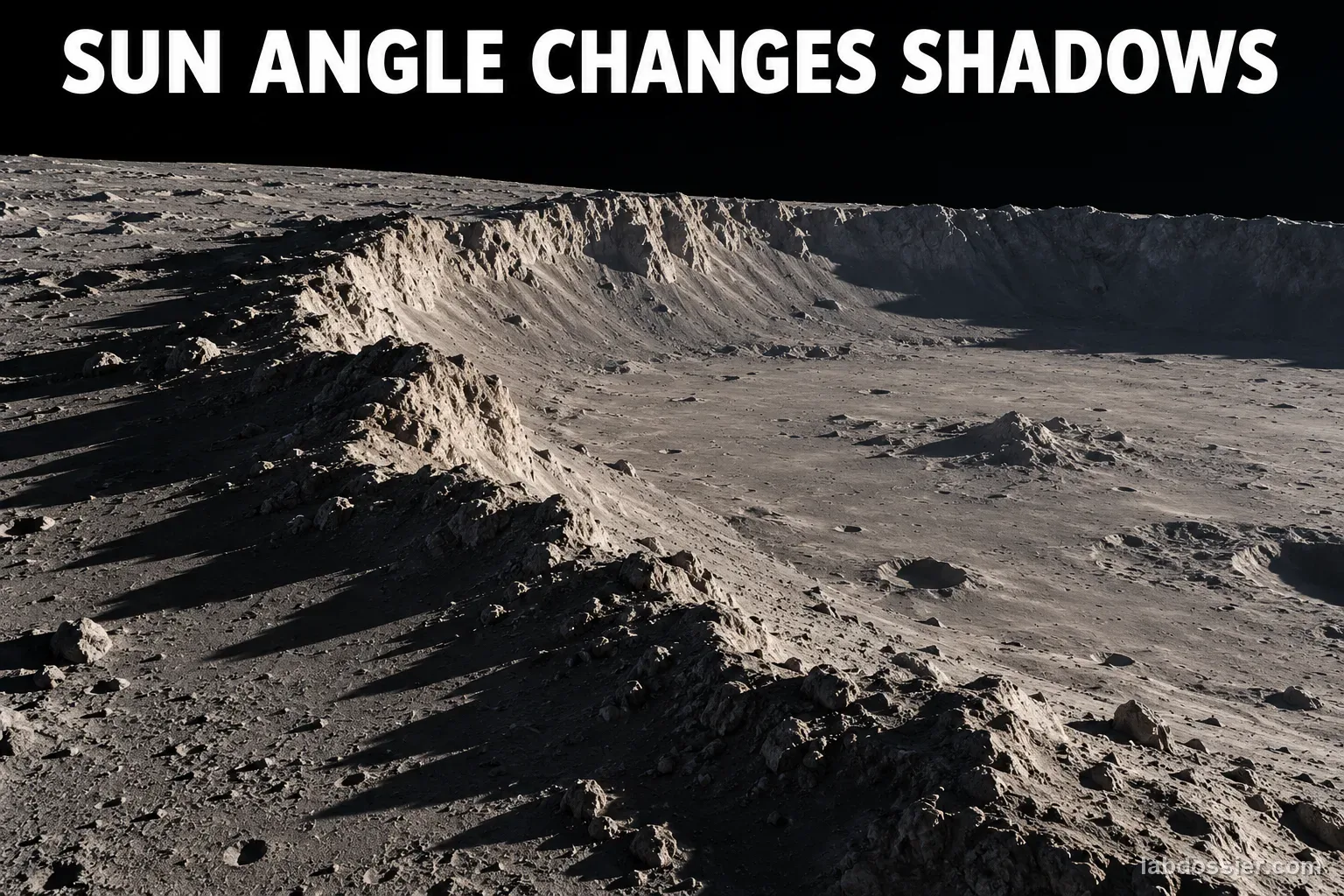
The Moon's low-angle sunlight can make slopes and crater relief appear through long shadows; high Sun can reduce shadow contrast and emphasize reflectance differences.
A raw or processed image's brightness is not, by itself, proof that one lunar material has higher reflectance. Calibrated signal and observation geometry are needed for a defensible comparison.
07 // Lab notes
- The tabletop target is a camera-control demonstration, not a physical replica of lunar regolith, vacuum, sunlight or the Orion imaging system.
- Do not claim that the nine classroom images predict Artemis camera settings or measure lunar albedo. The experiment isolates one camera variable under one room setup.
- NASA's LROC calibrated products correct exposure time and sensor effects and retain observation geometry; that instrument workflow is more complete than reading screen pixels from a photo.
08 // Remember
Image brightness mixes the scene with the instrument and its settings. To infer lunar reflectance, control or correct camera exposure and processing, then account for illumination and viewing geometry with calibrated data.
09 // A recent lunar archive makes image-reading skills timely
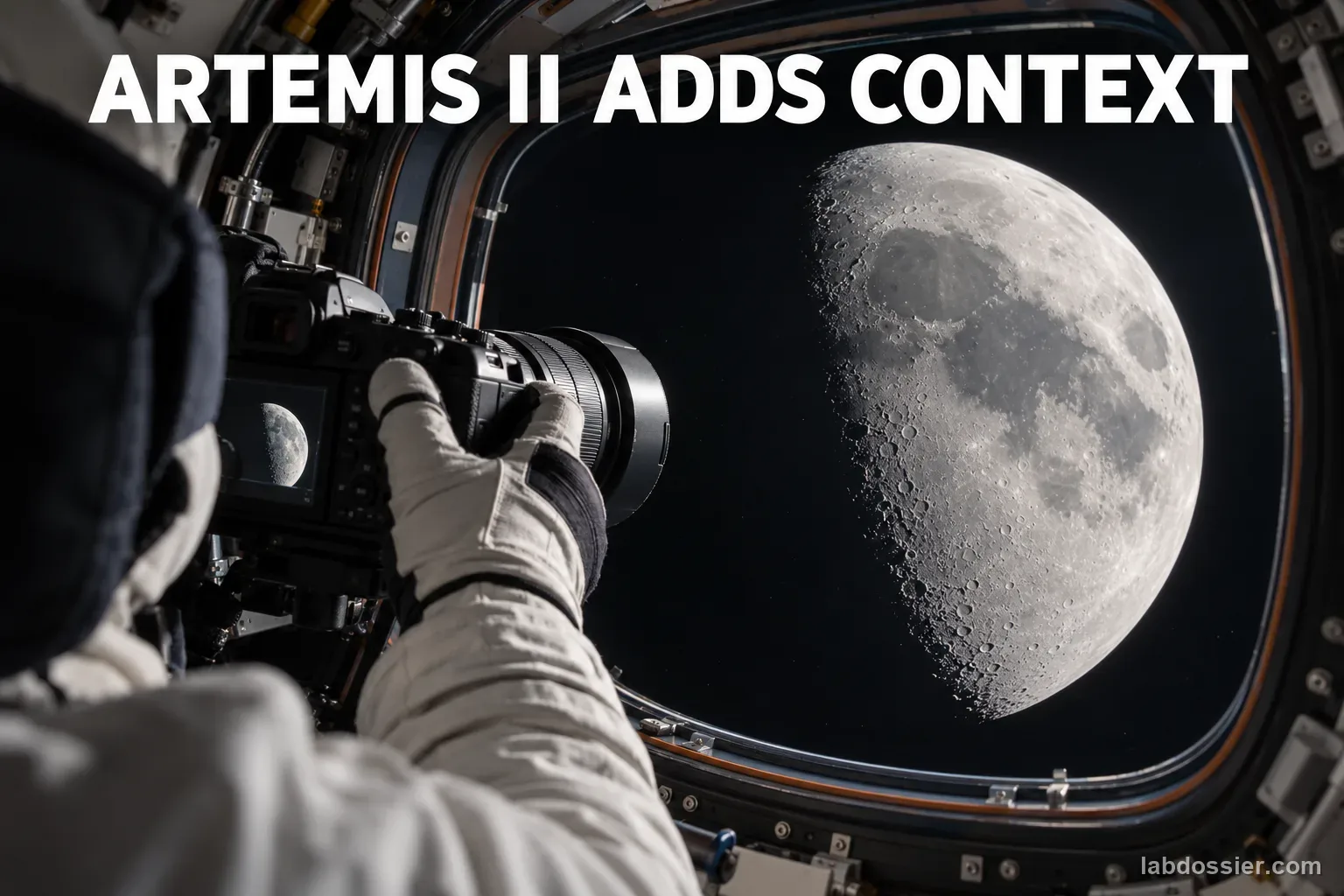
NASA released the Artemis II lunar science archive on October 7, 2026. It includes more than 800 GB of data, over 11,000 full-resolution images and video from crew handheld and Orion cameras, 8.5 hours of crew science audio, and crew-annotated images. The preliminary science report also shows how the crew's observations are connected to LRO location, elevation, roughness and brightness products. These different records add context; they should not be collapsed into one unqualified brightness ranking.
In NASA's preliminary report, astronauts described colors and textures while observing the lunar terminator. The low Sun created long shadows that revealed topography. That is a lighting and geometry effect in the scene, not evidence that the camera's exposure changed or that every bright pixel represents a brighter material.
10 // Three causes can be mixed in one displayed value
A pixel value is the instrument's recorded and processed response. It depends on the incoming light, how the surface reflects light toward the sensor, the viewing and Sun angles, exposure time, sensor response, and later processing. A display can further change apparent brightness. Keep those causes distinct when explaining an image.
NASA's LROC archive documents calibrated products that correct raw signal for exposure time, dark signal, nonlinearity, detector sensitivity and spectral response. Its observation products also preserve surface geometry metadata. This illustrates why scientific reflectance comparisons need more than a screenshot and why a classroom gray card is only a local camera control.
11 // Read the same-location pair as a lighting example
NASA's mare-crater comparison shows the same lunar crater in two LROC frames. With lower Sun, surface roughness stands out; when the Sun is high, reflectance variations dominate the view. The pair is useful precisely because the site is matched, but illumination geometry changes, so it does not isolate camera exposure. Record shadows, terrain and bright/dark patches separately rather than calling every difference an albedo change.
Artemis II crew photographs bring human observations, location context, annotations and a new viewpoint to lunar science. For a numerical surface-property claim, identify the exact archived product and its processing and geometry. If those details are unavailable, describe what is visible without claiming a calibrated reflectance value.
12 // Keep the inference proportional to the evidence
The tabletop test asks a narrow question: can changing shutter time alter recorded grayscale while target, lighting and camera otherwise remain fixed? Repeat each condition and retain raw readings. If the camera silently changes ISO, HDR, tone mapping or white balance, record that limitation or stop the controlled comparison.
The lunar-image exercise asks a different question: which visible changes are consistent with illumination angle, relief or reflectance? It is an interpretation task, not a second exposure experiment. State that the Moon images are not the tabletop target and that ordinary displayed Artemis photographs do not automatically provide radiometric calibration.
13 // Questions people ask
Is brightness the same as reflectance?
No. A camera records a signal influenced by illumination, surface reflectance, geometry, exposure and image processing. Reflectance is a surface property inferred using calibrated observations and a model of lighting and viewing geometry.
Why can the same crater look different at different times?
As the Sun angle changes, slopes receive different illumination and cast different shadows. NASA's LRO comparison shows the same crater under low and high Sun: roughness is more evident with low Sun, while brightness variations stand out more with high Sun.
Does Artemis II's new image archive make every photo calibrated science data?
The October 2026 release includes crew-camera images, video, audio and annotations. The archive is a rich science record, but a web-displayed photo is not automatically a calibrated reflectance product. Check the product documentation and metadata for the image being analyzed.
What if my phone keeps changing ISO or brightness automatically?
Then shutter time is not the only changing camera factor. Use a manual app that can hold settings steady, or switch to the NASA image interpretation and report that the camera experiment could not isolate exposure.
Can the gray card turn the tabletop experiment into lunar calibration?
No. It helps identify camera response in this room scene, but it does not supply lunar instrument calibration, the Moon's illumination geometry, or a lunar surface photometric model.
Can you explain the investigation?
How do Artemis-era lunar observations distinguish surface brightness from camera exposure? · Student Data Sheet
Question: When the Moon looks brighter in a photograph, did the surface reflect more light, did the illumination change, or did the camera record the scene differently?
Hypothesis: If the scene and lighting remain fixed while the manual shutter time changes, then recorded pixel values will generally change even though the target surface and its illumination have not changed, because exposure affects the signal recorded by the camera, while a lunar surface's observed radiance also depends on illumination, viewing geometry, reflectance and instrument calibration.
Materials
- matte gray cratered sphere or low-relief target
- neutral gray reference card
- cool, stable desk lamp
- camera with manual shutter control and tripod
- image viewer that reports grayscale values
Safety before starting
- Use a cool, stable desk lamp with adult supervision. Keep it away from paper and flammable materials; switch it off before adjusting the setup. Never point a camera, telescope, binoculars or other optics at the Sun.
- Secure the camera on a stable tripod or use a phone on a fixed support. Keep cables and equipment off walkways; do not climb or lean over a table to take photographs.
- Do not stare into bright lamps or lasers, and do not use lasers in this activity. Stop if equipment becomes hot, unstable or damaged; use NASA's published images instead if the room setup cannot be made safe.
Lab notes
- The tabletop target is a camera-control demonstration, not a physical replica of lunar regolith, vacuum, sunlight or the Orion imaging system.
- Do not claim that the nine classroom images predict Artemis camera settings or measure lunar albedo. The experiment isolates one camera variable under one room setup.
- NASA's LROC calibrated products correct exposure time and sensor effects and retain observation geometry; that instrument workflow is more complete than reading screen pixels from a photo.
Variables
Independent: Camera exposure time for one unchanged, continuously illuminated target · Dependent: Recorded grayscale value from the same target and reference-card regions
Keep constant: Same crater-textured target, lamp position and output, camera, tripod, distance, framing, focus, ISO, aperture, white balance, processing settings and analysis regions; change shutter time only
Procedure
- Build one steady, safe scene: Place a matte gray crater-textured ball or relief beside a neutral gray reference card. Fix a cool desk lamp in one position and mount the camera on a tripod. Darken changing room light; do not use the Sun or a hot lamp. Keep target, card, camera and lamp still for every trial.
- Lock everything except shutter time: Use a camera's manual mode or a trusted manual camera app. Set one ISO, aperture, focus, white balance and image-processing mode; turn off HDR, night mode, flash and automatic scene changes. Choose three shutter times within the camera's supported range, such as 1/60 s, 1/30 s and 1/15 s only if all three are available. If the camera cannot hold the other settings fixed, use the published-image analysis only and explain why the classroom exposure comparison is not controlled.
- Take matched repeats: Photograph the same framed scene three times at each shutter time, changing no other setting. Use a mixed order such as short–long–middle, then repeat a different order, so slow lamp or camera drift is less likely to line up with one exposure. Keep the gray card visible and record any warning or automatic adjustment instead of silently accepting the frame.
- Read the same pixels: With an image tool that reports grayscale values, mark the same small region on the target and card in every image. Record the mean on the chosen 0–255 scale; also note clipping if the tool can report it. Never compare screenshots taken at different display brightness. Keep the individual trial readings before calculating a mean and range for each shutter setting.
- Separate camera exposure from lunar lighting: Open NASA's LRO image pair of the same mare crater taken under low-Sun and high-Sun illumination. Mark long shadows, terrain edges and areas where brightness contrast is prominent. NASA explains that low Sun makes roughness stand out, while high Sun makes reflectance variations dominate. The pair changes solar geometry, so it cannot isolate camera exposure by itself.
- Write a claim with an evidence boundary: Use the tabletop readings to show that a fixed scene can record different pixel values when exposure changes. Use the lunar pair to identify lighting and topography effects. Artemis II's October 2026 public archive adds crew photographs, notes and observations, but a displayed image is not automatically a calibrated reflectance measurement. State what your evidence can distinguish and what it cannot.
Record your observations
| Trial | Shutter time | Target mean (0–255) | Gray-card mean (0–255) | Clipped pixels or note |
|---|---|---|---|---|
What could make a lunar region look brighter?
| Possible cause | What changes | Evidence needed |
|---|---|---|
Answer key and expected pattern
A longer shutter time will usually raise recorded brightness in this fixed scene until some pixels saturate; the actual readings depend on the camera, lamp and target and must be measured.
The Moon's low-angle sunlight can make slopes and crater relief appear through long shadows; high Sun can reduce shadow contrast and emphasize reflectance differences.
A raw or processed image's brightness is not, by itself, proof that one lunar material has higher reflectance. Calibrated signal and observation geometry are needed for a defensible comparison.
Remember: Image brightness mixes the scene with the instrument and its settings. To infer lunar reflectance, control or correct camera exposure and processing, then account for illumination and viewing geometry with calibrated data.