How often does AI answer a science question correctly—and can source checking help?
01 // Question
For this fixed set of science questions, how do answer accuracy and checkable source support compare when the same model receives no reference passage versus a verified passage?
The result applies only to the selected model, prompts, question set, date and source passage—not to all AI answers or topics.
02 // Variables
Independent
Reference information supplied to the model- No source passage
- A short, verified source passage that contains the required facts
Dependent
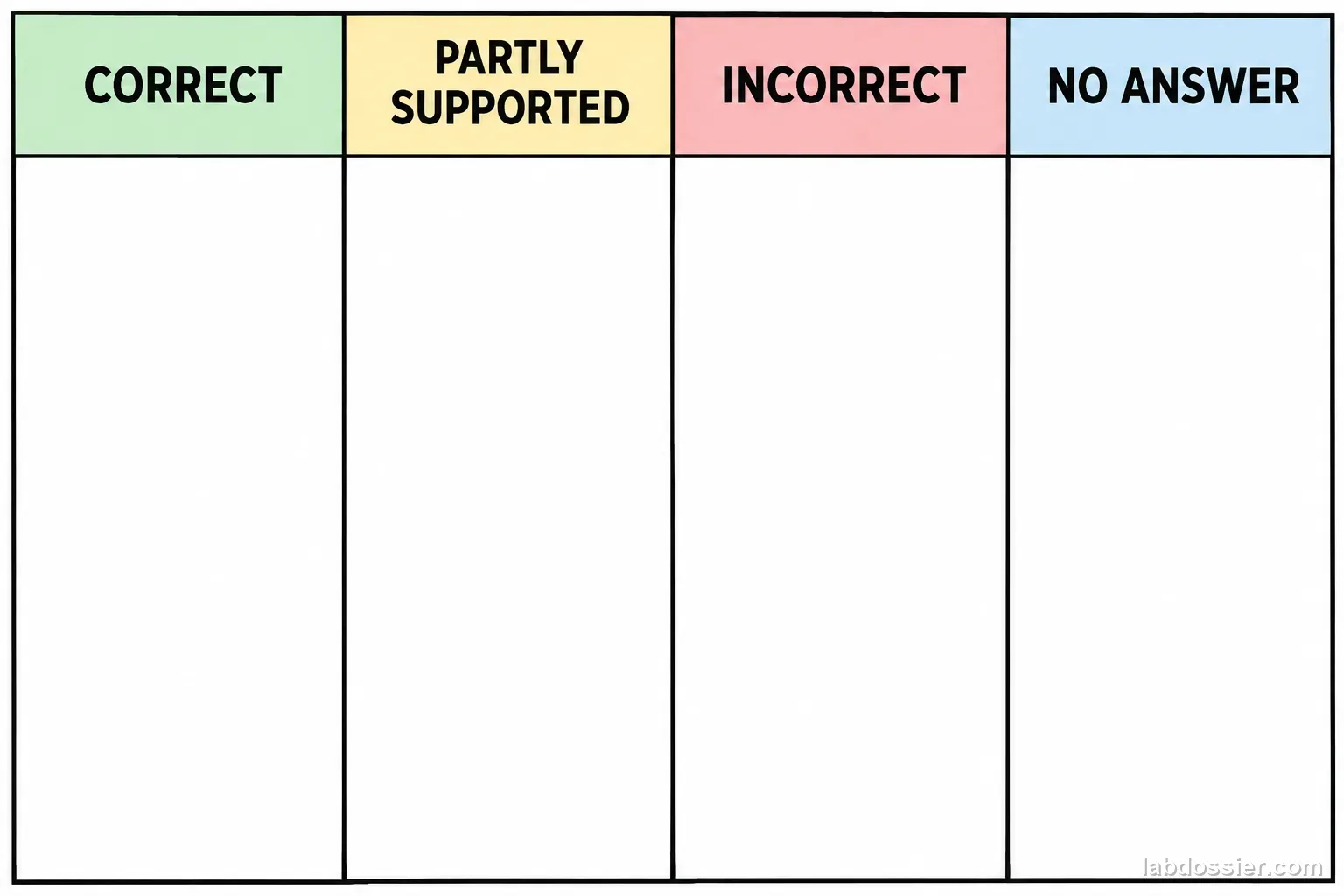
Factual and citation outcomes- Correct, incorrect, partly supported or no answer
- Whether a cited statement is present in the supplied passage
- Reported uncertainty, recorded but not treated as proof
03 // Hypothesis
IF the same model answers questions with a passage that actually contains the needed information, THEN its answers may be more directly checkable against that passage, BECAUSE the passage supplies evidence the scorer can trace, though it does not guarantee the generated answer will be correct or fully supported.
04 // Procedure
1. Choose a small, safe science topic
With a teacher, select one short public science passage from NASA, NOAA, USGS or another suitable primary science source. Use questions whose answers are explicit in the passage. Avoid health, legal, safety, personal or disputed questions.
2. Write and freeze the answer key
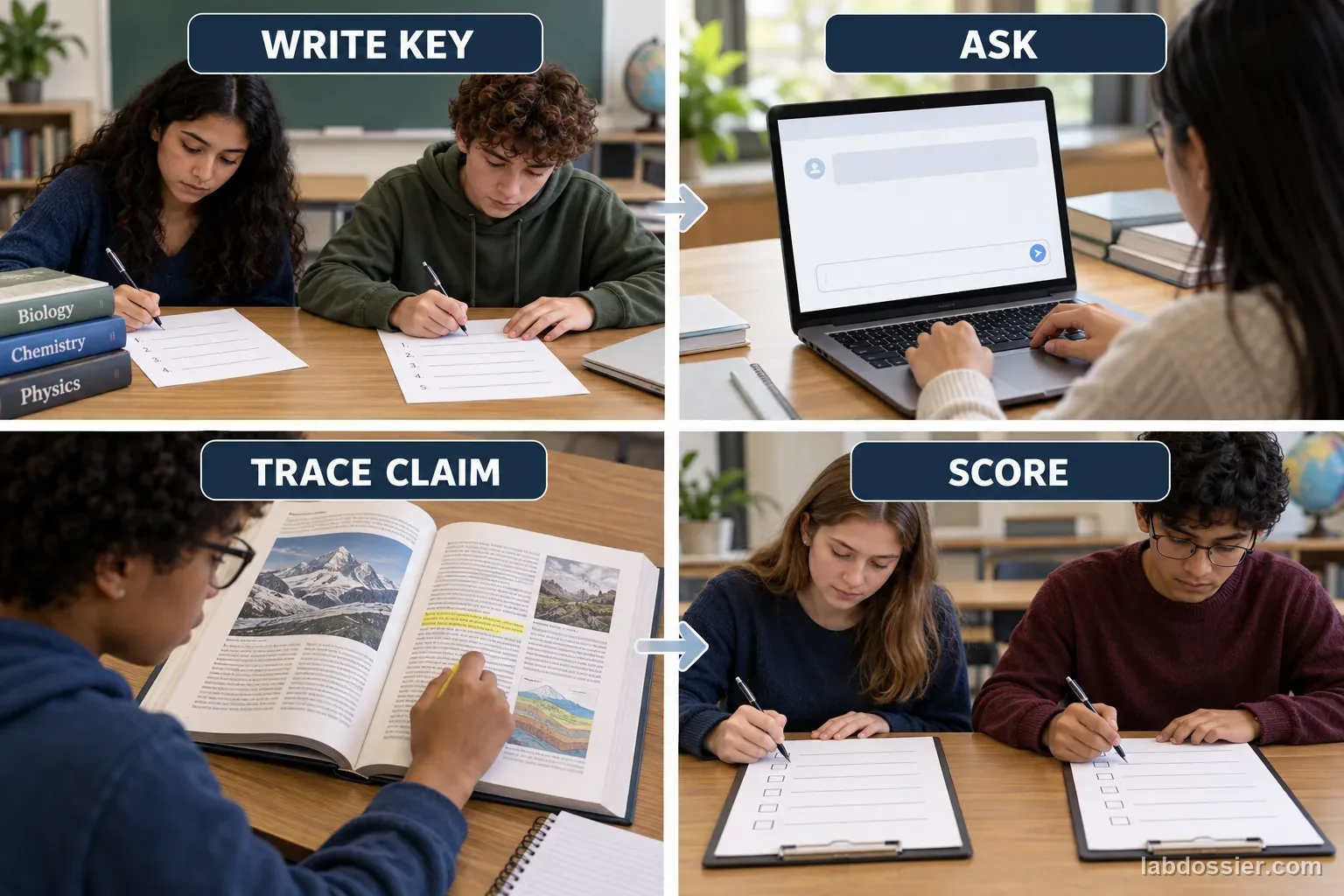
Create 12 short, independently answerable questions and write each expected answer with its supporting sentence or page location. Two people verify the key against the source before testing. Do not change the key after seeing model responses; log any genuine ambiguity.
3. Record the model and exact prompt
A teacher selects an approved tool and records its name, visible version, date, and whether web search is off. Use one fixed prompt asking for a concise answer, a source line if supplied, and ‘not sure’ when evidence is insufficient. Do not request personal information or high-stakes advice.
4. Run two isolated conditions
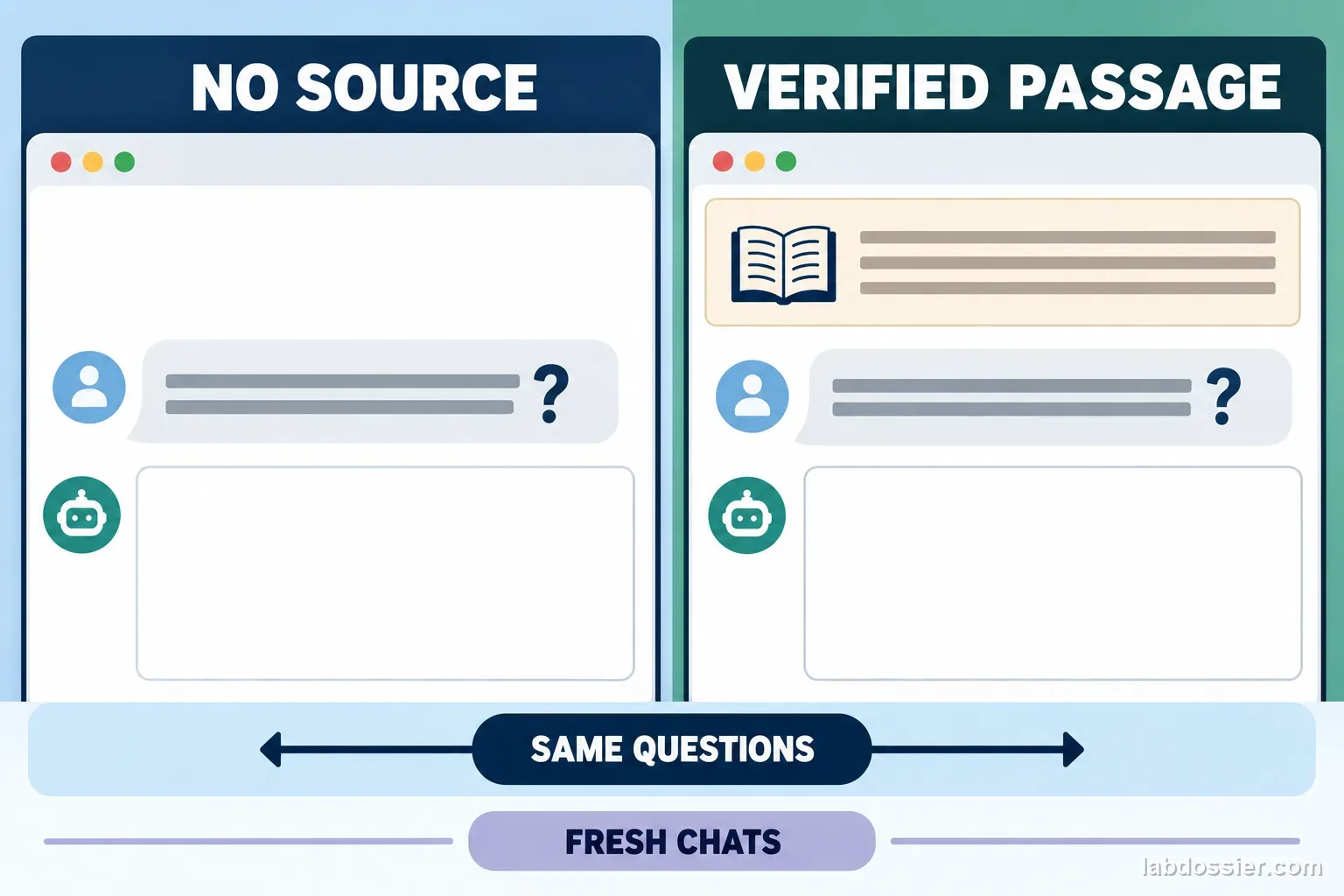
Use a fresh chat for each condition. In Condition A, ask the 12 questions without the passage. In Condition B, paste the same verified passage and ask the identical questions in a new chat. Randomize question order or prepare matched orders in advance; do not let the first chat carry over into the second.
5. Score the facts and the citations separately
Two scorers compare each answer with the frozen key and passage. Mark correct, incorrect, partly supported or no answer; settle disagreements by reopening the original source. Separately mark whether the answer's source line is actually present and supports the claim. A cited URL or confident tone alone does not count as evidence.
6. Report counts before percentages
For each condition, show the raw number in every category out of 12. Calculate the correct-answer percentage using 12 as the denominator, while also displaying no-answer counts. Compare paired question IDs, include scorer disagreements and describe this as one bounded classroom sample.
Materials // Prepare the bench
- teacher-approved AI tool with browsing settings visible
- one short, public primary science passage
- 12 source-answerable science questions
- two independently prepared answer keys or scorers
- blank response and scoring tables
- computer and notebook
05 // Data table
| Question ID | Key checked? | No-source response / score | Passage response / score | Citation support | Scorer note |
|---|---|---|---|---|---|
| Q01 | yes / recheck | supported / absent / unclear | |||
| Q02 | yes / recheck | supported / absent / unclear | |||
| Q03 | yes / recheck | supported / absent / unclear | |||
| Q04 | yes / recheck | supported / absent / unclear | |||
| Q05 | yes / recheck | supported / absent / unclear | |||
| Q06 | yes / recheck | supported / absent / unclear | |||
| Q07 | yes / recheck | supported / absent / unclear | |||
| Q08 | yes / recheck | supported / absent / unclear | |||
| Q09 | yes / recheck | supported / absent / unclear | |||
| Q10 | yes / recheck | supported / absent / unclear | |||
| Q11 | yes / recheck | supported / absent / unclear | |||
| Q12 | yes / recheck | supported / absent / unclear |
Report the two conditions using raw counts
| Outcome (out of 12) | No passage | Verified passage |
|---|---|---|
| Correct | ||
| Partly supported | ||
| Incorrect | ||
| No answer / uncertainty | ||
| Source line supports the claim | not applicable / count |
Check each source claim instead of trusting citation style
| Check | Pass | Needs follow-up |
|---|---|---|
| The cited page opens and is from the named source | ||
| The exact statement appears in the source | ||
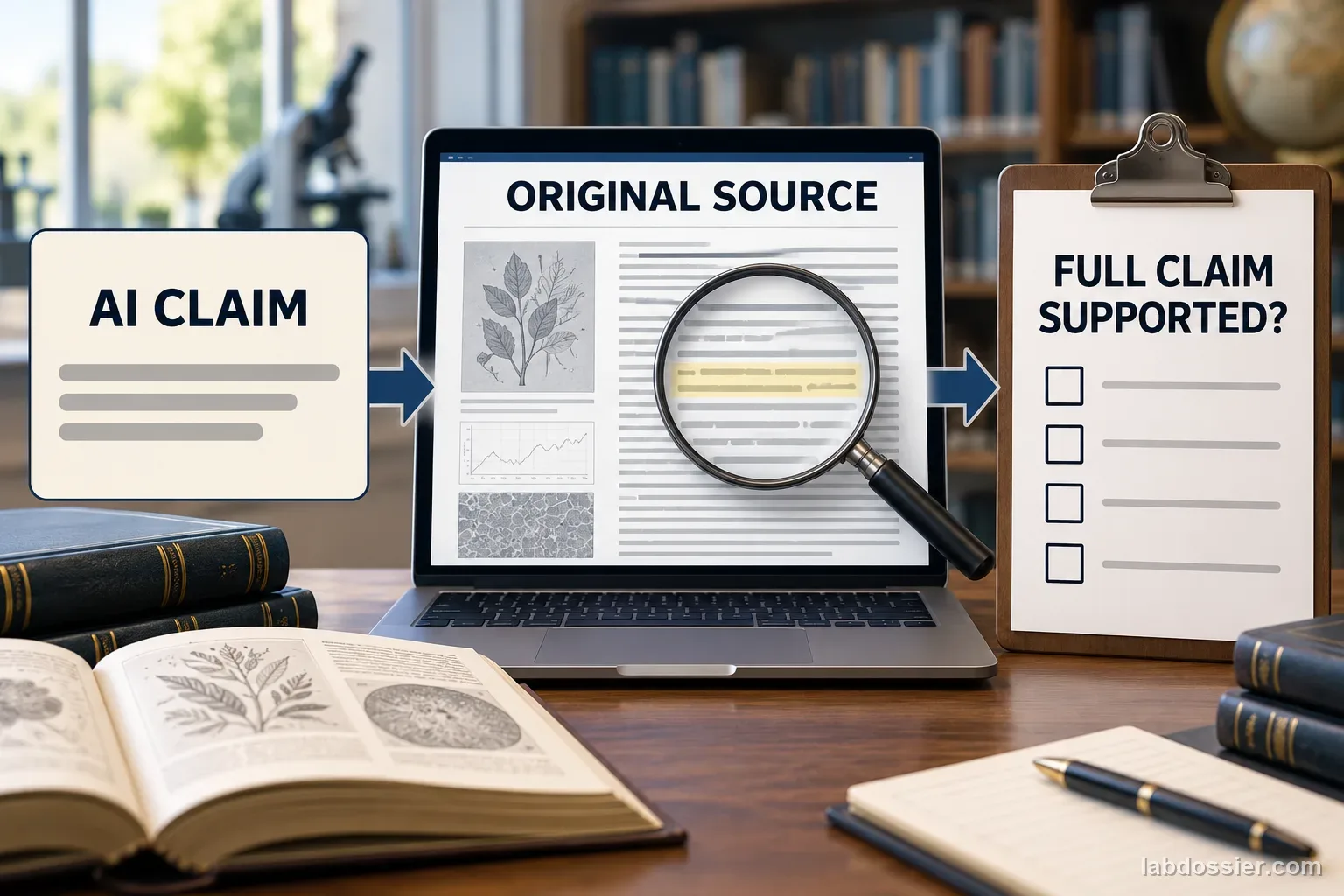
| The passage supports the whole claim, not just a nearby word | ||
| The answer uses the source's conditions and units accurately |
Formula Correct-answer rate = correct answers ÷ 12 × 100% (also report the raw count and no-answer count)
06 // What to expect
A verified passage can make a claim easier to check; it does not make every model answer true.
Report factual correctness separately from whether a citation is real and relevant.
A 12-question classroom sample is descriptive, not a model leaderboard or proof of general reliability.
07 // Lab notes
- Do not publish students' prompts, names, accounts or responses without school approval. Keep the answer key and source passage accessible for review.
08 // Remember
Check the claim in its original source. A citation-shaped answer is not verified until the source supports the claim.
09 // Choose a small, safe science topic
Select one age-appropriate public source from a scientific agency, university research group or other primary science provider. Keep the passage short enough that the model can receive the same text in the source-supported condition. Pick 12 narrow questions with answers stated in that passage; avoid questions that depend on changing news, opinion, medical guidance or a long chain of inference.
Before any model run, two people independently write the expected answers and note the exact supporting paragraph, figure or page. Resolve ambiguous wording now, not after seeing the outputs. This frozen key prevents graders from quietly changing what counts as correct to favor one condition.
10 // Run two isolated conditions
Record the tool, visible model/version, date, selected settings and whether web browsing is disabled. Use one fixed prompt requesting a concise answer, a supporting source line when supplied, and an explicit ‘not sure’ when evidence is insufficient. Do not ask the model to reveal hidden reasoning or private training data.
Open two separate fresh chats. Ask the same 12 questions without a passage in one chat; in the other, first provide the verified excerpt and then ask the identical questions. Randomize or pre-plan the question order so fatigue or copying cannot favor one condition. Do not show feedback between runs. Keep the full raw responses, including refusals and citation text.
11 // Score the facts and the citations separately
Two scorers independently compare each response with the frozen key and the source. Use four categories: correct; partly supported because a condition or detail is missing; incorrect; or no answer. Resolve disagreements by returning to the original source and record the reason. A real-looking URL does not make a claim correct, and a correct fact without a citation is not a verified citation.
For each condition, separately count whether each cited line or source actually exists and supports the full claim. Distinguish factual correctness from source traceability: an answer may be correct without a supplied citation, or cite a real page that does not support its statement. Preserve question IDs so the two conditions can be compared in pairs.
12 // Report counts before percentages
Each condition contains 12 questions. Show the number correct, partly supported, incorrect and unanswered before calculating the correct-answer rate. Use 12 as the denominator and report the raw fraction beside the percentage; keep unanswered responses visible rather than treating a refusal as a correct answer or silently dropping it.
A small classroom sample does not establish a general hallucination rate, compare all AI models or prove that a provided source will improve performance. Published benchmarks use different question pools, domains, models, scoring rules and dates. Describe the specific sample and any scorer disagreement; repeat with a new independently written question set before making a broader claim.
13 // Questions people ask
Does including a source make an AI answer correct?
No. The model can misread, omit or overstate the passage. Compare each full claim with the original text.
Why use a fresh chat for each condition?
A fresh chat reduces the chance that a prior answer or correction changes the next condition. The model can still vary, so report the tool, date and actual prompt.
What does ‘partly supported’ mean?
The source supports part of the response, but another detail, condition or conclusion is missing or unsupported. Keep it separate from fully correct.
Can the model's confidence label tell us if it is correct?
Not by itself. Confidence language is another response to record, not an independent measurement of truth.
Can 12 questions establish a general hallucination rate?
No. It is a small, topic-specific classroom sample. Larger published evaluations use different questions, scoring, models and conditions.
Can you explain the investigation?
How often does AI answer a science question correctly—and can source checking help? · Student Data Sheet
Question: For this fixed set of science questions, how do answer accuracy and checkable source support compare when the same model receives no reference passage versus a verified passage?
Hypothesis: If the same model answers questions with a passage that actually contains the needed information, then its answers may be more directly checkable against that passage, because the passage supplies evidence the scorer can trace, though it does not guarantee the generated answer will be correct or fully supported.
Materials
- teacher-approved AI tool with browsing settings visible
- one short, public primary science passage
- 12 source-answerable science questions
- two independently prepared answer keys or scorers
- blank response and scoring tables
- computer and notebook
Safety before starting
- Use public or teacher-created sources and non-private questions. Do not include student records, personal health details, passwords, or confidential work in an AI prompt.
- A plausible answer or citation is not automatically true. Open the cited source and verify each claim; do not use this exercise to make health, legal, financial, or safety decisions.
Lab notes
- Do not publish students' prompts, names, accounts or responses without school approval. Keep the answer key and source passage accessible for review.
Variables
Independent: Reference information supplied to the model · Dependent: Factual and citation outcomes
Keep constant: same AI model/version/date · same 12 question wordings · same answer format and prompt · fresh separate chats · same scoring rules · answer key completed before model testing
Procedure
- Choose a small, safe science topic: With a teacher, select one short public science passage from NASA, NOAA, USGS or another suitable primary science source. Use questions whose answers are explicit in the passage. Avoid health, legal, safety, personal or disputed questions.
- Write and freeze the answer key: Create 12 short, independently answerable questions and write each expected answer with its supporting sentence or page location. Two people verify the key against the source before testing. Do not change the key after seeing model responses; log any genuine ambiguity.
- Record the model and exact prompt: A teacher selects an approved tool and records its name, visible version, date, and whether web search is off. Use one fixed prompt asking for a concise answer, a source line if supplied, and ‘not sure’ when evidence is insufficient. Do not request personal information or high-stakes advice.
- Run two isolated conditions: Use a fresh chat for each condition. In Condition A, ask the 12 questions without the passage. In Condition B, paste the same verified passage and ask the identical questions in a new chat. Randomize question order or prepare matched orders in advance; do not let the first chat carry over into the second.
- Score the facts and the citations separately: Two scorers compare each answer with the frozen key and passage. Mark correct, incorrect, partly supported or no answer; settle disagreements by reopening the original source. Separately mark whether the answer's source line is actually present and supports the claim. A cited URL or confident tone alone does not count as evidence.
- Report counts before percentages: For each condition, show the raw number in every category out of 12. Calculate the correct-answer percentage using 12 as the denominator, while also displaying no-answer counts. Compare paired question IDs, include scorer disagreements and describe this as one bounded classroom sample.
Record your observations
| Question ID | Key checked? | No-source response / score | Passage response / score | Citation support | Scorer note |
|---|---|---|---|---|---|
Report the two conditions using raw counts
| Outcome (out of 12) | No passage | Verified passage |
|---|---|---|
Check each source claim instead of trusting citation style
| Check | Pass | Needs follow-up |
|---|---|---|
Formula: Correct-answer rate = correct answers ÷ 12 × 100% (also report the raw count and no-answer count)
Answer key and expected pattern
A verified passage can make a claim easier to check; it does not make every model answer true.
Report factual correctness separately from whether a citation is real and relevant.
A 12-question classroom sample is descriptive, not a model leaderboard or proof of general reliability.
Remember: Check the claim in its original source. A citation-shaped answer is not verified until the source supports the claim.