How can a small spacecraft change an asteroid's path through momentum transfer?
01 // Question
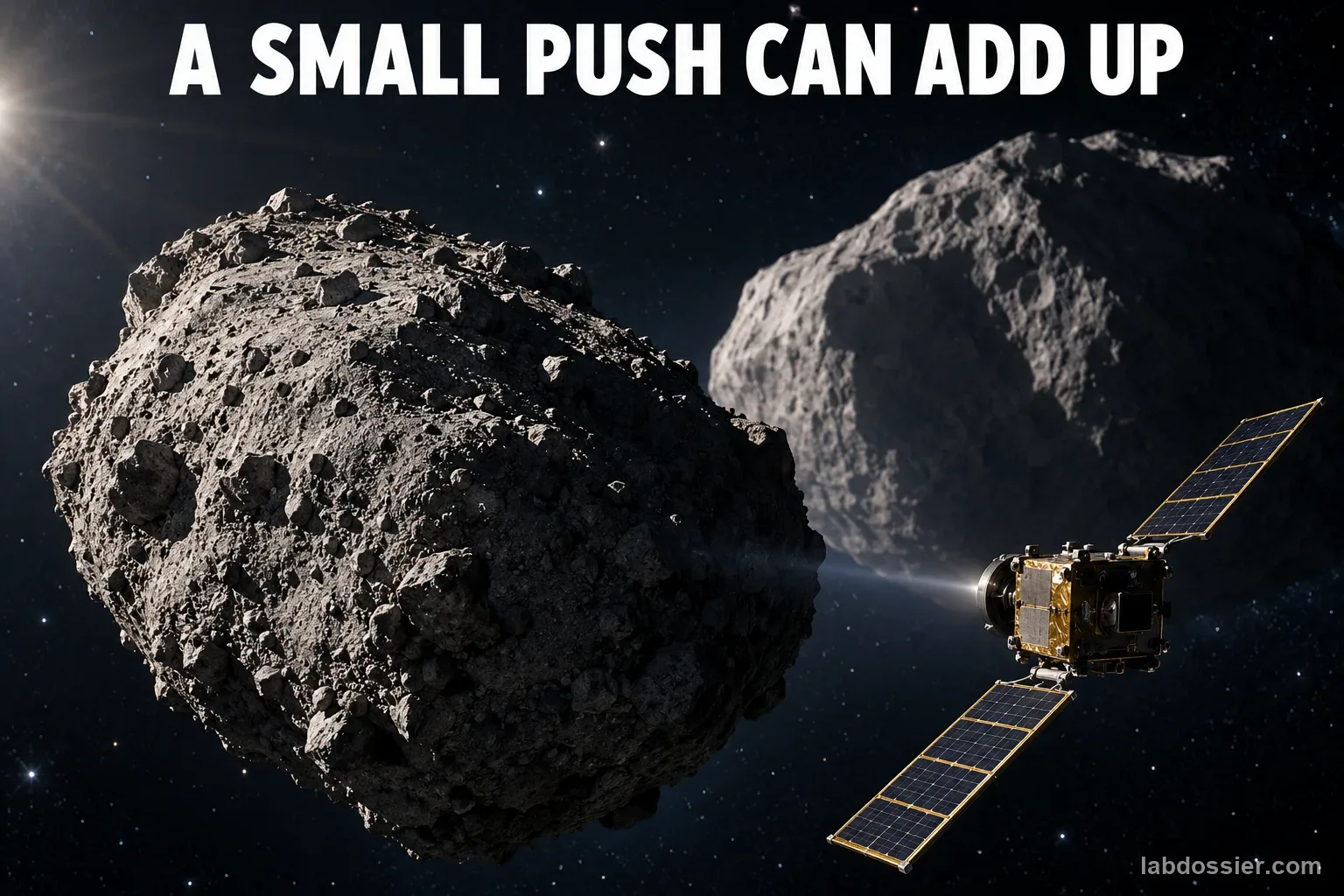
How does a controlled change in impactor speed affect the momentum transferred to a stationary target, and what extra effect did asteroid ejecta add during DART?
The carts demonstrate one-dimensional momentum transfer at low speed. They do not reproduce hypervelocity impact, asteroid material, ejecta, orbital mechanics or planetary-defense predictions.
02 // Variables
Independent
Measured speed of the same impactor cart immediately before contact- low-speed release setting
- middle release setting
- higher teacher-approved release setting
Dependent
Change in target-cart momentum after the collision- target speed after contact
- target momentum change using its measured mass
- combined cart momentum before and after, with direction signs
03 // Hypothesis
IF the same impactor cart reaches the stationary target at a greater measured speed, THEN the target's momentum change may increase, BECAUSE the moving cart carries momentum p = mv into the collision, although track friction and bumper behavior affect the measured transfer.
04 // Procedure
1. Set up a short, contained cart track
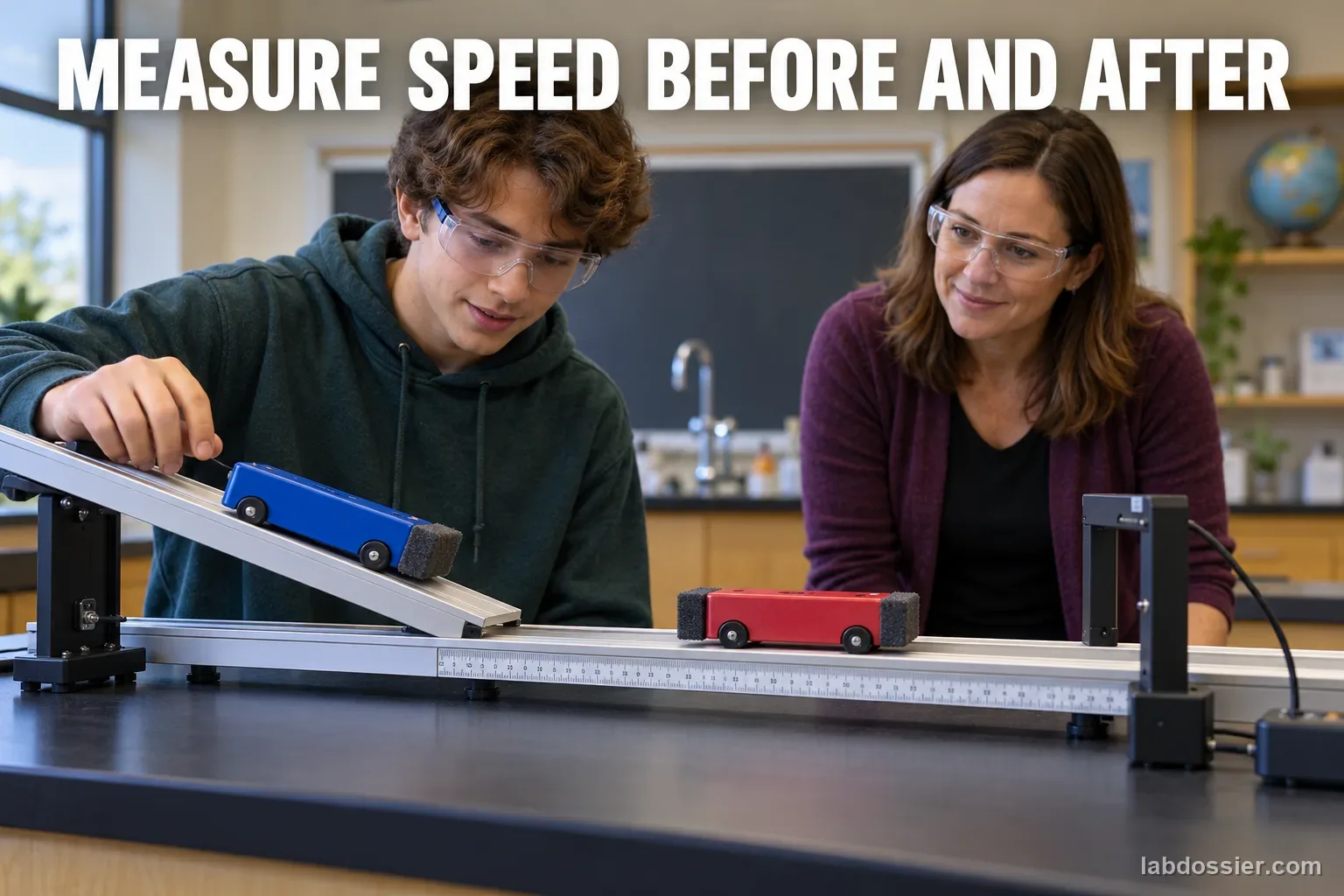
Use two lightweight dynamics carts on a level low-friction track with soft bumpers. Keep the target cart at a marked starting position. Place a teacher-approved catch box or stopper at the end and use no heavy add-on masses. Check that the track is stable and carts cannot fall to the floor.
2. Measure cart masses and choose safe speeds
Measure and record both cart masses, including attached bumpers. Select three low-speed release settings that keep every cart on the track; the teacher should check the range before trials. Use a photogate or fixed-camera video to measure the impactor's speed just before contact and the target's speed just after contact. Release without pushing the cart.
3. Run matched head-on collisions
For each speed setting, reset the target to the same mark and release the impactor from its matching start. Keep the hit centered and straight. Record the measured approach speed, both carts' post-collision speeds and directions, and any visible off-center contact. Repeat five times per setting; stop if a cart leaves the track or the track shifts.
4. Calculate momentum with direction
Choose the impactor's starting direction as positive. Calculate p = mv for each cart before and after contact, giving the stationary target an initial velocity of zero. Compute target momentum change and compare the combined cart momentum before and after. Small differences can come from measurement error, rolling friction, track alignment and bumper deformation; do not force conservation by changing raw values.
5. Compare with the DART evidence
NASA reports that DART struck Dimorphos at about 6.14 km/s. The impact shortened Dimorphos' orbit around Didymos by about 33 minutes; a 2026 NASA-reported study also found the binary pair's roughly 770-day orbit around the Sun shortened by 0.15 seconds. The new study estimates a momentum-enhancement factor of about two because escaping debris carried momentum away and gave the asteroid system additional recoil. These are different orbital measurements; neither is a cart-speed result.
6. Explain what Hera will measure
ESA's Hera mission is en route to Didymos after a February/March 2026 maneuver and plans to survey the post-impact binary system later in 2026. Its close-up measurements can help constrain Dimorphos' mass, shape, impact crater and the physical outcome needed to interpret DART. Until those observations, some target properties and impact details remain uncertain.
Materials // Prepare the bench
- two lightweight dynamics carts with soft bumpers
- short level track with a low, secured release ramp
- teacher-approved catch box or stopper
- balance for cart and bumper masses
- photogate or fixed-camera video with scale marks
- meterstick, timer, calculator and data sheet
05 // Data table
| Speed setting | Trial | Impact speed (m/s) | Target speed after (m/s) | Impactor speed after (m/s) | Target Δp (kg·m/s) | Alignment / notes |
|---|---|---|---|---|---|---|
| Low | 1 | |||||
| Low | 2 | |||||
| Low | 3 | |||||
| Low | 4 | |||||
| Low | 5 | |||||
| Middle | 1 | |||||
| Middle | 2 | |||||
| Middle | 3 | |||||
| Middle | 4 | |||||
| Middle | 5 | |||||
| Higher (approved) | 1 | |||||
| Higher (approved) | 2 | |||||
| Higher (approved) | 3 | |||||
| Higher (approved) | 4 | |||||
| Higher (approved) | 5 |
Keep the cart result separate from asteroid evidence
| Evidence | What it measures | What it does not establish |
|---|---|---|
| Classroom cart collision | Low-speed target momentum change on a track | Hypervelocity impact, ejecta, asteroid orbit or deflection success |
| DART mutual orbit measurement | Change in Dimorphos' orbit around Didymos | The Didymos pair's solar orbit by itself |
| DART 2026 solar-orbit study | A 0.15-second change in the pair's roughly 770-day solar period; ejecta-enhanced momentum | A future hazardous asteroid's exact response |
| Hera close survey | Post-impact mass, shape, crater and system properties | A universal momentum multiplier for every asteroid |
06 // What to expect
Within the cart setup, greater measured approach speed may correspond to a larger target momentum change, but repeated raw trials reveal the actual variation.
Combined cart momentum should be approximately consistent before and after contact within measurement and external-force limits; rolling friction and off-center hits can shift the estimate.
DART changed a real binary asteroid orbit, and ejecta recoil increased the transferred momentum. Its result depends on target properties and cannot be scaled directly from classroom carts.
07 // Lab notes
- NASA's March 2026 report distinguishes the roughly 33-minute change in Dimorphos' orbit around Didymos from the 0.15-second change in the binary system's roughly 770-day orbit around the Sun.
- The 2026 momentum-enhancement estimate near two is tied to that new solar-orbit analysis. Do not substitute it for every earlier beta estimate, impact geometry or asteroid material.
- Didymos and Dimorphos were not on an impact course with Earth. DART was a technology demonstration; it did not demonstrate a rapid response to a newly discovered threat.
08 // Remember
A spacecraft transfers its own momentum in a collision; material thrown off the asteroid can add recoil in the opposite direction. Measure cart momentum in the track system, and use DART orbit observations plus Hera's physical survey to evaluate asteroid-scale deflection.
09 // Momentum depends on mass, speed and direction
Momentum is p = mv, so a moving spacecraft carries momentum before contact. During a short collision, that momentum can change the target's motion. In a classroom track, measuring both carts before and after contact gives a bounded way to examine this transfer without simulating dangerous impact speeds.
A collision does not create momentum for the two-cart system. Small differences in measured totals are expected because the track is not perfectly isolated, the speed sensors have uncertainty, and bumpers flex. Record signed directions and raw values before comparing totals.
10 // Measure what the cart system gains
The activity changes only the impactor's measured approach speed across three teacher-approved settings. It keeps both cart masses and the target's starting position fixed, and repeats five trials at each speed. Use a photogate or frame-by-frame video near contact; ramp height alone is not the impact speed because friction and release details can vary.
Calculate the target momentum change from its measured mass and speed after contact. Also calculate the moving cart's momentum before and after, using a sign for direction. The result tests direct low-speed momentum transfer and not a scale model of an asteroid.
11 // Ejecta can add to an asteroid's push
DART did more than transfer spacecraft momentum directly. Impact displaced asteroid material that streamed away; because the ejecta carried momentum, its recoil added to the target's change in motion. NASA's March 2026 account reports that this momentum enhancement was about two for the analysis of the binary pair's orbit around the Sun.
That factor belongs to a specific high-speed impact and a specific observed orbital component. It is not the result of the cart experiment and should not be applied unchanged to every asteroid. The surface material and impact geometry control how much mass leaves, in what directions and at what speeds.

12 // Orbit measurements reveal the response
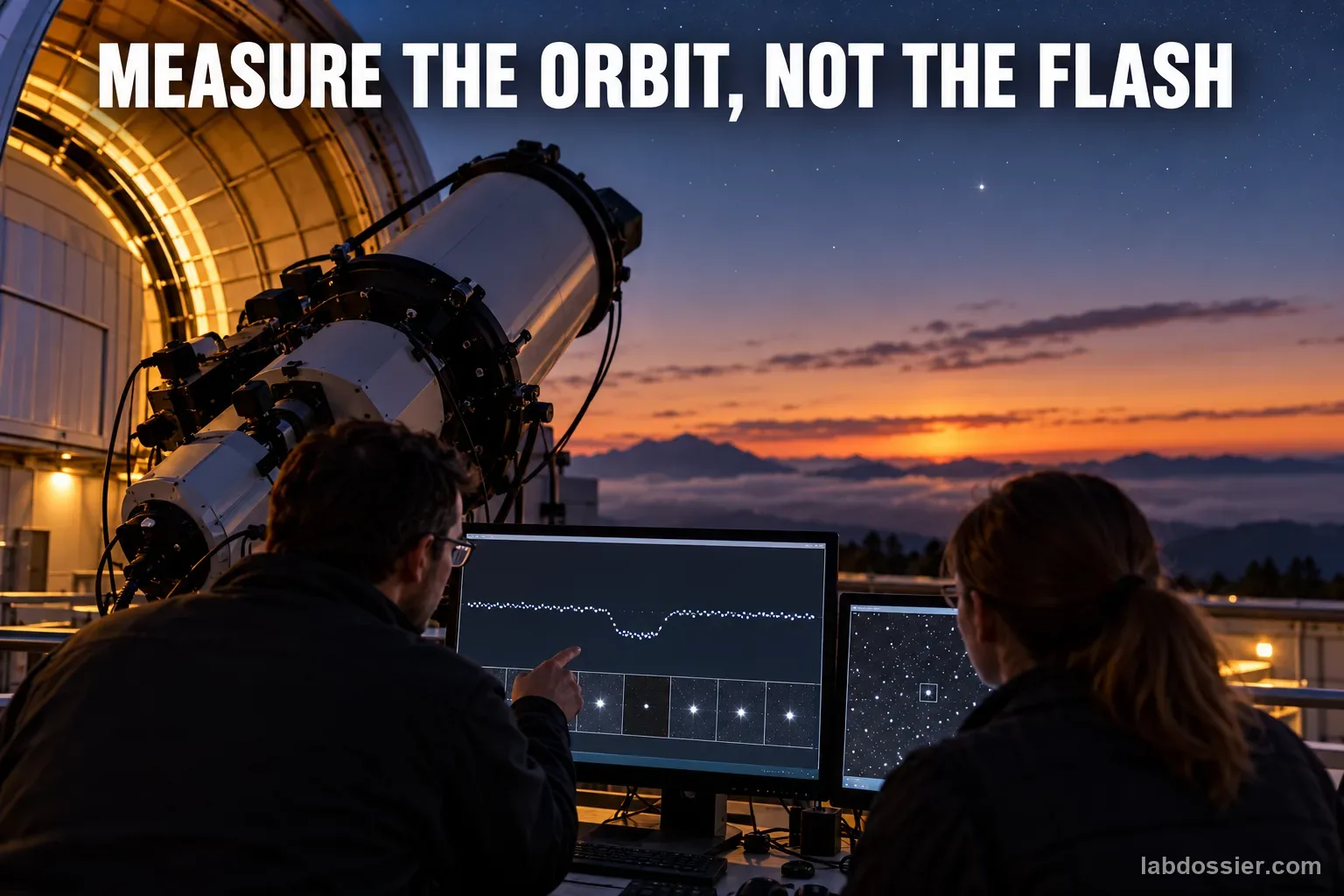
DART's effect was measured through orbital observations rather than by timing the brief collision alone. NASA reports an approximately 33-minute shortening of Dimorphos' orbit around Didymos. A separate 2026 analysis found a 0.15-second change to the binary system's roughly 770-day orbit around the Sun. These are two different orbital periods and two different measured effects.
The 2026 study combined observations of the pair's motion, including stellar occultations, where the system briefly blocks a background star. Timing many events across several years helps reveal a tiny change that cannot be seen directly as an immediate sideways jump in one photograph.
13 // Hera checks the impact site
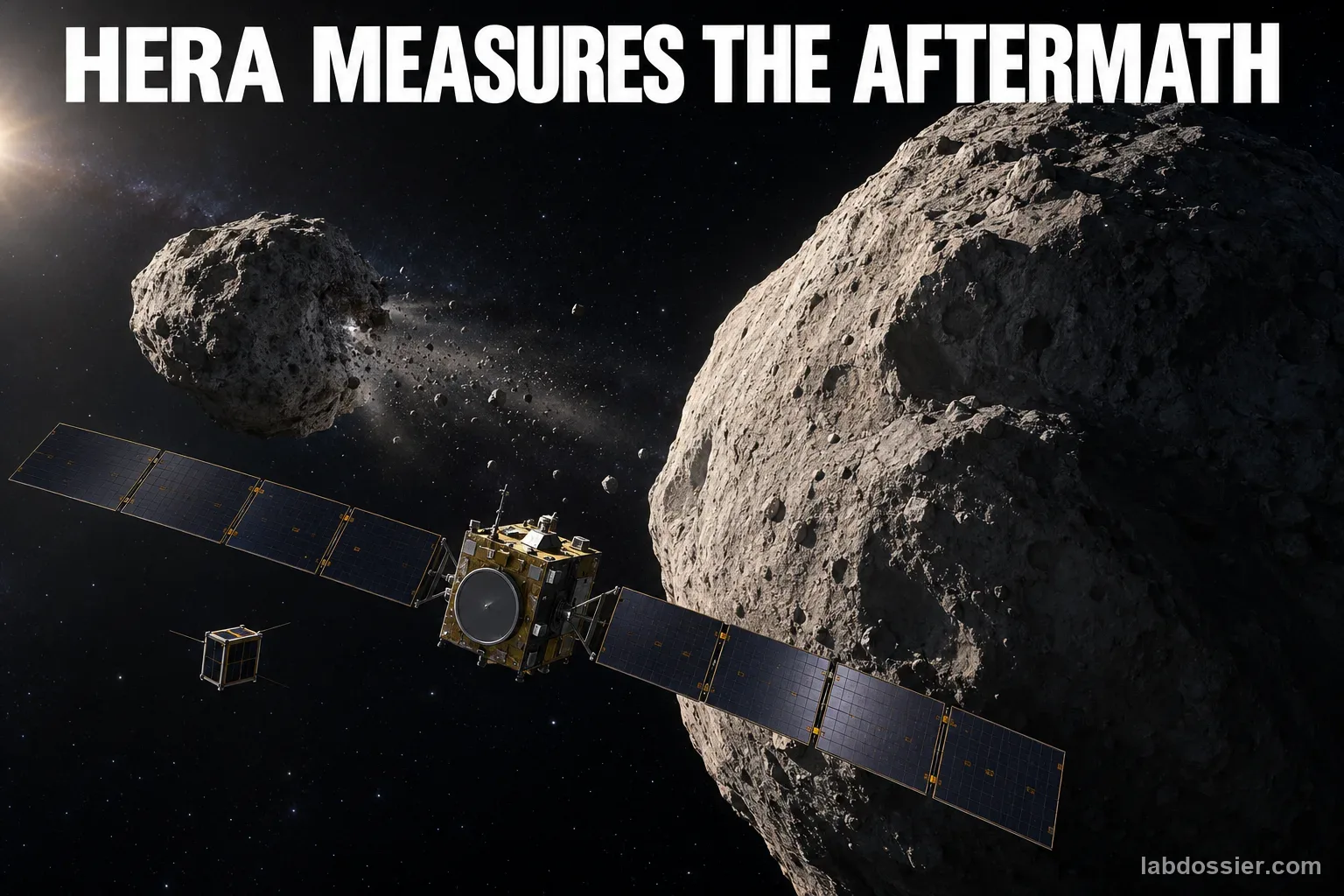
ESA's Hera mission is following DART to the Didymos system. In its March 2026 status report, ESA described a completed deep-space maneuver that aligned the spacecraft for rendezvous later that year and software preparation for close-proximity operations. Hera's instruments and CubeSats will investigate the asteroid pair and impact outcome, helping constrain mass, shape and crater details.
DART was a successful technology demonstration on a target not headed toward Earth. Planetary defense also requires finding hazardous objects early, estimating their orbits and physical properties, selecting an intervention, and verifying the result. The classroom carts illuminate only the direct momentum part of that longer chain.
14 // Questions people ask
How can debris increase momentum transfer?
When ejecta leaves the asteroid, it carries momentum away. The recoil pushes the asteroid in the opposite direction, adding to the spacecraft's direct impact contribution. The amount depends on the impact and target material.
Did DART change Dimorphos' orbit or the whole pair's orbit around the Sun?
Both effects have been measured. Earlier work found the orbit of Dimorphos around Didymos shortened by about 33 minutes. A NASA-reported 2026 study found the binary pair's roughly 770-day orbit around the Sun changed by 0.15 seconds.
Does a faster cart always produce a proportionally larger asteroid deflection?
The cart model only tests a low-speed collision with fixed masses and a track. Asteroid response also depends on mass, shape, porosity, impact direction, surface material, ejecta and orbital geometry, so a direct scale conversion is not justified.
What is Hera adding after DART?
Hera is designed to make a close survey of Didymos and Dimorphos, measuring physical properties and the impact outcome so scientists can better interpret the deflection experiment.
Could DART have pushed Didymos toward Earth?
NASA states that Didymos was not on an Earth-impact trajectory and the DART mission could not put it on one. The mission tested impact physics on a safe target system.
Can you explain the investigation?
How can a small spacecraft change an asteroid's path through momentum transfer? · Student Data Sheet
Question: How does a controlled change in impactor speed affect the momentum transferred to a stationary target, and what extra effect did asteroid ejecta add during DART?
Hypothesis: If the same impactor cart reaches the stationary target at a greater measured speed, then the target's momentum change may increase, because the moving cart carries momentum p = mv into the collision, although track friction and bumper behavior affect the measured transfer.
Materials
- two lightweight dynamics carts with soft bumpers
- short level track with a low, secured release ramp
- teacher-approved catch box or stopper
- balance for cart and bumper masses
- photogate or fixed-camera video with scale marks
- meterstick, timer, calculator and data sheet
Safety before starting
- Use only lightweight dynamics carts and a teacher-approved low release ramp. Secure the track, fit soft bumpers, and place a catch box or stopper before the track edge.
- Do not add heavy masses, launch objects by hand, use projectiles or increase the ramp height beyond the teacher-approved range. Keep hands and faces clear of moving carts; stop if a cart leaves the track or the setup shifts.
- Use a balance, photogate or fixed camera only as instructed. Keep cables out of walkways and retrieve carts only after all motion stops.
Lab notes
- NASA's March 2026 report distinguishes the roughly 33-minute change in Dimorphos' orbit around Didymos from the 0.15-second change in the binary system's roughly 770-day orbit around the Sun.
- The 2026 momentum-enhancement estimate near two is tied to that new solar-orbit analysis. Do not substitute it for every earlier beta estimate, impact geometry or asteroid material.
- Didymos and Dimorphos were not on an impact course with Earth. DART was a technology demonstration; it did not demonstrate a rapid response to a newly discovered threat.
Variables
Independent: Measured speed of the same impactor cart immediately before contact · Dependent: Change in target-cart momentum after the collision
Keep constant: Use the same two carts and measured masses, straight track, starting target position, soft bumper, head-on alignment, photogate/video method, release procedure and surface; run five trials at each safe speed setting and catch carts before the track edge
Procedure
- Set up a short, contained cart track: Use two lightweight dynamics carts on a level low-friction track with soft bumpers. Keep the target cart at a marked starting position. Place a teacher-approved catch box or stopper at the end and use no heavy add-on masses. Check that the track is stable and carts cannot fall to the floor.
- Measure cart masses and choose safe speeds: Measure and record both cart masses, including attached bumpers. Select three low-speed release settings that keep every cart on the track; the teacher should check the range before trials. Use a photogate or fixed-camera video to measure the impactor's speed just before contact and the target's speed just after contact. Release without pushing the cart.
- Run matched head-on collisions: For each speed setting, reset the target to the same mark and release the impactor from its matching start. Keep the hit centered and straight. Record the measured approach speed, both carts' post-collision speeds and directions, and any visible off-center contact. Repeat five times per setting; stop if a cart leaves the track or the track shifts.
- Calculate momentum with direction: Choose the impactor's starting direction as positive. Calculate p = mv for each cart before and after contact, giving the stationary target an initial velocity of zero. Compute target momentum change and compare the combined cart momentum before and after. Small differences can come from measurement error, rolling friction, track alignment and bumper deformation; do not force conservation by changing raw values.
- Compare with the DART evidence: NASA reports that DART struck Dimorphos at about 6.14 km/s. The impact shortened Dimorphos' orbit around Didymos by about 33 minutes; a 2026 NASA-reported study also found the binary pair's roughly 770-day orbit around the Sun shortened by 0.15 seconds. The new study estimates a momentum-enhancement factor of about two because escaping debris carried momentum away and gave the asteroid system additional recoil. These are different orbital measurements; neither is a cart-speed result.
- Explain what Hera will measure: ESA's Hera mission is en route to Didymos after a February/March 2026 maneuver and plans to survey the post-impact binary system later in 2026. Its close-up measurements can help constrain Dimorphos' mass, shape, impact crater and the physical outcome needed to interpret DART. Until those observations, some target properties and impact details remain uncertain.
Record your observations
| Speed setting | Trial | Impact speed (m/s) | Target speed after (m/s) | Impactor speed after (m/s) | Target Δp (kg·m/s) | Alignment / notes |
|---|---|---|---|---|---|---|
Keep the cart result separate from asteroid evidence
| Evidence | What it measures | What it does not establish |
|---|---|---|
Answer key and expected pattern
Within the cart setup, greater measured approach speed may correspond to a larger target momentum change, but repeated raw trials reveal the actual variation.
Combined cart momentum should be approximately consistent before and after contact within measurement and external-force limits; rolling friction and off-center hits can shift the estimate.
DART changed a real binary asteroid orbit, and ejecta recoil increased the transferred momentum. Its result depends on target properties and cannot be scaled directly from classroom carts.
Remember: A spacecraft transfers its own momentum in a collision; material thrown off the asteroid can add recoil in the opposite direction. Measure cart momentum in the track system, and use DART orbit observations plus Hera's physical survey to evaluate asteroid-scale deflection.