How can airflow move lunar-like ejecta, and where does a tabletop model stop matching the Moon?
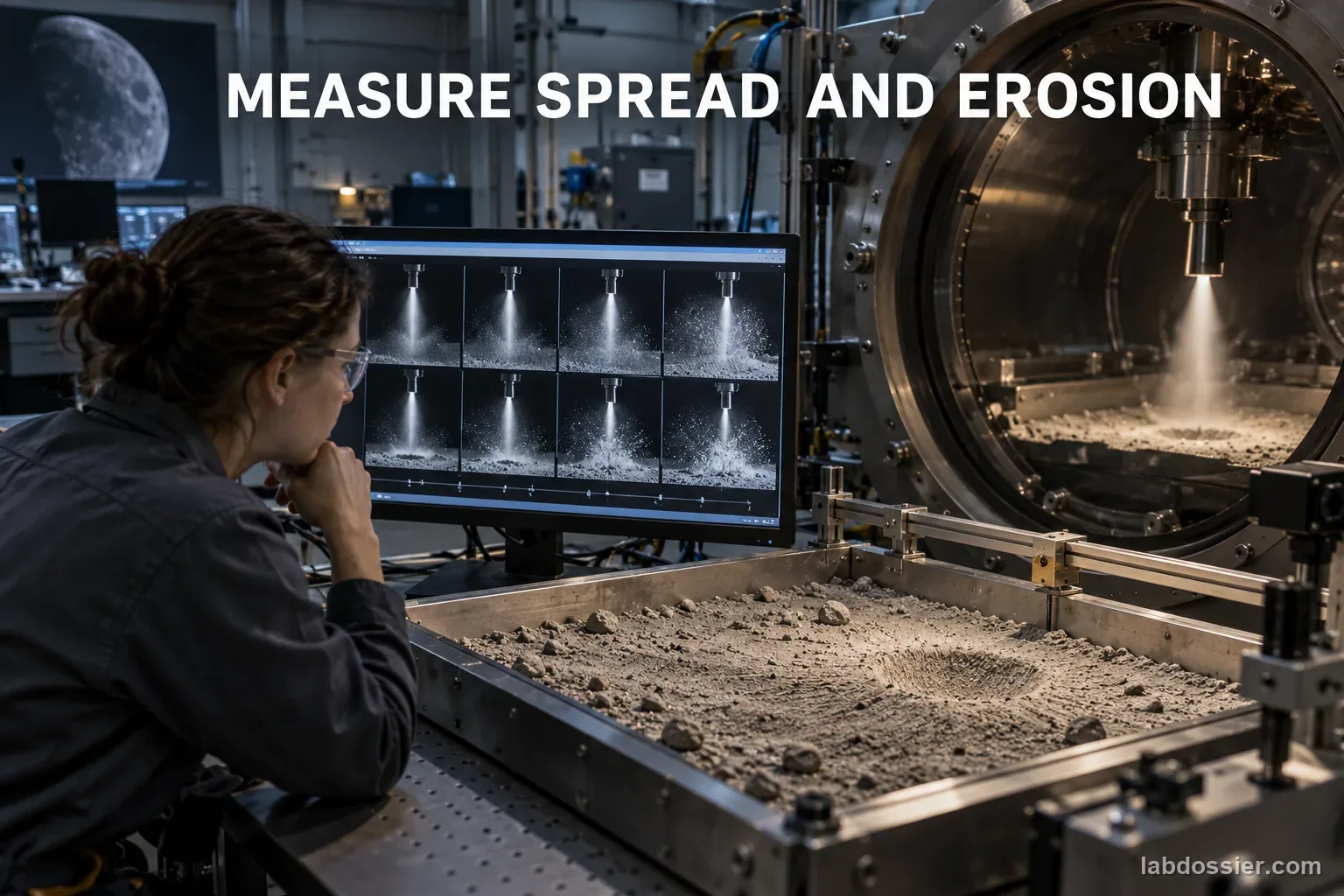
01 // Question
What can a safe airflow model reveal about loose surface material near a descending lander, and what important lunar-plume physics does it leave out?
This model uses room air and large paper pieces. It demonstrates only that directed flow can move surface material; it does not reproduce rocket exhaust, lunar vacuum, real regolith, ejecta speed or landing risk.
02 // Variables
Independent
Height of one blunt air nozzle above a fixed target surface- 2 cm
- 4 cm
- 6 cm
Dependent
Movement of large visible paper markers after one controlled air stroke- Number of markers that cross a 5 cm radius
- Farthest marker distance from the nozzle center
- Any marker that leaves the contained tray or does not move
03 // Hypothesis
IF nozzle height changes while the same contained air stroke and surface are used, THEN the number and distance of moved paper markers may change because the airflow spreads and weakens differently before it reaches the surface, BECAUSE flow direction and distance affect how much momentum reaches the markers, although this room-air setup is not a scaled rocket plume.
04 // Procedure
1. Set up a no-dust model in a tray
Use a clear plastic bin with a textured paper or cloth floor. Cut 20 large paper squares about 1 cm across and place them in the same marked target area; do not use flour, sand, powder, ash or fine particulate. Mark a 5 cm circle around the target center. Put the bin on a stable desk and keep the lid or guard in place if it still allows safe viewing.
2. Standardize one gentle air stroke
Use a blunt plastic syringe with no needle, or an adult-approved hand bulb. Keep the nozzle vertical at the center. Mark two syringe positions and move the plunger between them over one second; use the same stroke for every trial. Never point the airflow at a person. If a one-second stroke cannot be repeated, switch to a published-data-only comparison and say why.
3. Run randomized nozzle heights
Test nozzle heights of 2, 4 and 6 cm, measured from the surface to the nozzle tip. Randomize the height order. For each height, reset the same 20 paper squares to the starting pattern and perform five strokes. After each stroke, count squares beyond the 5 cm circle and measure the farthest square from the center. A zero movement result is valid data.
4. Separate repeatability from model realism
Calculate the mean and range of marker counts for each height, but preserve all five raw trials. If one stroke moved more pieces because it was faster or off-center, mark it and repeat only under a predeclared classroom rule. Do not convert the paper motion into lunar particle speed, plume pressure, crater size or damage radius.
5. Compare with actual NASA testing
NASA's 2026 plume-surface campaign uses instrumented tests in a 60-foot spherical vacuum chamber with a tray of simulated lunar regolith. Its first ethane plume system heats but does not burn and produces about 100 pounds of thrust; tests record crater formation and ejecta distribution, angle, height and particle speed. A NASA SCALPSS camera demonstration also imaged a real Blue Ghost lunar landing. These engineering tests, not the classroom tray, examine the mission-relevant physics.
6. Name what the airflow model cannot reproduce
The classroom stroke travels through Earth's atmosphere; lunar tests use vacuum conditions, real or validated regolith simulant, engine-specific exhaust, low lunar gravity, fine angular grains, electrostatic and gas-particle effects, and high-speed instruments. The paper pieces are much larger and lighter than dust grains. This setup is a qualitative flow analogy, not a scale model or a landing-safety test.
Materials // Prepare the bench
- clear lidded plastic tray
- 20 large paper squares about 1 cm across
- textured paper or cloth tray liner
- blunt plastic syringe with no needle or an adult-approved hand bulb
- ruler, marker, timer and data sheet
05 // Data table
| Nozzle height | Trial | Markers beyond 5 cm | Farthest marker (cm) | Stroke centered? | Observation |
|---|---|---|---|---|---|
| 2 cm | 1 | ||||
| 2 cm | 2 | ||||
| 2 cm | 3 | ||||
| 2 cm | 4 | ||||
| 2 cm | 5 | ||||
| 4 cm | 1 | ||||
| 4 cm | 2 | ||||
| 4 cm | 3 | ||||
| 4 cm | 4 | ||||
| 4 cm | 5 | ||||
| 6 cm | 1 | ||||
| 6 cm | 2 | ||||
| 6 cm | 3 | ||||
| 6 cm | 4 | ||||
| 6 cm | 5 |
Classroom analogy versus lunar landing test
| Feature | Tabletop model | NASA plume-surface research |
|---|---|---|
| Flow | A brief subsonic puff of room air | Engine-specific exhaust plume tested/modelled under mission-like conditions |
| Environment | Earth atmosphere and gravity | Large vacuum facility plus lunar-gravity/trajectory physics in validated analysis |
| Surface pieces | 20 large paper squares | Regolith simulant and data-bounded lunar soil models |
| Outcome | Paper count and travel distance | Crater erosion, ejecta angle/height/speed/distribution, camera and hardware hazards |
| Conclusion | Directed flow can move loose markers | Site- and engine-specific risks must be tested and model-validated |
06 // What to expect
The air stroke may move some paper pieces, and the pattern may change with nozzle height; the measured result depends on the exact tray, nozzle, stroke and paper markers.
NASA's 2026 vacuum campaign measures several engineering outcomes that the classroom setup cannot measure: crater formation, ejecta geometry and particle speeds.
The model can support a qualitative claim about directed flow moving loose surface markers, but not a quantitative prediction for lunar dust, lander damage, visibility or safe landing distance.
07 // Lab notes
- Use only large paper squares; do not use sand, flour, talc, ash, glitter or any powder/aerosol that can be inhaled or become airborne.
- NASA's 2026 article distinguishes the first ethane plume simulation system, which heats but does not burn and has about 100 pounds maximum thrust, from a later hybrid motor test. Do not describe the first system as a hot-fire engine test.
- The NASA JPL supercomputer project demonstrates coupled plume/soil modelling; its simplified Earth/Mars context and model state must not be treated as a universal lunar landing prediction.
08 // Remember
A paper model can show airflow moving markers; it cannot predict what rocket exhaust will do on the Moon. Use the classroom evidence only for its tested air-and-paper setup, and use vacuum tests and validated plume/regolith models for lunar landing risk.
09 // What NASA is testing in 2026
NASA's August 2026 report describes an instrumented plume-surface campaign in a 60-foot spherical vacuum chamber. A tray holds simulated lunar soil, and an ethane plume system (which heats but does not burn) provides up to about 100 pounds of thrust. Cameras and instruments record crater formation and ejecta angle, height, distribution and speed. NASA distinguishes this system from a later hybrid motor test.
The engineering question is whether exhaust can erode the surface and send particles toward nearby landers, instruments or other hardware. NASA's project page describes a broader program of cold-flow and hot-fire tests, cameras such as SCALPSS, and models. One test configuration cannot represent every engine, soil, trajectory or landing site.
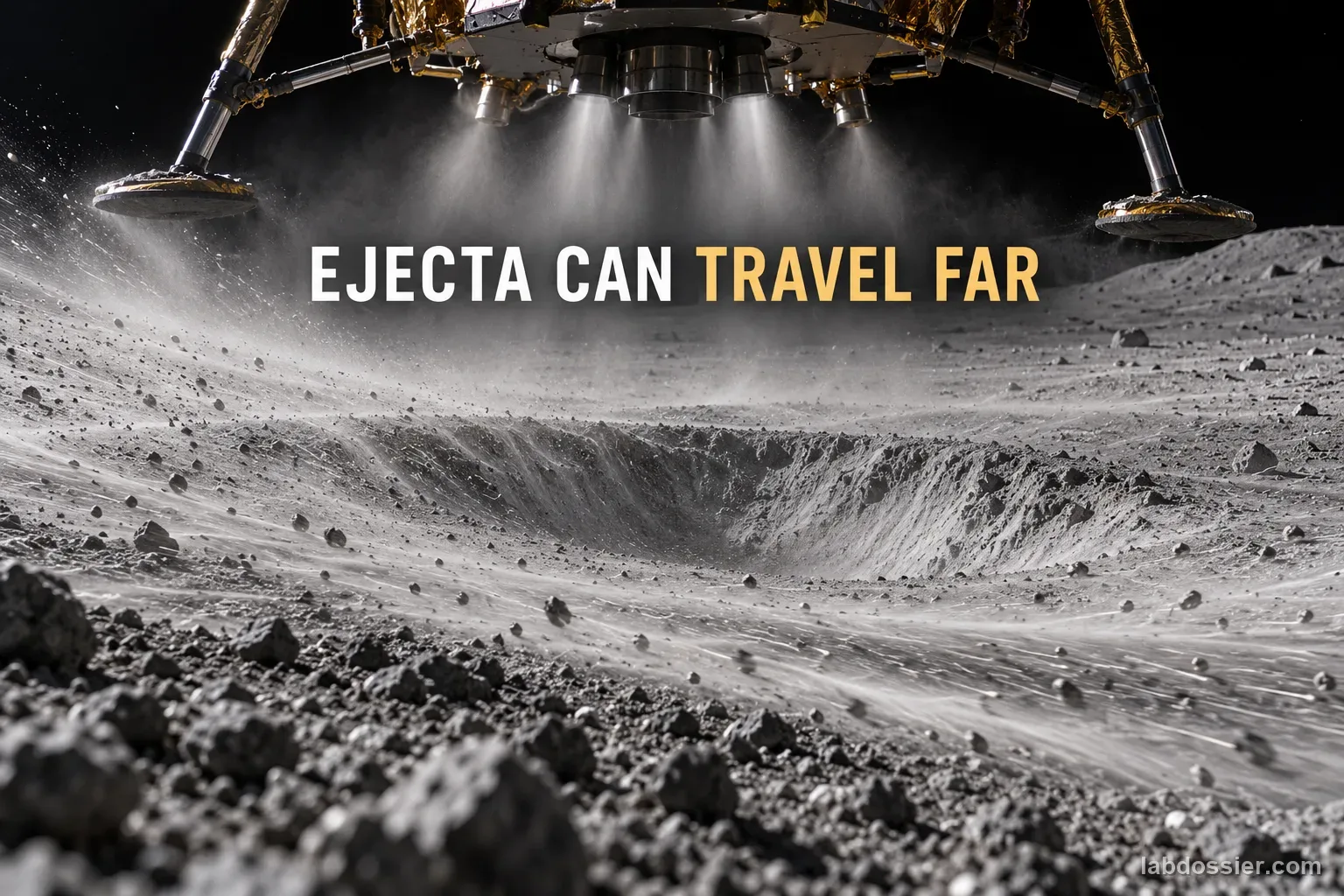
10 // A classroom airflow activity tests one narrow idea
The safe classroom version asks whether changing the height of a repeatable hand-generated air puff changes how many large paper markers move. It uses no dust and no rocket or compressed-gas equipment. The controlled comparison can reveal patterns in this tray, but it cannot reproduce the pressure, temperature, speed or gas-particle coupling of an engine plume.
Keep all 20 paper markers and the same tray between trials. Measure from the surface to the nozzle tip, hold the nozzle vertical over the center, use the same start and end marks, and take one one-second stroke. Randomize height order and reset the paper pattern each time. A no-movement result is valid; do not change the stroke after seeing an outcome.
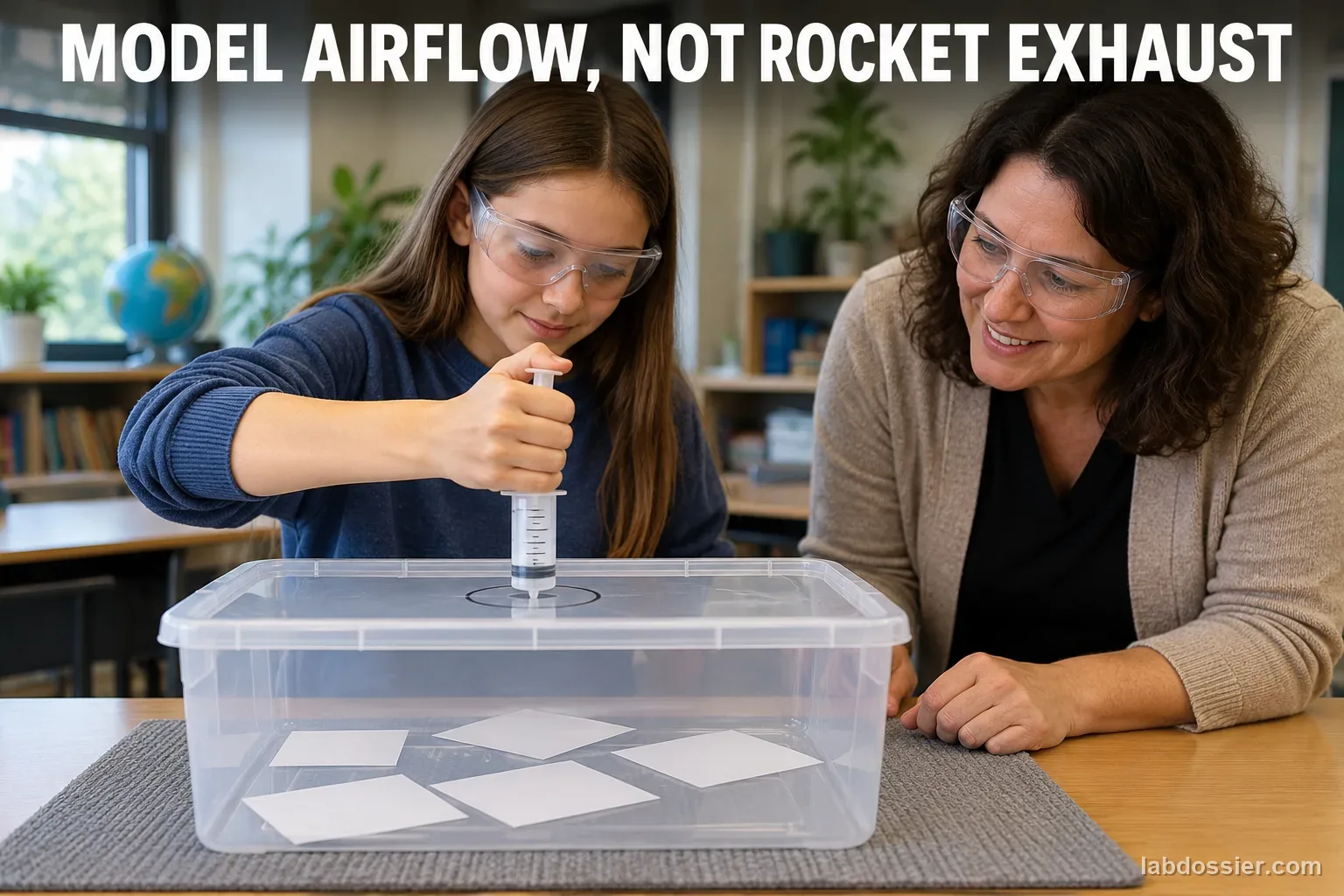
11 // Record movement without turning it into a lunar prediction
For every trial, count markers outside the 5 cm circle and measure the farthest marker from the nozzle center. Record whether the stroke stayed centered and any unusual movement. Compare the five raw trials before calculating the mean and range. If the stroke was inconsistent, mark the trial and follow a rule chosen before testing rather than silently removing it.
Do not convert a paper marker's distance into lunar particle velocity, force, crater depth, damage radius or safe landing clearance. The nozzle, large paper squares, Earth atmosphere, room gravity and brief hand stroke have no validated scale relationship to a lunar engine and regolith.
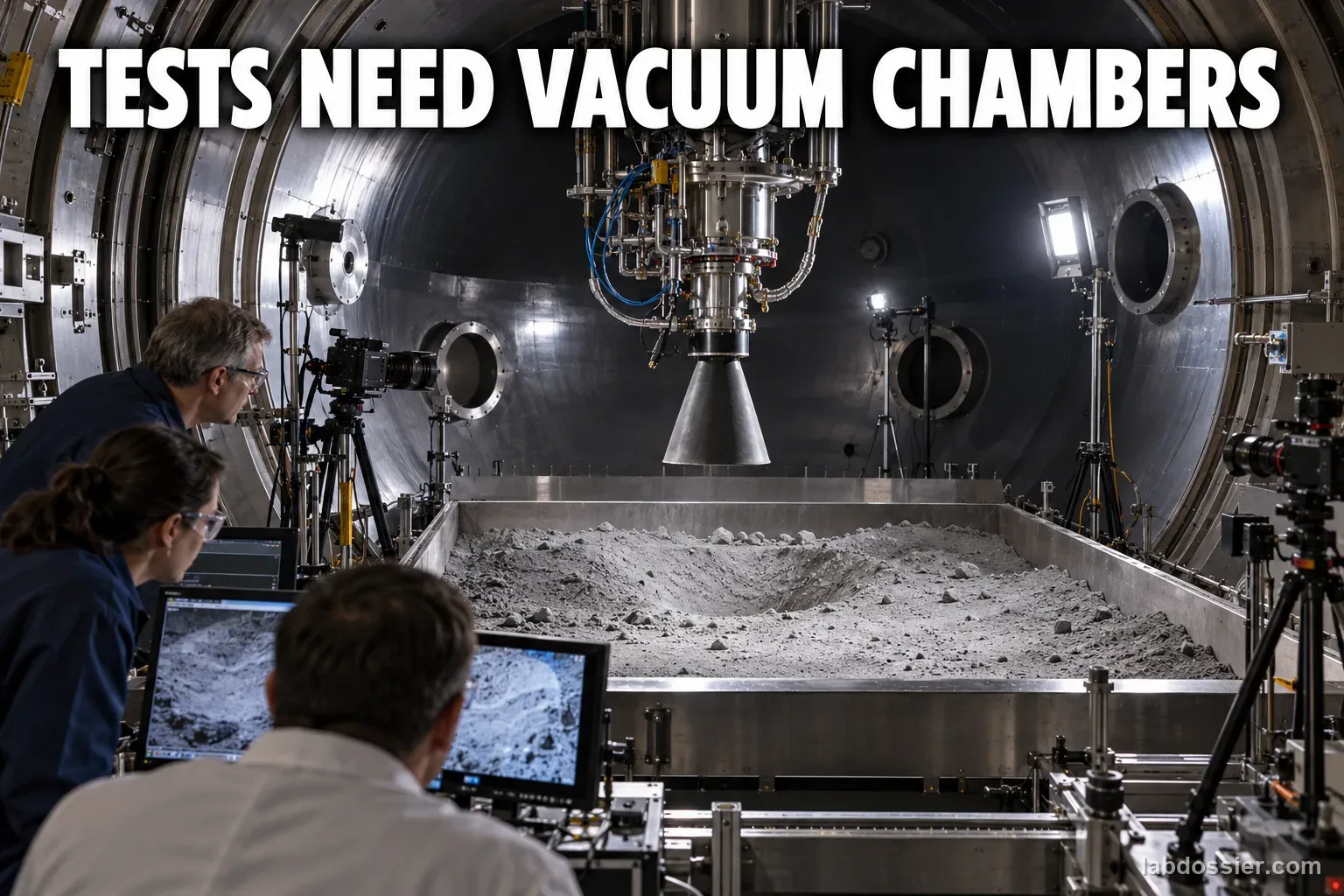
12 // Where the model stops matching the Moon
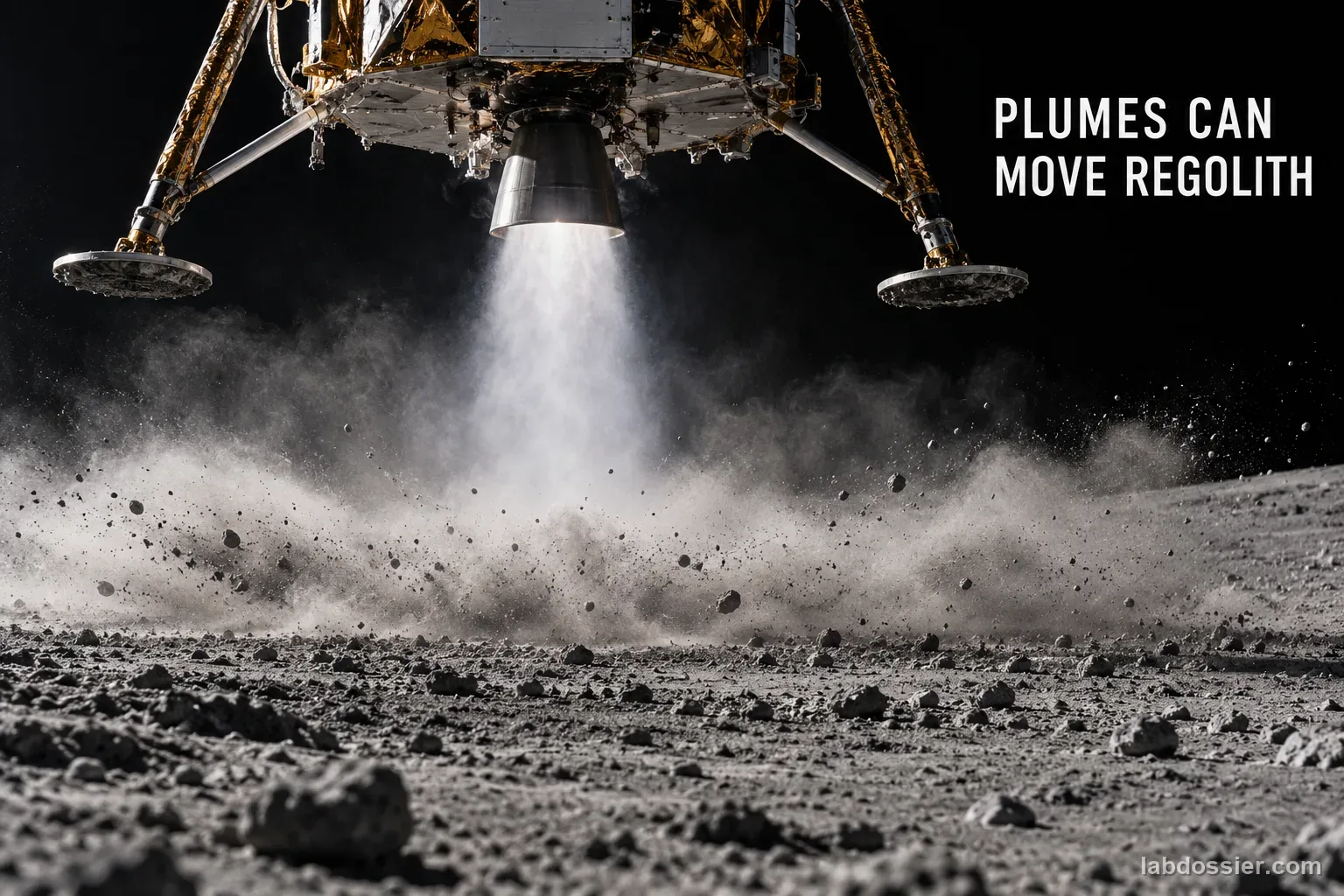
A lunar plume expands in near-vacuum over fine, angular regolith and interacts with the surface under lower gravity. Engine exhaust, grain size and cohesion, lander height and motion, local slope, electrostatic effects and spacecraft geometry all matter. NASA's supercomputing work couples time-varying gas flow with soil response; such models still need validation against suitable tests and are specific to their assumptions.
The classroom result supports only a bounded statement: in this room-air arrangement, the recorded hand stroke moved a certain number of large paper markers. Use NASA chamber data and validated analysis when discussing actual landing effects, and say which configuration each source studied.
13 // Questions people ask
Does a syringe puff reproduce a lander's engine plume?
No. It is room air at low speed in Earth's atmosphere. A rocket plume is engine-specific exhaust that expands under very different pressure and temperature conditions and interacts with fine regolith in lunar gravity.
Why use large paper squares instead of lunar soil simulant?
Large paper pieces make a contained, visible, low-dust classroom measurement. Fine powders can be inhaled and still would not reproduce angular lunar regolith, vacuum conditions or the correct grain sizes and electrostatic behavior.
What does NASA measure in its 2026 vacuum tests?
NASA reports measuring crater formation, ejecta-sheet angle and height, spatial distribution of solid ejecta, and regolith particle speed with several instruments.
Does more paper movement mean a lander would be less safe at that height?
No. The classroom height comparison is about one syringe and paper setup. It cannot be converted into lander clearance, plume strength, crater size, particle speed or a safe landing height.
What is SCALPSS?
Stereo Cameras for Lunar Plume Surface Studies is a camera system that captures imagery to help construct a three-dimensional view of terrain and plume-surface effects. NASA reports it imaged the Firefly Blue Ghost Mission 1 landing in 2025.
Can you explain the investigation?
How can airflow move lunar-like ejecta, and where does a tabletop model stop matching the Moon? · Student Data Sheet
Question: What can a safe airflow model reveal about loose surface material near a descending lander, and what important lunar-plume physics does it leave out?
Hypothesis: If nozzle height changes while the same contained air stroke and surface are used, then the number and distance of moved paper markers may change because the airflow spreads and weakens differently before it reaches the surface, because flow direction and distance affect how much momentum reaches the markers, although this room-air setup is not a scaled rocket plume.
Materials
- clear lidded plastic tray
- 20 large paper squares about 1 cm across
- textured paper or cloth tray liner
- blunt plastic syringe with no needle or an adult-approved hand bulb
- ruler, marker, timer and data sheet
Safety before starting
- Use only large paper squares in a clear tray. Do not use sand, flour, ash, talc, glitter, powders or any fine material that could become airborne or be inhaled.
- Use a blunt plastic syringe with no needle or an adult-approved hand bulb. Never use compressed-air cans, fans, leaf blowers, engines, combustion or rocket motors. Keep the airflow aimed into the tray and away from faces.
- Keep the tray on a stable desk, use the lid or guard when it permits safe observation, and stop if markers leave the tray or the setup becomes unstable. Follow classroom rules for cutting paper and cleanup.
Lab notes
- Use only large paper squares; do not use sand, flour, talc, ash, glitter or any powder/aerosol that can be inhaled or become airborne.
- NASA's 2026 article distinguishes the first ethane plume simulation system, which heats but does not burn and has about 100 pounds maximum thrust, from a later hybrid motor test. Do not describe the first system as a hot-fire engine test.
- The NASA JPL supercomputer project demonstrates coupled plume/soil modelling; its simplified Earth/Mars context and model state must not be treated as a universal lunar landing prediction.
Variables
Independent: Height of one blunt air nozzle above a fixed target surface · Dependent: Movement of large visible paper markers after one controlled air stroke
Keep constant: Use the same no-needle syringe, start/end volume marks and one-second stroke, vertical nozzle angle, bin, surface, paper size/count, nozzle center and radius measurement; reset the same 20 markers between trials
Procedure
- Set up a no-dust model in a tray: Use a clear plastic bin with a textured paper or cloth floor. Cut 20 large paper squares about 1 cm across and place them in the same marked target area; do not use flour, sand, powder, ash or fine particulate. Mark a 5 cm circle around the target center. Put the bin on a stable desk and keep the lid or guard in place if it still allows safe viewing.
- Standardize one gentle air stroke: Use a blunt plastic syringe with no needle, or an adult-approved hand bulb. Keep the nozzle vertical at the center. Mark two syringe positions and move the plunger between them over one second; use the same stroke for every trial. Never point the airflow at a person. If a one-second stroke cannot be repeated, switch to a published-data-only comparison and say why.
- Run randomized nozzle heights: Test nozzle heights of 2, 4 and 6 cm, measured from the surface to the nozzle tip. Randomize the height order. For each height, reset the same 20 paper squares to the starting pattern and perform five strokes. After each stroke, count squares beyond the 5 cm circle and measure the farthest square from the center. A zero movement result is valid data.
- Separate repeatability from model realism: Calculate the mean and range of marker counts for each height, but preserve all five raw trials. If one stroke moved more pieces because it was faster or off-center, mark it and repeat only under a predeclared classroom rule. Do not convert the paper motion into lunar particle speed, plume pressure, crater size or damage radius.
- Compare with actual NASA testing: NASA's 2026 plume-surface campaign uses instrumented tests in a 60-foot spherical vacuum chamber with a tray of simulated lunar regolith. Its first ethane plume system heats but does not burn and produces about 100 pounds of thrust; tests record crater formation and ejecta distribution, angle, height and particle speed. A NASA SCALPSS camera demonstration also imaged a real Blue Ghost lunar landing. These engineering tests, not the classroom tray, examine the mission-relevant physics.
- Name what the airflow model cannot reproduce: The classroom stroke travels through Earth's atmosphere; lunar tests use vacuum conditions, real or validated regolith simulant, engine-specific exhaust, low lunar gravity, fine angular grains, electrostatic and gas-particle effects, and high-speed instruments. The paper pieces are much larger and lighter than dust grains. This setup is a qualitative flow analogy, not a scale model or a landing-safety test.
Record your observations
| Nozzle height | Trial | Markers beyond 5 cm | Farthest marker (cm) | Stroke centered? | Observation |
|---|---|---|---|---|---|
Classroom analogy versus lunar landing test
| Feature | Tabletop model | NASA plume-surface research |
|---|---|---|
Answer key and expected pattern
The air stroke may move some paper pieces, and the pattern may change with nozzle height; the measured result depends on the exact tray, nozzle, stroke and paper markers.
NASA's 2026 vacuum campaign measures several engineering outcomes that the classroom setup cannot measure: crater formation, ejecta geometry and particle speeds.
The model can support a qualitative claim about directed flow moving loose surface markers, but not a quantitative prediction for lunar dust, lander damage, visibility or safe landing distance.
Remember: A paper model can show airflow moving markers; it cannot predict what rocket exhaust will do on the Moon. Use the classroom evidence only for its tested air-and-paper setup, and use vacuum tests and validated plume/regolith models for lunar landing risk.