Why can permanently shadowed lunar terrain stay cold beside sunlit ridges?
01 // Question
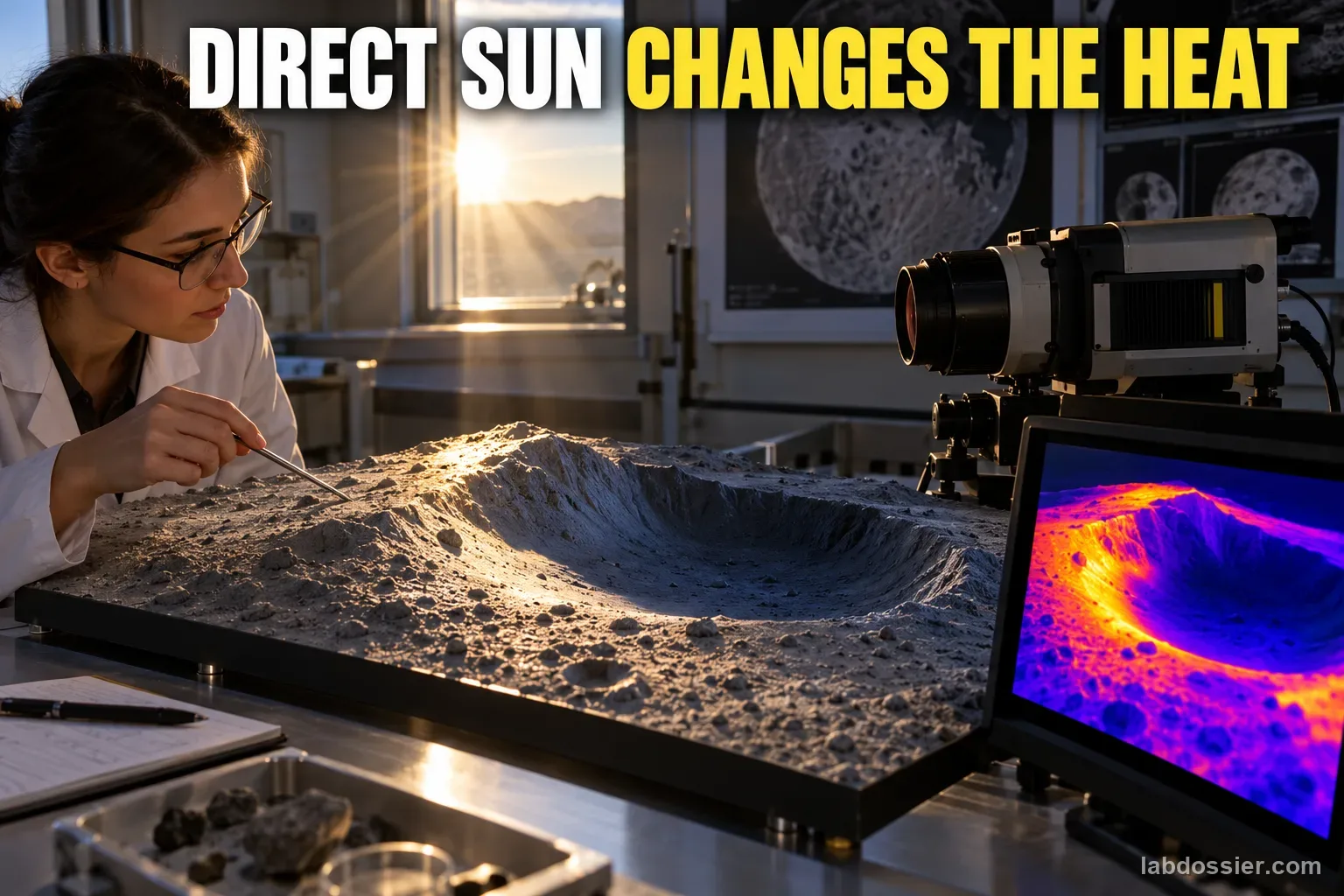
How can a permanently shadowed lunar crater be faintly visible and still remain extremely cold next to sunlit terrain?
The classroom test tracks relative visible illumination only. NASA's thermal measurements and models—not the bowl, phone lux app or camera image—support conclusions about lunar temperatures.
02 // Variables
Independent
Reflector surface while direct light to one fixed shaded sensor point remains blocked- No reflector in the marked position
- White matte reflector angled toward the shaded floor
- Dark matte card in the same reflector position
Dependent
Relative visible-light reading at the same point inside the model crater- Phone lux-sensor reading if available, or a fixed-exposure grayscale reading
- Three repeated readings per reflector condition
- Whether the direct beam reached the sensor point
03 // Hypothesis
IF direct light stays blocked while the crater model's reflector changes from absent or dark to matte white, THEN the shaded floor may receive a greater relative visible-light reading from reflected light, BECAUSE light can scatter from illuminated nearby surfaces into a region that has no direct line of sight to the source, although this does not restore direct sunlight or establish its temperature.
04 // Procedure
1. Build a shaded crater model
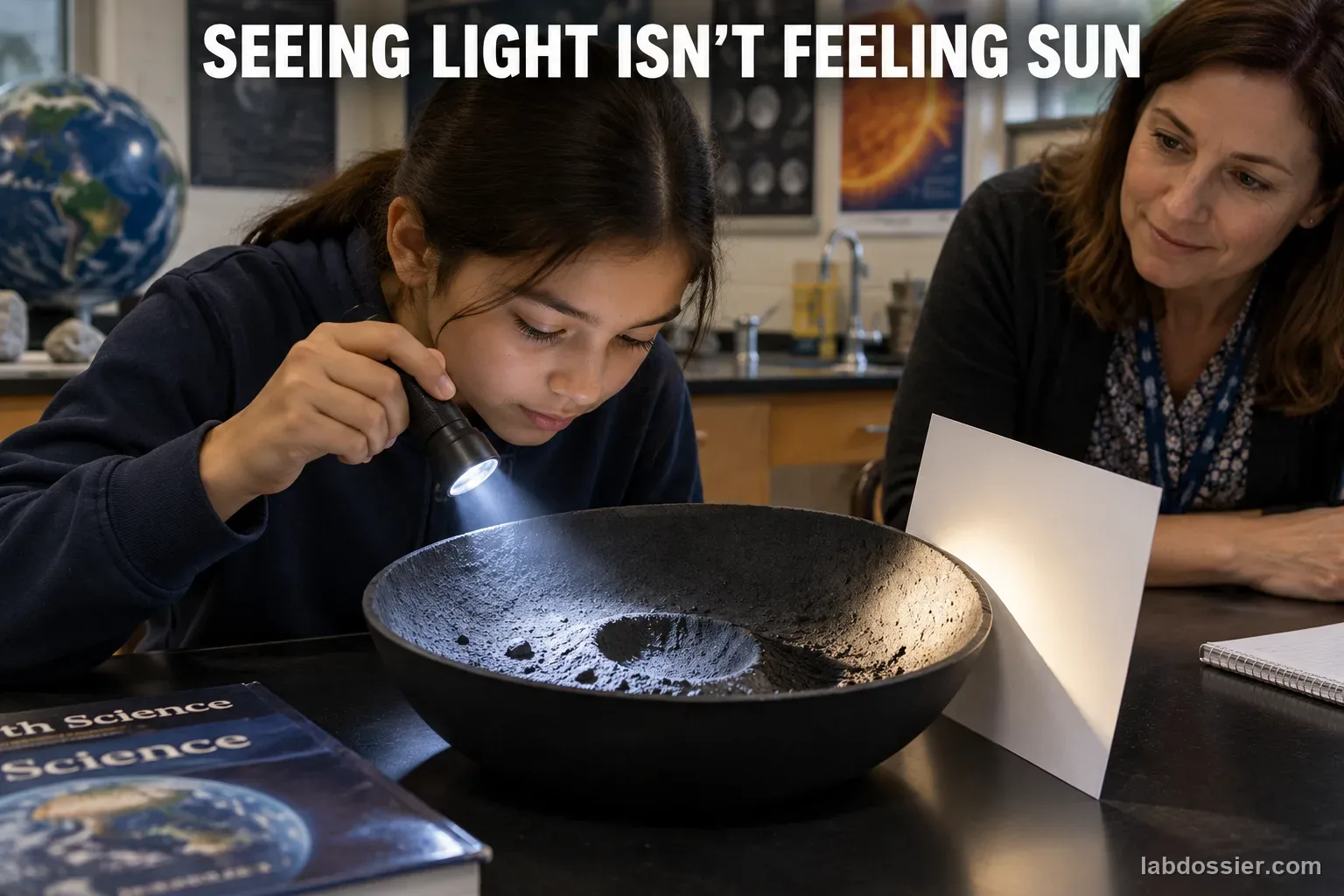
Set a matte-black bowl or crater-shaped model on a desk. Place one fixed measurement spot on its shaded floor and aim a cool LED flashlight across the rim so an opaque card blocks the direct beam from that spot. Do not use a laser, sunlight or a hot lamp. Keep the flashlight and bowl fixed throughout the trials.
2. Check that the beam is actually blocked
With the reflector removed, view the model from the sensor point and confirm no direct beam reaches the marked floor. Record any condition where the beam slips over the rim; reset it rather than calling that reading a permanently shadowed case.
3. Change only the reflector surface
Place a matte-white card at a marked point outside the direct beam, angled to reflect light toward the measurement spot. Take three readings at the same location and orientation. Repeat with no reflector, then with a dark matte card of the same size in the same position. Randomize the three condition orders if the lamp or room light may drift.
4. Compare relative light, not heat
Record the relative lux reading if your phone has a light sensor; otherwise use a fixed camera exposure and the same grayscale measurement region. A phone lux app is not a calibrated lunar radiometer, so compare only the matched classroom conditions. Do not put thermometers in the model and claim to reproduce the Moon's surface temperature.
5. Read the lunar evidence by instrument
Compare NASA's ShadowCam description with the LRO camera description: ShadowCam can image a permanently shadowed crater using sunlight reflected off nearby geologic features and its much greater sensitivity. Then examine NASA's current lunar South Pole environment page and Hayes et al.'s 2024 thermal-model result. Keep the visible-light camera evidence separate from temperature measurements and simulations.
6. Write a two-part explanation
First explain how a shadowed place can receive secondary visible light and be photographed. Then explain why lacking direct solar energy and an atmosphere to redistribute heat can keep some regions cold, while fine topography can block additional scattered sunlight and infrared from nearby terrain. State that temperatures and ice vary by exact site and that shadow alone does not prove water is present.
Materials // Prepare the bench
- matte-black bowl or crater-shaped model
- cool LED flashlight
- same-size matte-white card and dark card
- phone lux sensor or camera with fixed manual exposure
- ruler or tape to mark fixed locations
05 // Data table
| Reflector condition | Trial 1 relative light | Trial 2 relative light | Trial 3 relative light | Direct beam blocked? | Observation |
|---|---|---|---|---|---|
| None | |||||
| Matte white card | |||||
| Same-size dark card |
What each kind of evidence can support
| Evidence | What it shows | What it cannot show by itself |
|---|---|---|
| ShadowCam image | A sensitive camera can image some terrain inside permanent shadow using reflected sunlight | That the area receives direct sunlight or is warm |
| NASA lunar environment page | Some PSRs are extremely cold; nearby sunlit terrain can be much warmer; the surface has essentially no atmosphere to redistribute heat | The temperature of every point in every crater |
| Hayes et al. (2024) thermal model | At one LCROSS-site model, most terrain reached maximum temperatures around 50 K, with modeled 1–30 m ultra-cold traps as low as 20–30 K | A direct measurement at every PSR or proof that each modeled patch contains ice |
| Classroom crater model | Reflected visible light can reach a point while direct illumination remains blocked | Lunar temperature, vacuum heat transfer, actual regolith behavior or water abundance |
06 // What to expect
The matte-white reflector may raise the relative visible-light reading at the shaded measurement spot compared with no reflector or a dark card, while the direct beam remains blocked. Results depend on bowl geometry and room-light controls.
A sensitive camera can see reflected light in some permanently shadowed terrain; being photographable does not mean the site receives direct sunlight or enough energy to be warm.
No atmosphere means lunar surface heat is not spread around by air. Low solar input, local horizon geometry and additional small-scale shadowing help explain why adjacent sunlit and shadowed terrain can have very different thermal conditions.
The Hayes et al. values are a published model for the LCROSS impact site; they are not universal measured temperatures and do not prove ice in a classroom model or every crater.
07 // Lab notes
- Keep direct sunlight, reflected visible light, Earthshine and infrared emission from warm terrain as distinct energy paths. A classroom lux reading tracks visible illumination only.
- NASA says some permanently shadowed regions can reach about −203°C, but exact temperatures vary with latitude, elevation and terrain. The Hayes et al. 2024 20–30 K values are modeled micro-traps at one selected site, not a Moon-wide average.
- A permanently shadowed region does not necessarily contain the same ice or volatile abundance as another; shadow and cold are evidence relevant to preservation, not a direct deposit assay.
08 // Remember
A faint reflected photon can help a camera see a shadow without making it a sunlit, warm surface. Interpret visible illumination and thermal energy separately; local terrain, secondary illumination and temperature scale all matter in lunar cold traps.
09 // Visible photons and thermal energy answer different questions
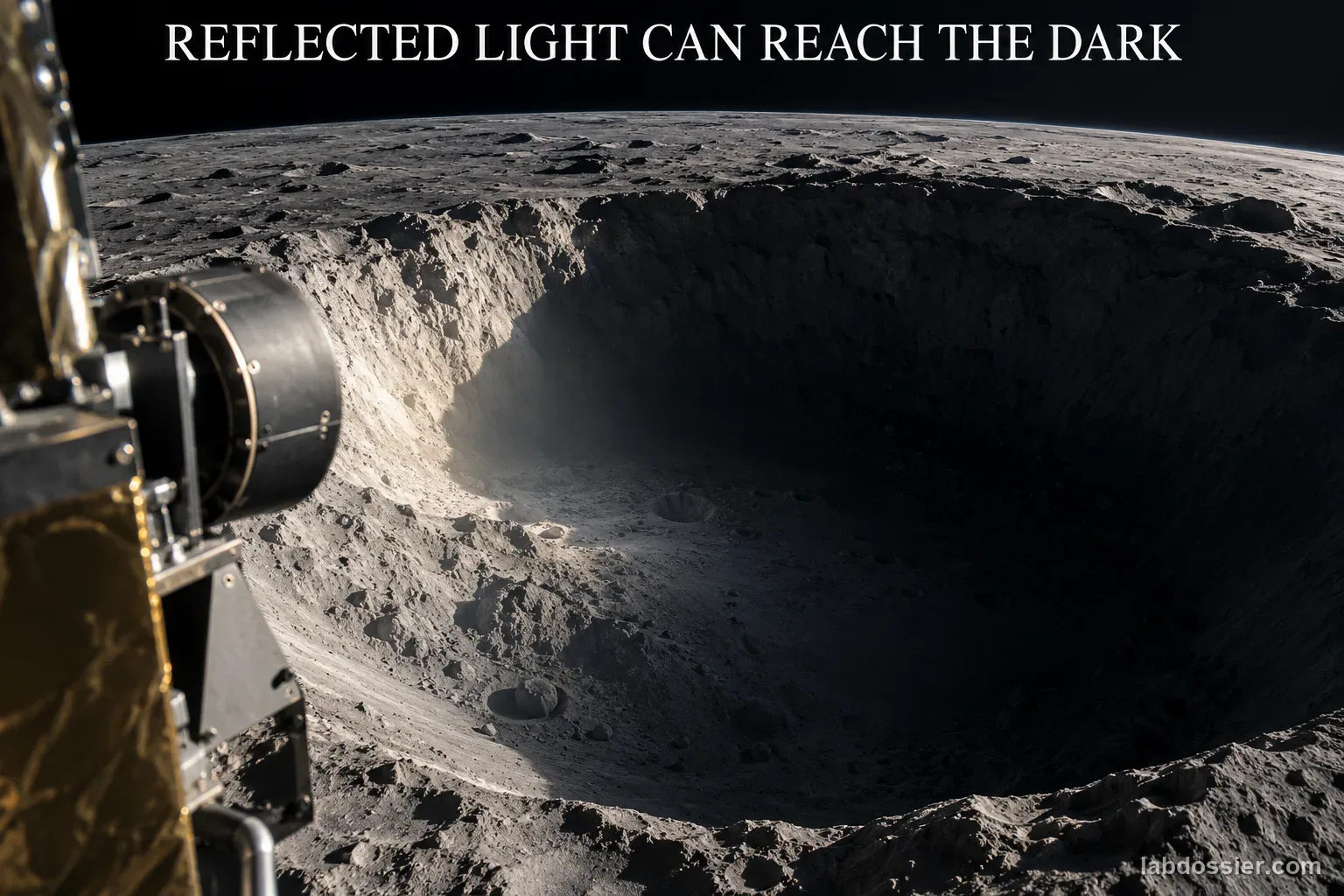
A permanently shadowed region (PSR) receives no direct sunlight at its surface under the relevant illumination definition, but that does not mean every PSR is perfectly black to a camera. Sunlight can scatter from a nearby crater wall or ridge into the shadow; Earthshine can contribute too. NASA designed ShadowCam to be about 200 times more light-sensitive than LROC so it could image terrain in these very dim conditions.
A faint visible-light signal can be enough for a sensitive camera to form an image, yet provide very little energy compared with direct solar illumination. Brightness in a photograph is not a thermometer reading. The sensor, exposure and reflected-light path affect what is visible; surface temperature depends on incoming energy, thermal emission, material properties and time.
10 // Why adjacent terrain can have sharply different temperatures
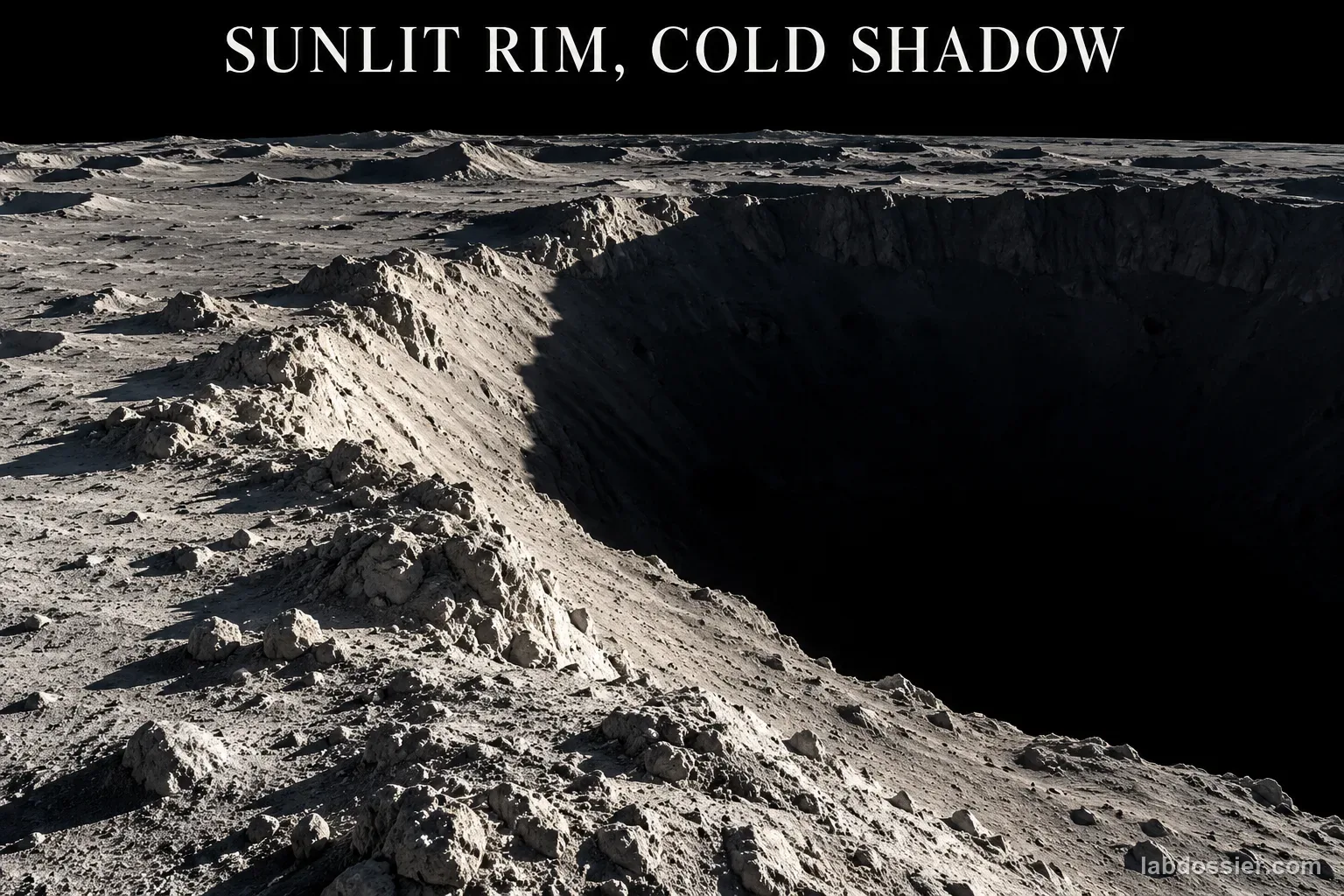
NASA's 2026 lunar South Pole overview explains that some PSRs can reach about −203°C while nearby sunlit areas can be much warmer. It points to the Moon's near-vacuum environment: there is essentially no atmosphere to spread heat from illuminated ground into a shadow as air and winds do on Earth. The exact temperature depends strongly on latitude, elevation and surrounding topography.
Low polar sunlight creates a complex maze of illuminated ridges, sloping walls and deep crater floors. A rim may see direct sunlight while the floor's local horizon blocks it. Inside a larger PSR, tiny ridges and roughness can also shield a patch from secondary reflected sunlight and infrared emission from neighboring terrain.
11 // A 2024 thermal model finds finer-scale cold traps
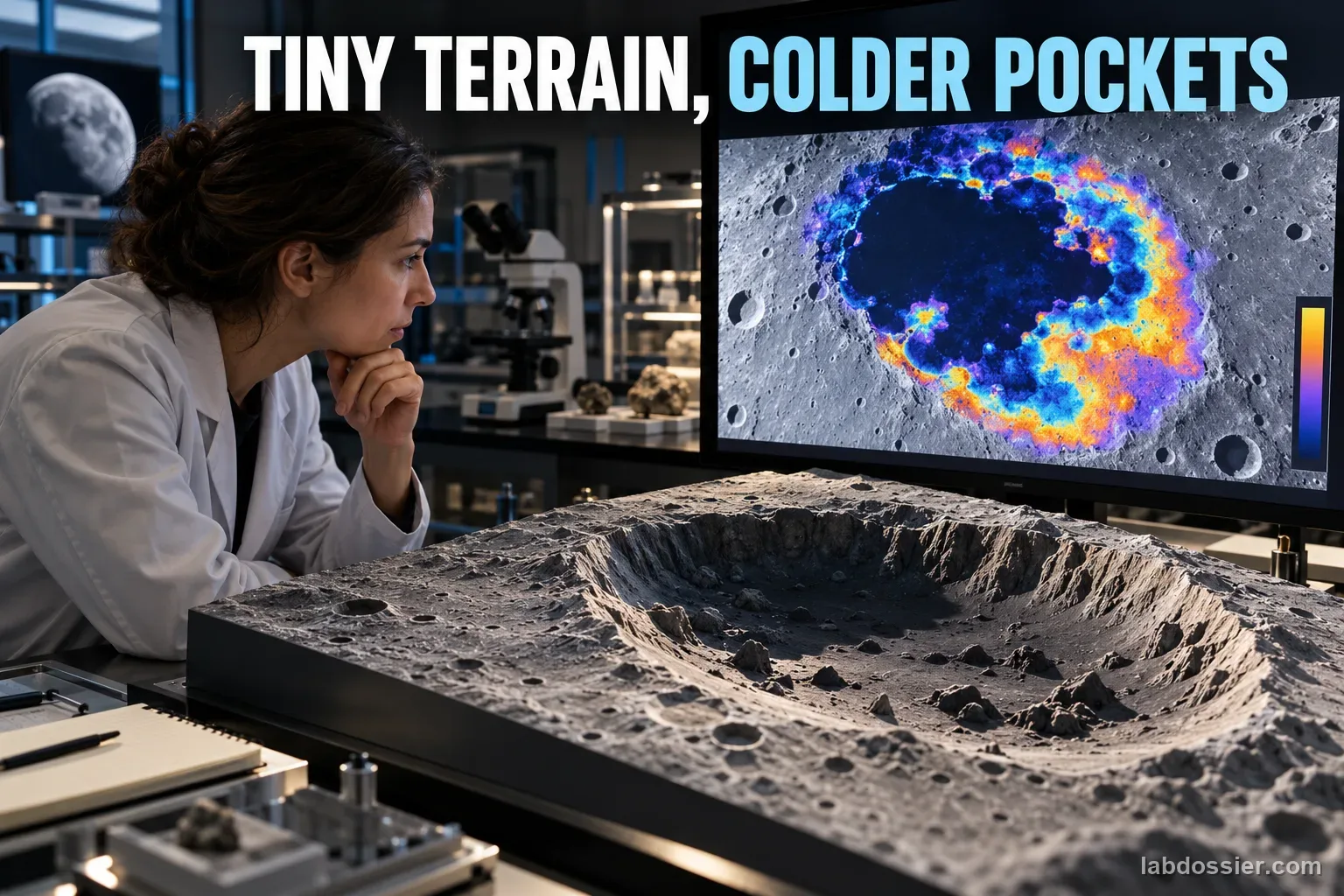
Hayes and colleagues modeled the LCROSS impact site using LOLA-derived terrain, an upscaled one-meter-per-pixel surface, scattered sunlight and infrared emitted by sunlit terrain. Their simulated terrain usually reached maximum temperatures around 50 K, while modeled one-to-thirty-meter ultra-cold traps reached about 20–30 K. These are results for a particular thermal model and site, not universal measured temperatures for every lunar shadow.
The paper also compares simulated brightness temperatures with Diviner measurements and discusses discrepancies and missing secondary illumination. Its analysis shows why resolution matters: coarser orbital pixels can average across tiny cold pockets and warmer surroundings. It does not prove every modeled patch contains water; volatile stability and abundance require separate evidence.
12 // Use the crater bowl only to test a light path
In the classroom model, the opaque rim blocks the flashlight's direct beam. A white card outside that beam may reflect visible light toward the marked floor; a dark card of the same size provides a comparison. Holding the bowl, source, sensor and geometry fixed isolates the role of that reflector in the small setup.
The measurement is relative visible illumination, not lunar temperature or total energy. A phone lux app is not a calibrated instrument for the Moon, and cardboard, a bowl and a flashlight do not recreate vacuum, lunar regolith, thermal infrared exchange or polar time history. Use the NASA instruments and thermal model for those questions.
13 // Questions people ask
If ShadowCam can see inside a crater, is it really permanently shadowed?
Yes. Permanently shadowed means direct sunlight does not reach that surface under the defined illumination conditions. Reflected sunlight from nearby terrain or Earthshine can still provide faint illumination for a sensitive camera.
Why does the shadow stay cold near sunlit ground?
The Moon has essentially no atmosphere to move heat from the bright region into the shadow. The shadow receives far less solar energy, and surrounding slopes can block reflected sunlight and thermal infrared from nearby terrain. Exact conditions depend on local geometry and time.
Is visible reflected light the same as heating?
No. A camera image or lux reading records visible light, not the full thermal energy balance. NASA temperature instruments and thermal models use different observations and assumptions.
What does ‘ultra-cold trap’ mean in the 2024 study?
Hayes and colleagues modeled small terrain patches within the LCROSS-site permanently shadowed region that were shielded from major secondary illumination. Their model found some 1–30 m features with maximum temperatures around 20–30 K; those are site-specific modeled results.
Does every cold shadow contain water ice?
No. Low temperatures can help preserve some volatile materials, but the distribution and abundance vary. A shadow image or cold-trap model is not a direct assay of the materials at every point.
Can you explain the investigation?
Why can permanently shadowed lunar terrain stay cold beside sunlit ridges? · Student Data Sheet
Question: How can a permanently shadowed lunar crater be faintly visible and still remain extremely cold next to sunlit terrain?
Hypothesis: If direct light stays blocked while the crater model's reflector changes from absent or dark to matte white, then the shaded floor may receive a greater relative visible-light reading from reflected light, because light can scatter from illuminated nearby surfaces into a region that has no direct line of sight to the source, although this does not restore direct sunlight or establish its temperature.
Materials
- matte-black bowl or crater-shaped model
- cool LED flashlight
- same-size matte-white card and dark card
- phone lux sensor or camera with fixed manual exposure
- ruler or tape to mark fixed locations
Safety before starting
- Use a cool LED flashlight only; do not use lasers, sunlight, hot lamps or concentrated optics. Never look at or point cameras, binoculars or telescopes toward the Sun.
- Keep the bowl, flashlight, cards and phone on a stable desk. Do not place the flashlight against paper or leave it switched on unattended; turn it off before moving the setup.
- Use matte card and lightweight materials only. Keep cables and bags away from walkways, and follow classroom rules for cutting card. Use published NASA imagery if a safe model cannot be set up.
Lab notes
- Keep direct sunlight, reflected visible light, Earthshine and infrared emission from warm terrain as distinct energy paths. A classroom lux reading tracks visible illumination only.
- NASA says some permanently shadowed regions can reach about −203°C, but exact temperatures vary with latitude, elevation and terrain. The Hayes et al. 2024 20–30 K values are modeled micro-traps at one selected site, not a Moon-wide average.
- A permanently shadowed region does not necessarily contain the same ice or volatile abundance as another; shadow and cold are evidence relevant to preservation, not a direct deposit assay.
Variables
Independent: Reflector surface while direct light to one fixed shaded sensor point remains blocked · Dependent: Relative visible-light reading at the same point inside the model crater
Keep constant: Use the same bowl and target point, flashlight brightness and distance, light-blocking rim, sensor position and orientation, room lighting, camera exposure or app, reflector size and trial duration; change reflector surface only
Procedure
- Build a shaded crater model: Set a matte-black bowl or crater-shaped model on a desk. Place one fixed measurement spot on its shaded floor and aim a cool LED flashlight across the rim so an opaque card blocks the direct beam from that spot. Do not use a laser, sunlight or a hot lamp. Keep the flashlight and bowl fixed throughout the trials.
- Check that the beam is actually blocked: With the reflector removed, view the model from the sensor point and confirm no direct beam reaches the marked floor. Record any condition where the beam slips over the rim; reset it rather than calling that reading a permanently shadowed case.
- Change only the reflector surface: Place a matte-white card at a marked point outside the direct beam, angled to reflect light toward the measurement spot. Take three readings at the same location and orientation. Repeat with no reflector, then with a dark matte card of the same size in the same position. Randomize the three condition orders if the lamp or room light may drift.
- Compare relative light, not heat: Record the relative lux reading if your phone has a light sensor; otherwise use a fixed camera exposure and the same grayscale measurement region. A phone lux app is not a calibrated lunar radiometer, so compare only the matched classroom conditions. Do not put thermometers in the model and claim to reproduce the Moon's surface temperature.
- Read the lunar evidence by instrument: Compare NASA's ShadowCam description with the LRO camera description: ShadowCam can image a permanently shadowed crater using sunlight reflected off nearby geologic features and its much greater sensitivity. Then examine NASA's current lunar South Pole environment page and Hayes et al.'s 2024 thermal-model result. Keep the visible-light camera evidence separate from temperature measurements and simulations.
- Write a two-part explanation: First explain how a shadowed place can receive secondary visible light and be photographed. Then explain why lacking direct solar energy and an atmosphere to redistribute heat can keep some regions cold, while fine topography can block additional scattered sunlight and infrared from nearby terrain. State that temperatures and ice vary by exact site and that shadow alone does not prove water is present.
Record your observations
| Reflector condition | Trial 1 relative light | Trial 2 relative light | Trial 3 relative light | Direct beam blocked? | Observation |
|---|---|---|---|---|---|
What each kind of evidence can support
| Evidence | What it shows | What it cannot show by itself |
|---|---|---|
Answer key and expected pattern
The matte-white reflector may raise the relative visible-light reading at the shaded measurement spot compared with no reflector or a dark card, while the direct beam remains blocked. Results depend on bowl geometry and room-light controls.
A sensitive camera can see reflected light in some permanently shadowed terrain; being photographable does not mean the site receives direct sunlight or enough energy to be warm.
No atmosphere means lunar surface heat is not spread around by air. Low solar input, local horizon geometry and additional small-scale shadowing help explain why adjacent sunlit and shadowed terrain can have very different thermal conditions.
The Hayes et al. values are a published model for the LCROSS impact site; they are not universal measured temperatures and do not prove ice in a classroom model or every crater.
Remember: A faint reflected photon can help a camera see a shadow without making it a sunlit, warm surface. Interpret visible illumination and thermal energy separately; local terrain, secondary illumination and temperature scale all matter in lunar cold traps.